The Plague Ship Returns to Harbour — and the World Met to Argue About It

THE PLAGUE SHIP RETURNS TO HARBOUR — AND THE WORLD MET TO ARGUE ABOUT IT
When was the last time you watched a plague ship being turned away from a harbour?
You do not have to imagine it. You have lived it. You stood, you and I, in the spring of 2020, as cruise ships were refused at ports from Sydney to Rome, as men and women pressed against the rails of vessels that had become floating quarantine wards, looking down at cities that would not let them land. It was 1348 all over again — except the sails had become diesel engines and the harbour masters had become prime ministers.
Venice knew this scene. In 1348, when the Black Death crept toward the lagoon, the Venetian Senate decreed that ships arriving from infected ports must sit at anchor for forty days — quaranta giorni, from which we inherit the word quarantine — on the island that became the Lazzaretto. Four hundred years before germ theory, before the word “virus” existed, a republic of merchants understood one thing with terrible clarity: the pathogen does not negotiate. It does not respect flags, treaties, or the price of the cargo in the hold. Either you prepare together, or you perish separately.
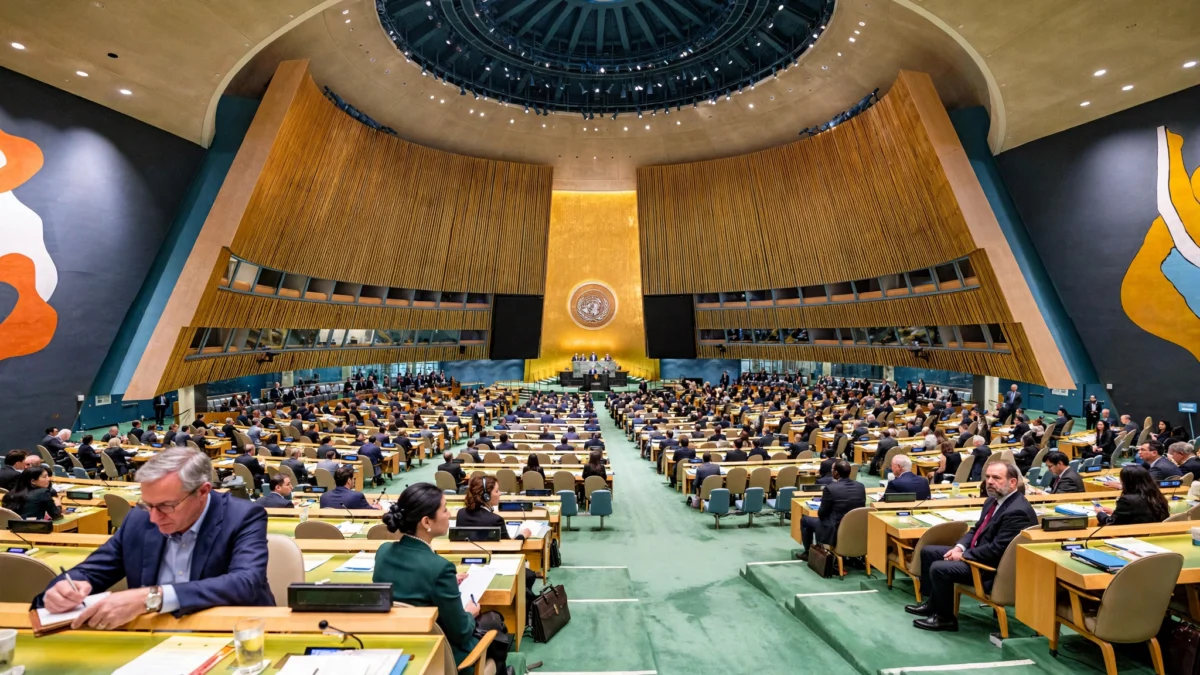
Yesterday, on 25 September 2026, the world gathered in the UN General Assembly Hall in New York for the second High-level Meeting on pandemic prevention, preparedness and response, under a theme that read like a prayer and a reproach at once: Fostering a multilateral and intergenerational approach to prevent, prepare for and respond to pandemics and public health emergencies, through the principles of equity and solidarity. At the end of it, a political declaration was approved — a document that reiterates the world’s intent to scale up preparedness, improve coordination, enhance financing, boost laboratory capacity, promote access to medications and vaccines, counter vaccine hesitancy and misinformation, adopt gender-equal policies, and reach universal access to family planning and sexual health services by 2030.
Read that list once more, dear reader. Every single item on it is a wound that COVID-19 opened and never closed.
THE MIRROR OF 1918
History does not repeat itself, the saying goes, but it rhymes — and on this subject it does not even bother to rhyme. It simply repeats the whole verse.
Consider 1918. The influenza that swept the world in the final year of the Great War killed tens of millions of people — more than the trenches did. It killed the young and the strong with a cruelty that baffled doctors; it hollowed out villages in India and mining towns in America alike. The world then did what the world always does: it buried its dead, it mourned for a season, and then it forgot — deliberately, thoroughly, almost triumphantly. Historians call it the “forgotten pandemic,” because for seventy years the most lethal event of the twentieth century was barely mentioned in the books.
And then came COVID-19. More than seven million confirmed deaths, according to the WHO — and every epidemiologist alive will tell you the true toll, measured in excess mortality, is far higher. Do you remember the mass graves on Hart Island in New York, the coffins stacked in refrigerated trucks because the morgues overflowed? Do you remember Delhi’s crematoriums running day and night, and the oxygen queues — men carrying their dying fathers in auto-rickshaws from hospital to hospital, begging for a cylinder of air?
I remember. You remember. The question is whether the men and women in that hall in New York remember — or whether they have already done what 1918 did, and filed the horror under history.
There is a precedent worth more than a hundred speeches. In May 2025, after three years of negotiation, the world adopted the WHO Pandemic Agreement — the first binding global accord ever written for pandemic prevention, preparedness and response. A first. In all of human history, through the plagues and choleras and flus that emptied continents, we had never once managed to write down, in law, that we would face the next one together. Yesterday’s declaration was supposed to be the moment when that ink began to dry into action.
Helen Clark, the former New Zealand prime minister who co-chaired the Independent Panel on Pandemic Preparedness and Response, said of the declaration: “That declaration can help the world move forward.” WHO Director-General Tedros Adhanom Ghebreyesus said the document “includes important commitments to concrete, measurable and urgent action to address gaps.” Countries from South Korea to Cape Verde to Guatemala spoke in support; Armenia and Rwanda shepherded the text; the Burundian foreign minister, Edouard Bizimana, called it “an expression of solidarity and international cooperation.”
But listen to the discord beneath the choir, because that is where the truth lives. The European Union said the document does not do enough on financing accountability and efficiency. Germany called for a stronger focus on prevention — on stopping the fire before the fire brigade is needed. And the United States objected to the mention of what it called “divisive ideologies” and to the proposed pathogen access and benefit-sharing arrangement. The irony is heavy enough to sink a ship: America, which has withdrawn from the WHO and took no part in finalising the pandemic treaty, objects to the terms of cooperation in a treaty it refused to write.
THE TREACHERY OF NEGLIGENCE
This is where I must speak plainly, in the language this column has always used. Treachery has many faces. There is the treachery of the battlefield — the Mir Sadiqs and Mir Jafars of history, whose names live on as curses. And then there is the quieter treachery: the treachery of negligence. Of knowing the dam will break and refusing to mend it. Of watching the flood come once, burying your neighbours, and then voting against the dam.
The Venetians understood, in the age of sail, what the architects of our age of flight still refuse to admit: a quarantine that covers one harbour but not the next is no quarantine at all. The pathogen laughed at their borders and it laughs at ours. The Lazzaretto worked because Venice enforced it on every ship, from every port, without exception and without favour.
Ask yourself, dear reader, what kind of preparedness the world can honestly claim when the richest nation on Earth walks away from the very organisation charged with coordinating the response? When financing — the simple, unglamorous matter of money for laboratories, surveillance, and stockpiles — is the clause everyone applauds and no one funds? The EU’s objection was not cruelty; it was honesty. A declaration without accountability is a sermon without a congregation.
And here is the warning the Independent Panel, co-chaired by Ellen Johnson Sirleaf and Helen Clark, put before the world’s leaders in writing: “Will you be ready when the next deadly pathogen emerges?” Their answer, in the same report, should chill every one of us: “Complacency will cost lives and devastate economies.”
The pathogen is not waiting for the politics to settle. It never does. While the delegates were still in New York, measles — measles, a disease we conquered with a vaccine half a century ago — was surging again in Pennsylvania, with 835 cases and 4 deaths this week, a small, sordid monument to vaccine hesitancy and misinformation, the very enemies the declaration promises to fight. If we cannot defeat a foe we already know how to kill, what will we do when we meet one we do not?
THE VERDICT OF THE SICKROOM
I will not end this column with a summary of yesterday’s meeting. You have read the facts above; they are what they are. I will end it with what my conscience demands.
Solidarity is not a theme for a conference. It is a duty — the duty of the strong toward the weak, of the prepared toward the unprepared, of the living toward those not yet born who will inherit either our wisdom or our graves. The declaration’s finest words — equity and solidarity — are the same words carved, in effect, over the door of every Lazzaretto that ever stood. The Venetians did not write them; they practised them, because their survival depended on it.
Ours depends on it too. The next pathogen is already evolving, somewhere in a cave, a market, a laboratory, a crowded city none of us can name. When it comes — not if, when — it will not ask whether we signed the declaration. It will ask whether we meant it.
History is a mirror, and it shows us two faces: the face of 1918, which forgot; and the face of Venice, which remembered. Yesterday in New York, the world stood between them. God grant it chose the right reflection.
SOURCES & REFERENCES
UN General Assembly – High-level Meeting on Pandemic Prevention, Preparedness and Response (25 September 2026)
AP / Akron News-Reporter – “UN pandemic preparedness” (25 September 2026)
TradersUnion – “UN pandemic preparedness 2026 meeting”
The Independent Panel for Pandemic Preparedness and Response – “The power to lead for a safer world” (PDF)
GlobalIssues – explainer on the pandemic preparedness meeting
