Starship Flight 14: The Tallest Ship Ever Built Is About to Sail the Ocean Above Us

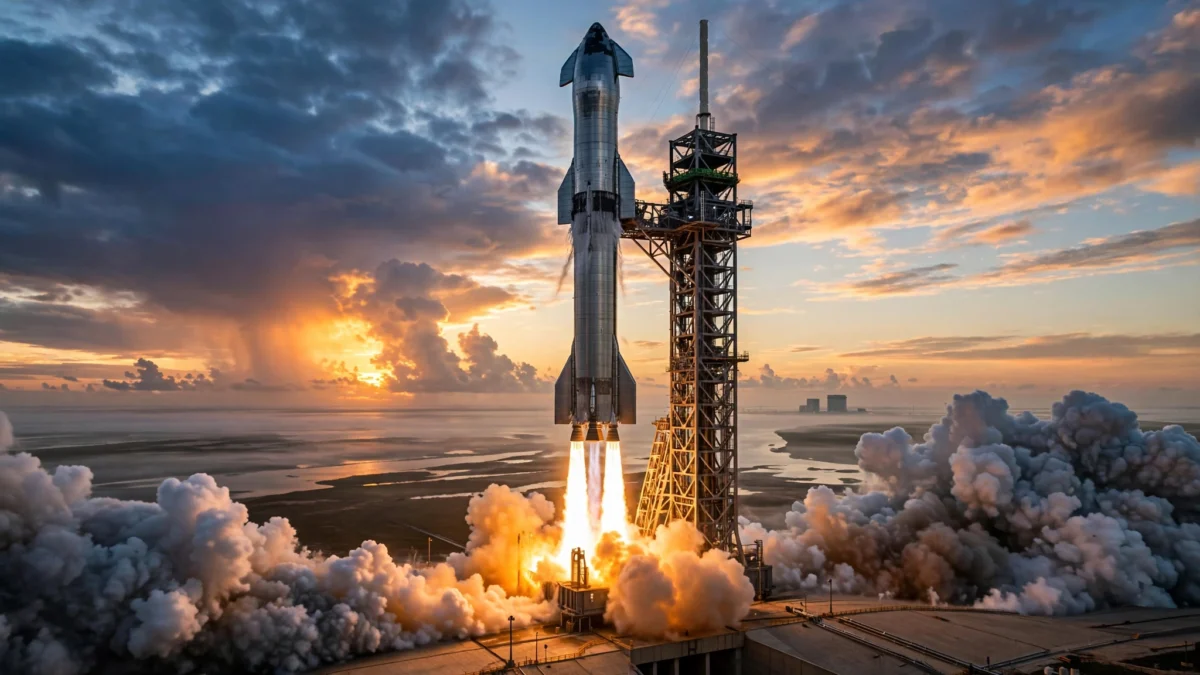
STARSHIP FLIGHT 14: THE TALLEST SHIP EVER BUILT IS ABOUT TO SAIL THE OCEAN ABOVE US
When was the last time you looked up at the night sky and felt genuinely small?
I do not mean the casual glance you throw at the moon while locking your car. I mean the kind of smallness that rearranges something inside you — the feeling our ancestors must have known when they stood on a shoreline and watched a ship vanish over the horizon, carrying men who would not be seen again for years, if ever.
On the morning of 23 September 2026, at a place called Starbase on the southern tip of Texas, a ship was finished being built that makes every vessel in human history look like a paper boat. It stands 124 metres tall — taller than the Statue of Liberty, taller than a forty-storey building — and it is pointed straight at the sky. Its name is Starship, and on Monday, 28 September, SpaceX will attempt something it has never attempted before: it will try to put this giant into orbit around the Earth.
This will be Flight 14. And it may be the most important flight of our lifetime.
THE NEW AGE OF SAIL
History does not repeat itself, the saying goes, but it rhymes — and right now it is rhyming loudly.
Five hundred years ago, the world was redrawn by whoever built the best ships. Portugal’s caravels, Spain’s galleons, and later the armed merchantmen of the East India Company did not merely cross oceans; they carried flags, cannons, and trading posts behind them. The map of the modern world — the borders of your country and mine — was drawn by men who understood one simple truth: whoever masters the routes masters the age.
Orbit is the new ocean.
Consider what SpaceX is actually doing on 28 September. According to SpaceX’s mission profile, Ship 41 — the upper stage, 52 metres of stainless steel — will ride atop Super Heavy Booster 21, climb some 275 kilometres above the Earth, and circle our planet roughly six times over nearly ten hours before splashing down in the Pacific. In its belly it carries 26 next-generation Starlink V3 satellites, the first batch of a constellation Elon Musk wants to grow beyond anything ever launched.
Do you see the pattern? The first ships carried spices and silk. These ships carry the internet itself. The cargo has changed; the logic has not. Whoever controls the routes controls the age.
A GIANT BUILT IN PUBLIC
What makes this moment different from the space race your parents watched on television is that this giant was built in the open, in front of all of us, failure by failure.
SpaceX stacked Ship 41 onto Booster 21 in the early hours of Wednesday, the launch tower’s mechanical arms — the famous “chopsticks” — lifting 52 metres of spacecraft and setting it down with the delicacy of a jeweller. The company shared the footage itself. The Federal Aviation Administration has put a temporary flight restriction over Starbase from 23 September to 7 October, and a fueling test — a “wet dress rehearsal” — is expected before the weekend. Everything now waits on one thing: the FAA’s final approval. The target is 7:15 in the morning, Central time, on Monday.
Every previous Starship flight stayed suborbital — magnificent, violent, instructive arcs that tested heat shields and engine relights but never completed a full circuit of the Earth. Flight 13, back in July, came the closest, even deploying test satellites that burned up in the atmosphere because the trajectory never reached orbit. This time the engineers have reworked the heat shield — new tile retention, barriers against the plasma that eats spacecraft alive on re-entry, curved shield geometry — and they are going for the real thing: a full ten hours, six orbits, a controlled return.
Thirteen flights of learning, each one exploding or succeeding in public, each one teaching the next. There is a lesson in that method for every nation and every institution that hides its failures and wonders why it never improves.
THE SHORE WHERE WE STAND
And now, dear reader, let me bring this down from 275 kilometres to the ground where you and I actually live.
You will watch this launch on your phone, most likely, in a country that has never put a single satellite into orbit on its own rocket. You will feel the thrill — because it is genuinely thrilling; no cynicism can survive watching 124 metres of steel defy gravity — and then, if you are honest, you will feel something else. A small, cold question: whose sky is this?
The satellites riding inside Ship 41 will beam internet to paying customers. The constellation they join already serves millions of subscribers and generates billions in revenue. This is not a science project; it is the construction of infrastructure — the railways and telegraph lines of the twenty-first century, except these run through the sky, owned by a private company, regulated by one country’s aviation authority.
I am not asking you to resent it. Progress is progress, and the engineers at Starbase have earned their dawn. But the age of sail should have taught us what happens when the ships belong to someone else and the rest of the world merely watches from the shore. The shore gets the postcards. The ship-owners get the century.
The developing world — our world — must decide whether it will be a passenger on other people’s rockets or whether it will build its own. Pakistan’s space programme, SUPARCO, was founded in 1961, eight years before men walked on the Moon; it once had a head start over agencies that have since left it far behind. That is not an accusation; it is a mirror. Mirrors are uncomfortable, but they are honest.
THE VERDICT OF THE SKY
On Monday morning, if the FAA says yes and the weather holds and the steel holds, a silver giant will rise over the Gulf of Mexico and keep rising until the blue curve of the Earth bends beneath it. Six times it will circle us. Six times, in ten hours, it will do what took Magellan three years.
Celebrate it. Feel small beneath it. That smallness is the beginning of wisdom.
But remember this too: the sky does not belong to whoever reaches it first. It belongs — or should belong — to all of us. Every great age of exploration began with wonder and ended with someone drawing borders in places no one had drawn them before. The question Flight 14 asks is not whether we can reach orbit. We can. The question is whether the orbit we reach will be a commons or a colony.
Look up on Monday. And then look around you — and ask what your country, your generation, is building to sail that ocean.
The ships are leaving. The only shame would be to wave from the shore forever.
SOURCES & REFERENCES
Spaceflight Now – “SpaceX stack Starship and Super Heavy for first orbital flight”
Basenor / NASASpaceflight – “SpaceX Starship Flight 14: Ship 41 at the Pad, Ship 44 Already Queued”
Starlust – “SpaceX stacks Starship ahead of its debut orbital flight on September 28”
EarthSky – “JUICE mission to fly by Earth next week” (ESA)
