The $27 Billion Refusal: What the War for Gold Is Really Telling Us

Twenty-seven billion dollars.
Say it slowly. That is the kind of money that buys governments, silences parliaments, and rewrites maps. It is more than the economies of many nations. And this week, in the quiet boardrooms of Perth, Australia, a group of directors looked at that mountain of money — and said no.
Australia’s largest gold producer, Northern Star Resources, has rejected an unsolicited A$38.7 billion ($27.1 billion) takeover proposal from South Africa’s Gold Fields, in what would have ranked among the largest takeovers of an Australian company in history. Shares of Northern Star jumped 10.6% to A$24.46 on Monday after the news broke — the market, it seems, agreed with the refusal.
Read the chairman’s words carefully, because in corporate language, every word is a loaded weapon. “Gold Fields has sought to acquire one of the world’s premier gold portfolios at a price that falls well short of what the Board considers to be its fundamental value and at a highly opportunistic time,” said Chairman Michael Chaney.
“Highly opportunistic.” That is the politest way a chairman can say: you tried to rob us in daylight.
The Offer on the Table
Let me tell you what the offer actually was, because the numbers reveal the whole game. Under Gold Fields’ proposal, Northern Star shareholders would have received 0.3125 new Gold Fields shares and A$7.25 in cash for each of their shares. The bid was made on 14 September, when it was worth A$27.00 a share — but by Friday’s close, as Gold Fields’ own stock slipped, the offer had melted to A$25.19.
That represents a mere 14% premium to Northern Star’s last closing price. In Australian takeovers, boards and shareholders typically demand a premium of at least 30% before a deal proceeds. Gold Fields, in other words, offered barely half of what such prizes usually command — and demanded, among other “onerous conditions,” a period of “hard” exclusivity. No shopping around. No second suitor. Sign here, and let us take your treasure.
There was more the board disliked: the proposal would have left Northern Star’s shareholders holding large amounts of Gold Fields stock, carrying what the board called “a higher jurisdictional risk profile” than its own asset base — a polite corporate way of saying that investors did not trust the paper they were being handed. And the timing was no accident: the bid arrived just ahead of key growth catalysts, including the commissioning and ramp-up of the Fimiston Mill.
I have seen this film before. It only changes costumes.
The Golden Mile Remembers
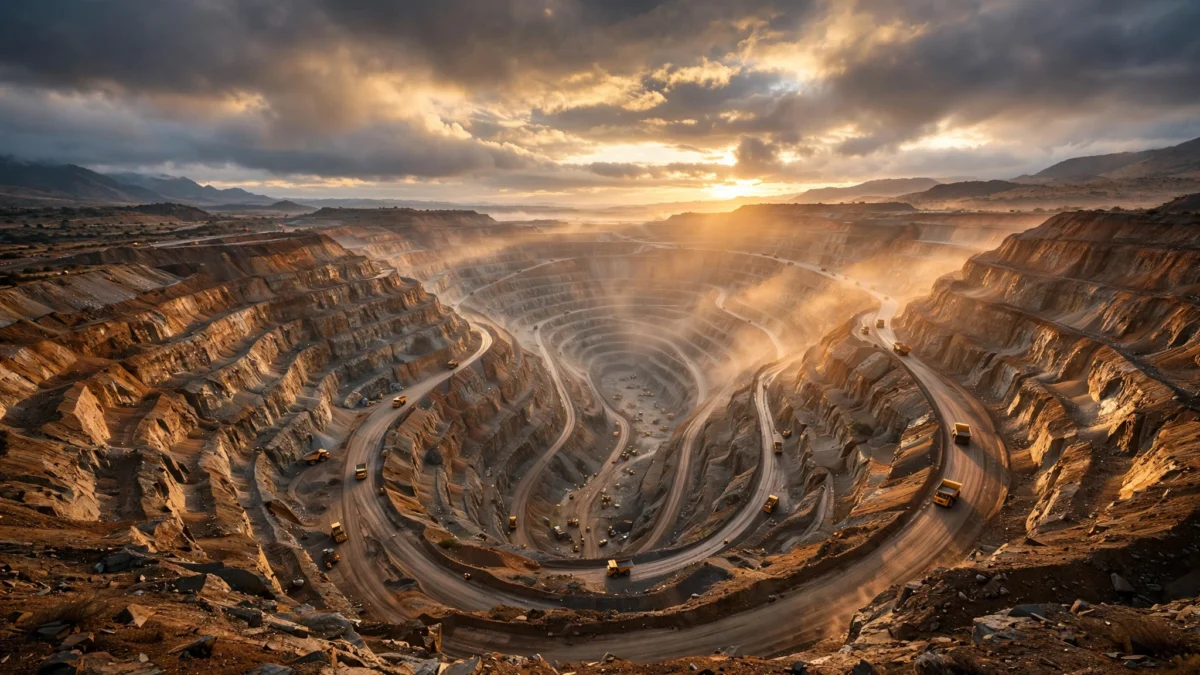
The heart of what Gold Fields wants to buy sits in the red dust of Western Australia, around the town of Kalgoorlie — the Super Pit, officially the Fimiston open pit, Australia’s most famous gold mine, which Northern Star operates through its Kalgoorlie Consolidated Gold Mines. Stand at its edge and you look into a wound 3.5 kilometres long and some 600 metres deep, so vast it can be seen from space. Since the Golden Mile’s discovery, more than 50 million ounces of gold have been pulled from that earth.
Its story begins in 1893, when an Irish prospector named Paddy Hannan found a hundred ounces of gold in the outback, and the great Kalgoorlie gold rush began. Thousands poured across the desert chasing a yellow metal they could barely describe. The streets of Kalgoorlie were once paved with crushed rock from the mines — rock that was later found to contain high-grade gold telluride, so the townspeople dug up their own streets to feed the ore back into the mills. Even the roads were rich.
Now hold that history in one hand, and today in the other, and ask yourself: what has changed?
Gold has always been the metal that empires bled for. The Spanish Empire drained the Americas for it; the British built the gold standard on it. And here is the irony I cannot look away from: the bidder comes from South Africa, a land whose gold was dug by African hands to enrich empires across the sea. The target sits in Australia, whose earth was surveyed by the same colonial logic. Two continents that once yielded their treasure to foreign flags are now having their gold traded between corporate empires — no cannons this time, only scrip offers and exclusivity clauses.
I write this as someone whose country’s history carries the East India Company in it — a trading company that arrived with ledgers and stayed with armies. History does not repeat itself, but its methods do get refined. The conquest has moved from the battlefield to the boardroom. The weapon is no longer the musket; it is the merger.
The Hand Inside the Fortress
But no fortress falls to an army alone. Every empire, every company, every nation has learned the same hard lesson: the most important battles are fought inside the walls.
Consider what happened before the bid ever arrived. Since June, Northern Star has been the target of a campaign by Elliott Investment Management, an American activist fund that urged the company to conduct a “strategic review” — corporate English for “prepare yourself for a sale” — which it said could result in a sale to a rival such as Gold Fields. In July, under that pressure, Northern Star appointed a new chief executive. Elliott says it holds about 5.6% of the miner. Its partner John Pike declared this week that while “there was immense potential for value creation at Northern Star,” the board had “an obligation to engage with any serious buyer.”
Do you see the pattern? The bid did not fall from the sky. A faction within pressed for the very outcome the bidder desired. The gates were being discussed from the inside before the siege engines arrived. History’s oldest story: Troy had its wooden horse; every corporate takeover has its activist campaign. I pass no verdict on any man — the facts are public, and you, dear reader, are intelligent enough to draw your own lines. But I will say this: nations and companies alike should watch not only the bidder at the door, but the advisers in the room.
Why Gold, Why Now?
And now the question that matters more than any deal. Why is the whole world fighting over gold again, in 2026?
Because the world is afraid.
Gold surged to record highs at the start of this year, and then the ground shifted — prices have fallen more than 20% since the Iran war began in late February, as energy costs spiked, inflation fears returned, and expectations of American interest-rate hikes rose, raising the cost of holding an asset that pays no yield. Across the Atlantic, yields on 30-year US Treasuries have climbed toward 5.5%, their highest since 2004 — a sign that faith in the paper promises of governments is trembling.
And through it all, the most patient buyers of all keep buying. Central banks, according to the World Gold Council’s latest data, remain on course for another strong year of net purchases of gold, “supported by portfolio diversification, and inflation- and risk-hedging requirements.” After a data revision, first-quarter purchases were far lower than first thought, but demand roared back to 289 tonnes in the second quarter. These are not speculators chasing a chart; they are the guardians of nations’ reserves, quietly converting paper confidence into yellow metal.
Ask yourself why. When central banks — the very institutions that print the paper — start hoarding the metal, what are they telling you? They are telling you what every peasant and every emperor has always known: paper promises, but gold keeps.
The Metal That Cannot Lie
So what is the real story of the $27 billion refusal? It is not a story about a premium of 14% versus 30%. It is a story about value — who decides it, and in what currency it is measured.
The board of Northern Star has said, in effect: we know what our gold is worth, and your paper is not worth our earth. A mining analyst at Wilson Asset Management, which holds Northern Star shares, called the bid “opportunistic” and agreed with the rejection. The market agreed too, pushing the shares up 10.6%.
I will not pretend to know whether Gold Fields returns with a higher bid, or whether another suitor emerges, or whether Elliott’s pressure eventually cracks the fortress. That is the future’s business. But the lesson of this week is already written, and it is an old one.
Know the value of your own soil. The world is once again measuring its trust in yellow metal, because the paper has begun to lie. Gold cannot be printed. Gold cannot promise. Gold cannot tweet. It simply is — and in an age of infinite promises, that honesty has become the rarest commodity of all.
The empires that once crossed oceans for this metal are gone. The companies that dig it today will pass too. The gold will remain, gleaming in the red dust of Kalgoorlie, waiting for the next age to learn the lesson again: some things cannot be bought cheap. Not land. Not dignity. And never, ever, gold.
Sources & References
- Reuters — Australia’s Northern Star rejects $27 billion takeover approach from Gold Fields (28 September 2026)
- Morningstar / Dow Jones Newswires — Central Banks Bought Less Gold Than Previously Thought in First Quarter, WGC Says (30 July 2026)
- Le Private Banker — Central Banks Slash Gold Purchases in Early 2026 After Data Revision (30 July 2026)
- Reuters — Stocks cautious in Asia as oil gains, yields rise (28 September 2026)
- Plaza Kalgoorlie — Kalgoorlie Super Pit | Australia’s Largest Gold Mine (history of the 1893 gold rush and the Golden Mile)

About the Author — Abdul Mannan
Related Articles
Northern Star Rejects $27 Billion Gold Fields Takeover as Undervalued
Northern Star has rejected an unsolicited A$38.7 billion takeover proposal from South Africa's Gold Fields, calling it "highly…

Markets Bet on RBA Rate Hike to 4.60% as Inflation Pressures Build
All four major banks now forecast a 25bp RBA rate hike to 4.60% on September 29, with ANZ…

Apple Ordered to Pay Record $5.7 Billion in Haptic Patent Case
A US jury ordered Apple to pay more than $5.7 billion to Taction Technology over haptic feedback patents…