The Watch Changes Hands: Eleven Souls Above the Earth

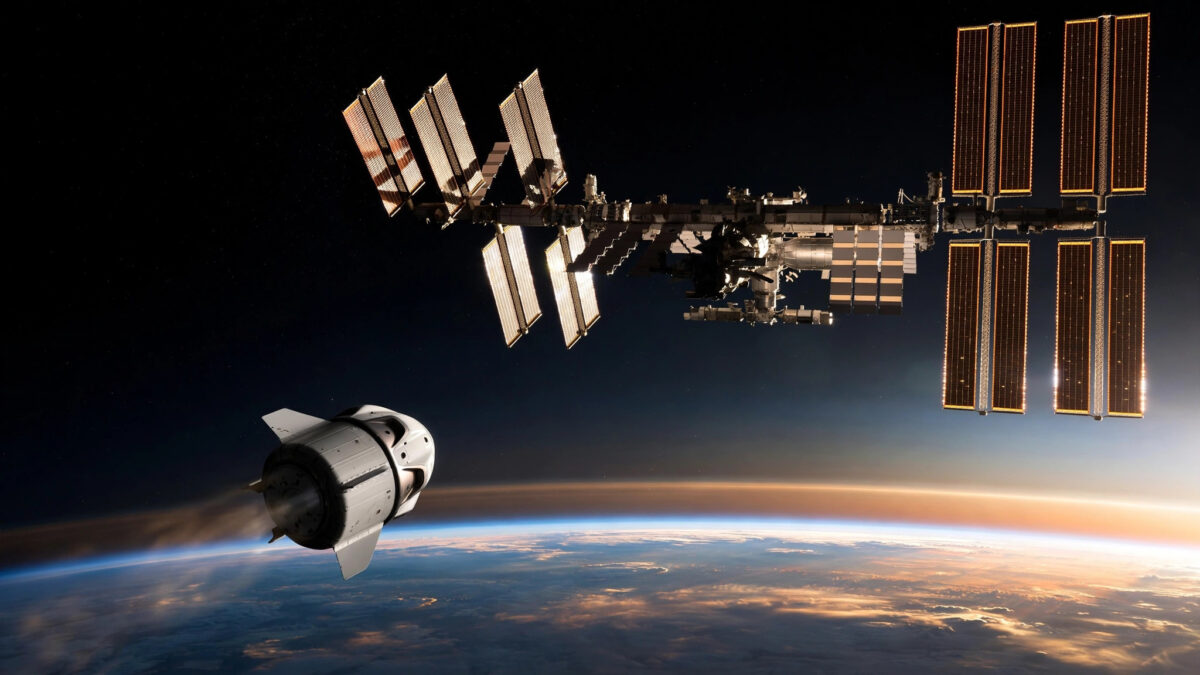
While you were checking your phone this weekend, a change of guard took place four hundred kilometres above your head. Nobody on Earth noticed.
Eleven human beings — the largest company of souls currently living off this planet — are now crowded inside the International Space Station. Four of them arrived on Thursday in a time so short it would shame a transatlantic flight: seven hours and fifty-five minutes, the fastest American crew flight to the station in history. The other four will be home by midweek, falling through fire back into the Pacific. And yesterday morning, in a ceremony as old as armies and navies, one commander handed the station over to another: Jessica Meir gave the keys of humanity’s only off-world outpost to Pyotr Dubrov, a Russian, while the world argued about its borders.
I ask you, my reader — when was the last time you looked up? Truly looked up, and not at a screen?
The Fastest Road in Human History
NASA’s SpaceX Crew-13 — Jessica Watkins and Luke Delaney of NASA, Joshua Kutryk of Canada, Sergey Teteryatnikov of Russia — left Florida on the morning of 1 October 2026. Less than eight hours later they were knocking on the hatch of the station. Do you understand what that means? The journey of a lifetime, the dream of ten thousand childhood nights, is now shorter than a delay at Heathrow. A private company’s capsule, re-flown, delivered them in the time it takes to drive from Lahore to Peshawar.
This is the “Rocket Revolution” — and this week is literally named for it. World Space Week, declared by the United Nations and celebrated this year from 4 to 10 October in one hundred nations, has chosen exactly that theme. The Association’s president, Dennis Stone, said the falling price of launches has “stimulated the space ecosystem and exciting new space applications.” Translation: the sea lanes of the sky have opened to traffic.
The Ships Have Changed; the Ceremony Has Not
Here is where history holds up its mirror, and I hold you by the sleeve and make you look into it.
Five hundred years ago, a caravel rode at anchor off some foreign coast, and one captain rowed out to hand the watch to another — the ship’s log, the charts, the responsibility for the crew’s lives. The ritual was solemn because the ocean did not forgive. Today, four hundred kilometres above the Earth, Meir and her crew packed their personal cargo, tested their pressure suits, wiped their own data from the station’s computers, and formally transferred “mission responsibilities” to their successors. NASA says it plainly in its station blog. The words are bureaucratic; the meaning is ancient: we held the watch; now it is yours.
The ocean has only changed its address. And notice this, because it matters: the guard changes hands between an American, a Frenchwoman of the European Space Agency, and a Russian — in orbit, where no flag can be planted on anything, the old enmities dissolve like sugar in water. Down here we cannot share a river without a war cry. Up there, they share the air.
Meanwhile, Down Here
Crew-12 — Meir, Jack Hathaway, Sophie Adenot, Andrey Fedyaev — launched on 13 February 2026. For nearly eight months they ran experiments on cancer treatments and quantum technologies, the kind of research that will outlive every argument currently screaming on your television. NASA and SpaceX now target no earlier than 1:05 a.m. on Wednesday, 7 October, for their Dragon’s undocking, with splashdown off California around 11:25 a.m. on Thursday. They will come home to a planet that spent their eight months exactly as it spends everything — distracted, furious, and staring at the ground.
And I must tell you the detail that broke my heart and mended it in the same breath: this same week, the European Space Agency is marking World Space Week by sending its science to children through Pokémon — a Pikachu plush that actually floated aboard the station for two months, touring a thousand orbits, is now travelling Europe’s museums teaching children the solar system. The future belongs to whoever can make a child look up. Europe understood. Did we?
Why This Column, Why This Week
Pakistan’s own space agency, SUPARCO, is co-leading thousands of school events for World Space Week this year — the SpaceNews report names it alongside Saudi Arabia’s Ministry of Education. Read that sentence again and let it sit. Our agency, long treated as a footnote, is on the roster of a United Nations space week. The question is whether the rest of us will treat space as a school function or as a destiny.
The Arabs sent a satellite into orbit this very week — the UAE’s Altair-1 joined a planned ten-strong constellation on Monday. The week we read this column, nations are planting flags that cast no shadow because they are planted in orbit. Nobody will remember the Twitter war of 5 October 2026. Everybody will remember who reached the sky.
The Verdict
Civilisations are not remembered for how loudly they argued but for how far they reached. The Romans built roads; the Abbasids built libraries and observatories; the Ottomans — for all their swords — measured the stars from Istanbul’s hills. Every empire that turned its gaze upward outlived, in memory, every empire that only guarded its treasury.
Eleven people are standing on the watchtower tonight. Four will descend by Thursday, burned clean by re-entry, salted by the Pacific. Four more have taken their place. The guard changes, the watch continues, the stars do not care about our noise.
The only question is the one I asked you at the beginning: when was the last time you looked up? And the harder one, which history will ask of our generation: while the watch was changing hands above us — were we looking, or were we looking away?
Sources & References
- NASA Commercial Crew Blog — “NASA, SpaceX Set No Earlier Than Oct. 7 for Crew-12 Departure” (3 Oct 2026): undocking NET 1:05 a.m. EDT 7 Oct, splashdown ~11:25 a.m. 8 Oct off California; crew names; 4 Oct change-of-command ceremony with Pyotr Dubrov.
- NASA Space Station Blog — “Station Crew Expands as NASA’s SpaceX Crew-12 Prepares to Depart” (2 Oct 2026): record-setting 7-hour 55-minute Crew-13 flight; station population of 11; crew names and agencies.
- SpaceNews — “World Space Week 2026 Celebrates the ‘Rocket Revolution'” (30 Sep 2026): UN-declared World Space Week, 4–10 Oct, 100 nations; theme quote from Dennis Stone; ESA–Pokémon collaboration; SUPARCO’s participation.
- KEDT (NPR/PBS) — “NASA, SpaceX’s Crew-13 is onboard the ISS” (2 Oct 2026): record flight details and Crew-12 return timeline.

About the Author — Abdul Mannan
Related Articles

Starship Flight 14: The Tallest Ship Ever Built Is About to Sail the Ocean Above Us
STARSHIP FLIGHT 14: THE TALLEST SHIP EVER BUILT IS ABOUT TO SAIL THE OCEAN ABOVE US When was…