Kenya Confirms Its First-Ever Ebola Case as Man Dies in Nairobi After Travelling From Congo

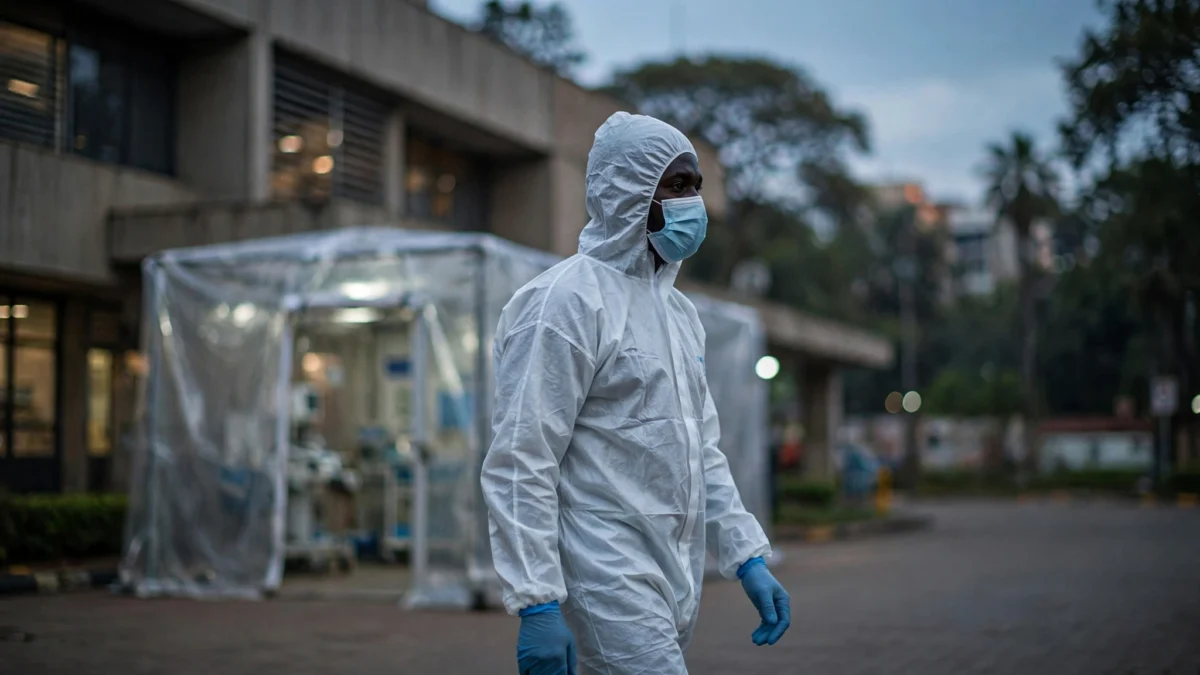
Kenya has confirmed its first Ebola case, after a Kenyan citizen who had been living in the Democratic Republic of Congo for seven years died in a Nairobi hospital days after arriving in the country, the health ministry announced on Tuesday. The man, who travelled from Congo through Uganda before boarding a flight to the Kenyan capital, is the first person ever to test positive for Ebola on Kenyan soil — a development that has set off one of the largest contact-tracing operations the country has mounted against a viral haemorrhagic fever.
According to Kenya’s health minister Aden Duale, the patient arrived at Nairobi’s Jomo Kenyatta International Airport on Saturday, October 3, and died on Monday night. Twenty-eight people who came into contact with him — including family members and health workers — have been identified so far, and authorities are also pursuing 23 passengers and four crew members who were on the same flight, with quarantine arrangements already underway.
The confirmation marks a new front in Central Africa’s fight against an Ebola outbreak that has already become the largest ever recorded in Congo. Health officials in Nairobi moved quickly to calm nerves, insisting that containment measures were in place and urging the public not to panic — but the case exposes the difficulty of keeping a fast-moving virus inside borders in a region where people, goods and flights move constantly between countries.
A month of illness, a journey across two borders
The patient had been unwell for roughly a month before he reached Kenya, according to the health ministry. During that time he sought treatment at several hospitals in Congo, where he had lived for the past seven years. He then travelled by road from Congo to Kampala, the Ugandan capital, and boarded Jambojet Flight 8523 to Nairobi on October 3, the ministry said.
When he landed, he passed through what the ministry described as the normal public health screenings at the airport. Kenya’s Director General for Health, Patrick Amoth, said officials believed the patient had known he was already ill, and that the treatment he received in Congo may have masked some of his symptoms — which is why he cleared the mandated health checks on arrival.
From the airport, a relative drove him directly to Nairobi Hospital, where his condition quickly raised alarms. He presented with fever, chills, intense fatigue and weakness, muscle pain, painful swallowing, a sore throat, and bleeding beneath the skin at injection sites, according to the ministry’s statement. Given his travel history and symptoms, the attending doctor treated him as a suspected case of viral haemorrhagic fever, placed him in isolation, and collected samples for testing.
The samples tested positive for the Ebola Bundibugyo virus at two separate laboratories — the National Virology Reference Laboratory and the Kenya Medical Research Institute laboratory — confirming the diagnosis. The patient was given supportive treatment but died on Monday night, Duale said. Arrangements for a safe and dignified burial, conducted under strict public health protocols, were being made for Tuesday.
Contact tracing on an urgent footing
The 28 identified contacts — relatives and the health workers who attended to him — are being traced, monitored and placed under quarantine, the health ministry said. Authorities are also working with the airline to track down the 23 passengers and four crew members who shared the Jambojet flight from Kampala to Nairobi.
Dr Mary Stephen of the World Health Organization’s Africa office told UN News that the Kenyan government was making every effort to identify all possible contacts, describing containment as critical to preventing any community spread. Around 10 of the man’s relatives have been described as highly cooperative — some, according to Dr Stephen, volunteered themselves for quarantine. Twenty-one health workers who treated him at Nairobi Hospital have also been contacted and placed under quarantine, even though they had used infection prevention and control measures while treating him, as a precaution.
Contacts are expected to remain in isolation for 21 days — the maximum incubation period for Ebola — and will only be released after testing negative for the virus, the Associated Press reported.
The ministry stressed that Kenya had not been caught off guard. Duale said the country had maintained heightened surveillance for Ebola since Congo’s outbreak began in May, screening 652,584 travellers at points of entry as of October 6. Of 267 samples tested across five laboratories — including the national reference laboratory, two Kenya Medical Research Institute facilities in Nairobi and Kisumu, and two mobile laboratories deployed at the Busia and Lwakhakha border points — only the latest sample had returned positive.
Duale urged Kenyans not to panic, saying the government had activated measures to contain the disease and prevent further transmission. “Arrangements for quarantine of those at risk to protect the public is ongoing,” he said.
The outbreak behind the case: Congo’s largest-ever
The Kenyan case is an imported one, but its source is an outbreak that has been growing for months and has so far resisted containment. Congo declared an Ebola outbreak in mid-May, caused by the relatively rare Bundibugyo species of the virus, though the outbreak may have started months earlier, according to Reuters.
The toll is staggering: more than 8,000 cases and over 4,000 deaths, making it the largest Ebola outbreak Congo has ever recorded. In its latest update, the World Health Organization reported 8,442 confirmed cases and 4,080 deaths in Congo as of October 2, with transmission continuing across 63 health zones in seven provinces, according to the agency’s September 25 situation report.
The outbreak has already crossed one border. It spread into Uganda earlier this year, where 20 cases and two deaths were recorded — most of them in people who had travelled from Congo. Uganda completed its monitoring period without further cases and the World Health Organization declared it free of the disease in August. That reprieve held for barely two months before the virus’s shadow fell on Nairobi.
Ebola spreads through direct contact with the bodily fluids of infected people, living or dead — blood, sweat, saliva and other fluids — and can cause fever, vomiting and diarrhoea, with severe cases progressing to internal and external bleeding. There is no specific cure; treatment is supportive, aimed at keeping the patient alive while the immune system fights the virus. Early supportive care, including fluids and treatment of symptoms, substantially improves the chances of survival — which is why rapid identification and isolation of cases is the cornerstone of every response.
The World Health Organization is supporting Kenya, Congo and Uganda with contact tracing, surveillance and screening, and is working with the Africa Centres for Disease Control and Prevention to mobilise member states, UN News reported.
Analysis: Why It Matters
Kenya’s first Ebola case matters far beyond the tragedy of one man’s death, because it tests a set of defences that East Africa has been building for years — and the first signs suggest the virus found the gaps.
The first gap is the screening net. Kenya screened more than 650,000 travellers and tested 267 samples without finding a single case — and then the case walked through the airport anyway, with symptoms masked by prior treatment. That is not an indictment of the effort; it is a reminder of the limits of symptom-based screening against a disease whose early signs can be dampened by medication. Airports are designed to catch the visibly ill. A patient who knows he is sick, has been treated, and boards anyway is a different kind of problem — one that screening alone cannot solve.
The second gap is the travel chain itself. The patient did not fly in from Congo directly. He travelled by road to Kampala and only then took a commercial flight to Nairobi. Regional travel in East Africa is dense and layered: buses, border crossings, short-haul flights, and hub cities like Nairobi that connect the continent to the world. A virus that reaches Nairobi has, in a practical sense, reached everywhere — the Kenyan capital is one of Africa’s busiest aviation hubs. That is precisely why the contact-tracing list includes 27 people from a single one-hour flight: in 2026, a localised outbreak and a global itinerary are separated by a single boarding pass.
The third point concerns the virus itself. The Bundibugyo species is the quieter cousin of the better-known Zaire ebolavirus, which caused the devastating 2014–2016 West Africa epidemic. It is rarer, less studied, and this Congolese outbreak is by far the largest it has ever caused — a grim natural experiment in how dangerous this strain can be when it finds vulnerable populations and weak health systems. Every case it exports is a data point the world cannot afford to miss.
The fourth is the health-worker dimension. Twenty-one health workers who treated the patient are now in quarantine, despite having used infection prevention and control measures. That is standard, careful protocol — but it also illustrates the occupational arithmetic of Ebola responses: every case consumes a small army of medical staff who must then step out of circulation for three weeks. In a severe outbreak, hospitals can lose capacity faster than they gain patients. Protecting health workers is not just compassion; it is strategy.
Finally, there is the regional picture. Uganda’s clearance in August showed that even in 2026, Ebola outbreaks can be contained with rigorous tracing. But Congo’s outbreak has not been contained — 8,000 cases and counting — and its continued spread is exactly the cross-border transmission risk the World Health Organization has been warning about. Kenya now joins the front line. The country has never recorded an Ebola case before; it has no institutional memory of managing one, only the preparations built during other countries’ crises. Those preparations — the five laboratories, the mobile border labs, the surveillance network — are being tested in real time.
What to watch next is a short list with high stakes. First, whether any of the 28 contacts, the quarantined health workers, or the traced flight passengers develop symptoms — a single secondary case would change the character of this event from an imported tragedy to a domestic transmission chain. Second, how strictly the safe-burial protocol is followed; Ebola transmission after death is one of the virus’s cruellest features, and dignified, safe burials are among the most effective interventions available. Third, whether the World Health Organization issues new guidance or risk assessments as its investigation proceeds, and whether neighbouring countries tighten screening in response. And fourth, the trajectory of the Congolese outbreak itself — because as long as it burns at this scale, every border in the region is only as secure as the weakest crossing.
The Kenyan health ministry’s message — do not panic, but take precautions — is the right one, and it is also the hardest to hold. Ebola has a way of turning rational public health into public fear. The next 21 days will show whether Nairobi’s preparations were built for this moment, or merely for the idea of it.
Sources
– Kenya confirms first Ebola case imported from Congo, patient has died — Reuters
– Kenya races to trace all contacts after first Ebola death, WHO official says — UN News
– Man Dies of Ebola in Kenya, Marking Country’s First-Ever Confirmed Case of the Disease — People / Associated Press

About the Author — Abdul Mannan
Related Articles

One in Eight Cancer Cases Worldwide Linked to Common Infections, WHO Study Finds
A WHO cancer agency study estimates 2.3 million new cancers in 2024 — one in eight worldwide —…
Pennsylvania Measles Outbreak Passes 1,000 Cases With Five Deaths — the Worst US Outbreak Since 1991
Pennsylvania's measles outbreak has surpassed 1,000 confirmed cases with five deaths, according to state health officials — making…
WHO Warns Congo Ebola Outbreak Outpacing Response as Cases Top 8,200
The WHO chief says Congo's Ebola outbreak — now past 8,200 confirmed cases — is outpacing the emergency…