Houthi Missile Strikes on Riyadh Airport Kill Three as Regional War Escalates Into Its Deadliest Phase

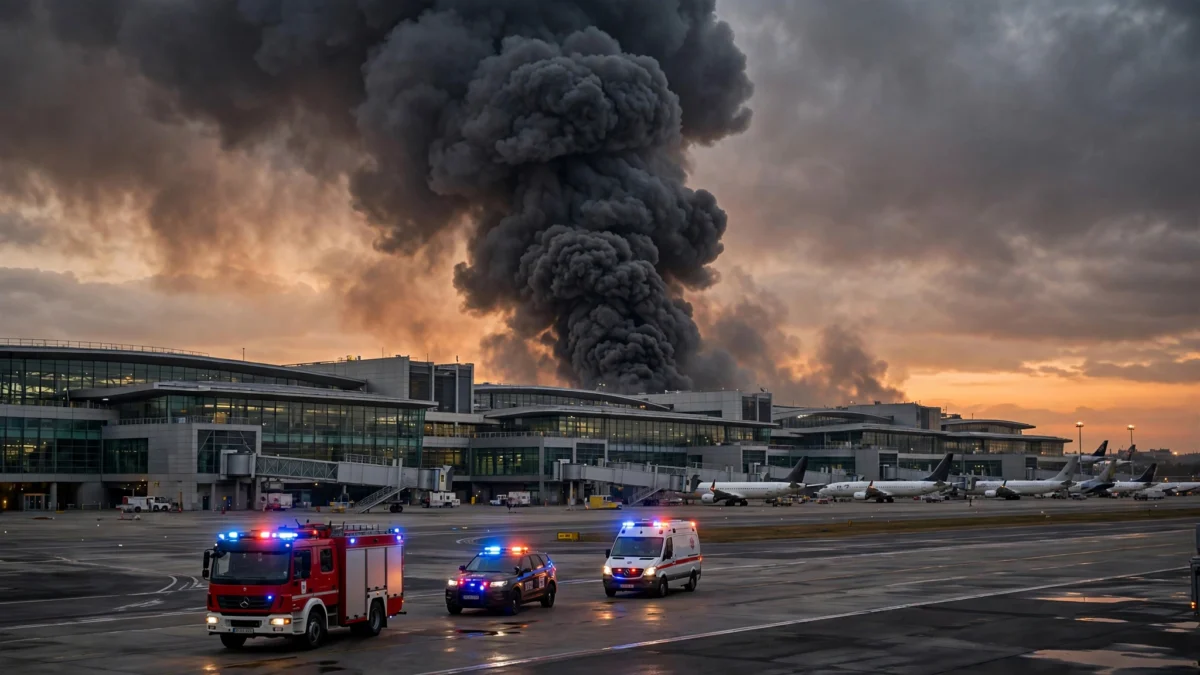
Three Saudi nationals were killed and several people of other nationalities wounded in two Houthi missile attacks on Riyadh’s King Khalid International Airport on Thursday, the Saudi authorities announced on Friday — making it the deadliest strike on the kingdom since Saudi Arabia and its allied forces in Yemen launched a major military offensive last weekend.
According to a statement from Saudi Arabia’s General Authority of Civil Aviation published on X on Friday, the first attack targeted airport facilities while the second struck a Saudia Airlines aircraft that was on the ground, the Associated Press reported. The statement did not name those responsible, though Yemen’s Houthi group claimed it had fired a ballistic missile at the airport.
The kingdom’s flagship carrier confirmed that the damaged jet was not carrying passengers at the time, and identified one of the dead as Captain Hamoud Ali Alkalthami, a Saudia pilot. The civil aviation authority said the injuries suffered by Saudi citizens and residents of other nationalities “ranged from minor to serious” and that there was also material damage to airport property, the AP reported.
The Saudia Group said operational activities at the airport had returned to normal as of 6pm local time on Thursday, hours after the attack. Flight-tracking data from flightradar24 showed a gradual resumption of flights, including some Middle Eastern carriers, Reuters reported on Friday.
Smoke over Terminal 4, cancelled flights
Images posted on X and verified by CNN showed smoke rising over Terminal 4 at King Khalid International Airport, as well as what appeared to be a damaged Saudi aircraft. The Associated Press cited a witness as saying several explosions had been heard in Riyadh, including at the airport. Reuters reported smoke billowing over the airport as airlines scrambled to cancel services to the Saudi capital.
The strikes came as Riyadh was preparing to host a major meeting of global oil chiefs — a gathering that would place some of the world’s most powerful energy executives in a capital whose airspace the Houthis had explicitly vowed to shut down. According to aviation analytics firm Cirium, cited by several outlets, almost half of Riyadh’s departures had been cancelled by 1500 GMT on Thursday, and the firm projected 31 further cancellations across Saudi airports on Friday. Lufthansa and Air India were among the airlines that temporarily suspended flights to Riyadh.
On Thursday, Saudi authorities said the country’s air defences had intercepted and destroyed two ballistic missiles fired toward Riyadh, and that falling debris had damaged a kindergarten and a medical clinic — an indication that the missile traffic extended beyond the airport itself.
Third consecutive day of attacks
Thursday’s assault was the culmination of an intensifying campaign. The leader of the Iran-backed Houthis warned Saudi Arabia to prepare for a “long conflict” as his group stepped up attacks on the kingdom for a third consecutive day, CNN reported. The Houthis said Thursday they had carried out a new wave of strikes targeting two civilian airports — Riyadh and Najran Airport near the southern Saudi-Yemen border — as well as the Royal Saudi Air Force’s King Khalid Air Base, claiming the attacks involved both cruise and ballistic missiles and had damaged property and disrupted air traffic.
The group has announced repeated rounds of ballistic missile fire at Saudi Arabia in recent weeks, proclaiming that it would shut down Saudi airspace and warning workers at oil facilities that those installations would also be struck, Reuters reported.
Earlier in the week, the Houthis had already killed three people with strikes on airports in the kingdom, according to Reuters — meaning six people have now died in airport attacks within days. A Sudanese national was killed at the Riyadh airport earlier in the week, the AP reported.
Retaliation and the wider offensive
Saudi airstrikes hit Houthi targets in the Yemeni capital Sanaa overnight into Friday, Houthi officials and affiliated media said, part of an intensifying air war against the Iran-allied group aimed at reversing its recent territorial gains, its threats to international shipping and its attacks on the kingdom, Reuters reported.
A Saudi-led coalition backing government forces in Yemen said it had destroyed three missile launch platforms used by the Houthis and warned it would respond firmly to attacks on civilians. The coalition has also launched what state media described as a large-scale operation against Houthi military infrastructure, claiming 136 targets destroyed across October 9 and 10.
Pakistan publicly condemned the Houthi attacks at the United Nations, reaffirming support for Saudi security under the Makkah Joint Defence Agreement while ruling out sending Pakistani forces across the border into Yemen for offensive operations, according to an aggregation of the coalition’s announcements. The line captures the delicate position of Saudi Arabia’s partners: politically aligned, militarily cautious.
Yemen: the fiercest front
Yemen’s civil war has rapidly emerged as the fiercest front in a wider regional conflagration triggered by the United States and Israeli attack on Iran that started on February 28, Reuters reported. The conflict is critical for global energy markets, with the Houthis firing on shipping in the Red Sea and its southern gateway, the Bab el-Mandeb Strait, further squeezing Gulf oil supplies at a time when Iran has been partly blocking the Strait of Hormuz.
Last month, the Houthis staged a lightning advance down Yemen’s Red Sea coast to take full control of the coastline around the strait, prompting Saudi Arabia to re-enter the long-dormant conflict and back a government counteroffensive. On Monday, government forces retook territory around the Bab el-Mandeb coastline after intense Saudi airstrikes, and fighting continues there. The Houthis, however, have also managed to cut off a key road connecting Taiz — a city of more than half a million people holding a garrison of thousands of pro-government fighters — with advances in mountain districts, Reuters reported.
The Saudi-backed military operation by Yemen government forces was launched only days ago with the aim of reversing the lightning Houthi advance that left the rebels in control of thousands of square kilometres along the Red Sea coast and the strait, one of the world’s most important waterways, which accounts for roughly a tenth of global container shipping, The Times reported.
The strait has taken on added importance this year: with Iran trying to choke oil exports through the Strait of Hormuz, Saudi Arabia has been rerouting millions of barrels a day to its Red Sea port of Yanbu. The Houthis, and their allied militia in Iraq, have targeted the pipeline and the port itself, as well as Saudi oil tankers, according to The Times.
The operation was meant not only to force the Houthis to withdraw but also to restore a semblance of Saudi deterrence after the kingdom ended its seven-year war with the rebels in 2022. “For now, it appears to have had the opposite effect,” The Times reported.
Diplomacy and the Pakistan–Turkey angle
Saudi Arabia is seeking assistance from Pakistan and Turkey, its partners in a mutual defence pact, to help ward off Houthi attacks, and has pushed for wider help from allies to aid it in reversing the group’s gains inside Yemen, Reuters reported.
The request underscores how seriously Riyadh views the threat: a seven-year war that ended in 2022 has been re-opened, the enemy is now striking the capital’s airport, and the kingdom is explicitly asking treaty partners for help. Britain, for its part, has advised against all but essential travel to Riyadh and several other provinces and cities that have come under fire in recent days, The Times reported. The Foreign Office’s advisory lands as Saudi Arabia prepares to host its annual Future Investment Initiative conference — known as “Davos in the Desert” — later this month, an event that attracts major financiers and business leaders and now must be staged under the shadow of missile alerts.
The US Mission in Saudi Arabia said it was “aware” of attacks targeting the airport in Riyadh and warned American citizens to exercise heightened vigilance, noting previous attacks on civilian airports in the country and cautioning that the conflict “has the potential to escalate,” CNN reported.
Analysis: Why It Matters
The airport is now the battlefield. The Houthis are not simply lobbing missiles at Saudi territory — they are systematically targeting the infrastructure of connectivity: civilian airports, airspace, the logistics of a capital. The declared aim is explicit — “shut down Saudi airspace” — and the mechanism is civilian casualties at the gates of the kingdom’s economic nerve centre. Hitting King Khalid International twice in one day, killing a national-carrier pilot and damaging an aircraft, is a form of pressure that no military parade or battlefield advance replicates: it makes every investor, airline scheduler and foreign ministry do the Houthis’ signalling work for them. Thursday’s half-empty departure boards were the message.
Deterrence is running in reverse. The Times’ assessment is the uncomfortable core of this story: a Saudi-backed offensive launched days ago to reverse Houthi gains and restore deterrence appears, so far, to have produced the opposite — a bolder Houthi campaign, deeper strikes, and a death toll on Saudi soil rising within the week. The 2022 decision to end the seven-year war was premised on the belief that Saudi Arabia could manage the Houthis from a distance. The events of this week suggest the opposite: the Houthis have grown stronger in the intermission — stronger on the Red Sea coast, stronger in missile technology, and more willing to strike the Saudi capital’s civilian infrastructure.
The timing is a deliberate squeeze. The attacks arrived days before a major meeting of global oil chiefs in Riyadh and weeks before the Future Investment Initiative. This is not coincidental pressure; it is leverage applied to the kingdom’s two most prized assets — its reputation as a stable venue for global capital and its reliability as the world’s swing oil producer. The Bab el-Mandeb and Hormuz double squeeze on oil flows, the rerouting of Saudi barrels through Yanbu, and now missile strikes on the capital’s airport together paint a picture the Houthis intend markets to read as vulnerability. Whether the “long conflict” the Houthi leader promises materialises or not, the threat alone reprices risk.
Travel advisories are diplomacy in shorthand. Britain’s decision to advise against all but essential travel to Riyadh is a small bureaucratic act with large meaning. Travel warnings are how Western governments signal diminished confidence without issuing statements that inflame a crisis. Watch for who follows: if France, Germany or the United States upgrade their own advisories, Riyadh’s problem ceases to be a Yemeni military issue and becomes a diplomatic credibility issue — with the FII conference as the immediate stage.
Pakistan and Turkey will define the coalition’s ceiling. Saudi Arabia’s request for help under the mutual defence pact puts its two largest treaty partners in a tight spot. Pakistan’s line so far — condemnation at the UN, rhetorical backing under the Makkah agreement, but a public ruling-out of offensive cross-border operations — is the template Turkey will likely follow: solidarity without entanglement. The coalition’s stated “firm response” to civilian attacks therefore rests almost entirely on Saudi and Emirati airpower, which is precisely the instrument that failed to break the Houthis between 2015 and 2022.
What to watch next
1. The Future Investment Initiative. Whether “Davos in the Desert” goes ahead as planned later this month — and who shows up — will be the clearest market verdict on Saudi stability.
2. Oil-facility threats. The Houthis have explicitly warned oil-facility workers. Any strike on Yanbu, the rerouting port, or the pipeline would be a dramatic escalation with direct global price consequences.
3. The Bab el-Mandeb fight. Monday’s government gains around the strait coastline and the ongoing fighting there will decide whether the Saudi-backed offensive can hold its one success — or whether the Houthis retake the initiative.
4. Aviation disruption. Flight cancellations, airline suspensions and travel advisories are the real-time barometer of the campaign. A return to normal schedules would signal the Houthi airspace-shutdown threat is being contained; a lengthening suspension list would signal the opposite.
5. Taiz. The siege of Yemen’s third-largest city, with a key supply road cut, is the humanitarian fault line beneath the military story. A city of half a million under tightening encirclement is where the war’s civilian cost will be measured.
Sources
- Reuters — “Houthi strikes on Riyadh airport killed three Saudis as war escalates”
- The Times — “UK advises against travel to Riyadh as airport strike kills three”
- CNN — “Attack on Saudi airport kills 3 as Iran-backed Houthis warn of long conflict”
- Associated Press (via Nagaland Post) — “Saudi authorities say 3 killed in attacks on Riyadh airport claimed by Houthi rebels”
- Particle News — “Houthi Missiles Strike Saudi Airports as Riyadh Announces Large-Scale Operation”

About the Author — Abdul Mannan
Related Articles
Ukraine Hits Russian Oil Terminal in Rostov Hours After Trump’s Diesel Deal With Putin
A fire erupted at the Yug Rusi oil-loading terminal in Rostov-on-Don overnight amid a reported Ukrainian drone attack,…
US Imposes Month-Long Curfew on Okinawa Troops After Marine Held Over Alleged Murder of Japanese Woman
The month-long midnight curfew on 30,000 US personnel follows the arrest of a 20-year-old Marine over the alleged…
South Korea Recalls Ambassador to Ukraine as Russian Fuel-Shipment Row Deepens
South Korea is recalling its ambassador to Ukraine and threatening legal action after a Guardian investigation traced 176,000…