Trump Administration Bars Microsoft, Adobe and Six IT Firms From Green-Card Pipeline in Sweeping Visa-Fraud Crackdown

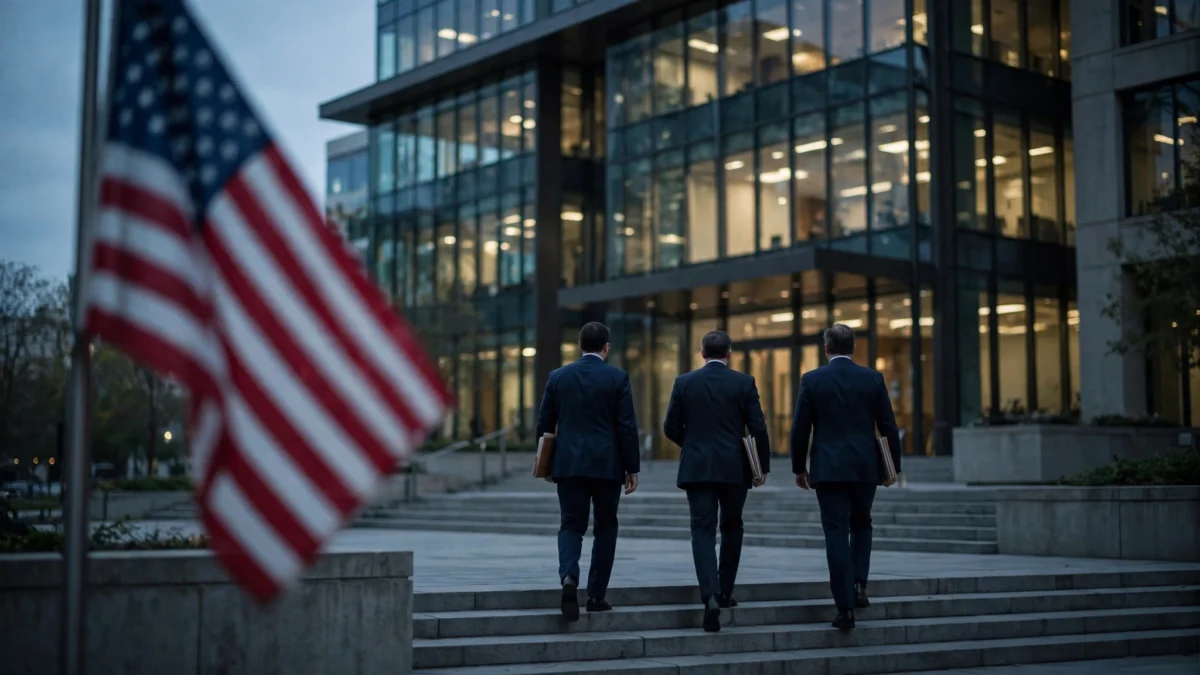
The Trump administration has suspended Microsoft, Adobe and six other companies from the federal programme that allows employers to sponsor foreign workers for permanent residency, accusing the firms of systematically abusing the visa system to replace American workers with cheaper foreign labour.
The move, announced on Thursday 8 October at a White House news conference by Vice President JD Vance and Labour Secretary Keith Sonderling, is the administration’s most direct strike yet against high-skilled immigration programmes and the large technology and outsourcing companies that depend on them.
Under the action, the Department of Labor will no longer accept new applications from the named companies under the Permanent Labor Certification programme — commonly known as PERM — and will halt the processing of pending applications involving them, according to officials cited by the Wall Street Journal and Reuters-affiliated reporting carried by The Business Standard. PERM is the crucial legal step most employment-based green cards require: before sponsoring a foreign worker for permanent residency, an employer must certify that hiring them will not harm the wages or job opportunities of American workers.
The eight companies named are Microsoft, Adobe, Cognizant, Infosys, Tata Consultancy Services, Wipro, HCL Technologies and Capgemini, according to a list published by the Department of Labor and reported by LiveMint and Techstrong IT.
Speaking at the briefing, Mr Vance accused the companies of deliberately under-advertising jobs domestically in order to create artificial labour shortages, which they then used to justify hiring foreign workers instead of Americans. According to the Associated Press, he told reporters that firms routinely ran obscure job advertisements in small-town newspapers to manufacture the appearance that no qualified American was available for the position.
“There has been no company in the United States, unfortunately, that has abused the system more than Microsoft,” Mr Vance said, according to the Associated Press and the Wall Street Journal. He claimed that Microsoft laid off roughly 6,000 American employees last year while obtaining 6,300 H-1B temporary worker visas and nearly 3,000 green cards.
“If you do the math, for every worker that Microsoft laid off, they replaced that worker with one and a half foreign indentured servants,” the vice president said, using a phrase he repeated several times during the briefing. “Our message to Microsoft is: you’re a great American company, but you’ve got to hire great American workers. You cannot lay off American workers and then replace them with foreign indentured servants.”
Mr Sonderling, the Labour Secretary, said the suspensions stemmed from what he described as multiple active federal investigations, and characterised some of the targeted firms as operating as “visa mills,” according to Techstrong IT. He said the department would not accept new applications or process pending ones involving any of the named companies.
Microsoft is the largest filer of PERM applications among all employers, according to data from the US Labor Department reported by The Business Standard, making it the most exposed company under the suspension.
Microsoft’s Response
Microsoft issued a detailed rebuttal shortly after the news conference. A spokeswoman, Kate Frischmann, told the Wall Street Journal that the vast majority of Microsoft’s employees in the United States are American citizens, and said the company planned to send the administration additional information.
Of the approximately 6,000 H-1B visa applications Microsoft submitted in the last fiscal year, she said, 80 per cent were to extend or change the status of existing employees rather than to hire new workers. “Microsoft only files H-1B petitions for those who meet the rigorous standards of this visa category,” Ms Frischmann said. “We pay our employees some of the highest compensation in the tech sector, and our wages are among the highest of all H-1B filings. We pay our H-1B employees the same as any other employees doing comparable work.”
The announcement carried a striking political irony: it came the same day that President Donald Trump honoured a group of technology leaders at a White House event recognising their contributions to American industry. Microsoft chief executive Satya Nadella was among those recognised. According to The Business Standard, Mr Nadella once held an H-1B visa himself — as did Elon Musk, who was also honoured — while three of the other executives recognised are immigrants. Mr Nadella publicly thanked the president in a post on X, saying he would continue to advance technology and drive American prosperity.
Adobe did not immediately respond to requests for comment on Thursday, according to the Wall Street Journal.
The Universities Probe
The administration’s actions did not stop with corporate employers. On the same day, officials announced the opening of fraud investigations into the J-1 exchange visitor visa programmes at nine leading American research universities, according to Techstrong IT and The Business Standard. Details of which universities were targeted were not immediately disclosed, but the move puts some of the country’s top higher-education institutions on notice alongside their corporate counterparts.
The twin actions mark the broadest strike yet against skilled-worker immigration programmes since Mr Trump returned to office, according to The Business Standard — potentially cutting off a common path to permanent residency for foreign technology workers while pressuring universities that rely heavily on international researchers and students.
It is important to note what the suspension does not do. According to reporting by LiveMint, it applies only to PERM applications — the labour-certification step toward a green card — and does not, by itself, cancel existing H-1B visas. Certain green-card routes may also be unaffected, including petitions based on extraordinary ability and some cases under the EB-2 National Interest Waiver category, which follow different procedures.
Analysis: Why It Matters
This announcement is far more than an immigration story. It is a business story, a labour-market story and a geopolitical signal — and its shockwaves will travel from boardrooms in Seattle and Silicon Valley to university campuses and outsourcing headquarters in Bengaluru.
First, consider the instrument the administration chose. It did not go to Congress to change immigration law; it reached for the Department of Labor’s administrative power over an obscure certification process that most Americans have never heard of. The PERM system is a procedural bottleneck — every employment-based green card in the EB-2 and EB-3 categories flows through it. By freezing that bottleneck for the eight biggest filers, the White House achieved with one press release what years of stalled legislative reform could not: an immediate, visible disruption of the skilled-immigration pipeline. The cleverness of the move is its speed; the risk is its fragility. Administrative actions that name specific companies are prime candidates for legal challenge, and the industry will almost certainly test this one in court, just as business groups have already challenged the administration’s recently imposed $100,000 fee for a single H-1B visa application.
Second, the choice of target reveals the administration’s theory of the case. The eight companies span two distinct business models: American technology giants such as Microsoft and Adobe, and global IT outsourcing firms — Cognizant, Infosys, TCS, Wipro, HCL Technologies and Capgemini — that built their business on moving skilled workers across borders. For years, critics of the H-1B programme have argued that the outsourcing model in particular floods the visa lottery with applications, crowding out the very high-skill hiring the programme was designed to attract when Congress created it in 1990. By sweeping both groups into a single action, the White House is asserting that the abuse is structural, not incidental — a claim the companies’ own lawyers will vigorously dispute, but one that will resonate politically with workers who feel displaced.
Third, the numbers at the heart of the dispute deserve scrutiny. Mr Vance’s arithmetic — 6,000 layoffs set against 6,300 H-1B visas and nearly 3,000 green cards — is powerful rhetoric, but the comparison mixes different categories of activity across different timeframes. Microsoft counters that 80 per cent of its H-1B filings merely extend the status of workers already on its payroll. Both claims can be true at once: a company can simultaneously trim its workforce and retain foreign-born employees, particularly if the layoffs and the visa holders sit in different business units. Microsoft also said in July that it would cut 4,800 jobs, about 2.1 per cent of its global workforce, according to The Business Standard — a figure the administration will cite as evidence of the pattern, and the company will describe as routine restructuring. The real question the investigations must answer is not whether the numbers look lopsided in a press briefing, but whether the companies made materially false certifications to the government about recruiting American workers — a much higher evidentiary bar.
Fourth, the same-day timing with the White House honour for tech executives — including an immigrant CEO who once held an H-1B — was either a deliberate show of confidence or an extraordinary scheduling failure, and either way it weakened the clarity of the administration’s message. Honouring the architects of the immigration system you are dismantling invites the obvious counter-narrative: that the American technology boom the administration celebrates was itself built, in part, on the very visa programmes now under attack. The administration’s answer will be that the programmes worked for an earlier era and have since been captured by abusers — but that case must be won in investigations and evidence, not in duelling press conferences.
Finally, there is the India dimension, which cannot be ignored in a business analysis. Five of the eight companies — Infosys, TCS, Wipro, HCL Technologies and Capgemini (a French firm, but heavily India-centred in delivery) — anchor a vast services industry that employs millions in India and serves American corporations. The outsourcing model has already been strained by the $100,000 H-1B fee; a PERM freeze tightens the vise further. India will treat this as a trade-and-mobility issue, and it will enter the already complex negotiations between the two governments on tariffs, market access and the broader technology partnership. For Pakistan’s own IT sector, watching from the sidelines, the lesson is double-edged: disruption of the Indian outsourcing giants could open competitive space, but a precedent of visa-by-punishment makes every emerging-market services exporter more cautious about depending on US immigration channels.
What to Watch Next
The companies will almost certainly challenge the suspensions in court, and judges will have to weigh the government’s investigative claims against the employers’ right to due process. Watch whether the Department of Labor publishes the underlying investigation materials, or whether the action rests on allegations the companies cannot yet see and answer.
The universities probe is the sleeper development of this story. Nine research universities under fraud investigation for J-1 visas could reshape how American higher education recruits the international researchers on whom much of its scientific output depends. If the probes expand, universities may tighten admissions and hiring defensively, with consequences for research funding and publication that only become visible years later.
On Wall Street, the market reaction will tell its own story. A PERM freeze raises the compliance cost of every foreign hire and injects policy uncertainty into workforce planning at eight of the industry’s biggest employers. Investors will want to know how much of Microsoft’s and Adobe’s talent strategy assumed a stable green-card pipeline — and what the alternative costs look like.
In Washington, the $100,000 H-1B fee and the PERM suspension together amount to a two-front squeeze on skilled immigration by administrative means. Whether Congress responds — either to ratify the crackdown or to restrain it — will determine whether this is a lasting policy shift or a second-term experiment that expires with the administration.
And in New Delhi, the government of the world’s largest democracy will have to decide how hard to push back. The outsourcing giants are national champions; their troubles in America are India’s economic problem. The response — quiet diplomacy or public retaliation — will shape the next chapter of a technology relationship both countries claim to value.
Sources
Wall Street Journal — Vance Says U.S. Will Suspend Microsoft and Other Firms From Green Card Program
The Business Standard — Trump administration freezes green cards for Microsoft, IT firms, probes universities
Techstrong IT — Trump Administration Suspends Microsoft, Tech Giants from Green Card Program, Launches University Visa Probes

About the Author — Abdul Mannan
Related Articles

SoftBank’s Masayoshi Son Seeks Up to $100 Billion From Gulf Investors for New AI Buyout Fund, FT Reports
Masayoshi Son has been sounding out Gulf investors for up to $100 billion to build a new fund…

SpaceX’s $8 Billion Spectrum Deal Sends Telecom Giants Reeling as Starlink Mobile Aims for the US Wireless Market
SpaceX has agreed to buy Grain Management's nationwide 800 MHz spectrum portfolio in a deal worth about $8…
US Budget Deficit Hits $2 Trillion in Fiscal 2026 — Third-Largest in American History, CBO Says
The Congressional Budget Office estimates the federal deficit reached $1.993 trillion in fiscal 2026, the third-largest shortfall on…