Trump Stuck at 34% Approval in New FT Poll as Economy Casts Shadow Over GOP With 22 Days to Midterms


A new nationwide poll published on Sunday puts Donald Trump’s approval rating at 34 per cent, with the economy once again emerging as the heaviest weight on his presidency — just 22 days before Americans vote in midterm elections that will decide control of Congress.
The Financial Times–Focaldata survey, conducted among registered voters, found that only one quarter approve of the president’s handling of jobs and the economy, while roughly one in five approve of his handling of inflation, according to a detailed breakdown of the findings published on Sunday. More than two-thirds of respondents said the economy was heading in the wrong direction, and 45 per cent said Mr Trump was making it harder for Republican candidates to win in November.
The poll also recorded growing public unease over the war with Iran. Mr Trump’s approval on the Iran question has fallen by more than seven percentage points since May, with fewer than one in four voters now backing his handling of the conflict. Most respondents said they supported reaching a swift agreement to end it.
The September reading of the same FT/Focaldata tracking series had put the president’s approval at 33 per cent — the weakest since the question was first asked in May — meaning the October result shows a presidency that has barely moved, rather than one recovering, as the midterm campaign enters its final stretch.
A drumbeat of weak numbers
The FT poll did not land in isolation. It arrived at the end of one of the worst polling stretches of Mr Trump’s political career, with independent survey after independent survey pointing in the same direction.
According to USA Today, a Pew Research Center survey released on October 8 found only 30 per cent of Americans approving of the president’s job performance — a new second-term low. That poll also found Democrats holding an eight-point lead on the generic congressional ballot, with 84 per cent of registered voters calling the economy very important to their vote and only 21 per cent rating current economic conditions as excellent or good.
An Associated Press–NORC poll released on October 1 put Mr Trump’s approval at 31 per cent, a new career low across both his terms, with just 26 per cent approving of his economic management — a figure lower than Joe Biden’s worst economic rating during the inflation of 2022, according to the same report. A Quinnipiac University survey put him at 34 per cent approval against 61 per cent disapproval, matching his worst disapproval reading in that pollster’s history. A Reuters/Ipsos poll completed in the first week of October recorded 32 per cent approval, also a record low in that series. And the Wall Street Journal found his 37 per cent approval the lowest for any president heading into a midterm since the newspaper began polling in 1990.
Taken together, the polling consensus is unusually tight: the president’s standing is roughly a third of the country approving, around three-fifths disapproving, with the economy — and the cost of living in particular — cited by voters as the top reason.
The economy, the anchor
The economic backdrop explains much of the gloom. The United States added only 29,000 jobs in September, far below economists’ expectations, according to the FT’s analysis of its poll — a weak number for a campaign season in which Republicans have argued that tariff-driven investment is booming.
Voters, for their part, are judging by what they pay rather than what the White House promises. Gasoline and diesel prices have surged amid the war with Iran, which the Trump administration launched in February with strikes alongside Israel. Diesel — the workhorse fuel of American trucking, farming and industry — has repeatedly touched record territory, adding a cost layer to almost everything that moves.
Trade policy is adding to the strain. A 50 per cent tariff on roughly $20 billion of Canadian goods drew disapproval from 56 per cent of voters in the earlier FT reading, including more than 60 per cent of independents and nearly a third of Republicans; Ottawa has answered with duties of up to 50 per cent on American imports, and the FT poll’s latest wave suggests the trade fight has only deepened voter scepticism.
Mr Trump has responded by leaning into an economic pitch. At a campaign rally in Syracuse, New York, on October 10, he promised a “$5,000 Trump dividend” to every adult American citizen if Republicans retain control of both the House and the Senate — a proposal he said would cost roughly $1 trillion and be financed by tariff revenue and economic growth, according to an IANS dispatch from the rally. He framed the November 3 vote as a direct referendum on his economic stewardship.
But the strategy carries a risk the FT poll makes plain: voters who disapprove of the president tend to disapprove of him as the messenger too. Earlier FT polling found that 43 per cent of voters said a Trump endorsement would make them less likely to support the endorsed candidate.
The Iran drag and the election question
Foreign policy has become a second front for the administration. The FT poll found support for a swift settlement of the Iran conflict — and Mr Trump has moved to accommodate that mood: on Thursday he ruled out new American strikes on Iran before the November 3 vote, even as the US naval blockade of Iran remains in place and American forces continue to build up in the region.
Yet the economic fallout of the conflict — through fuel prices, borrowing costs and shipping disruption — keeps flowing back into the numbers that matter most to the midterms. The Iran approval reading’s slide of more than seven points since May is one of the sharpest declines in the FT series.
Separately, a YouGov poll for the Daily Mail, conducted October 2–5 among 1,053 American adults, found that 52 per cent did not expect Mr Trump to accept a Republican defeat in the midterms, while only 23 per cent believed he would; a quarter were unsure. The same poll found that nearly three in four Americans — including 72 per cent of Republicans — said the president should accept the final results. Mr Trump has already said publicly that he believes Republicans can win, and he has tied the outcome of the congressional races directly to his presidency.
Analysis: Why It Matters
Polls are snapshots, not forecasts, and three weeks is a long time in American politics. But the FT/Focaldata result matters less for the exact number — 34 per cent — than for the pattern it confirms: an approval floor that has held at roughly one-third of the electorate for months, an economy that voters judge by prices rather than promises, and a president whose own endorsement has become a measurable liability for his party’s candidates.
That combination is historically dangerous for the party in power. Midterm elections are almost always referendums on the president, and presidents sitting in the low-to-mid thirties have typically watched their parties bleed seats. The Financial Times poll’s own internal question is the most brutal version of that verdict: nearly half of registered voters believe the president is actively making it harder for his own party’s candidates.
The analysis points to three forces converging. First, inflation is outliving the administration’s explanations. Tariffs were sold as a price worth paying for reindustrialisation; voters are treating them as a tax they pay at the till. When two-thirds of the electorate says the economy is headed the wrong way, policy arguments stop landing.
Second, the Iran war has become an economic story wearing a foreign-policy costume. Americans may debate the wisdom of the strikes, but they all feel the price of fuel, and the FT data show the war’s domestic price is now the president’s problem. His pledge of no new strikes before the election reads less as confidence than as containment — an admission that escalation is a vote-loser.
Third, the president has made the midterms about himself. The “Trump dividend” promise ties the election’s outcome to a payoff only he can deliver; the Syracuse framing makes November 3 a judgement on his presidency. That is a gamble: when a president’s approval sits at 34 per cent, a referendum framing invites the country to say no.
There is a counter-case worth noting. Presidential approval is not a ballot box, and turnout — not national mood — decides close House races. A motivated minority can outperform a demoralised majority, and midterm models have misled before. But the direction of travel across every reputable tracker — FT, Pew, AP-NORC, Quinnipiac, Reuters/Ipsos, the Journal — is the same, and polling aggregator FiftyPlusOne has estimated Democrats gaining around 25 House seats and four or five Senate seats, enough for majorities in both chambers.
What to Watch Next
- The jobs data and fuel prices. With 29,000 jobs added in September and record fuel costs, every new economic release before November 3 is a campaign event. Another weak report would cement the economy as the decisive issue; a strong one would be the White House’s best argument.
- Early voting and turnout. With 435 House seats and 35 Senate seats on the ballot, the question is not just who voters support but who actually shows up. Watch early-vote numbers in the battleground states drawing national attention — Texas, Kansas, Iowa, Michigan and Ohio among them.
- The generic ballot. Pew’s eight-point Democratic lead is the number to track in the final weeks; if it widens toward double digits, historical models suggest the wave is real. If it narrows, Republicans may be clawing back.
- Iran and energy prices. The administration has promised no new strikes before the vote, but tanker attacks in the Strait of Hormuz and retaliation cycles could still move fuel prices — and with them, voter moods.
- Trump’s closing pitch. The $5,000 dividend promise is the clearest signal of how the president intends to close: pocketbook populism. Whether voters believe the cheque will come — and whether they resent the condition attached — will show up in the final tracking polls.
Sources
- Financial Times–Focaldata poll findings on Trump approval and the economy — tradersunion.com
- Political Wire: Trump Approval Remains Deeply Negative (34% / 59%)
- USA Today: Trump’s approval rating sinks to new second-term low, Pew poll shows
- USA Today: Trump approval rating hits new career low in latest AP-NORC poll
- LiveMint: 32%, 24%, 52%, 86% — Reuters/Ipsos poll ahead of midterms
- Dagens: YouGov poll on Trump accepting a midterm loss

About the Author — Abdul Mannan
Related Articles
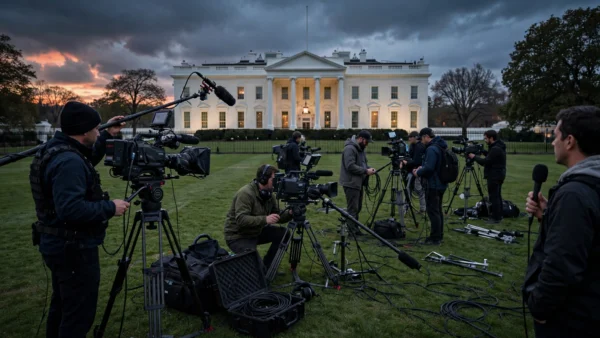
DOJ Opens Antitrust Investigation of Five Major TV Networks Over White House Press-Pool Boycott
The Justice Department says it is investigating whether ABC, CBS, CNN, NBC and Fox News violated federal antitrust…

Trump Tells Ukraine to “Get a New President” as Rift With Zelensky Deepens Over Russian Diesel Deal
Trump says it is "time for Ukraine to get a new president" as he clashes with Zelensky over…

Trump Says US May Join Saudi Strikes Against Houthis After New Riyadh Airport Attack
President Donald Trump said on Saturday that the United States may join Saudi Arabia's strikes against Yemen's Houthi…