Judge Orders Trump Administration to Pull Taxpayer-Funded Ads, Delivering Rare Rebuke Weeks Before Midterms

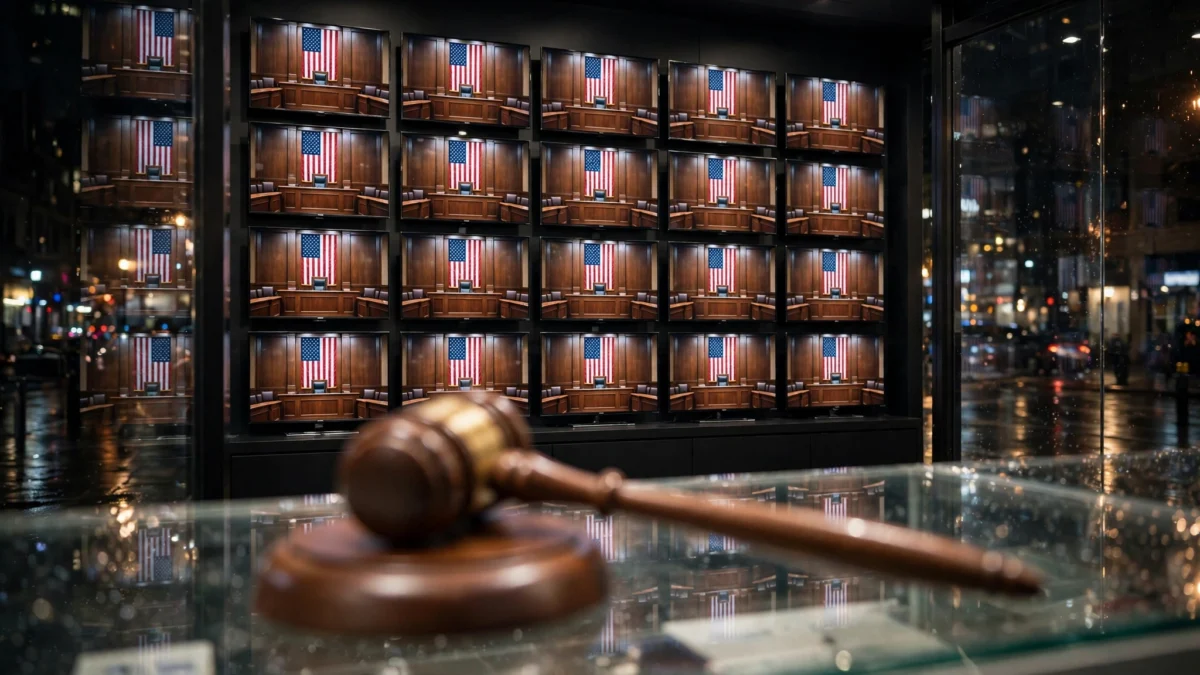
A federal judge in New York ordered the Trump administration late on Sunday night to cancel any remaining airings of a controversial television advertising campaign paid for with taxpayer money, ruling that the government must halt the ads immediately even as officials insisted the campaign was already winding down, according to reporting from the Associated Press.
U.S. District Judge Jennifer L. Rochon granted a temporary restraining order in a case brought by a coalition including the nonpartisan watchdog group Common Cause, which argued that the ads represented an illegal misuse of congressionally appropriated funds. The two-week order bars the administration from entering into, renewing or expanding any agreement connected to the challenged advertisements, and explicitly instructs the government to cancel any slots, placements, reservations or arrangements for their airing or dissemination.
The ruling landed on Sunday night with hours to spare before the administration’s own stated end date for the campaign, and it injects an unusual judicial confrontation into the final weeks of a midterm election season that will decide control of Congress on November 3.
What the judge decided
Judge Rochon’s order came in response to an emergency request filed by plaintiffs who accused the White House of breaking the law by spending public money on advertising that, in their telling, amounted to taxpayer-funded promotion of President Donald Trump’s political message ahead of the midterms.
According to the Associated Press, Rochon told the administration to cancel any remaining ads, including any set to air later on Sunday night. Her order stated that the defendants “shall not enter into, renew, or expand any agreement authorizing the development, creation, dissemination, placement, or airing of the challenged advertisements” for the duration of the two-week order.
The White House did not immediately respond to requests for comment on Sunday night, the AP reported. The administration had argued in a court filing late on Saturday that a restraining order was unnecessary because, in its words, “the alleged offending conduct will end tomorrow” — a reference to the campaign’s planned conclusion on Sunday. Judge Rochon was unpersuaded. She found that the challengers would suffer irreparable harm and that halting the campaign served the public interest, according to the Wall Street Journal’s account of the four-page ruling.
The Department of Homeland Security had tapped $20 million in taxpayer money for the advertisements, drawn from funds Congress appropriated as part of the administration’s immigration enforcement agenda. In a sworn declaration cited by CNN, a senior Homeland Security official, Holly Mehringer, stated that an advertising company, LMD Agency Inc., “purchased media buys under the terms of the Order through Sunday, October 11, 2026, at an approximate cost of $19,000,000.” The department told the court it had directed the agency not to make any additional media buys past October 11 and had “no plans” to purchase further ads.
Even so, the judge declined to accept the administration’s assurances at face value. According to CNN, she concluded that the government’s promise to wind down the campaign did not render the lawsuit moot, and she ordered the government to halt any further airings as of 6:45 p.m. ET on Sunday.
The ads at the centre of the case
The commercials, which began airing on national television in late September, predominantly feature President Trump and promote the administration’s policies, according to the Wall Street Journal. They ran on cable and broadcast channels across the country and were classified by the administration as “public service announcements,” financed out of the U.S. Customs and Border Protection budget.
The campaign drew an uncommonly broad backlash almost as soon as it began. Democrats and other Trump critics denounced it as propaganda paid for by the public purse, and at least one senior Senate Republican objected to the arrangement as well, according to CNN’s reporting.
On October 5, Trump himself acknowledged the criticism. In a social media post, he defended the taxpayer-funded spots as “rather standard” but announced: “I have decided to do the Patriotic Ads, among others, and pay for them myself, and with money I raised for MAGA, Inc.,” referring to his allied super PAC. Six days later, however, the taxpayer-funded ads were still airing, CNN reported — a sequence of events the plaintiffs seized upon to argue that the administration’s promises could not be trusted without a court order.
The Wall Street Journal has separately reported that President Trump personally pushed for the ads and was involved in their creation, a detail that undercuts any suggestion that the spots were the routine handiwork of agency communications staff.
The legal argument
At the heart of the lawsuit is a federal statute that prohibits congressionally appropriated money from being used for “publicity or propaganda,” along with potentially other restrictions on the use of public funds for political purposes. Legal experts quoted in the AP’s reporting have suggested that the advertising campaign may have violated that law.
The plaintiffs — Common Cause, a labour union and its political action committee, and an Alabama Democratic candidate for state office — argued that the expenditures served purposes Congress never authorised. The Homeland Security money tapped for the ads came from a $175 million package Congress granted the department as part of Trump’s immigration enforcement agenda, according to the AP.
In a statement issued through Democracy Forward, the nonprofit legal organisation representing them, the plaintiffs said: “We are pleased the court acted swiftly to prevent more taxpayer dollars from being used for such blatantly unlawful political propaganda.” They added: “There is no legal justification — and no precedent — for the president to use the machinery of the government and funds set aside by Congress for other uses to influence electoral outcomes that further his own agenda.”
The ruling is not the only front in this fight. A separate lawsuit filed by the Democratic National Committee in Washington on October 7 also sought emergency relief to halt further government-funded broadcasts, according to the reporting. Multiple parallel legal challenges against the campaign remain active, and a final judicial determination on whether the advertisements violated federal law is still pending. Sunday’s order is a temporary measure: it suspends the campaign while the underlying litigation proceeds.
Why the timing matters
The court battle is unfolding 22 days before the November 3 midterm elections, which will determine which party controls Congress for the remainder of Trump’s presidency. That context is impossible to separate from the case. The challengers argued, in effect, that a sitting president was using public resources to broadcast self-promotional advertising into voters’ homes in the closing weeks of a campaign season — a line that democracies have long guarded.
The judge’s willingness to act late on a Sunday evening, with the campaign supposedly hours from ending on its own, signals that the court took seriously the possibility that assurances of a voluntary wind-down were worth little. The administration’s own timeline weakened its position: if the campaign was genuinely ending, a two-week freeze changed nothing of substance; if it was not, the court had good reason to intervene.
Analysis: Why It Matters
Beyond the immediate question of whether a handful of remaining ad slots get cancelled, the Rochon ruling touches on something more durable: the boundary between the government and the campaign.
Modern American presidencies have always blurred that line at the edges. Incumbents travel on Air Force One, announce policy from the Oval Office, and turn official duties into implicit advertising. What made this episode different was its brazen mechanics. This was not a president benefiting from the ambient advantages of incumbency; it was a direct transfer of $19 million in appropriated funds — money Congress had earmarked for immigration enforcement — into television buys featuring the president himself, running in the weeks before a national election that his party must win to hold Congress.
The administration’s classification of the spots as “public service announcements” from Customs and Border Protection deserves scrutiny on its own terms. Public service advertising typically warns citizens about scams, health risks or emergencies. These spots, by every credible account, promoted the president and his agenda. The gap between the label and the product is precisely what the publicity-and-propaganda statute was written to police — a law Congress passed to prevent exactly this kind of thing: the executive branch spending public money to sell the public on the executive branch.
There is a second, quieter significance in the judge’s handling of the government’s mootness argument. The Justice Department’s filing — “the alleged offending conduct will end tomorrow” — is a move courts see often: an agency caught in an arguable violation promises to stop, then asks the court to walk away. Judge Rochon’s refusal to do so rests on a well-established principle that voluntary cessation does not moot a case when the defendant could simply resume the conduct. Her scepticism was hardly abstract: six days after the president himself promised to pay for the ads out of his own fundraising, the taxpayer-funded versions were still on the air. A court that had taken the administration at its word would have had little to stand on.
The ruling also lands in a midterm environment where institutional checks on executive spending are under unusual strain. Congress is out of session for the final campaign stretch, and the appropriations committees that would ordinarily scrutinise a $20 million reprogramming are consumed by electioneering. In that vacuum, the judiciary becomes the only functioning check — which is why a four-page Sunday-night order from a single district judge carries weight well beyond its 14-day lifespan.
Finally, there is the question of precedent. If the underlying litigation ultimately concludes that the campaign was lawful, future administrations of either party will have a roadmap: classify self-promotional advertising as public service messaging, fund it from agency budgets, and time the buys for election season. If the court ultimately rules against the government, it will draw one of the clearest lines in modern American law around what taxpayer money may and may not do in the months before an election. Either way, Sunday night’s order was the moment the courts decided this was a question worth answering rather than waving through.
What to watch next
First, watch whether the administration complies in full or tests the edges of the order — for instance, whether ads paid for with MAGA Inc. money, as Trump promised on October 5, begin appearing in the same slots.
Second, watch the DNC’s parallel suit in Washington, filed October 7, which could produce a second, potentially broader ruling.
Third, watch the merits litigation itself. The temporary restraining order lasts two weeks; the underlying case will decide whether the entire $19 million campaign was illegal from the start, and whether any consequences follow.
Fourth, watch Capitol Hill. With both parties’ lawmakers already on record criticising the campaign, there may be appetite after the midterms for tighter statutory language on agency advertising — or at least for hearings on how the Homeland Security funds were reprogrammed.
Fifth, watch the campaign trail. The optics of a president whose taxpayer-funded ads had to be pulled off the air by court order are now part of the closing argument of the midterm cycle, whether or not the ads themselves were ever decisive.
Sources
Associated Press (via multiple regional outlets): “Judge orders the Trump administration to cancel taxpayer-funded promotional TV ads” — https://www.wvlt.tv/2026/10/12/judge-orders-trump-administration-cancel-taxpayer-funded-promotional-tv-ads/
CNN: “Judge orders Trump to halt taxpayer-funded ads with hours left in administration’s push” — https://www.cnn.com/2026/10/11/politics/trump-taxpayer-funded-ads-stop?cid=external-feeds_iluminar_meta
The Wall Street Journal: “Judge Says Pro-Trump Ads Funded by Taxpayers Must Be Taken Off Air” — https://www.wsj.com/us-news/law/judge-says-pro-trump-ads-funded-by-taxpayers-must-be-taken-off-air-b4c83a4f
KXL (AP): additional detail on DHS $20 million allocation and the $175 million immigration-enforcement appropriation — https://www.kxl.com/judge-orders-the-trump-administration-to-cancel-taxpayer-funded-promotional-tv-ads/

About the Author — Abdul Mannan
Related Articles
Trump Stuck at 34% Approval in New FT Poll as Economy Casts Shadow Over GOP With 22 Days to Midterms
A new Financial Times–Focaldata poll puts Donald Trump at 34% approval with 22 days to the November 3…
DOJ Opens Antitrust Investigation of Five Major TV Networks Over White House Press-Pool Boycott
The Justice Department says it is investigating whether ABC, CBS, CNN, NBC and Fox News violated federal antitrust…
Trump Tells Ukraine to “Get a New President” as Rift With Zelensky Deepens Over Russian Diesel Deal
Trump says it is "time for Ukraine to get a new president" as he clashes with Zelensky over…