Trump Rallies in Youngstown to Shore Up Ohio Senate Race as Polls Show Husted Trailing Brown

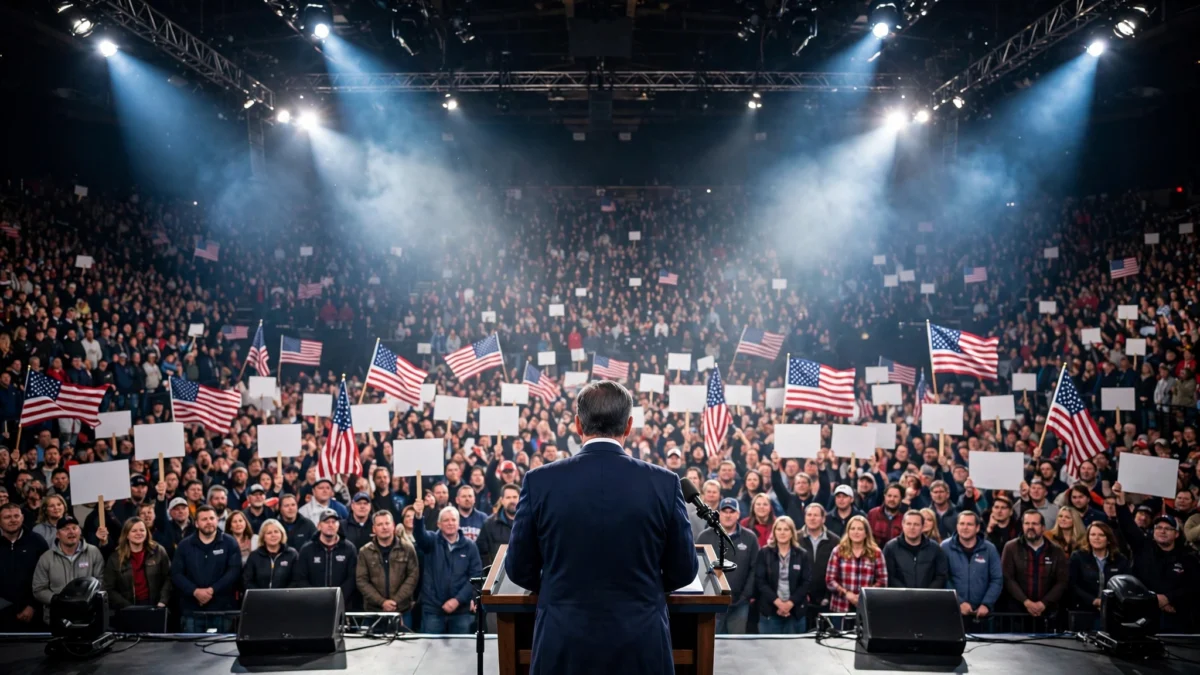
President Donald Trump brought his midterm campaign sprint to Youngstown, Ohio, on Monday night, headlining a raucous, nearly 90-minute rally aimed at shoring up Republican Senator Jon Husted in a Senate contest that polls show slipping toward Democrat Sherrod Brown with three weeks to go before the November 3 elections, according to CNN.
The rally, held in the same Youngstown arena where Trump staged a packed “thank you” tour stop in 2017, mixed the familiar pageantry of a presidential campaign event with an increasingly urgent pitch: that Republican control of Congress — and with it the final two years of his presidency — depends on voters turning out in places his party already won.
It was a livelier affair than some of Trump’s recent rallies, CNN reported, though not without discord. Large sections of seating to the left and right of the press riser — prime seats with direct views of the president — sat empty. The evening was interrupted twice: once when a brawl appeared to break out between a protester wearing a “Release The Epstein Files” t-shirt and a rally-goer in the stands, and again when a young woman held up a Mexican flag.
Immigration takes centre stage
A large portion of Trump’s remarks returned to immigration, the theme he rode hard in the 2024 campaign, with extended attacks on Somali and Haitian communities. At one point he conjured two out-of-state Democrats — Minnesota Representative Ilhan Omar and Michigan Senate nominee Abdul El-Sayed — as greater threats than Brown himself, who is giving Husted what CNN described as a run for his money in a state Trump had turned into a reliably red bastion.
Trump devoted significant time to Omar, whose Washington, DC-area home was searched by federal officers early Monday under a warrant, according to a Justice Department spokesperson and a source familiar with the matter cited by CNN. Trump insisted he was not involved in the search, then went on to call Omar — a United States citizen — a “disaster” and to attack the country where she was born.
As he launched into a tirade against Somalis in the United States, supporters in the audience began chanting “Deport!”, according to CNN. Trump repeated his insult describing Somalis as “low IQ people” and made blue-state Minnesota his foil, warning Ohioans: “If you want to stop Ohio from being plundered, ransacked, and destroyed like Minnesota’s being destroyed, we’re going to stop it. Just like we did with Springfield, we’re going to stop it.”
The Springfield reference recalled his 2024 campaign claim about Haitian migrants in Springfield, Ohio — a claim CNN described as false, noting he repeated it at Monday’s rally.
A plea to “pretend” he is on the ballot
Turning to the Senate race itself, Trump tried to link Brown — a progressive populist first elected to the Senate in 2006 — to national Democrats in broad terms, calling him “the candidate of the Marxists, the communists, the anti-American radicals, who want to tear down America’s heritage,” and arguing he wants the Midwest “turned into Mogadishu,” according to CNN.
Brown holds a 6-point lead over Husted in CNN polling released last week. An earlier Reuters report, citing September surveys, put Husted trailing by 3 to 5 percentage points — a consistent picture of a Republican incumbent on the defensive in a state Trump carried with more than 55 percent of the vote in 2024.
Trump seemed to acknowledge Ohioans’ history of backing Brown personally, arguing that a single Senate vote carries national consequences. “It’s one vote, but that one vote can steer Congress into a direction that you’re not going to be happy with. And it’s not Ohio values,” he said, according to CNN. He repeated his call for supporters to “pretend” he is on the ballot this year — “every time I run, we do great,” he said.
The stakes: a Senate majority on a knife’s edge
Republicans currently hold a 53-47 majority in the Senate, and Democrats need a net gain of at least four seats to take control of the chamber, according to Reuters. Ohio is one of eight Senate races rated competitive, and the Husted-Brown contest has become the costliest advertising battle of the 2026 midterms: AdImpact, a political advertising tracker, says the race has attracted $298 million in ad spending so far, more than any other Senate race this cycle, Reuters reported.
The money race mirrors the polls. Brown has raised $38.6 million to Husted’s $14.3 million, according to Federal Election Commission records cited by Reuters. Republican-aligned super PACs, including groups linked to Trump, billionaire Elon Musk and the Koch political network, poured $14 million into Ohio advertising in a single week in September to bolster Husted. No Going Back PAC, closely tied to Trump’s MAGA Inc. super PAC, led the drive with $6.7 million in television, digital and mail ads, according to FEC data cited by Reuters.
The contest is a special election for the seat vacated by JD Vance when he became vice president in 2025; the winner will serve out the remaining two years of the term through 2028, Reuters reported. Brown, who served three terms in the Senate before losing reelection in 2024 while on the ballot with Trump, is attempting a comeback against Husted. Analysts rate the race a toss-up.
A 32-day sprint through friendly territory
The Youngstown rally kicked off a week of campaigning through normally friendly territory. After Ohio, Trump is scheduled to visit Alaska and Montana — states he won by 13 and 20 points respectively in 2024 — as his team bets on him juicing base turnout in conservative areas, according to CNN and Reuters. By the end of the week, Trump will have campaigned in 11 states in two weeks, including two stops each in Texas and Ohio plus a Tuesday rally in Alaska, where Republican Senator Dan Sullivan faces a close contest with Democrat Mary Peltola, Reuters reported.
Speaking to reporters Saturday night after a stop in Clarksville, Tennessee, Trump said he was visiting places that backed him while acknowledging the difficult fights ahead: “I’ll be going to Ohio, which backed me, but we have very close races,” he said, according to Reuters.
Larry Sabato, director of the Center for Politics at the University of Virginia, told Reuters the travel schedule looks deliberate: “His staff is putting him in places where he’s likely to be able to draw a friendly crowd to the rally,” Sabato said, adding that the candidates Trump is campaigning for “might well win.”
Trump is facing political headwinds from high gasoline prices and the US-Israeli war with Iran, Reuters reported. In Ohio, gasoline prices have risen 35 percent over the past year to an average of $4.16 per gallon, according to AAA data cited by Reuters, and Trump’s aggressive trade policy with Canada has drawn retaliatory Canadian tariffs affecting about $3 billion worth of Ohio exports, based on 2025 figures.
There were signs of star power around the trip: Super Bowl-winning NFL coach Jon Gruden — a Sandusky, Ohio, native and former college teammate of Husted’s who introduced Trump at the rally — and boxer-turned-influencer Jake Paul, who was raised in Cleveland, travelled aboard Air Force One with the president, according to the New York Post. Senate Majority Whip John Barrasso, Senator Bernie Moreno of Ohio and Representative Max Miller were also in attendance. Trump also used the rally to boost the Republican gubernatorial ticket, urging the crowd to vote for both Husted and gubernatorial candidate Vivek Ramaswamy.
Early voting data offered a mixed picture for Republicans. The first days of early voting in Ohio showed signs Democrats are more enthusiastic, with affiliated Democrats making up larger shares of pre-election voters than they did two years ago — even in the most Republican parts of the state — according to data from the secretary of state’s office cited by CNN. Republicans in recent years, however, have been far more likely to vote early in person or on Election Day itself.
Analysis: Why It Matters
A defensive map for an incumbent president’s party. The geography of Trump’s closing argument is the story. With 21 days left, the president is spending his political capital in Ohio, Alaska, Montana and Texas — states he won, some of them by double digits. That is not a persuasion campaign aimed at swing voters; it is a turnout operation aimed at the party’s own base. When a president has to fly to states he carried comfortably just to keep Senate seats competitive, it signals that the midterm headwinds — prices at the pump, an expensive foreign war, a restive electorate — are real, and that Republican strategists believe enthusiasm, not conversion, is the binding constraint.
The Ohio paradox. No state illustrates the Republican dilemma better than Ohio. Trump has won it three times, most recently with more than 55 percent. Yet the Senate seat is a toss-up, with the Democrat leading in every recent poll. The explanation is Sherrod Brown himself: a populist who spent nearly two decades railing against the same trade deals Trump attacks, Brown has repeatedly proven he can win Ohio voters who also vote Republican for president. Trump’s answer is to nationalise the race — to make it a referendum on him rather than a choice between two Ohio politicians. “Pretend I’m on the ballot” is unusually candid about the strategy: borrow the presidential brand to close a personal-vote gap.
Immigration as the closing argument. The rally’s emotional core was not the economy or the Senate map but immigration — Somalis, Haitians, Springfield, “Deport!” chants. This is the 2024 playbook reheated: when economic news is difficult (gasoline up 35 percent in Ohio), cultural grievance is the reliable mobiliser. Whether it still works as a closing message with suburban voters who have already heard it for a decade is one of the open questions of this cycle.
The empty seats. It would be a mistake to read too much into a few vacant sections — rally crowds are choreographed, and cameras lie. But the contrast CNN noted is hard to ignore entirely: the same arena, packed in 2017, with prime seats empty nine years later, arriving in the same week that Ohio’s own early-voting data shows a Democratic enthusiasm edge. Enthusiasm gaps decide midterms. If the base that once filled arenas is even slightly less eager, the “pretend I’m on the ballot” plea starts to look less like confidence and more like a warning.
The Omar shadow. Hanging over the rally was the morning’s FBI search of a sitting congresswoman’s home. Trump publicly distanced himself from the search while making its target the villain of his speech — a straddle that lets him benefit from the spectacle while disclaiming the machinery behind it. With three weeks to go, how that investigation develops — and whether it reads to voters as law enforcement or lawfare — could become one of the campaign’s final wild cards.
What to Watch Next
- Alaska on Tuesday — Trump’s rally for Senator Dan Sullivan against Democrat Mary Peltola tests whether the base-turnout strategy travels beyond the lower 48.
- New Ohio polling — whether Brown’s lead holds, grows or narrows in the race’s final three weeks, and whether the $298 million ad blitz moves numbers.
- Early-vote trends — Ohio’s secretary of state data will show whether the early Democratic enthusiasm edge persists or whether Republicans close the gap with in-person early voting.
- The Montana stop — another deep-red state where Trump is being deployed defensively; watch the crowd and the message discipline.
- The Omar investigation — any further Justice Department action, or pushback from congressional Democrats, could reshape the campaign’s closing narrative.
Sources
- CNN — “Trump holds raucous Ohio rally as he tries to shore up base voters for GOP” (October 12, 2026)
- Reuters — “Trump to campaign in Ohio, Alaska with Republicans facing tight races” (October 12, 2026)
- Reuters — “Trump to speak at Ohio rally as Republicans defend Senate seat in close race” (October 3, 2026)
- Reuters — “Trump-linked ‘pop-up’ PACs blitz Ohio with ads against Brown in costly Senate race” (September 18, 2026)
- Reuters — “‘I’m getting fed up’: voters line up before dawn as early voting begins in Ohio” (October 6, 2026)

About the Author — Abdul Mannan
Related Articles

‘Breaking Bad’ Actor and Disability Rights Advocate RJ Mitte Dies at 34
RJ Mitte, who played Walter White Jr. on 'Breaking Bad' and became one of Hollywood's most visible advocates…
Bipartisan Senate Group Calls on Trump to Reverse Course on Russian Diesel Deal as Republicans Break Ranks
Seven senators — four Republicans and three Democrats — demanded on Sunday that President Trump abandon his Russian…
Federal Agents Raid Congresswoman Ilhan Omar’s Washington Home in Immigration Fraud Investigation
HSI agents executed a judicially authorised search warrant at Rep. Ilhan Omar's Washington home on Monday in what…