The Sanction That Built a Rival: How America’s Chip War Forged China’s Silicon Empire

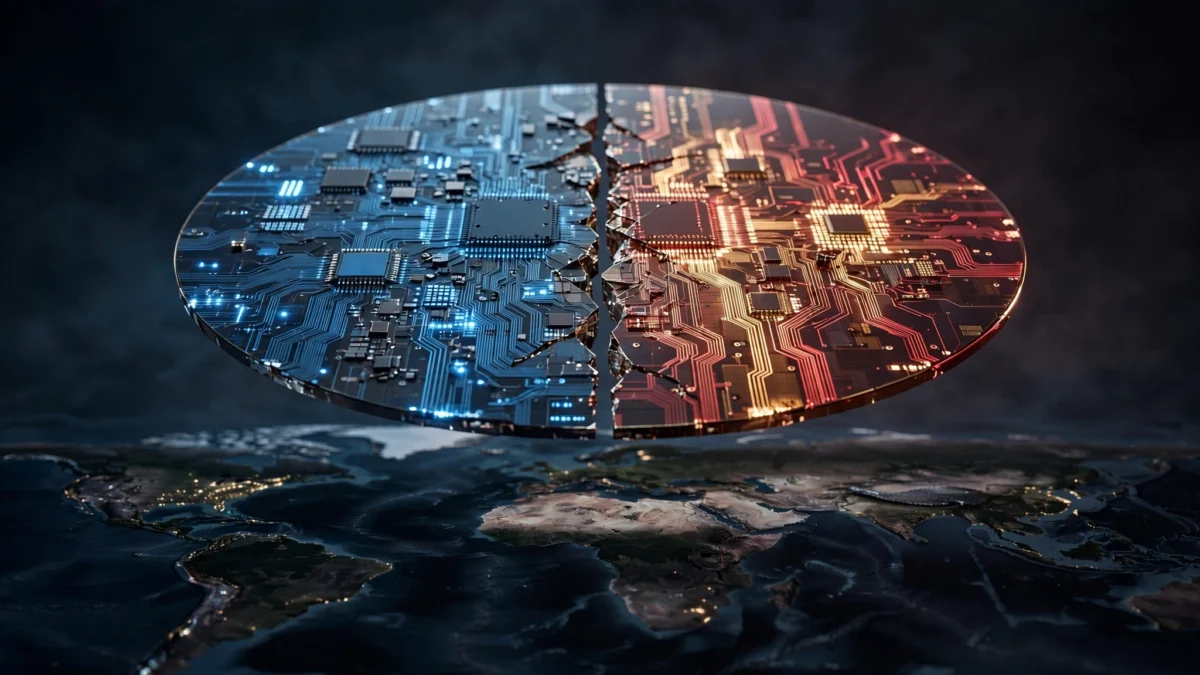
What if the wall you built to keep your rival out becomes the very school where he learns to outbuild you?
History has a cruel sense of humour. It never lets a siege end the way the besieger planned.
On 13 October 2026, Reuters published a set of numbers that deserve to be read twice — because the first reading tells you what happened, and the second tells you what it means. According to an IDC report seen by Reuters, Nvidia’s share of China’s data-centre AI chip market has fallen to just 34% in the first half of 2026. In the first six months of this year, Nvidia shipped 678,000 AI accelerators into China — down 44% from the same period a year earlier. And Huawei, the company Washington spent the better part of a decade trying to strangle, shipped 572,000 accelerators, up from just over 300,000 a year before, seizing 28% of the market. Behind them, Alibaba’s chip-design unit T-Head holds 7%, Cambricon 5%, Baidu’s Kunlunxin 4%, and Hygon 3%. Nine of the eleven Chinese chipmakers tracked by IDC increased their shipments year on year. Total AI-accelerator shipments in China reached 2.008 million units in the half — while shipments of graphics processing units, the chips most widely used to train AI models, fell 26% to 991,000, because the supply America would allow into mainland China kept shrinking.
Read that paragraph again, slowly. The sanctions did not shrink the market. They shrank the sanctioner’s share of it.
Jensen Huang, Nvidia’s chief executive, has been saying this out loud for years — that Washington’s export curbs are forcing an American company to surrender China’s $50 billion AI chip market to Huawei. Reuters carries his warning again today. And today, for the first time, the numbers agree with him completely.
The punishment that became an education
This is where the history lesson begins, because this story did not start in 2026. It started in May 2019, when Washington placed Huawei on its Entity List, cutting the company off from American chips, American software, and the global semiconductor supply chain it depended on. The intention was plain: bury the company. Starve it of silicon and watch it die.
What happened instead is now the stuff of business-school case studies. Huawei built its own operating system, HarmonyOS. It held its lead in 5G. It learned, painfully and then brilliantly, to design around the blockade. And now, seven years later, the blockade’s target stands as Nvidia’s nearest challenger in the largest AI hardware market on earth. In September, Huawei announced it will launch two new AI chips in 2027 — the Ascend 960DT in the first quarter and the 960PR in the third — with its UnifiedBus technology stitching vast numbers of chips into giant computing systems. It has already shipped more than a thousand such systems to over 370 customers. This is not a company that survived a siege. This is a company the siege trained.
So I ask you, reader: was the Entity List a punishment — or an education?
America has run this play before
Washington has staged this drama before, and it has never ended the way the script promised. In the 1980s, America decided that Japan’s semiconductor industry was the mortal threat. Tariffs, quotas, and the 1986 Semiconductor Agreement followed; Japan’s chipmakers were cut down to size and lectured on fair play. But the future of chips did not return to America. It migrated — to South Korea, to Taiwan, to the very neighbourhood the siege was meant to discipline. The blockade taught the whole region how to build. America won the agreement and lost the industry.
Or take the oil weapon of 1973. The embargo was supposed to bend the West to its knees. Instead it built the West’s fuel efficiency standards, its North Sea rigs, its strategic petroleum reserves, its entire doctrine of energy security. Every embargo in modern history has a second act, and the second act always belongs to the embargoed. The besieger writes the first chapter in anger; the besieged writes the second in patience.
China’s strategists have read those chapters. Beijing did not merely endure the chip controls — it converted them into a national mission. Domestic alternatives were promoted, state capital flowed, and Chinese firms were told, in effect, to stop asking for permission. Even the smuggling could not save the old order: IDC notes that Nvidia’s most advanced chips, the B200 and B300, are barred from export to China and have been smuggled into the country anyway — and still the share collapsed. When the black market cannot rescue you, the war is over.
You cannot embargo an idea
Now look closely at the mechanism, because this is the part that matters, and it is the part the strategists keep missing.
Export controls do not destroy demand. They only redirect it. China’s hunger for AI compute did not vanish when the shipments stopped — it became the most bankable business plan in Beijing. Capital flooded toward every domestic chipmaker with a credible roadmap. Engineers who might have spent their careers integrating American hardware were handed a harder and nobler assignment: build the hardware itself. That is why nine of eleven Chinese chipmakers grew. That is why Tencent is reported to be selling bonds expected to raise at least $4.5 billion to fund its AI ambitions. The siege did not starve the city. It taught the city to farm.
And here is the irony the planners never modelled: a market you are locked out of is a market where your rival trains without you watching. For six years, Huawei’s engineers solved problems in the dark — power efficiency, interconnects, software stacks — with no American competitor across the table to learn from or be measured against. They emerged with systems, with customers, with a roadmap to 2027 and beyond. Nvidia, the company that could have owned that classroom, was locked outside of it by its own government’s fear.
There is a phrase going around the industry now: silicon sovereignty. Every great power has decided that the chip is the new oil, the new steel, the new sea-lane — the foundation on which military power, economic power, and AI power all rest. Washington tried to guard the wells. Beijing decided to drill its own. And drilling, it turns out, teaches geology in a way that buying never does.
The verdict history always delivers
So here is my verdict, and I offer it the way history offers all its verdicts: quietly, and too late for the powerful to use.
Power that tries to freeze time always accelerates it. The wall meant to keep China in the technological past has become the pressure chamber forging China’s technological future. Nvidia did not lose China because its chips were inferior — its chips remain the finest on earth. It lost China because its own government’s fear proved stronger than its engineers’ ambition. And fear, unlike ambition, has never built anything.
The siege is over, reader. The numbers from IDC are not a forecast; they are an obituary for a strategy. The only question history still asks is the one it always asks when the walls come down: who learned more inside the siege — the ones who built the wall, or the ones who learned to climb it?
Sources & References
- Reuters — “Nvidia’s China AI-chip share falls as Huawei closes gap, report finds” (13 October 2026; IDC data)
- Reuters — “China’s Huawei to launch two new AI chips in 2027” (17 September 2026)
- Reuters Breakingviews — “Huawei shifts from survivor to Nvidia challenger” (24 September 2026)
- Tech Startups — “Top Tech News Today, October 8, 2026” (Tencent debt-raise context)
- PaisaKawach — “China’s AI Chip Push Reshapes Global Markets” (13 October 2026; Tencent bond-sale reporting)

About the Author — Abdul Mannan
Related Articles

James Webb Catches Water Clouds Thickening and Thinning on a Frigid World 7.5 Light-Years Away
Astronomers watching the coldest known brown dwarf with the James Webb Space Telescope recorded the first direct evidence…

NASA May Already Hold Proof of Life Beyond Earth — Sealed Inside a Tube on Mars Nobody Can Retrieve
A leopard-spotted rock drilled by NASA's Perseverance rover in 2024 is the strongest potential sign of ancient life…

New Injection Targets ‘Hidden’ Belly Fat by Triggering Fat-Cell Death, Early Trial Data Show
An experimental injection called CBL-514 that destroys fat cells instead of shrinking them cut "hidden" visceral fat by…