James Webb Catches Water Clouds Thickening and Thinning on a Frigid World 7.5 Light-Years Away

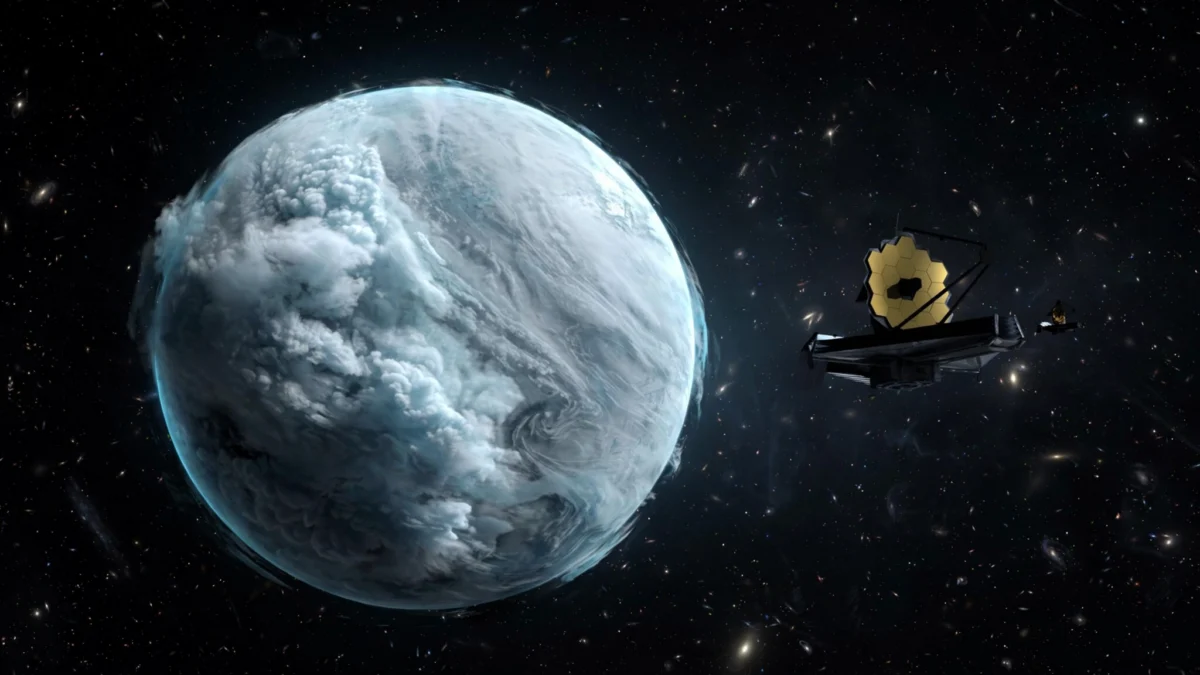
Astronomers have watched weather happen on another world — not in the solar system, but on a frigid, Jupiter-sized object floating alone through space just 7.5 light-years from Earth. Using the James Webb Space Telescope, a research team led by Brittany Miles, an assistant astronomer at the University of Arizona’s Steward Observatory, stared at the coldest known brown dwarf, WISE 0855, for 11 straight hours, recording a spectrum of its faint light every 15 minutes. The result, reported in a study accepted for publication in The Astrophysical Journal and posted on the arXiv preprint server, is the first direct confirmation that water clouds on a body beyond our solar system grow thicker and thinner over time — in other words, weather, much like the weather on Earth.
The achievement is also the most detailed time-series portrait ever taken of this frigid world, according to the research team. According to reporting by phys.org and Astrobiology, which covered the University of Arizona announcement, the observations reveal that the atmosphere of WISE 0855 is shaped by at least two distinct processes happening at the same time: water clouds at high altitudes that thicken and thin as the object rotates, and chemical gases being dredged upward from deep below by convection. Untangling those two overlapping signals — which older telescopes could not do — is the technical breakthrough that makes this discovery possible.
A Neighbour Colder Than Earth
WISE 0855 is an extraordinary object, even by the strange standards of brown dwarfs. Officially catalogued as WISE J085510.83−071442.5, it was discovered in 2014 by NASA’s Wide-field Infrared Survey Explorer, or WISE, mission. At just 7.5 light-years away, it belongs to the fourth-closest known stellar system to the Sun — a close neighbour in cosmic terms, though completely invisible to the naked eye because it emits almost no visible light.
Brown dwarfs occupy the murky middle ground between planets and stars. They begin their lives much like stars do, collapsing out of clouds of gas, but they never accumulate enough mass to fuse atoms steadily in their cores and ignite with starlight, according to descriptions of the object carried by the reporting outlets. Instead, they glow dimly with leftover heat from their formation. WISE 0855 sits at the very bottom of that category: roughly twice the mass of Jupiter but nearly the same size, and with a temperature of about 265 kelvins — colder than the average surface temperature of Earth. In many ways, astronomers say, it looks and behaves like a free-floating giant planet.
That planetary resemblance is precisely what makes it so valuable. For years, astronomers have suspected that water ice clouds form in its frigid upper atmosphere — water can condense into clouds at these temperatures in much the same way it does in the cold upper reaches of Earth’s atmosphere or in the deep atmospheres of Jupiter and Saturn. Earlier studies, including deep spectra taken by Webb itself, had found hints of water in the atmosphere. But hints are not weather. To call something weather, you must watch it change.
Eleven Hours, One Spectrum Every Fifteen Minutes
The new study turned WISE 0855 into a time machine of sorts. The observations were taken on December 2, 2023, using Webb’s NIRSpec near-infrared spectrograph, as part of a Webb observing programme proposed by a group led by Andrew Skemer of the University of California, Santa Cruz, according to additional reporting. Over eleven hours — a span that covers a good fraction of the object’s rotation — the telescope captured a fresh spectrum every fifteen minutes, producing a movie of the atmosphere rather than a single snapshot.
Each spectrum records how much light the object emits at thousands of individual wavelengths, and each molecule imprints its own fingerprint on that light. As the brown dwarf rotated, bringing different parts of its atmosphere into view, those fingerprints shifted. Webb’s medium-resolution spectrograph was sensitive enough to track variations in individual molecular features, letting the team separate the signal of shifting cloud cover from the signal of gases rising out of deeper atmospheric layers — something older observations could never do.
Before Webb, astronomers worked with photometry: measurements of total brightness over time. Brightness goes up and down, and brightness alone cannot say why. A dip in brightness could mean thicker clouds, a cooler region, or a different chemical mix — or all three at once. As Miles put it in the University of Arizona announcement: “Before JWST, we only had photometry, which mixed up the effects of clouds, chemistry and temperature all together. Now we can actually distinguish them.”
The separation matters because the two processes the team found are fundamentally different physical phenomena. The first is weather in the familiar sense: high-altitude water clouds forming, thickening, dispersing and thinning as the object spins — the same kind of cycle that drives cloud patterns on Earth, Jupiter and every other cloudy world we know. The second is atmospheric chemistry in motion: convection, the same process that makes hot air rise above a stove, pulling deep chemical gases upward into regions where they would not normally be found. Both leave marks on the light; Webb can read them separately.
Why This Was Hard
WISE 0855 is faint. It emits its feeble heat almost entirely in the infrared, at wavelengths invisible to human eyes and long blocked from detailed study by Earth’s own atmosphere. Before Webb, the workhorses were NASA’s Spitzer Space Telescope and the Hubble Space Telescope, along with large ground-based observatories such as the Keck telescopes in Hawaii. Those instruments had already shown that WISE 0855’s brightness varied as it rotated — a sign that something on its surface was changing — but they could not tell observers what that something was.
Webb changed the equation because it combines three things: a huge 6.5-metre mirror that collects faint infrared light, a position beyond the Moon where the sky is dark and cold in the wavelengths that matter, and spectrographs that split the light finely enough to isolate individual molecules. The result is not just a detection but a demonstration — a proof that time-resolved spectroscopy can do weather monitoring on the coldest, most planet-like objects beyond the solar system.
There is an elegant economy to the experiment as well. Eleven hours is a modest amount of Webb time by the standards of major programmes, and forty-four spectra — one every quarter of an hour — is enough to catch the rotation of a world that spins far faster than Earth. WISE 0855 is believed to rotate in roughly a few hours, meaning the observing window captured multiple passages of the same cloud features, letting the team check that the patterns repeated — the signature of real, rotating weather rather than random flicker.
Analysis: Why It Matters
The headline — weather on another world — is the least important part of this story. The important part is what it certifies: that astronomers now own a reliable method for dissecting the atmospheres of the coldest objects beyond the Sun, one molecule and one cloud deck at a time. That method is about to be pointed at much bigger questions.
First, brown dwarfs are the training ground for exoplanet science. The coldest brown dwarfs, the so-called Y dwarfs, have temperatures, sizes and atmospheric chemistry comparable to giant exoplanets — but they float freely in space, without a blinding host star beside them. A planet orbiting a star must be picked out from the glare of its sun, a million to a billion times brighter; a free-floating brown dwarf can be studied directly. Every technique proven on WISE 0855 — time-series spectroscopy, the separation of cloud signals from chemical signals, the reading of convection in molecular fingerprints — is a technique that can be applied to directly imaged exoplanets, where the same ambiguities currently limit what single-epoch spectra can say.
Second, the finding rewrites the error bars on a whole class of observations. Until now, a single spectrum of a cold brown dwarf or a young giant exoplanet was interpreted as a static portrait: this is what the atmosphere is. This work shows that atmospheres breathe. If clouds can thicken and thin over a few hours of rotation, then two spectra taken at different times may disagree for perfectly physical reasons — not because one of them is wrong. Future surveys will have to treat variability as the default assumption, not an afterthought. That is a small change in practice with large consequences for the precision of atmospheric models.
Third, there is the convection result, which is arguably as significant as the clouds. Deep chemical gases being dredged upward means the atmosphere is not in chemical equilibrium — the chemistry you see at the top is not the chemistry you would predict from the temperature alone. Disequilibrium chemistry is a known headache in exoplanet atmosphere modelling, and direct evidence of the conveyor belt driving it gives theorists something concrete to calibrate against. It also sharpens a cautionary note for the search for life elsewhere: if even a lifeless, frigid brown dwarf shows chemically surprising air, the bar for declaring a biosignature on an exoplanet — a gas mixture that seems to demand biology — must account for dynamic, churning atmospheres that can mimic the unexpected without any life at all.
Fourth, consider the neighbourhood. WISE 0855 was discovered only in 2014, and it is the fourth-closest system to the Sun. The solar neighbourhood is still hiding objects this interesting this close to home — worlds with weather, complex chemistry and planetary character that we only began to study properly in the last decade. It is worth remembering that our map of even the nearest space is still being drawn. NASA’s SPHEREx telescope, which launched in March 2025 and recently completed an infrared census of dozens of nearby brown dwarfs, is expected to sharpen that map further; a complementary study of 37 chemically rich brown dwarfs from SPHEREx data was announced just days ago.
Finally, there is a quiet milestone here for the James Webb Space Telescope itself. Webb was sold to the public on the promise of first light and distant galaxies, but some of its most durable contributions may turn out to be these patient, time-domain portraits of nearby oddities — movies instead of snapshots. The telescope’s lifetime is finite, and each programme competes fiercely for time. That the team could extract a first-of-its-kind weather record from a single 11-hour visit is a testament to how thoroughly the instrument has outstripped the expectations set for it before launch.
What to Watch Next
- The peer-reviewed paper. The study is currently a preprint accepted for publication in The Astrophysical Journal. The final published version will carry the full dataset, the statistical tests behind the cloud-versus-chemistry separation, and the precise numbers on cloud variability that the press announcements have only summarised.
- Longer baselines on WISE 0855. Miles and her team plan more hours of Webb observations to pin down the object’s rotation period precisely and to map how cloud patterns evolve across successive rotations — the difference between a weather snapshot and a weather forecast.
- The same test on other Y dwarfs. WISE 0855 is the coldest and nearest of its class, but it is not the only one. If variable water clouds turn out to be common among ultra-cold brown dwarfs, weather monitoring could become a routine part of substellar astronomy.
- Directly imaged exoplanets. The techniques validated here will be aimed at young, self-luminous giant planets orbiting distant stars, where time-series spectroscopy could reveal storms, cloud bands and chemical weather on genuine exoplanets for the first time.
- The SPHEREx synergy. With SPHEREx now surveying the sky in 102 infrared colours, astronomers have a wide-field census machine to find more cold targets — and Webb has shown it can turn the most promising of them into weather reports. Expect the two missions to work in tandem for years.
Sources
- phys.org — “Discovery marks the first detection of variable water clouds outside of the solar system” (University of Arizona announcement)
- Astrobiology — “First Detection Of Variable Water Clouds Outside Of Our Solar System”
- Interesting Engineering — “US study finds first water cloud changes outside solar system”
- Newsy Today — “First Variable Exoplanet Water Clouds Discovered” (Dec 2, 2023 NIRSpec observation date, Andrew Skemer programme details)

About the Author — Abdul Mannan
Related Articles

The Sanction That Built a Rival: How America’s Chip War Forged China’s Silicon Empire
On 13 October 2026, Reuters revealed IDC data showing Nvidia's share of China's AI-chip market has collapsed to…
NASA May Already Hold Proof of Life Beyond Earth — Sealed Inside a Tube on Mars Nobody Can Retrieve
A leopard-spotted rock drilled by NASA's Perseverance rover in 2024 is the strongest potential sign of ancient life…

New Injection Targets ‘Hidden’ Belly Fat by Triggering Fat-Cell Death, Early Trial Data Show
An experimental injection called CBL-514 that destroys fat cells instead of shrinking them cut "hidden" visceral fat by…