The Square That Survived Empires: Kraków, and the Enemy Who Came From Within

What does a city do when the enemy it has spent centuries learning to fear arrives — and turns out to be its own son? I ask you this question on the morning of 8 November 2026, and I ask it not as a man reporting a distant tragedy, but as a man who has been watching the same question travel from city to city, from country to country, knocking on every door we thought was locked. On Saturday afternoon, in Kraków — the old royal capital of Poland, the city of kings and poets, the city that survived the Mongols and the Nazis and the Soviets — a gunman drove his car onto the Main Market Square, the Rynek Główny, and opened fire on the people strolling there. Six people are dead. Four women and two men. Fifteen more are wounded, twelve of them seriously. And the man who did it was not an invader from across a border. He was not a stranger smuggled in under cover of darkness. He was a Polish citizen, twenty-five years old, a lathe operator from a small town, a man who — the interior minister tells us — held “very, very radical views” and was fascinated by far-right ideologies. The square survived empires. It could not survive one of its own.
Hold that sentence in your mind for a moment, because it is the whole story. Not the gun, though the gun matters. Not the square, though the square matters. The story is this: the danger came from inside the house. And every nation on earth that has built a wall against the stranger must now ask itself the question Kraków is asking today — what do you do when the wall holds, and the fire starts in your own kitchen?
Saturday, Three O’Clock, in the Heart of Europe
Let me tell you what happened, plainly, because the facts deserve to be told plainly before any of us reaches for meaning. At around three o’clock on Saturday afternoon, 7 November, a man drove a Subaru — a car with no licence plates — onto the Main Market Square from Sławkowska Street. The square was full, as it always is on a Saturday: tourists taking photographs of the Cloth Hall, families walking between the cafés, street sellers, children, old couples on benches. The man began firing from the car, at random, at whoever was nearest. The police later said he carried a military-style rifle — reports describe an AR-15-type weapon — and a large quantity of ammunition in the vehicle. He wore military-style clothing. Two police officers were among the wounded; one of them was shot three times and needed surgery. The gunman drove on, and officers confronted him near the junction of Stradomska and Dietla streets, about half a mile from the square. They shot him. He was taken to hospital in critical condition, where he underwent surgery — a second operation, the reports say — and remains there under guard.
The dead have not yet been named. We know only this: four women and two men, and among them a British citizen — a visitor, a tourist, someone who had come to one of Europe’s most beautiful cities for a weekend and will never go home. The Małopolska police confirmed the toll. The regional governor, Krzysztof Jan Klęczar, put it at six killed and fifteen wounded. The numbers shifted through the afternoon, as they always do in such hours — first two dead, then five, then six — and I tell you this not to confuse you but to remind you that behind every number that changes on a news ticker there is a family waiting by a telephone, learning, hour by hour, that the worst has happened.
Poland’s prime minister, Donald Tusk, travelled to Kraków on Saturday evening. He called it terrorism, and his words were blunt: “Until now, we have not had such drastic cases of terrorism in Poland.” The interior minister, Marcin Kierwiński, told a press conference that everything indicated the gunman had acted alone, and that he held radical, ultra-nationalist views. The defence minister, Władysław Kosiniak-Kamysz, called it an act of terror aimed at residents and tourists alike. Anti-terrorism units searched the suspect’s home. Prosecutors are expected to consider terrorism charges if the far-right link is confirmed. President Karol Nawrocki began the formal process for national mourning on 8 and 9 November. Kraków’s mayor, Łukasz Gibała, declared city mourning until 11 November, with public events cancelled. The flags are at half-mast. The square is cordoned off. And a city that has buried kings is preparing to bury six more of its dead.
The Square That Outlived Every Empire
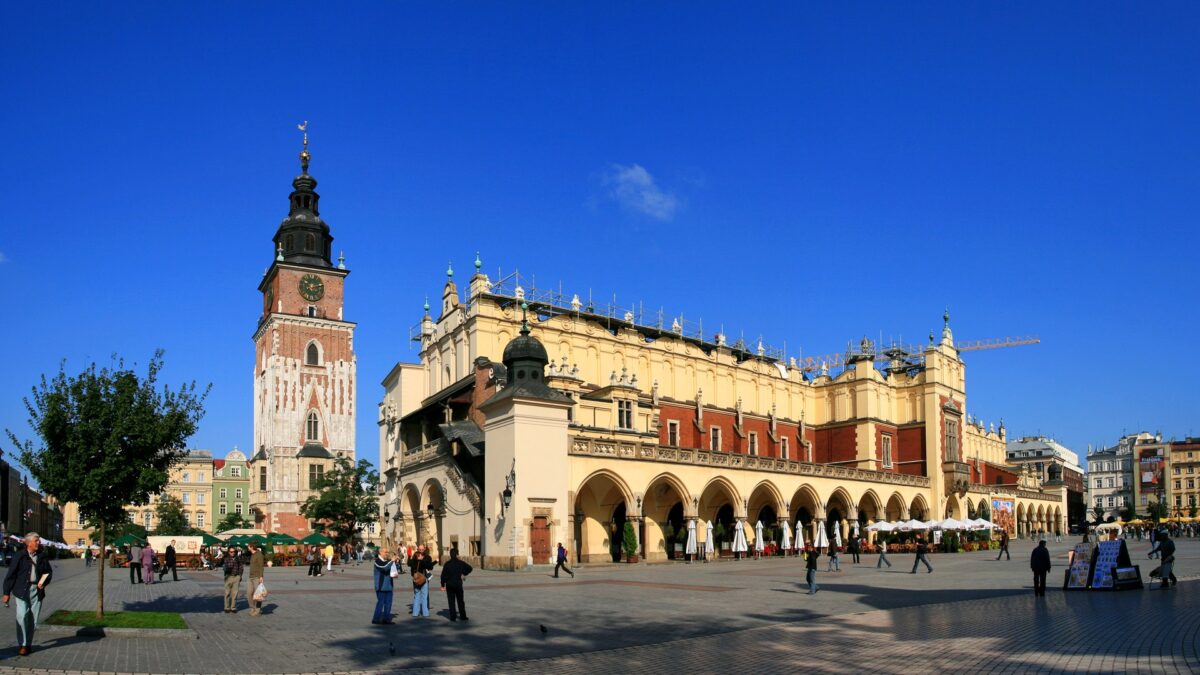
But to understand what was wounded on Saturday, you must understand the square itself — because the Rynek Główny is not merely a place. It is one of the great rooms of Europe. Laid out in 1257, after the Mongols had burned the old Kraków to the ground, it is one of the largest medieval market squares on the continent — two hundred metres on each side, a city within a city. The Cloth Hall, the Sukiennice, stands in its centre, where merchants have traded since the Middle Ages. St Mary’s Basilica rises at its corner, and every hour, on the hour, a trumpeter plays the Hejnał from its taller tower — a melody that stops suddenly, mid-note, in memory of the trumpeter who was shot through the throat by a Tartar arrow in 1241 while sounding the alarm. The children of Kraków grow up knowing that story. The tune breaks, and the silence that follows is the history of the city.
Think of what that square has seen. It saw the Mongols come and burn, and it was rebuilt. It saw the kings of Poland crowned and buried in the Wawel. It saw the partitions that erased Poland from the map for more than a century, and it saw Poland return. It saw the Nazis march in, in September 1939 — Hans Frank, the governor-general of occupied Poland, made Kraków his capital — and it saw the occupation end. It saw the Soviets, and the long grey decades of communism, and it saw the crowds of 1989. It saw Pope John Paul II, Kraków’s own Karol Wojtyła, return to his city and speak to a million people. And through all of it — through invasion, occupation, partition, and war — the square endured. In 1978, UNESCO placed Kraków’s Old Town on its very first World Heritage List, one of the first twelve sites in the world to receive that honour, because the world recognised what the people of Kraków had always known: this square is not Poland’s alone. It belongs to civilisation.
And here is the terrible irony that history, that stern teacher, forces upon us. Kraków was one of the very few great Polish cities that the Second World War did not destroy. Warsaw was razed to the ground, street by street, house by house — nine-tenths of it gone. Gdańsk was shattered. Wrocław was shattered. But Kraków survived, almost intact, because the Germans chose to keep it as their capital and the Soviets chose not to shell it. The city that the armies of the twentieth century spared is the city where, on a Saturday afternoon in November 2026, a single man with a rifle did what no army had done. History does not always repeat itself, my friends. Sometimes it inverts itself. The empires came with divisions and could not break the square. One man came with a car and a rifle, and broke it.
The First Lie Told After the Shots
And now I must tell you about the second crime of Saturday — a crime without a gun, committed in the minutes after the shooting, by thousands of people who were nowhere near Kraków. Before the police had confirmed anything, before a single name had been released, before the smoke had cleared from the square, the verdict was already being delivered on social media. The gunman, the commentators announced, must be a Muslim. He must be a Ukrainian. He must be an immigrant, a foreigner, an outsider — because that is the story the age wants to hear, the story that flatters our fears and confirms our prejudices. Within minutes, the comment sections were full of it: hateful remarks aimed at Muslims, at Pakistanis, at Ukrainians; conspiracy theories about false flags and staged attacks; men and women who had never set foot in Poland pronouncing, with total confidence, on who had done this and why.
And then the truth arrived, and it was the opposite of what they had said. The gunman was a Polish citizen. A young Polish man, from a Polish town, holding Polish far-right views — fascinated, the minister said, by the very ideologies that those same commentators celebrate. The stranger they blamed did not exist. The enemy they imagined was not the enemy that came. And I ask you — I ask you directly, reader, because this concerns you as much as it concerns Kraków — how many times must this happen before we learn? How many times must the crowd point its finger at the foreigner, only to discover that the finger should have been pointed at the mirror? The rush to blame is the oldest reflex in human history. When something terrible happens, the first instinct of the frightened mind is to find someone who is not us. It is easier to hate a stranger than to examine a neighbour. It is easier to build a wall than to look inside the house. The people of Kraków, to their credit, did not join in this. It was the distant commentators, the professional haters, the men who make their living from other people’s fear, who did the blaming. But the blaming happened, and it happened fast, and it tells us something essential about the age we live in: we have built machines that can spread a lie around the world in the time it takes a policeman to reach the scene of a crime, and we have not yet built the patience to wait for the truth.
The Gun in the Safest Country
There is another question Kraków forces upon us, and it is a question Europe has been avoiding for a long time. Poland is one of the least armed countries in Europe. I want you to hold that fact beside the facts of Saturday, because the two together form a riddle. Poland’s gun laws are strict. A civilian who wants a firearm must pass medical and psychological examinations, prove a significant reason — sport, hunting, collecting — and submit to storage rules and police checks. Ownership is a privilege granted by permit, not a right. There are roughly two and a half civilian firearms for every hundred people in Poland — among the lowest rates in Europe — and fewer than one in a hundred citizens holds a valid permit. Firearm homicides have fallen from 111 in 2002 to 21 in 2023. Mass shootings in Poland are almost non-existent; the history books can barely name one before this weekend. Poland was, by every measure, one of the safest countries in Europe. And yet, on Saturday, in the safest square of one of the safest cities of one of the safest countries, a man with a rifle killed six people.
What does that mean? It means, first, that no law is a wall against a determined man. The laws of Poland are good laws, and they have kept Poland safe, and they should not be abandoned because one man broke through them. But it also means something deeper, and more uncomfortable: that the danger of our age is not primarily a question of how many guns a country has, but of how many grievances it has, and how many young men are sitting alone in rooms, feeding their anger on the poison that flows through their screens. The gunman of Kraków did not need an arsenal. He needed a rifle, a car, and a head full of hate — and the hate, we are told, came from the far-right ideologies he followed online. The weapon was old. The radicalisation was new. And that is the riddle of our century: we have learned to control the weapons, but we have not learned to control the words that load them.
Consider, too, the timing. The shooting came weeks after a series of stabbings in Poland in October, which had already put the country on high alert. And in that nervousness, there is a lesson for every government that believes safety can be bought with steel and concrete. Poland has spent billions fortifying its eastern border — the fences, the soldiers, the drones — because the danger, we were told, would come from the east, from across the frontier. And the danger did come. It came from a small town in south-central Poland, from a lathe operator, from a young man who had never crossed a border in anger in his life. The border held. The threat was already inside. History has a bitter sense of humour: the fortress that is built against the foreigner is always, in the end, tested by the neighbour.
What Terrorism Means When It Wears Your Own Face
Prime Minister Tusk called it terrorism, and he was right to do so — but notice what that word now has to carry. For a generation, in the Western imagination, the word “terrorist” has come with a face already attached: foreign, bearded, alien, from somewhere else. The word was a wall between “us” and “them”. Kraków has broken that wall. Here is a terrorist who looks like the people he shot. He speaks their language. He was born in their country. He shares their passport, their history, their streets. And that is why this attack matters beyond Poland — because it forces the whole of Europe, and the whole of the West, to confront a truth it has been avoiding: the most dangerous radicalisation of our time is not happening in distant deserts. It is happening in bedrooms and basements, in ordinary towns, among ordinary young men, through screens that whisper, day after day, that the world has been stolen from them and that someone — the immigrant, the foreigner, the Jew, the Muslim, the liberal, the neighbour — must pay.
This is not a Polish problem. It is a European problem, and a global one. The same poison has produced the same harvest in Christchurch and in Buffalo, in Halle and in Hanau, in El Paso and in Oslo. Different countries, different flags, the same disease: a young man, alone with a screen, convinced by voices he has never met that his hatred is a kind of heroism. And the most terrible thing about it is how ordinary the process is. No secret training camp. No foreign handler. No grand conspiracy. Just a man, a screen, and a story that told him his emptiness had an author, and that the author was someone else.
And here, dear reader, is where the column must turn from the world to you — because the question Kraków asks is not only a question for prime ministers and police chiefs. It is a question for every one of us who lives in this age of screens. What do we do with the hate that is being manufactured in our midst, one lonely young man at a time? Do we pretend it is someone else’s problem? Do we wait for the next square, the next school, the next market, and then rush to blame the stranger again? Or do we finally admit that the front line of this war is not a border, but a bedroom — and that the work of stopping it begins not with a fence, but with a conversation, a community, a hand extended to a young man before he reaches for a gun?
The Trumpet That Stops Mid-Note
There is a melody in Kraków that stops in the middle. Every hour, the trumpeter of St Mary’s Basilica plays the Hejnał, and every hour, the tune breaks off — a reminder of the trumpeter who died sounding the alarm in 1241. The people of Kraków have listened to that broken melody for nearly eight centuries, and they have made it their own: a song that does not finish, because the warning is never finished. On Saturday, the warning sounded again, and this time it was not a Tartar arrow that cut it short. It was a rifle, in the hands of a man who had been taught to hate by the very age that claims to have outgrown hate.
I think of the six who died. I think of the British visitor who came to see a beautiful city and will never see his home again. I think of the four women and two men whose names we do not yet know, but whose families know them, and will carry them forever. I think of the police officer who was shot three times and fought on. I think of the paramedics who worked in the square, and the people who ran toward the wounded instead of away. And I think of the city itself — the square, the Cloth Hall, the cafés, the children — and I wonder what it will feel like, in the weeks to come, to walk across those cobbles again, and to remember that the most ordinary thing in the world, a Saturday afternoon, can be broken in a minute.
So let me end with the question I began with, because it is the only question that matters now. What does a city do when the enemy it has spent centuries learning to fear arrives — and turns out to be its own son? It does what Kraków has always done. It mourns. It buries its dead. It refuses the easy lie of blaming the stranger. It looks, honestly, at the poison in its own house — and it begins, slowly and painfully, to clean it. The square survived the empires because the people of Kraków never surrendered it. They will not surrender it now. But survival, this time, will demand something harder than endurance. It will demand honesty — the honesty to admit that the danger is not only at the border, but in the bedroom; not only in the foreigner’s hands, but in our own children’s screens; not only in the world out there, but in the words we allow to be spoken, and the hate we allow to grow, unchallenged, in our midst.
The trumpet stops mid-note. The silence that follows is ours to fill. Let us fill it with something better than blame.
Sources & References
- CNN — “Gunman who killed 6 in Kraków attack held far-right views, Polish minister says” (7 November 2026)
- Reuters — “Two killed, at least 10 injured in shooting in Polish city of Krakow” (7 November 2026; updated toll: six killed, 15 wounded)
- Energy Radio — “Krakow shooting: British citizen among 6 killed, Tusk says terrorism” (7 November 2026)
- Circuit Magazine — “Krakow Shooting: Five Killed in Main Market Square” (7 November 2026)
- Wikipedia — “Gun laws in Poland” (civilian firearm ownership, permit statistics, firearm homicide figures)
- Wikipedia — “Kraków Cloth Hall” (Main Market Square, UNESCO World Heritage Site since 1978)

About the Author — Abdul Mannan
Related Articles
When the City of Lights Could Not See the Sky: Delhi’s Smog and the Price of Our Own Fire
Tomorrow is Diwali, the festival of lights. Tonight, Delhi — a city a thousand years old — cannot…
The Jester, the Guru and the Verdict: What Russell Brand’s Conviction Really Means
A jury at Southwark Crown Court found Russell Brand guilty of rape and three sexual assaults. This is…
The Day the Number 7 Shirt Came Home: Cristiano Ronaldo, Portugal, and the End of Football’s Greatest Era
On 5 November 2026, Cristiano Ronaldo handed back Portugal's number 7 shirt after 23 years. This is not…