The Girls Who Lost First and Won the World: Nigeria’s Flamingos and the Night Africa Stood Tall

What do you do when the world has already written your ending?
That is the question I carried with me all through Saturday night, long after the final whistle had sounded in Rabat. Picture the scene, if you can. The Mohammed VI Football Complex, floodlights burning white against a Moroccan sky. A team of Nigerian girls, none of them older than seventeen, standing in the middle of the pitch with their arms around each other, weeping and laughing at the same time, while a golden trophy caught the light and threw it back at the cameras. Japan, the former champions, stood a few yards away in silence. And somewhere in the stands, a small pocket of Nigerian supporters sang a song that had begun, three weeks earlier, as a joke — because nobody, not even the most hopeful soul in Lagos, had dared to sing it then.
Nobody had dared, because this team had lost its first match.
Let me say that again, slowly, so that its weight settles on you. The Flamingos of Nigeria — the girls in green — lost their opening game of the FIFA U-17 Women’s World Cup, 2-1 to Poland. And then they won the World Cup. No team in the history of this tournament had ever done that: lost the first match and lifted the trophy. History, you see, does not always obey the script we write for it. Sometimes history tears the script up, and hands the pen to a sixteen-year-old girl from Nigeria.
I have spent my life reading history as a mirror, and I tell you plainly: what happened in Rabat on the night of 7 November 2026 is not only a football result. It is a parable. It is about a continent that has waited all its life to be told it belongs at the top table, and about a group of girls who refused to wait any longer.
The Night in Rabat
The final began the way finals often begin: with nerves. Japan, coached by Sadayoshi Shirai, are a side built on patience and precision. They had marched through their group without conceding a goal — five against Zambia, two against France, two against Venezuela — and they had beaten Kenya, then Ghana, and then, in the semi-final, the holders North Korea on penalties, after a stoppage-time own goal had dragged the match to a shootout. They were, by any honest measure, the favourites. They had won this tournament before, in 2014. They knew what the last night feels like.
Nigeria, by contrast, attacked from the first whistle as though the match owed them something. FIFA’s own report tells the story with the economy of a man who saw it with his own eyes: efforts from Awawu Bashiru and Oluebube Umejiaku flew just past the post; a wide free-kick caused chaos in the Japanese box, and goalkeeper Kou Kadowaki dropped the set-piece to Umejiaku, who headed against the bar. The warning was written on the crossbar. Japan did not read it.
In the 39th minute, Bashiru sent a dropping ball looping towards the Japanese goal. Kadowaki looked certain to catch it. The ball squirmed between her gloves and dropped into the net. One-nil. And two minutes into the second half, the moment that will be replayed in Nigerian homes for a generation: Esther Stephen hit a long, raking pass upfield, and Umejiaku — sixteen years old, all speed and nerve — raced on to it, controlled it with her left foot, and lifted the most delicate of chips over the onrushing goalkeeper. Two-nil. The goal was impudence itself, the kind of goal that only the young can score, because only the young have not yet learned to be afraid of trying it.
Japan, to their eternal credit, refused to die quietly. Their goalkeeper, Jane Ijirigho of Nigeria, miscued a punch; Wara Shimizu’s snapshot cleared the bar. Then, with ten minutes left, the substitute Anri Ito bravely headed a corner back across goal for her namesake Fuki to volley in. Two-one. The last ten minutes were the longest ten minutes in the lives of eleven Nigerian girls, and every Nigerian watching — in Lagos, in Abuja, in London, in Atlanta, in Rabat itself — held their breath with them.
And then the whistle. And then the noise. And then the tears.
Nigeria 2, Japan 1. Nigeria, champions of the world. The first African nation ever to win the FIFA U-17 Women’s World Cup. The first African women’s team, at any age level, ever to win a FIFA World Cup. Read that sentence again, and let it sit beside everything you thought you knew about who wins world titles and who merely watches others win them.
The Road Nobody Would Have Chosen
But the final was only the last chapter. The story that makes this triumph immortal is the road that led to it — a road that began in defeat.
On the opening day, Poland beat them 2-1. I want you to imagine that dressing room. Seventeen-year-old girls, thousands of miles from home, at their first World Cup, and the tournament has begun by telling them they are not good enough. Most teams, at that moment, begin to negotiate with failure. They start calculating goal differences. They start hoping for favours from other results. They start, quietly, to prepare their excuses.
The Flamingos did none of that. What they did instead is the reason I am writing this column and not another one. They won their next six matches, one after another, each harder than the last, and they scored thirteen goals and conceded four across that run.
First, Puerto Rico, beaten 2-0, with goals from Oluwakemi Adegbuyi and Precious Oscar. Then the true test of character: North Korea, the holders, four-time champions of this tournament, beaten 3-1, with Adegbuyi, Umejiaku and Kanyinsola Yusuf all on the scoresheet. Think about that for a moment. The defending champions, the most feared youth team in women’s football, beaten by a side that had lost its opening game.
Then Mexico in the round of sixteen, beaten 2-1, with Umejiaku and Mary Dunstan scoring. Then Venezuela in the quarter-final, a match that refused to yield until the 89th minute, when Umejiaku was fouled in the penalty area and the captain, Azeezat Oduntan, stepped up and converted the penalty with the calm of a woman twice her age. One-nil. A single kick, in the eighty-ninth minute, between history and heartbreak.
And then Brazil, in the semi-final, in what was arguably the finest performance by any African team at any World Cup in living memory. Queen Joseph opened the scoring in the 56th minute. Bashiru struck twice, in the 71st and the 80th. FIFA’s own numbers tell you how one-sided it was: Nigeria had thirty-five shots to Brazil’s seven, and Brazil managed only a single effort on target all night. Greise Kelly scored a late consolation for Brazil, but the match was already gone, and with it went the last excuse anyone could offer for not taking these girls seriously.
Six wins. Six. After a defeat that should have ended them. Do you see the shape of this story now? It is not the story of a favourite fulfilling its destiny. It is the story of a team that was written off on day one and answered, match by match, until there was nobody left to beat.
Forty-One Years in the Making
And yet — and here is where history holds up its mirror — this was not the beginning of the story. It was the end of one that began forty-one years ago, in a stadium in Beijing, in the summer of 1985.
That year, Nigeria’s boys, the Golden Eaglets, won the very first FIFA U-16 World Championship, beating West Germany 2-0 in the final. It was the first time an African team had won a FIFA world title, and it announced to the planet that Nigerian football had arrived. The boys went on to become the most successful nation in the history of that tournament, winning it five times. But the girls — the girls waited. They waited through decades in which the world told them, in a hundred polite ways, that the women’s game was a sideshow, an afterthought, a courtesy.
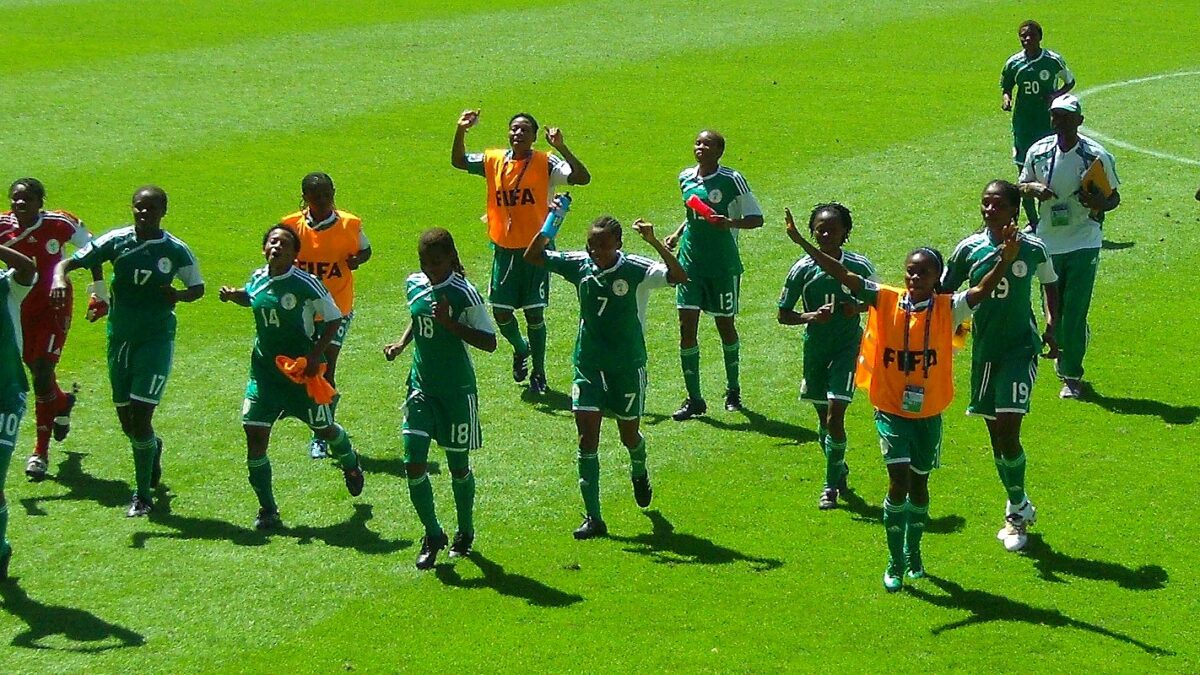
The wait was not empty. The Super Falcons, Nigeria’s senior women, became the most decorated team Africa has ever produced, carrying the continent’s flag to every World Cup. And the girls kept coming closer. In 2010, in Germany, Nigeria’s under-20 women reached the World Cup final — and fell at the last step, beaten by the hosts. I keep a photograph from that campaign on my desk as I write: young Nigerian players in green, arms in the air, celebrating a victory over the United States, joy written across every face. They believed then, as these girls believe now. In 2022, in India, the Flamingos reached the semi-final of this very tournament, lost to Colombia, and then beat Germany to finish third. Third. So close that they could smell the trophy, and still a lifetime away from touching it.
That is the weight these sixteen-year-olds carried into Rabat on Saturday night. Not only their own hopes. Forty-one years of waiting. A final lost in Germany. A third place in India. The long, patient, stubborn history of Nigerian girls who were told the world was not theirs, and who kept showing up anyway.
History, my friends, does not reward the patient with interest. It rewards them with everything, all at once, on a night nobody predicted.
The Girl With the Golden Ball
Every great story needs a face, and this one has a face that the world will not forget: Oluebube Umejiaku, sixteen years old, scorer of the goal that won the final, Player of the Match in the final, and winner of the Golden Ball as the outstanding player of the entire tournament.
I have watched many footballers in my life, and I have learned to distrust easy superlatives. But listen to what the girl herself said after the match, because her words tell you more about this team than any statistic could. “I feel good, I feel very happy. I thank God for everything,” she said. “It was very difficult for us but the instructions of the coaches made us put our heads up and just take everything as it comes. We didn’t have to push for the goals, just to keep ourselves up and we needed to encourage ourselves on the field of play.”
Read that again. “We needed to encourage ourselves on the field of play.” Not the crowd. Not the cameras. Not the promises of reward back home. Themselves. That is the whole secret of this team, contained in one sentence from a sixteen-year-old. They encouraged each other. When the opening match was lost, they encouraged each other. When the quarter-final stood at nil-nil in the eighty-ninth minute, they encouraged each other. When Japan pulled a goal back with ten minutes left in a World Cup final, they encouraged each other. And so they won.
Beside her stood Bashiru, scorer in the semi-final and the final, the girl whose looping shot in the 39th minute broke the deadlock. Beside her stood the captain, Oduntan, whose penalty against Venezuela was an act of pure nerve. Beside her stood Queen Joseph, and Esther Stephen, whose pass made the second goal, and the goalkeeper Jane Ijirigho, and every girl who wore the green shirt in Morocco. I name them because history has a habit of remembering only the goalscorers, and this trophy belongs to all of them. A trophy is never won by eleven players. It is won by a squad, by a bench, by a coaching staff, and by every girl who trained in the heat of Abuja believing a day like this might come.
And it came.
What Japan Taught Them
But I would be doing this story an injustice if I told it only as a Nigerian triumph. For a victory is only as great as the opponent it overcomes, and Japan were magnificent — not only in how they played, but in how they lost.
Their coach, Sadayoshi Shirai, spoke after the match with a grace that deserves to be quoted in full. “First of all, I have to say that Nigeria were a very strong team,” he said. “We understood their strengths, but there were moments when they managed to get in behind our defence. Even so, I think our players fought incredibly hard until the very end, doing everything they could to cope with Nigeria’s speed and physical power. I also believe that if we had managed to score earlier, we might have had a better chance of winning the match. I want them [Japan’s players] to be proud of themselves. The way they fought until the very end of this World Cup will have inspired many people, and I hope they can take confidence from that.”
There is a lesson in those words for all of us, far beyond football. Defeat, handled with dignity, is not disgrace. Japan lost a World Cup final, and their coach’s first instinct was to praise the winners and to tell his own players to hold their heads high. In a world where grown men in suits blame referees, conspiracies and the weather for every failure, a football coach and a team of teenage girls showed us how losing is done. Nigeria won the trophy. Japan won something else — the respect of everyone who watched. And that, too, is a kind of victory.
Why This Trophy Weighs More Than Gold
Now I come to the question that matters most, the question I ask you directly, reader: why should this trophy matter to anyone who does not care about football?
It matters because of who won it, and where, and how.
It matters because no African women’s team had ever won a FIFA World Cup before — not the seniors, not the under-20s, not the under-17s. The men’s game has had its glorious near-misses: Cameroon in 1990, Senegal in 2002, Morocco’s run to the semi-finals in 2022. Great nights, all of them. But the trophy itself, the thing you lift above your head while the confetti falls, had never come home to Africa in the women’s game. Until Saturday. Until a group of girls who were not supposed to win it went and won it on African soil, in Rabat, in Morocco, under African skies.
It matters because of what it says to every girl in Lagos and Kano and Enugu and Accra and Nairobi and Dakar who has been told, in so many words, that football is not for her. The world has spent a century telling girls that their place is in the stands, applauding the boys. On Saturday night, the girls were not in the stands. They were on the pitch, and the whole world was applauding them. President Bola Tinubu congratulated them the moment he returned from campaign engagements. FIFA’s own president, Gianni Infantino, stood and applauded them. That applause is not decoration. It is the sound of a door opening.
And it matters because of the bird they are named for. The flamingo. A strange, beautiful creature that stands on one leg in shallow water where other birds would sink, and takes its colour from what it feeds on — it becomes, quite literally, what it consumes. There is a sermon in that name, if you care to hear it. These girls fed on belief when the world fed them doubt. They stood on one leg, balanced, patient, unmoved by the storm around them, while others sank. And when the moment came, they were the most vivid colour on the pitch.
That is what this trophy means. Not a medal. Not a headline. A proof. A proof that investment in girls is not charity, it is strategy. A proof that the first defeat is not the last word. A proof that Africa does not need to ask for a place at the table — it can win the whole tournament and take the table home with it.
The Verdict
So let me leave you with this, and I ask you to carry it beyond football, into whatever struggle is yours.
The Flamingos lost their first match. Let that fact do its work on you. They did not lose the tournament. They lost a match, in the group stage, and the world wrote them off before the ink was dry. And then they won six matches in a row — against the holders, against Brazil, against Japan — and they are champions of the world today.
How many of us have lost a first match? How many of us have been told, by a result or a rejection or a closed door, that the story is over? How many of us have believed it?
These girls did not believe it. They believed in each other, they believed in the work, and they believed that the ending is not written until the last whistle blows. That is not football. That is a philosophy of life, delivered by sixteen-year-olds who have understood something that many of us, at twice or three times their age, have not yet learned: that defeat is an event, not an identity. You are not your worst day. You are what you do the morning after it.
Nigeria’s Flamingos have given Africa a trophy. But they have given the rest of us something larger. They have given us a new answer to the oldest question in the world: what do you do when the world has already written your ending?
You pick up the pen, you write a better one — and you win.
Sources & References
- FIFA — “Japan 1-2 Nigeria | Report and highlights | FIFA U-17 Women’s World Cup 2026 final” (7 November 2026)
- Okay News — “Nigeria Win First U-17 Women’s World Cup With Victory Over Japan” (7 November 2026)
- The Trent — “Nigeria Flamingos Win U-17 Women’s World Cup, Make History” (8 November 2026)
- Ademola Sports — “Japan vs Nigeria: Flamingos chase history as Africa’s first U-17 Women’s World Cup title beckons” (preview and campaign record)
- Sports Village Square — “Flamingos stun Brazil to reach first-ever FIFA U-17 Women’s World Cup final” (4 November 2026)
- Linda Ikeji’s Blog — “Nigeria’s Flamingoes win U-17 Women’s World Cup, beating Japan 2-1” (8 November 2026)
- The Moment — “Tinubu celebrates Flamingos on historic U-17 Women’s World Cup victory” (8 November 2026)

About the Author — Abdul Mannan
Related Articles

The Square That Survived Empires: Kraków, and the Enemy Who Came From Within
On a Saturday afternoon, a gunman drove into Kraków's Main Market Square and opened fire. Six people died.…

When the City of Lights Could Not See the Sky: Delhi’s Smog and the Price of Our Own Fire
Tomorrow is Diwali, the festival of lights. Tonight, Delhi — a city a thousand years old — cannot…

The Jester, the Guru and the Verdict: What Russell Brand’s Conviction Really Means
A jury at Southwark Crown Court found Russell Brand guilty of rape and three sexual assaults. This is…