Three Men, Twelve Thousand Bombs: The Shenzhen Summit and the Fate of the World

What if I told you that three men will sit in one room next Thursday, and that between them they hold the power to end human civilisation before lunch?
That is not a line from a novel. That is the news. On Thursday, 19 November 2026, in Shenzhen, the gleaming tech capital of southern China, President Donald Trump of the United States, President Xi Jinping of China and President Vladimir Putin of Russia will sit down together for the first trilateral meeting of the leaders of the world’s three greatest nuclear powers. It has never happened before. Not once, in the eighty-one years since the first atomic bomb fell on Hiroshima, have the three men who command the largest nuclear arsenals on Earth met in the same room at the same time.
Stop for a moment and let that fact settle. Eighty-one years of summits, of handshakes in palaces and shouting matches at the United Nations, of hotlines and treaties and crises that brought the world to the edge of the abyss — and never once have the three of them sat together. Now they will. And the question that should haunt every reader of this column is a simple one: are they meeting to pull the world back from the edge, or merely to admire the view from it?
What We Know — and What We Do Not
The facts, as confirmed by the White House on Friday, 13 November, are these. The meeting will take place on the sidelines of the Asia-Pacific Economic Cooperation summit, the APEC Economic Leaders’ Meeting, which China’s Foreign Ministry has announced will be held in Shenzhen from 18 to 19 November, chaired by President Xi, with twenty-one member economies in attendance. President Trump is due to arrive late on Wednesday, 18 November, after engagements in the Philippines. White House spokeswoman Olivia Wales confirmed the plan, saying that Mr Trump “will discuss the reduction of nuclear weapons in the world, whose proliferation President Trump believes is very dangerous.”
A senior American official, briefing reporters on condition of anonymity, added three details that matter enormously. First, the main topic will be nuclear non-proliferation and the reduction of arsenals. Second, the war with Iran may also be discussed. Third — and this is the detail that will echo loudest in Kyiv — Russia’s war in Ukraine will not be on the agenda. The same official was candid about expectations: the meeting is intended as the “beginning of hopefully a conversation” on nuclear disarmament, and no agreements are expected to be announced.
Let me be plain with you, my reader: when a government tells you in advance that no agreement is expected, it is telling you two things at once. It is managing your expectations, yes. But it is also confessing something. It is confessing that the three most powerful men on Earth are meeting about the most dangerous weapons ever built, and they do not yet know how to begin talking about them. That confession should frighten us more than any threat.
There is another fact we must not glide past. As of Friday, neither Moscow nor Beijing had publicly confirmed the meeting. The White House announced it; the Kremlin and Zhongnanhai stayed silent. Perhaps they will confirm it in the days ahead. Perhaps the silence is mere protocol. But silence, in diplomacy, is itself a language, and I have learned over the years to listen to it. A summit announced by one side only is a summit that can still be cancelled by the other two. The world should hold its breath, but it should not yet exhale.
The World They Are Meeting In
To understand why this meeting matters, you must understand the world in which it takes place — because these three men are not meeting in the world of 1986, or 1972, or even 2016. They are meeting in a world that has quietly, almost without noticing, removed every lock from the nuclear door.
On 5 February 2026, the New START treaty expired. Signed in 2010 by President Barack Obama and President Dmitry Medvedev, in force from 2011, extended once in 2021 by President Joe Biden and President Putin, it was the last remaining treaty limiting the nuclear weapons of the United States and Russia. It capped each side at 1,550 deployed strategic warheads, 700 deployed delivery vehicles — the missiles, submarines and bombers that carry them — and 800 launchers in total. It gave inspectors the right to walk into each other’s missile fields and count. And then, on a cold February day this year, it simply ended. Its own terms allowed no further extension. Russia had suspended its participation in 2023, though it said it would keep observing the numerical limits. In September 2025, the Kremlin said it was prepared to keep observing the treaty’s central limits for one year after expiry, without verification. A promise, not a treaty. A handshake, not a lock.
The Federation of American Scientists put it with a bluntness that should be carved into every history book: for the first time since 1972, there is no treaty-bound cap on strategic nuclear weapons. Fifty-four years of limits — gone. The only legally binding restraint left on nuclear weapons anywhere on Earth is the Nuclear Non-Proliferation Treaty, which was never designed to cap the arsenals of the great powers. It was designed to stop the spread. The spread it could not stop, and the arsenals it was never meant to touch, are now both beyond its reach.
And what arsenals they are. The Stockholm International Peace Research Institute, in its Yearbook published in June 2026, counted the world’s nuclear inventory at an estimated 12,187 warheads as of January 2026. Nine countries hold them. About 9,745 sit in military stockpiles, ready for potential use. About 4,012 are deployed — fitted to missiles or loaded onto bombers, ready to fly. Russia holds the largest share, an estimated 5,420 warheads in total, with 1,796 deployed. The United States holds an estimated 5,042, with 1,770 deployed. China, the fastest-growing arsenal on Earth, holds an estimated 620, up from 600 a year earlier, with 34 now deployed where a year ago there were 24. Between them, the United States and Russia hold nearly 86 per cent of all the nuclear weapons in the world. And somewhere between 2,100 and 2,200 warheads, almost all of them American and Russian, sit on high operational alert — on missiles that can be launched within minutes.
Read those numbers again, slowly. Twelve thousand one hundred and eighty-seven. Four thousand and twelve deployed. Two thousand on hair-trigger alert. These are not museum pieces. These are not the dusty relics of a Cold War that ended. These are living weapons, maintained, modernised, and — this is the part the world prefers not to think about — growing. SIPRI’s researchers noted that while the total inventory fell slightly from the year before, the number of warheads actively available for military use rose. The arsenals are not shrinking. They are sharpening.
History Is Watching This Room
I have always believed that history does not repeat itself, but that it stands in the doorway of the present, watching, waiting to see whether we have learned anything at all. And if history is standing in the doorway of that room in Shenzhen, it will recognise the scene. It has seen three men in a room before.
It saw them at Yalta, in February 1945, when Roosevelt, Churchill and Stalin carved up the post-war world over eight days in a Crimean palace while the war was still burning. The men in that room redrew the map of Europe with a pencil, and the lines they drew became the Iron Curtain, the Cold War, the division of Germany, the partition of Korea. Three men, one room, and the fate of half the world decided over dinner. Yalta taught us the first lesson of the three-man summit: when the great powers meet alone, the rest of the world becomes a footnote.
It saw them at Reykjavik, in October 1986, when Ronald Reagan and Mikhail Gorbachev — only two men that time, but the lesson is the same — came within a hair’s breadth of abolishing nuclear weapons altogether. They sat in a small white house in Iceland and talked, leader to leader, without their advisers, without their briefing books, and for one dizzying afternoon the abolition of the bomb seemed possible. Then it slipped away, over a disagreement about missile defence, and the world went back to counting warheads. Reykjavik taught us the second lesson: the greatest breakthroughs in history have come not from prepared agendas but from unscripted human conversation — and the greatest tragedies from the moments when that conversation stops one sentence too soon.
And it saw the world at the edge of the abyss in October 1962, when the Cuban Missile Crisis brought the United States and the Soviet Union to thirteen days of terror. It saw a young President Kennedy and a wily Nikita Khrushchev exchanging letters that grew more desperate by the hour, while submarines stalked each other in the Atlantic and the world held its breath. It saw, too, the secret that saved us: that behind the public threats, there was a private channel, a back door, a human being on each side willing to find a way out. The crisis taught us the third lesson, the one we have forgotten most dangerously: that in the nuclear age, communication is not a courtesy. It is a survival mechanism.
Now consider what has changed. In 1962, there were two nuclear superpowers and a hotline between them. In 1972, Richard Nixon and Leonid Brezhnev signed SALT I, the first treaty to cap arsenals, and the world began the long climb down from a Cold War peak of roughly 70,000 warheads. In 1986, two men nearly abolished the bomb. In 2026, there are three nuclear giants, no treaty between any two of them, no inspections, no verification, and a Chinese arsenal that has never been part of any arms-control agreement at all. China has always refused to join the bilateral arithmetic of Washington and Moscow, arguing — not without reason — that its arsenal is a fraction of theirs. But a fraction that grows by twenty warheads a year, and by silos in the desert counted in the hundreds, is a fraction that will not stay a fraction for long. Mr Trump’s demand is that any new deal must include China. Beijing’s answer, so far, has been silence.
So when these three men sit down in Shenzhen, they are not merely continuing a conversation. They are attempting to begin one that has never existed: a three-way conversation about weapons that two of them built in the tens of thousands and the third is building now, in a world where the old rules have expired and no new rules have been written. That is why the White House’s phrase — “the beginning of hopefully a conversation” — is both the most honest and the most terrifying sentence in the whole announcement. It is honest because it admits how far we have fallen. It is terrifying because it admits that the conversation has not yet begun.
The City That Chose Itself
There is a poetry to the choice of Shenzhen that I cannot ignore, and you should not either. Forty-six years ago, Shenzhen was a fishing village of thirty thousand souls. Then, in 1980, Deng Xiaoping declared it China’s first Special Economic Zone, and it became the furnace of the Chinese miracle — a city of seventeen million people, of towers that scrape the sky, of factories that make the world’s telephones and the world’s future. It is the city where China proved that it could out-build, out-make and out-think the rest of the planet.
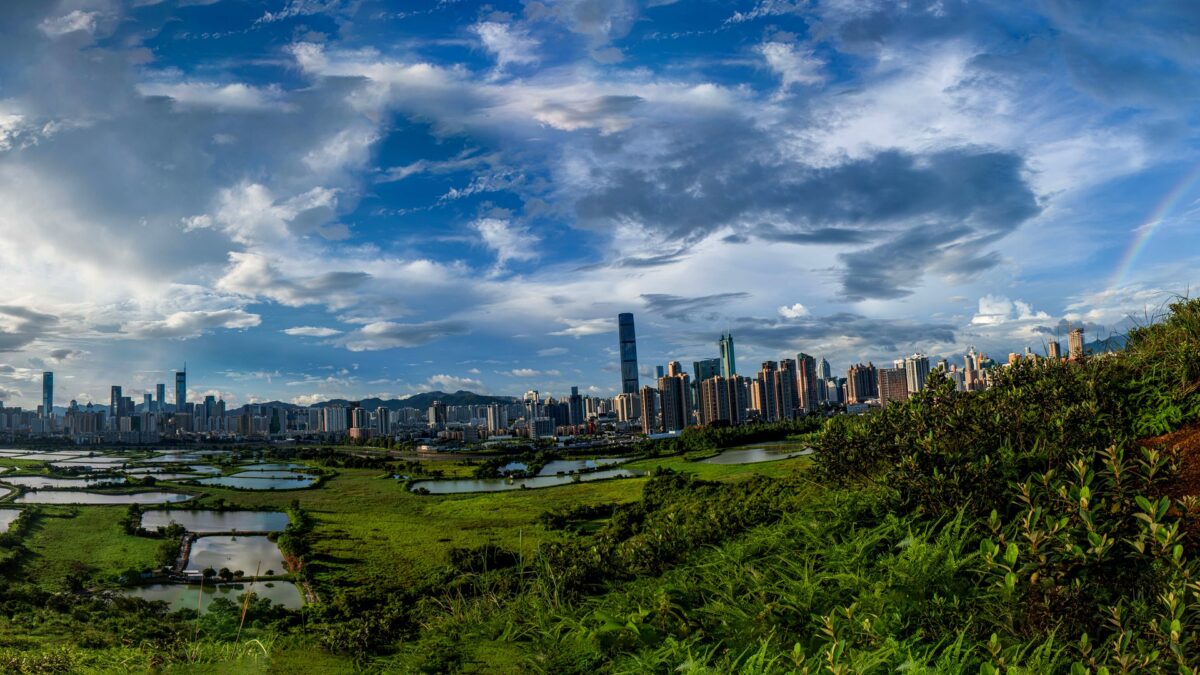
And now it is the city where the three leaders of the nuclear age will meet. Is that a coincidence? I do not think so. Summits are staged, and every staging is a message. Beijing chose Shenzhen to say: this is the future, and the future is ours. Washington accepted Shenzhen to say: we are not afraid to meet you on your ground. And Moscow — Moscow, which has not yet confirmed it is coming at all — may be saying something else entirely by its silence. The city itself is the argument. The skyline in the photograph above this column is not a backdrop. It is a statement. The question is whether the three men in the room will hear it.
There is another message in the staging, and it is written in the omissions. Ukraine is not on the agenda. Let me say that again, because it deserves to be felt, not merely read: the largest land war in Europe since 1945, a war that has killed hundreds of thousands of people, displaced millions, and brought Russian and Western forces into the most dangerous confrontation since the Cuban Missile Crisis — that war will not be discussed in the room where the three men who could end it, or widen it, are sitting together. The senior American official was explicit. The war with Iran may be discussed. Ukraine will not be.
Ask yourself what that means. It means that the meeting has been designed to succeed at the narrow thing — a conversation about nuclear weapons — by excluding the very war that makes the nuclear question urgent. It means that the men in the room have agreed, before they sit down, to look away from the fire in order to discuss the fire extinguisher. Perhaps that is wisdom. A summit that tries to solve everything solves nothing, and the diplomats who designed this meeting know their history: the summits that failed were the ones that carried too much weight. But it also means something darker. It means that Ukraine has been declared, for the purposes of this room, a separate problem — a problem for another day, another table, another set of men. And the people of Ukraine, who did not choose to be a separate problem, will be watching the photographs from Shenzhen and asking a question that no one in that room will answer: if the three most powerful men on Earth can meet to discuss the weapons, why can they not meet to discuss the war?
The Silence of the Two
I return, as I must, to the silence of Moscow and Beijing. As of Friday, the meeting had been announced by Washington alone. That is not a small thing. In the choreography of great-power diplomacy, a joint announcement is itself a signal of agreement; a unilateral announcement is a gamble. It is possible — likely, even — that the confirmations will follow, and that the three leaders will indeed sit down on Thursday. But the silence tells us something about the state of the triangle.
Consider the triangle itself. The United States and China are locked in the defining rivalry of the century — over technology, over trade, over Taiwan, over the South China Sea, over the very shape of the world order. The United States and Russia are locked in a confrontation over Ukraine that has severed nearly every channel of communication built since the Cold War. And China and Russia, who call each other partners without limits, are partners whose interests diverge sharply the moment you look closely — in Central Asia, in the Arctic, in the price of oil, in the balance of a relationship in which one side is increasingly the senior partner and the other increasingly the junior.
A triangle has three sides, and every side of this one is under strain. That is precisely why the meeting matters — and precisely why it may fail. A trilateral summit is not three bilateral meetings held at once. It is a different animal. In a bilateral meeting, two men can trade concessions. In a trilateral meeting, every concession to one is a signal to the other. Every word is heard twice. Every silence is interpreted three ways. The geometry is unforgiving. And the men who will attempt it are three of the most strong-willed, most domestically embattled, most convinced of their own historical destiny that the world has seen in a generation.
And yet — and yet — I find myself unwilling to dismiss this meeting as mere theatre. For one reason, and it is a reason the cynics forget: theatre matters. The photograph of three leaders sitting together is itself a fact in the world. It tells every general, every diplomat, every frightened citizen in every capital that the men who hold the weapons are at least willing to be in the same room. In the nuclear age, that willingness is not nothing. It is, in fact, almost everything. The thirteen days of October 1962 were survived because two men were willing to talk. The Reykjavik miracle nearly happened because two men were willing to sit alone in a room. The absence of talk is what kills. The presence of talk is what saves. If Shenzhen gives the world nothing more than a photograph of three men talking, it will have given the world something real.
What Is Actually at Stake
Let me now speak plainly about what is at stake, because the language of diplomacy has a way of anaesthetising the truth. What is at stake is not a treaty. Treaties are paper. What is at stake is whether the human race will continue to live under a system in which three men can, by error or by anger or by miscalculation, end civilisation — and whether those three men are willing to build a system in which they cannot.
The numbers I gave you earlier are not abstractions. Two thousand one hundred warheads on high alert means two thousand one hundred weapons that can be launched in minutes, on warning systems that have cried wolf before. History records the false alarms: the training tape mistaken for a real attack in 1979; the computer chip that failed in 1980 and showed two hundred incoming missiles that did not exist; the Soviet officer, Stanislav Petrov, who in 1983 looked at his screen, saw five American missiles incoming, and decided — on instinct, against every protocol, against every order — that it must be a false alarm. He was right. Had he been wrong, or had he been obedient, you would not be reading this column, because there would be no one left to write it and no one left to read it. The world survived 1983 not because its systems worked, but because one man refused to trust them.
That is the world these three men govern. A world in which survival depends on machines that fail and on human beings who must, in minutes, decide whether the end of the world has begun. And into that world, on 30 October 2025, President Trump announced on social media that the United States would resume testing its nuclear weapons for the first time since the 1990s — a statement that sent a shiver through every arms-control expert alive, because testing is the first step toward a world in which the weapons are not merely counted but improved, not merely held but used. Whether that announcement was rhetoric or policy, it changed the atmosphere. And atmosphere, in the nuclear age, is everything.
So when the three leaders meet in Shenzhen, they are not meeting to discuss an abstraction. They are meeting to discuss whether the machinery of annihilation that they inherited — the silos, the submarines, the bombers, the hair-trigger alerts — will be governed by rules, or by nothing at all. They are meeting to decide whether the next generation will inherit a world with limits, or a world without them. And they are meeting in the shadow of a fact that no one in that room can afford to say aloud: that the old system, the system of treaties and inspections and hotlines that kept the world alive for fifty years, is dead. It died on 5 February 2026, quietly, in a filing cabinet, without a funeral. What replaces it will be decided, in part, in Shenzhen.
The Question I Leave With You
I have written this column in the voice of a man who has watched the great powers meet and part for many years, and who has learned to distrust both the optimists and the cynics. The optimists will tell you that Shenzhen is the dawn of a new arms control, a new Reykjavik, a new beginning. The cynics will tell you that it is a photo opportunity, a distraction, a summit about nothing. Both are wrong, and both are right, and that is the nature of history: it never announces itself as triumph or farce. It announces itself as a room, and three men, and a door that is either open or closed.
Here is what I ask you to watch for on Thursday, when the photographs come out of Shenzhen. Do not watch for a signed treaty. There will be none. Do not watch for a joint statement full of promises. There may be one, and it will mean little. Watch instead for three things. First, watch whether the three men emerge from that room together, standing side by side, or whether they emerge separately, through separate doors. The body language of a summit is the summit. Second, watch whether they announce a date — any date — for the next meeting. A summit that ends with a date is a summit that intends to continue. A summit that ends with adjectives is a summit that intends to be forgotten. And third, watch what happens in the weeks after: whether the arsenals keep growing, whether the testing resumes, whether the silos keep rising in the desert. The truth of Shenzhen will not be in the communiqué. It will be in the counting.
And finally, I ask you to remember something that the men in that room may themselves have forgotten. The weapons they command were built by human beings, and they can be unbuilt by human beings. The treaties that restrained them were written by human beings, and new treaties can be written by human beings. The world was not always like this. For most of human history, no one held the power to end it. That power is new, and it is a choice, and choices can be unmade. The men in Shenzhen did not invent the bomb. But they are the only three people on Earth who can begin to put it back in its box. That is the burden of their office, and it is the burden of our age.
History will be standing in the doorway of that room on Thursday, watching. It has seen three men in a room before. It knows what they are capable of — the carving of continents at Yalta, the near-abolition at Reykjavik, the thirteen days of terror that ended in wisdom. It knows, too, what happens when the men in the room fail. The question is not whether history will remember Shenzhen. The question is what it will remember. A beginning — or a missed one.
Three men. Twelve thousand bombs. One room. And the rest of us, eight billion souls, waiting outside the door.
Sources & References
- Associated Press — “Trump, Xi and Putin plan an unprecedented joint meeting, White House says” (14 November 2026). Confirmation of the trilateral meeting, the 19 November date, the Shenzhen venue, the nuclear focus, Ukraine off the agenda, and the senior official’s “beginning of hopefully a conversation” remark.
- SIPRI Yearbook 2026 (via Jagran Josh) — Global nuclear inventory of 12,187 warheads in January 2026; Russia 5,420, United States 5,042, China 620; 9,745 in military stockpiles; 4,012 deployed.
- Federation of American Scientists — New START expired 5 February 2026; for the first time since 1972, no treaty-bound cap on strategic nuclear weapons; Russia’s September 2025 offer to observe central limits for one year.
- Council on Foreign Relations — “Nukes Without Limits? A New Era After the End of New START” (February 2026); treaty limits of 1,550 deployed warheads, 700 delivery vehicles, 800 launchers; the Nuclear Non-Proliferation Treaty as the only remaining legally binding restraint.
- New START treaty record — Signed 2010 by Obama and Medvedev; in force 5 February 2011; extended 2021; Russia suspended participation 21 February 2023; expired 5 February 2026.
- Brussels Reporter — “Trump, Putin and Xi to discuss nuclear arms at China summit” (14 November 2026); APEC Economic Leaders’ Meeting, Shenzhen, 18–19 November; Trump’s late-Wednesday arrival.
- The Maravi Post — “Trump, Putin, Xi prepare for historic power summit” (14 November 2026); Moscow and Beijing had not yet publicly confirmed the meeting as of Friday; China’s Foreign Ministry announcement of the APEC dates.
Featured image: The skyline of Shenzhen, China, seen from Hong Kong. Photo: Wikimedia Commons / Sparktour (CC BY-SA 4.0).

About the Author — Abdul Mannan
Related Articles
When America Could Not Fly: The Day the Sky Went Silent
At 3:36 p.m. on Friday, 13 November 2026, the busiest airspace on Earth fell silent. This is the…

When the World’s Office Went Dark: The Microsoft Outage and the Price of Putting Everything in One Company’s Hands
On Thursday, 12 November 2026, the inbox of the world stopped working. No hacker did it. No bomb…
The King of Chips Has Fallen: Jensen Huang, Nvidia, and the Oldest Lesson in History
On Thursday morning, the most powerful man in artificial intelligence resigned in disgrace. Jensen Huang built Nvidia into…