The Car You Buy But Never Own: Tesla’s $29,990 Cybercab and the $299-a-Month Future

The Car That Arrived Without a Driver — and Without an Owner
What if you bought a car, paid for it in full, parked it in your own driveway — and it refused to move?
Not because the battery was dead. Not because the key was lost. But because you had stopped paying rent on the right to drive it.
That is not a riddle. That is not a warning about some distant future. That happened this week, in Texas, in the year 2026 — and the queue to buy into it has already formed.
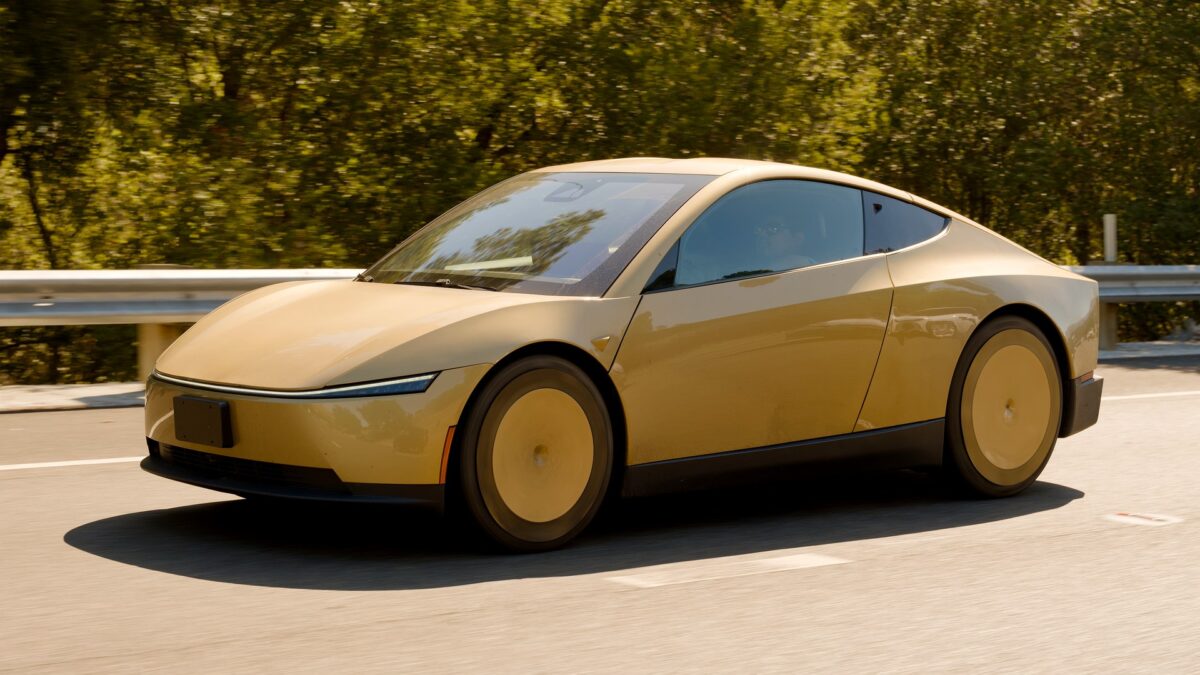
On Friday, 13 November, Tesla invited a chosen few of its customers to do something the motor industry has never done before: to buy, for personal use, a car with no steering wheel, no pedals, no mirrors and no rear window — a golden two-seater called the Cybercab — for $29,990, and then to pay $299 every single month for the privilege of it moving at all.
Read that again. The car costs thirty thousand dollars. And it does not drive without a subscription.
I have spent my life watching power change its costume. It used to arrive with armies and flags. Then it arrived with contracts and fine print. Now it arrives as convenience — smiling, golden, butterfly-doored — and asks only for a small monthly fee. History teaches us to watch the small fee. The East India Company, too, first came as traders.
The Offer on the Table
Let us be precise, because precision is the only defence against seduction. Tesla’s Robotaxi account announced the invitations on X on Friday evening. The order page, seen and screenshotted by buyers and reported by TechCrunch and Electrek, lists the Cybercab at $29,990 before taxes, with a $1,000 non-refundable deposit and an estimated delivery in December 2026 in Austin, Texas. One month of the subscription is included. After that, the meter runs.
The Autonomy Subscription is not an optional extra, like heated seats or a better sound system. It is pre-checked on the order page. The fine print says, plainly: “Subscription and regular vehicle maintenance required to operate.” The invitation email is blunter still: “Only available in supported service areas. Subscription required for operation.”
And here is the sentence that should stop every reader cold: without an active subscription, there is no manual mode. There is no steering wheel to grab, no pedal to press, no way to drive the car yourself. If the subscription lapses, your thirty-thousand-dollar car becomes a very beautiful, very golden garden ornament.
Elon Musk himself, replying to the tech reviewer Marques Brownlee, conceded the fee was “too high”. He said it “should match the cost of Tesla [Full Self-Driving] and connectivity for other models, which is more like ~$115/month.” That is a remarkable admission — the chief executive of the company telling the world his own price is wrong — and it is also a warning. Even at $115 a month, the principle stands. The question is not whether the rent is $299 or $115. The question is whether the rent should exist at all.
A Hundred Years Ago, the Promise Was the Opposite
History is a mirror, and I hold it up now because the reflection is so exact it frightens me.
In 1908, Henry Ford put the Model T on the road for $825, and within a few years his moving assembly line had cut that price again and again. Ford’s promise was ownership. A farmer in Michigan could buy the machine, repair it himself, drive it wherever the road went, and pass it to his son. The car was the great democratiser of the twentieth century precisely because, once bought, it belonged to you. It asked nothing more of you except petrol and care.
Tesla’s promise is the photographic negative of Ford’s. The Cybercab is cheap to buy — Musk promised a price “below $30,000” when he unveiled it at the “We, Robot” event on 10 October 2024, and he has kept that promise to the dollar — but the ownership is hollow. You may own the metal. You do not own the motion. The motion is rented, monthly, for as long as you use the car, at a price Tesla says it can change with 30 days’ notice.
Do the arithmetic with me, because no one else in the excitement will. Sixty months of $299 is $17,940. Add the $29,990 purchase price and the five-year cost of this “cheap” car is about $47,600, before taxes, insurance and the mandatory maintenance — Electrek’s own calculation. That is not the price of a bargain. That is the price of a luxury car, paid in instalments, for a two-seater that cannot leave its designated zone.
And what a zone. That is the second catch, and it is the bigger one.
The Invisible Fence
The Cybercab will only operate inside the geofenced areas where Tesla already runs its Robotaxi service: eight cities — Austin, Dallas, Houston, Fort Worth and San Antonio in Texas, and Miami, Orlando and Tampa in Florida. Step outside the fence and the car, for all practical purposes, does not exist as a vehicle.
Worse, the fence is smaller than the map suggests. Electrek reports that in Austin — the very city where Tesla is delivering these cars, the city where the Cybercab has been carrying paying riders since 3 September 2026 — the service area covers only about 59 per cent of the city. Buyers must accept delivery in one of a handful of Texas cities, and then drive — or rather, be driven — only where Tesla permits.
Consider what this means in ordinary human terms. You buy a car so that you may go where you wish, when you wish. That is the whole point of a car; it is the freedom that made the automobile the defining machine of the modern age. The Cybercab reverses the equation. You go where Tesla wishes, when Tesla permits, inside the lines Tesla has drawn. The car is not your servant. You are its tenant, and the fence is the landlord’s boundary.
I think of the old walled cities, where the gates closed at dusk and no one passed without the watchman’s leave. We tore those walls down centuries ago. Now we are invited to buy them back, in gold, with butterfly doors.
You May Not Even Earn With It
Perhaps, you say, the subscription pays for itself. Perhaps the owner can send the car out to earn fares while he sleeps — the robotaxi dream Musk has sold for a decade. The fine print answers that hope with a cold hand.
The Verge, reading the order terms, reports that early buyers are explicitly prohibited from using the vehicle for commercial purposes — no Uber, no DoorDash, and no putting the car on Tesla’s own Robotaxi network. The car is for personal use only. You pay the subscription. You may not earn from it. The revenue, if any is to be made from your car’s labour, belongs to someone else.
Let me put this in the plainest language I know. You pay $29,990 for the machine. You pay $299 a month for the machine to work. You may not use the machine to earn. And if you stop paying, the machine stops. Tell me, reader — in what century would we have called this ownership? In the age of the Company, when the trader took your land and charged you rent to farm it, we had a word for it. We called it exploitation, and we wrote poems against it.
The Machine Itself Is a Marvel — and That Is the Trap
I will not pretend the Cybercab is not extraordinary. It is. A two-passenger electric coupe with butterfly doors, a single 219-horsepower motor, an estimated range of around 280 miles, no steering wheel, no pedals, no mirrors, no rear window — a cabin with a single touchscreen and nothing else. It drives on cameras alone, where rivals like Waymo use lidar and radar as well. It has been carrying paying passengers in Austin since September, and Tesla says more than 300 are in service. Production began at Gigafactory Texas in February 2026, and Tesla has announced it will cease Cybertruck production next year to free factory capacity to build more Cybercabs.
This is real engineering, and I salute it. But a marvel is not the same as a blessing. The splitting of the atom was a marvel. The question is always who holds the switch.
And the switch, in this case, is held in Washington as well as in Austin. On the same day the Cybercab entered paid service — 3 September 2026 — the National Highway Traffic Safety Administration opened an audit into the basis on which Tesla self-certified a car with no steering wheel as compliant with federal safety standards. That audit is still open. Tesla’s answers to the regulator’s questions were due on 30 October. Neither side has said publicly what was filed. So the car you are invited to buy today is a car whose legal foundation is still under examination — a car that certifies itself, and asks you to trust the certification.
The Crowd Has Already Spoken — and It Is Divided
If you doubt that this story has seized the public imagination, look at the noise it made within hours. WorldStar Hip Hop carried the announcement to its 47 million Instagram followers. Comment threads filled with the same argument, fought in a thousand voices: “$30k and a mandatory $300 monthly fee — sounds like a scam,” said one. “I need that. It would pay itself off fast,” said another. “Never in my entire life will I buy a vehicle that requires a subscription to run,” said a third. And the question that kept returning, half joke and half genuine fear: if there is no driver and no steering wheel, what happens when you get pulled over?
That question is a joke only until it is not. A car without a driver cannot explain itself to a police officer. A car without a steering wheel cannot be moved by its owner in an emergency. A car that only works inside a fence cannot take your child to hospital if the hospital is outside the fence. These are not hypotheticals. They are the ordinary emergencies of ordinary life, and the Cybercab has no answer for them except the subscription and the geofence.
The crowd is divided because the future always divides the crowd. Some see liberation — no driving, no parking, no effort. Others see a cage with good lighting. Both are right about the machine. The argument is about the terms.
The Subscription Is the Story
Step back, and you will see that the Cybercab is not really a story about a car. It is a story about the slow, quiet conversion of ownership into tenancy — the great economic shift of our lifetime, arriving now in your driveway.
We used to buy music. Now we rent it, monthly, and the songs vanish when we stop paying. We used to buy films. Now we rent access to them. We used to buy software. Now we subscribe to it, and the tools we use to do our work can be switched off by a company we have never met. The car was the last great object that still belonged to us outright — the most expensive thing most families will ever own, and the one thing that was truly theirs. The Cybercab ends that. It takes the most personal machine in our lives and turns it into a service.
There is a name for a society in which you own nothing and rent everything: it is called feudalism, with better marketing. The lords of the old order took your land and charged you for its use. The lords of the new order sell you the land and charge you for walking on it. The mechanism is new. The relationship is ancient.
Do not misunderstand me. I am not against the driverless car. A world in which the elderly can travel alone, in which the blind can move freely, in which the exhausted night-shift worker need not drive home half asleep — that is a world worth building, and the Cybercab’s technology points toward it. But a technology that liberates must be owned by the liberated, not rented to them at a price the landlord may raise with a month’s notice. The question is never whether the machine is clever. The question is always who it serves.
What I Ask of You
So here is what I ask of you, reader — not as a columnist, but as a fellow traveller on a road that is changing beneath our feet.
When the invitation arrives in your inbox — and it will arrive, because the invitations always arrive, golden and smiling — read the fine print before you read the price. Ask who owns the motion. Ask where the fence is drawn. Ask what happens when you stop paying. Ask whether the car can take you where you need to go, or only where it is allowed to go. Ask whether you are buying a machine or joining a tenancy.
And ask the oldest question of all, the one every generation must ask of every new power that knocks at its door: does this make me more free, or more dependent? The answer to that question is the only review that matters. Everything else — the butterfly doors, the gold paint, the touchscreen, the applause — is decoration.
The Cybercab is real. It drives on a real highway outside Palo Alto, and I have seen the photograph with my own eyes — a golden car, moving, with no one driving it. That is a marvel, and marvels deserve our wonder. But wonder is not consent. The future is not something that happens to us. It is something we choose, one purchase at a time, one subscription at a time, one small monthly fee at a time.
Choose carefully. The car you buy today may be the last car you ever own — not because cars will disappear, but because ownership will. And when ownership is gone, what remains is not freedom. It is rent, dressed in gold, with butterfly doors.
History is watching. It always is.
Sources & References
- TechCrunch — “Tesla opens Cybercab pre-orders ‘for personal use,’ with geo restrictions and a $299 monthly fee” (14 November 2026)
- Electrek — “Tesla Cybercab orders open at $29,990 + $299/mo, only in Robotaxi zones” (13 November 2026)
- Wikipedia — “Tesla Cybercab” (vehicle history, specifications, production timeline)
- TopElectricSUV — “Tesla Cybercab wows visitors with its butterfly doors raised at Auto Zurich 2026” (7 November 2026)
- Supercharged Daily — “Cybercab guide: specs and promises” (reviewed 9 November 2026)
- Wikimedia Commons — “Tesla Cybercab on Interstate 280 near Palo Alto” (photograph by Daniel Lu, 19 September 2026, CC BY-SA 4.0)

About the Author — Abdul Mannan
Related Articles

Three Men, Twelve Thousand Bombs: The Shenzhen Summit and the Fate of the World
On Thursday, the leaders of the three greatest nuclear powers sit down together for the first time in…
When America Could Not Fly: The Day the Sky Went Silent
At 3:36 p.m. on Friday, 13 November 2026, the busiest airspace on Earth fell silent. This is the…
When the World’s Office Went Dark: The Microsoft Outage and the Price of Putting Everything in One Company’s Hands
On Thursday, 12 November 2026, the inbox of the world stopped working. No hacker did it. No bomb…