They Learned to Switch the Human Brain On and Off — With Light

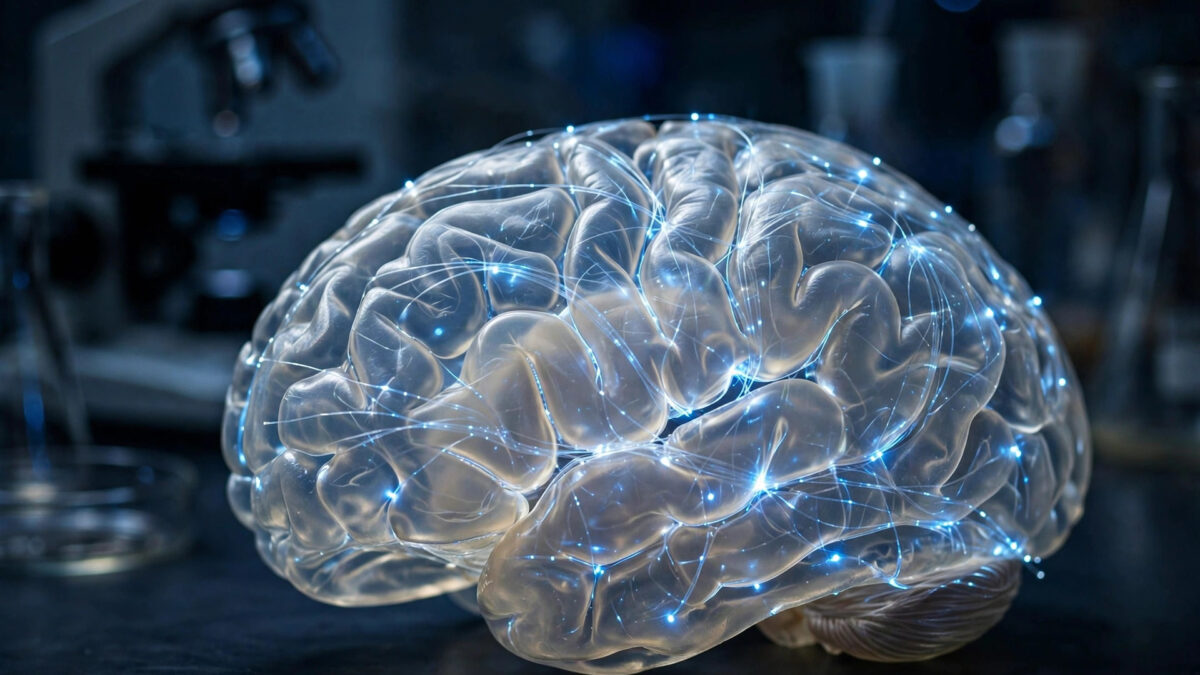
Pause for a moment and ask yourself the question most of us spend our entire lives avoiding: who exactly is sitting behind your eyes?
I do not mean the two soft orbs in their sockets. I mean the silent passenger who remembers your mother’s voice, who wakes you at 3 a.m. with a fear you cannot name, who decides — in a fraction of a second — whether you will forgive or take revenge. For ten thousand years, priests, poets and physicians have all claimed to know that passenger. This week, for the first time in human history, science did not merely claim it. Science reached in and touched the switch.
On Monday, 5 October 2026, the Nobel Assembly at the Karolinska Institutet in Stockholm announced the year’s Nobel Prize in Physiology or Medicine. It went to three scientists — the American Karl Deisseroth, aged 54, and two Germans, Peter Hegemann, 71, and Georg Nagel, 73 — “for discoveries concerning light-gated ion channels and optogenetics,” as Reuters reported. Twelve million Swedish crowns, roughly 1.2 million dollars, shared between them. But the money is the least interesting part of this story. The interesting part is what they discovered: a way to switch individual nerve cells in a living brain on and off — with light.
Read that sentence again. Slowly. Let it land.
A Frog’s Leg in Bologna
Every revolution has an ancestor, and this one twitches in a thunderstorm in the 1790s. Luigi Galvani, a physician in Bologna, hung the severed legs of frogs on his balcony railing and watched them kick when lightning flashed. Dead flesh moved. Something invisible — what he called “animal electricity” — animated the machine of the body. It was crude, it was ghoulish, and it was the first proof that the nervous system speaks in sparks.
Two centuries passed. The sparks were mapped, the neurons drawn, the synapses named — and still the deepest question stood untouched, exactly where Francis Crick found it in 1979. Crick, the co-discoverer of the structure of DNA and himself a Nobel laureate, declared that the only way to truly understand the brain would be to turn its neurons on and off on demand, one circuit at a time. And then he added the sentence that reads today like prophecy: “the ideal signal would be light.”
Light. Not electricity, which floods everything it touches. Not chemicals, which drown the brain in fog. Light — precise, instant, clean. A beam that could pick out a single circuit among eighty-six billion neurons and say: you, fire; you, be silent.
For decades, that sentence sat in the literature like a locked door with no key. Then the key turned up in a pond.
The Alga That Chased the Sun
In the 1990s, Peter Hegemann — then at the Max Planck Institute for Biochemistry in Germany — found himself staring at a creature most of us would swat away without noticing: Chlamydomonas, a single-celled green alga that swims toward light. How, he wondered, does a creature with no eyes, no brain, no nervous system of any kind know where the sun is? The answer, he discovered, was a light-sensitive protein. In the 2000s, working with Georg Nagel at the Max Planck Institute for Biophysics in Frankfurt, he showed that this protein acts as a switch: struck by blue light, it opens a channel and lets ions flow through, firing an electrical impulse. They named it channelrhodopsin. As the Nobel Committee’s Abdel El Manira put it during the announcement, “they had just discovered the switch neuroscientists had long dreamed of.”
But a switch in an alga is a curiosity. Karl Deisseroth, at Stanford University in California, turned it into a revolution. In work published in 2005, he took the gene for that algal protein and engineered it into the nerve cells of living rats — nerve cells that could now be activated simply by shining light on them. The committee member Anna Wedell called it “a completely new dimension of understanding of the function of the brain.” She was not exaggerating. Optogenetics, as the method came to be called, is now used in laboratories around the world to map which cells are responsible for which function — the circuits of specific memories, of fear, of addiction, of movement — in the words of the Nobel Assembly, “to reveal the brain’s mysteries.”
Consider the poetry of it, my friend: the key to the most complex object in the known universe was not forged in a supercomputer or a particle accelerator. It was borrowed from pond scum that liked the sunshine.
What It Means for You
You are not a neuroscientist, and neither am I. So let me bring this down from the laboratory ceiling to the floor of your own life.
In 2021, a blind man with retinitis pigmentosa — a disease that steals sight from nearly two million people worldwide — recovered partial vision through an optogenetic treatment, in a clinical trial co-led by the ophthalmologist José-Alain Sahel. Read that once more: a man who lived in darkness saw light again because scientists taught his eye to listen to light the way that alga does. The method has so far been used in humans only on a very limited basis, the Nobel Assembly is careful to say, and Georg Nagel himself admitted from a sunlit terrace in Italy, where the committee’s call found him, that he thought the prize had come too early: “I didn’t expect this, really!”
But look where the road points. Parkinson’s disease, where the brain’s movement circuits misfire. Epilepsy, where storms of uncontrolled firing seize the mind. Depression, addiction, the disorders of memory that turn old age into a slow farewell. For every one of these, the obstacle was never imagination — it was precision. We knew the brain was electrical; we simply could not touch one wire without shaking the whole house. Optogenetics is the first tool that touches one wire.
Karl Deisseroth learned he had won the way most of us learn the best news of our lives — half asleep, disbelieving. “My phone rang at my bedside,” he told reporters. “There was about 30 seconds when I had trouble forming words.” I confess I found that detail more moving than the prize itself. The man who taught the world to switch brains on with light was himself switched on, mid-dream, by a ringing telephone.
Light as Mercy — and a Warning
And now, reader, the question I promised at the start: who is sitting behind your eyes?
Here is what I believe, and I say it as a man of faith as much as a writer: every sacred tradition ever given to mankind describes light as the symbol of guidance and mercy — the thing that finds you in darkness and leads you out. Yesterday’s medicine has, almost by accident, made that metaphor literal. They gave light to a blind man. If that does not humble you, nothing in this column will.
Yet I would be a dishonest columnist if I ended on celebration alone, because every column I have ever written has been a moral courtroom, and this one must be too. A switch that can turn a diseased circuit off can, in other hands, turn a healthy one off as well. A tool that maps the circuitry of memory can map the circuitry of obedience. Whoever holds the lamp holds the room. The twentieth century taught us — at terrible cost — that every great power first arrives as a blessing and is only later audited as a temptation. The atom gave us both the reactor and the bomb; the same century will judge what we do with the switch.
So here is my verdict, and I address it to you directly: celebrate this prize, for it is deserved — three patient men, a pond alga, a ringing telephone at dawn — but do not mistake a tool for wisdom. The brain is not a machine to be operated; it is the seat of the soul’s tenancy, and the soul was never ours to rewire. Science has now been given the lamp. Whether it becomes a lantern for the lost or a spotlight for the powerful depends — as it has always depended — not on the discovery, but on the discoverers’ children. On us.
The light is in our hands now. God help us use it like the alga did — to swim toward the sun, and not away from it.
Sources & References
- Reuters — American Deisseroth and Germans Hegemann and Nagel win 2026 Nobel medicine prize
- Associated Press — Nobel Prize in medicine goes to 3 scientists for brain activity research
- CNN — Nobel Prize in medicine awarded to trio for technique that helps decode mysteries of the brain
- New Scientist — Nobel prize for medicine goes to trio who developed optogenetics
- Le Monde — Nobel Prize in Medicine 2026: One American and two Germans honored for technique activating neurons with light
- Phys.org — US-German trio wins medicine Nobel for work on optogenetics

About the Author — Abdul Mannan
Related Articles

The Plague Ship Returns to Harbour — and the World Met to Argue About It
THE PLAGUE SHIP RETURNS TO HARBOUR — AND THE WORLD MET TO ARGUE ABOUT IT When was the…