Gaza Ceasefire at One Year: Promises Unfulfilled as Strikes and Suffering Continue

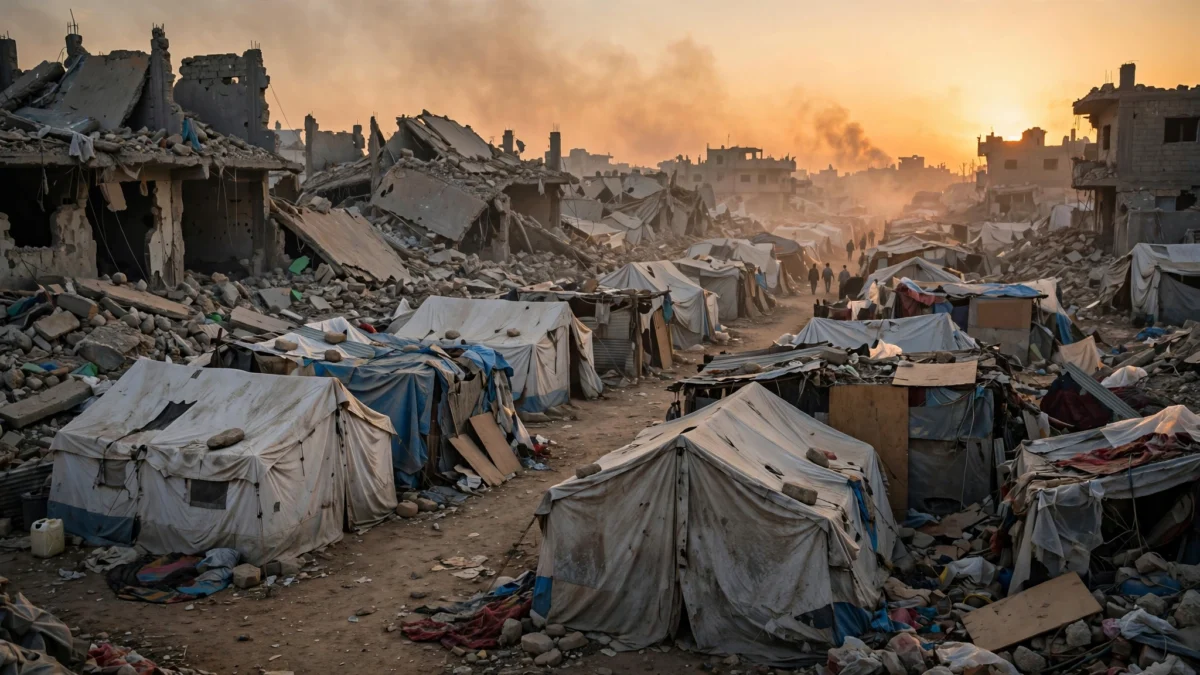
One year after the United States-brokered ceasefire agreement of 10 October 2025 was supposed to close the book on the Gaza war, almost none of its long-term promises have been kept. The deal stopped the war’s heaviest fighting, brought the remaining Israeli hostages home, and quietened the Gaza front. But the political transition it pledged never arrived, reconstruction never began, Israeli forces still control most of the territory, and strikes continue on a near-daily basis — while Gaza’s roughly two million people face a third or fourth winter in tents.
The anniversary has been marked by a bleak consensus across news agencies, rights monitors and more than a hundred humanitarian organisations: the ceasefire exists largely on paper. What was meant to be the start of recovery has become, in the words of one joint statement issued this week, a war that continues under another name.
What the deal promised — and where things stand
The 20-point agreement announced by US President Donald Trump and Arab mediators followed months of negotiation under both the Biden and Trump administrations. It was an ambitious document. In its first phase it required Hamas to release the remaining hostages, Israel to halt its offensive and pull back to agreed lines, a surge of humanitarian aid, and then a second phase with a full political transition: a new Palestinian administration for Gaza, backed by international forces, alongside the disarmament of Hamas, the beginning of reconstruction, and a complete Israeli withdrawal.
The hostage chapter is the one commitment that was delivered. Three days after the announcement, Hamas freed the 20 remaining living hostages taken during the group’s 7 October 2023 attack, according to the Associated Press. For Israel, that return was the deal’s emotional centre — the public had agonised over the captives’ fate — and it was paired with a year of quiet on the Gaza front: no rocket attacks from Hamas, whose missile stockpile had been depleted by sustained bombardment.
Nearly everything else stalled. Israel reduced the intensity of its attacks but kept striking Gaza almost every day, according to the AP’s one-year assessment. Israeli forces were permitted to remain in 53 percent of Gaza under the agreement’s terms, yet a year later they control about 70 percent of the territory, according to official accounts cited by the agency — the so-called Yellow Line, the ceasefire’s withdrawal boundary, has effectively been pushed deeper into Gaza.
Disarmament, the issue both sides called the hinge of the second phase, never happened. Israel tied all further movement to Hamas’s complete disarmament, while Hamas and the Trump administration argued the steps should proceed in parallel. The group announced in July that it was disbanding its governing body and handing civilian administration to the US-blessed National Committee for the Administration of Gaza, led by technocrat Ali Shaath — but the AP reports that the promised new Palestinian administration, backed by international forces, never materialised, and reconstruction has barely started.
Prime Minister Benjamin Netanyahu has hardened his position through the summer, according to the AP, openly rejecting an arrangement announced by Trump — Israel’s closest ally — ahead of Israeli elections scheduled for later this month. On the anniversary of the 2023 attack he vowed to kill everyone involved in it, saying that 4,000 of 6,000 Hamas militants had been killed.
The toll of a ceasefire that is not a ceasefire
Gaza’s health ministry, whose figures are considered accurate by the United Nations, reports that Israeli strikes have killed about 1,450 Palestinians since the ceasefire took effect. Humanitarian organisations put the figure in the same range: more than 100 civil-society and aid groups said this week that more than 1,400 Palestinians have been killed, including at least 327 children, and that families are still recovering bodies from rubble with their bare hands because machinery is restricted. Islamic Relief, citing the health ministry, said at least 1,454 Palestinians have been killed and more than 5,000 wounded since the agreement — a casualty roughly every 90 minutes, with a child killed nearly every day of the past year on average.
Human Rights Watch, in a statement issued for the anniversary, said Israeli forces continue to kill and wound civilians and to deny sufficient food, aid and water to Palestinians, and that reconstruction has not yet begun despite promises of humanitarian relief at the heart of the Comprehensive Plan to End the Gaza Conflict. The total death toll since October 2023 now exceeds 74,000, including more than 21,000 children, according to the health ministry figures cited by HRW.
The statement was unsparing in its framing: the outside world, said acting Israel and Palestine researcher Sarah Sanbar, “may be under a dangerous illusion that life in Gaza is returning to normal, but reality tells a very different story,” describing tents under bombardment and families without enough food or drinking water.
Two million people in tents
The human geography of Gaza a year after the ceasefire is one of enforced compression. Almost all of the territory’s roughly 2.1 million people are now crammed into about 35 percent of the land, according to Islamic Relief, because Israel’s expanded Yellow Line has effectively expelled Palestinians from around 65 percent of Gaza. Families are living in overcrowded displacement sites where tents are infested with rodents that bite children as they sleep and contaminate water supplies, the organisation reports, and many are preparing for their third or fourth winter in damaged tents or roofless buildings.
Oxfam’s joint statement — signed by more than 100 humanitarian, human-rights and civil-society organisations — warned that “the killing and deprivation in Gaza must not be normalised under the cover of a ceasefire agreement.” Nearly two million people still need shelter, not a single hospital is fully functioning, and 1.4 million face crisis-level hunger, the organisations said. Aid volumes remain far below required levels, critical access routes have been repeatedly obstructed, and restrictions on construction materials mean even basic recovery is impossible.
A Palestinian NGO Network board member, quoted in the joint statement, said local organisations are responding to immense needs “under Israeli occupation with destroyed offices, displaced staff, and shrinking budgets,” and called on governments to act to end the attacks and restrictions and for donors to provide direct, flexible funding. An Islamic Relief aid worker in Gaza, whose name was withheld for safety, described daily fear: “There is no ceasefire in reality,” the worker said, describing strikes near displacement camps, the constant noise of drones, and homes that feel unsafe.
The politics behind the deadlock
The ceasefire’s second phase was supposed to be its political heart — a transition away from Hamas rule under an internationally backed civilian administration. The National Committee for the Administration of Gaza was named, and Hamas formally announced in July that it was handing over Gaza’s administration to it. But the AP’s anniversary reporting describes the transition as effectively frozen: no functioning new administration, no multinational security force deployed, and no disarmament.
The deadlock follows a logic both sides understand but neither has broken. Israel’s government insists Hamas must be fully disarmed before any further Israeli concessions; Hamas and the Trump administration’s position is that disarmament and other steps — withdrawal, aid, reconstruction — must move together. With Netanyahu in a tight election race, his government has moved in the opposite direction of the deal’s second phase, expanding territorial control and intensifying rhetoric rather than withdrawing.
The American dimension is the deal’s strangest feature. Trump declared the war over a year ago and brokered the agreement personally; yet it was the US president’s own announcement that Netanyahu rejected over the summer, according to the AP. The US military set up a command post with foreign allies near the Gaza border to monitor the truce — but the monitoring has not stopped near-daily strikes, and the Board of Peace authorised under UN Security Council Resolution 2803, tasked with assessing compliance with the Comprehensive Plan, has not produced the large-scale rebuilding it was created to oversee.
Analysis: Why It Matters
A year into a ceasefire that has killed roughly 1,450 people, the honest question is what the word “ceasefire” now means — and the answer matters far beyond Gaza, because it determines whether international diplomacy still has a working vocabulary.
Consider what the October 2025 agreement actually achieved, stripped of ceremony. It ended large-scale combat. It returned the hostages — the one irreversible, universally recognised good the deal produced. It improved humanitarian access compared with the war’s darkest months. Those are real achievements, and they are why the deal was celebrated as the signature diplomatic accomplishment of Trump’s second term. They also, tellingly, are everything the agreement achieved: the parts of the deal that required the fighting to stop worked; the parts that required building something new — an administration, a demilitarisation, a reconstruction — did not.
That pattern is the story’s real subject. Ceasefires between a state and a non-state armed group almost always follow this shape: the violence pauses because both sides are exhausted or pressured, but the political questions the war was fought over remain untouched. What makes Gaza’s case unusual is the scale of the gap between the document and the reality. The agreement promised a complete political transition. What happened was a management arrangement for an indefinite occupation: the Yellow Line moved, control expanded from 53 percent to 70 percent, and the “second phase” became a standing argument about sequencing — disarmament first or everything together — that neither side has any incentive to resolve.
Follow the incentives and the deadlock stops looking mysterious. For Netanyahu, weeks from an election, the ceasefire’s calm on the Israeli side is the best of all worlds: no rockets, no major ground operations, continued freedom to strike in Gaza, and expanding territorial control — all while his base hears promises that everyone involved in October 7 will be killed. Conceding on withdrawal or endorsing a genuine Palestinian administration would cost him voters; maintaining the status quo costs him almost nothing diplomatically, because Washington, the only capital that could force movement, is unwilling to do so.
For Hamas, the calculus is inverted but equally self-protecting. The group traded its hostages — its last high-value leverage — for the deal, and has since handed nominal administration to a technocrat committee while retaining, as every credible account notes, effective security control on the ground. Disarming now, with no reconstruction flowing and Israeli forces expanding their footprint, would mean surrendering its remaining leverage for promises that the past year has shown to be unreliable. The sequencing argument — disarmament alongside withdrawal, not before it — is, on these terms, entirely rational.
And for the Trump administration, the agreement has already paid its political dividend: the declaration that the war was over, the hostages home, the summit imagery. Enforcing the second phase against a defiant Israeli prime minister in the middle of an election would spend political capital for gains that are abstract and distant. The Board of Peace exists; its compliance assessments have not moved a single bulldozer.
The cost of all this is paid by the people the agreement named as its beneficiaries. Two million people are being squeezed into a shrinking pocket of a devastated territory, entering another winter in tents, with aid restricted, hospitals non-functional, and strikes that kill someone roughly every hour and a half — all under an agreement that was supposed to end exactly this. The joint statement of the 100-plus organisations captured the moral hazard precisely: a ceasefire that is not enforced does not merely fail; it provides cover. Violence that would be a scandal in wartime becomes background noise in a “post-war” period that the world has already filed away.
There is a larger lesson here about how modern ceasefires die. They rarely collapse in a dramatic breach. They decay: one side’s withdrawal line creeps outward, the other side’s disarmament deadline slides, the reconstruction funds pledged at conferences never arrive, and the monitoring missions file reports nobody acts on. Gaza’s ceasefire did not break this week; it broke by degrees over twelve months, and the anniversary is simply the date on which the decay became impossible to ignore.
What to watch next
First, the Israeli elections later this month, and whether any new government revisits the second phase — though no major party is campaigning on concessions in Gaza. Second, the winter: with nearly two million people in tents and aid restrictions in place, the cold months are the deal’s next humanitarian stress test. Third, the Yellow Line itself — whether the creeping expansion of Israeli control, now at roughly 70 percent of the territory, continues or is challenged by any of the deal’s guarantors. Fourth, the Board of Peace and the compliance machinery of Resolution 2803, whose credibility now rests on whether it can enforce an agreement that its own author appears to have abandoned. And fifth, the reconstruction question: until building materials flow and hospitals reopen, the ceasefire will remain what the aid organisations say it is — a word, not a condition.
One year on, the October 2025 agreement stands as a warning about the difference between stopping a war and ending one. The guns mostly fell silent. The war’s work — the displacement, the deprivation, the killing — continued under its name.
Sources
- Associated Press via TBS News: “Gaza ceasefire stalls a year after US-brokered deal as Israeli strikes continue”
- Agence France-Presse via The Fort Worth Press: “Year later, Gaza ceasefire promises mostly unfulfilled”
- Human Rights Watch: “Gaza: Ceasefire Anniversary Marks Year of Failed Promises”
- Joint statement of 100+ organisations: “Gaza ceasefire exists in name only” — Oxfam Canada
- Islamic Relief: “One Palestinian killed or wounded in Gaza every 90 minutes since the ceasefire announcement”

About the Author — Abdul Mannan
Related Articles
Syria Weighs Military Aid for Saudi Arabia as Yemen War Escalates After Deadly Houthi Airport Strikes
Reuters reports that Damascus is weighing defensive or offensive military support for Riyadh against the Iran-backed Houthis —…
Houthi Strikes Kill Three and Wound Dozens at Saudi Airports as Yemen War Spreads to Riyadh
Houthi attacks on airports in Riyadh and Abha have killed three people and wounded 36, the deadliest confirmed…
Saudi Arabia Confirms Houthi Strikes Damaged Two Southern Airports, Wounding Three
Riyadh confirms Monday evening strikes damaged the Jazan and Najran airports, wounding three, as Houthi rebels claim a…