US Imposes Month-Long Curfew on Okinawa Troops After Marine Held Over Alleged Murder of Japanese Woman

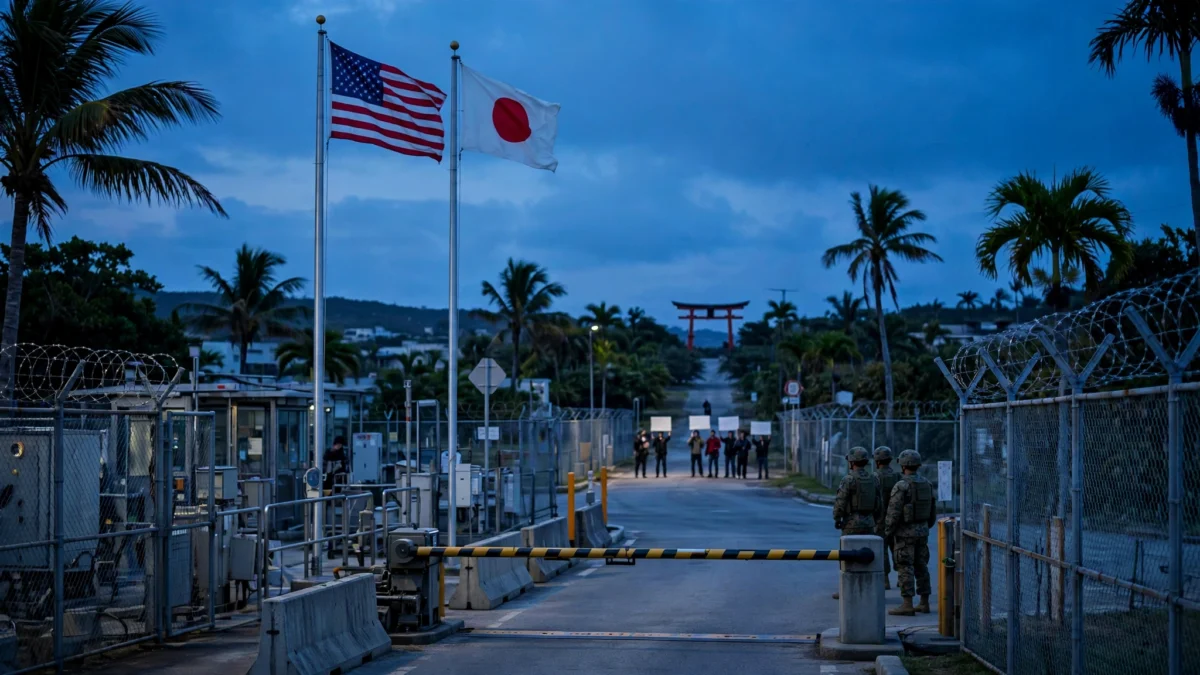
Tokyo, October 10 — The United States military has imposed a month-long midnight curfew and an alcohol ban on all American troops stationed in Okinawa, Japan, after a 20-year-old US Marine was arrested on suspicion of murdering and robbing a local woman in a Naha hotel — the latest in a decades-long string of crimes involving US personnel that has repeatedly fuelled Okinawan anger at the American military presence.
Lance Corporal Devin Jacob Ballard, 20, was arrested by Okinawa police on October 4 on suspicion of killing 39-year-old Anna Yagi, according to Reuters. Police say Yagi was found dead in a hotel room in Naha, the most populous city on the island. Ballard, who is stationed at the Marine Corps Air Station Futenma as part of the III Marine Expeditionary Force, has denied the allegations, according to Japanese authorities, Reuters reported.
Police told the Stars and Stripes newspaper that Yagi died of asphyxiation after Ballard allegedly pressed on her neck. Hotel staff found the woman unconscious in her room in the early hours of Saturday after she failed to check out, and local media reported that around 200 officers took part in the search for a man earlier caught on CCTV entering the hotel with the victim. National broadcaster NHK said the serviceman denied the charges, citing police investigators.
The case has detonated a political crisis for the US military footprint in Japan. On Tuesday, Lt. Gen. Benjamin Watson, commander of the III Marine Expeditionary Force, ordered all US military operations on Okinawa paused for 48 hours starting October 7 while troops underwent training on standards and discipline. During that period, American personnel were prohibited from consuming alcohol or leaving their bases, USA Today reported. The training featured what Watson described as discussions on liberty policy, enforcement mechanisms, alcohol awareness, Okinawan culture, and alliance responsibilities.
Then, from October 9, all US service members stationed on Okinawa were placed under a month-long overnight curfew running from midnight to 5 a.m., Reuters reported — an extraordinary measure applied across the island’s roughly 30,000 American military personnel and civilian employees.
“Every interaction with our neighbors either builds or undermines the trust that is essential to our team. When that trust is damaged, it affects the strength of our alliance and the security of this region,” Watson wrote in a letter to US military personnel in Okinawa on October 6, according to USA Today.
The response from Tokyo has been furious. Prime Minister Sanae Takaichi called the killing “extremely brutal and heinous,” said she had strongly protested to the United States, and demanded measures to prevent such incidents from recurring, Reuters reported. Okinawa Governor Genta Koja lodged a formal protest over the alleged killing with Watson and the US Consul General in Okinawa, Andrew Ou, on Monday, the Wall Street Journal reported, and was due to meet Takaichi in Tokyo to discuss the official response. Protesters took to the streets in both Naha and Tokyo to condemn the incident.
Three decades of anger
Yagi’s killing has reopened one of the oldest wounds in the US-Japan alliance. Okinawa hosts the bulk of America’s military presence in Japan — more than half of the roughly 50,000 US service members in the country are stationed on the island chain — despite Okinawa accounting for less than one per cent of Japan’s land area. Resentment over that concentration has been a feature of Okinawan life and politics for decades, and sporadic violent crimes involving US personnel have repeatedly stoked anger.
The darkest chapter came in 1995, when three US servicemen abducted and raped a 12-year-old Okinawan girl — a crime that triggered some of the largest protests in post-war Japanese history, with more than 85,000 people rallying on the island, and forced Tokyo and Washington to agree to the eventual relocation of the Futenma air base. Three decades later, that base has still not moved; the planned replacement facility at Henoko Bay, off Okinawa’s northern coast, remains years from completion and is bitterly opposed by Okinawans who say the island already bears an unfair burden.
Serious crimes have continued to punctuate the decades since. In 2016, the murder of a 20-year-old Okinawan woman by a former US Marine — Kenneth Franklin Shinzato, who was working as a civilian contractor — provoked mass protests and renewed calls for the bases to go. In 2024, two US service members were charged with sexual assaults in separate cases in Okinawa that year, again inflaming local opinion. The US military has responded to such episodes before with curfews, alcohol bans and “liberty restrictions” — measures that Okinawans and Japanese politicians have repeatedly dismissed as insufficient.
The current crisis lands at a particularly sensitive moment. Okinawa sits roughly 1,000 kilometres southwest of Tokyo, at the junction of the East China Sea and the Pacific — the front line of American deterrence of China, and the strategic ground from which the United States would operate in any Taiwan contingency. Tokyo has been steadily deepening defence ties with Washington, and US officials have warned that incidents like this risk undermining the trust that the alliance depends on in an increasingly dangerous region. Takaichi, Japan’s first female prime minister, has staked her credibility on a hawkish defence posture; being seen as soft on crimes by US personnel would be politically toxic.
A pattern that never breaks
What makes this episode resonate beyond Okinawa is the sense of recurrence. Every few years, a crime involving US personnel reignites the same cycle: outrage, protests, formal apologies, a new round of disciplinary measures — and then, eventually, another incident. The US military’s standard response — the 48-hour operational pause, the alcohol ban, the midnight curfew — is now so familiar that Japanese media and activists can recite it before it is announced. The curfew imposed on October 9 is a measure the military has used repeatedly in the past, and Okinawan politicians have said openly that it does not address the root of the problem: the sheer scale of the US footprint on the island.
Governor Koja has long argued that Okinawa bears a disproportionate share of the alliance’s costs, and that relocation of bases off the island — not disciplinary theatre — is the answer. His formal protest on Monday, lodged jointly with the US Consul General, signals that this time the pressure on Washington and Tokyo will extend beyond routine regret. The meeting between Koja and Takaichi in Tokyo puts the issue directly on the prime minister’s desk at a moment when she is trying to consolidate her new government.
There are also legal and procedural questions that will not go away quickly. Under the US-Japan Status of Forces Agreement (SOFA), Japan has primary jurisdiction over crimes committed by US personnel off duty, and Ballard is in Japanese custody — but the agreement has long been criticised in Okinawa as granting too much protection to American suspects, including in cases where the US military can claim custody before indictment. Any perception that Ballard’s prosecution is being softened, or that the US is sheltering him, would pour fuel on the fire.
Analysis: Why It Matters
The curfew is a measure of how seriously the US military takes this crisis — and, simultaneously, a measure of how little such measures have ever achieved. Thirty thousand troops grounded after midnight, a 48-hour stand-down of all operations on one of America’s most strategically important bases, alcohol bans enforced on and off base: the theatre of discipline is elaborate, because the damage is real. But Okinawans have seen this show before. The question hanging over Okinawa this week is not whether the curfew will calm this month’s outrage — it will — but whether it does anything at all about next year’s crime.
The alliance context is what elevates this from a local crime story to a geopolitical one. Okinawa is not some peripheral garrison; it is the linchpin of American power projection in the Indo-Pacific. Futenma’s MV-22 Ospreys, Kadena Air Base’s fighters, the logistics hubs that would sustain a Taiwan contingency — all of it sits on an island whose population has spent 80 years being told its sacrifices are essential for everyone’s security, and whose population increasingly answers that the sacrifice is not shared. Every incident like this one strengthens the hand of those — in Okinawa, in the Japanese Diet, and in Beijing’s propaganda apparatus — who argue that the American presence is a liability dressed up as a guarantee.
Takaichi’s position is genuinely difficult. She is a defence hawk who wants closer coordination with Washington and has little patience for the pacifist instincts of the Okinawan left. But she cannot afford to look indifferent to the murder of a Japanese woman by an American Marine in the first months of her premiership. Her “extremely brutal and heinous” language, and her direct protest to the United States, were pitched precisely to preempt that charge. The governor’s visit to Tokyo keeps the issue live; whether she offers Koja anything substantive — a fresh look at base burden-sharing, a tighter SOFA arrangement, a binding timetable for Futenma’s removal — will tell us whether this crisis becomes a policy inflection point or another entry in the cycle.
For Washington, the calculus is equally delicate. The Trump administration’s posture toward allies has been transactional — and Okinawa’s governor knows it. The US cannot lose Okinawa’s cooperation; it is the only large-scale American military footprint within striking distance of Taiwan and the East China Sea. But the administration has also been openly hostile to the idea that the US owes its allies deference, and its willingness to expend political capital on base-community relations is unproven. Watson’s letter struck the right notes about trust and alliance responsibility, but letters do not change incentives. The measures he ordered are the same ones his predecessors ordered, and they buy time, not solutions.
There is one more dynamic worth watching: the Japanese public. The protests in Naha and Tokyo over Yagi’s killing were small, but they tap into a mainstream unease that opinion polls have registered for years — a majority of Japanese support the alliance but a persistent plurality, and a majority of Okinawans, believe the burden is unfairly distributed. If Ballard’s case produces a harsh, transparent Japanese prosecution, the story may subside. If it stalls, or if any element of the SOFA is seen to shield him, the story will not.
What to watch next: how Japanese prosecutors charge Ballard and whether the US asserts any custody rights under SOFA; whether the midnight curfew and alcohol ban are extended beyond 30 days or quietly lifted; what Koja extracts from his meeting with Takaichi; whether opposition parties in the Diet force a debate on base burden-sharing; and whether Beijing uses the episode in its information operations aimed at weakening Japanese support for the alliance. The curfew ends in November. The anger it was imposed to contain may not.
Sources
- Reuters, “US forces face curfew, alcohol ban in Japan’s Okinawa after murder case,” October 7, 2026
- The Wall Street Journal, “U.S. Forces in Okinawa Face Curfew, Booze Ban After Killing,” October 2026
- USA Today, “Alcohol ban, curfew: US disciplines troops after Marine murder allegation,” October 7, 2026

About the Author — Abdul Mannan
Related Articles
Ukraine Hits Russian Oil Terminal in Rostov Hours After Trump’s Diesel Deal With Putin
A fire erupted at the Yug Rusi oil-loading terminal in Rostov-on-Don overnight amid a reported Ukrainian drone attack,…
South Korea Recalls Ambassador to Ukraine as Russian Fuel-Shipment Row Deepens
South Korea is recalling its ambassador to Ukraine and threatening legal action after a Guardian investigation traced 176,000…
US Sanctions the International Criminal Court as an Institution, Hours After Its Former Judge Wins the Nobel Peace Prize
The Trump administration has imposed sweeping financial sanctions on the International Criminal Court itself — the first time…