Ukraine Hits Russian Oil Terminal in Rostov Hours After Trump’s Diesel Deal With Putin

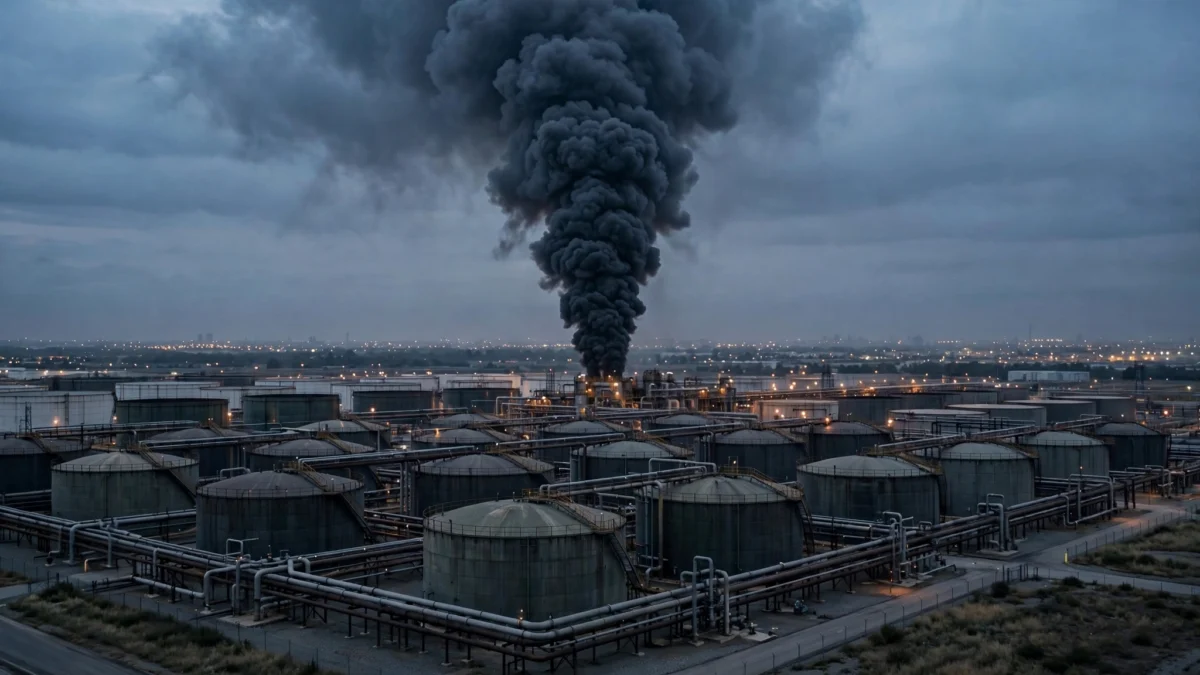
A large fire broke out at an oil-loading terminal in Russia’s southern city of Rostov-on-Don overnight between October 9 and 10, amid a reported wave of Ukrainian drone strikes on Russian energy infrastructure, in an escalation that landed just hours after United States President Donald Trump announced a controversial agreement to buy millions of tonnes of diesel from Russia.
The burning facility was identified by an open-source intelligence analyst with the independent Russian outlet ASTRA as the Yug Rusi oil-loading terminal in Rostov-on-Don’s Zheleznodorozhny district, based on footage filmed by local residents and published by the Exilenova+ monitoring channel, according to a report by the Kyiv Independent. Videos circulating on social media appeared to show towering flames and thick black smoke rising from the site, and the monitoring channel later reported that the terminal was still burning.
The Yug Rusi terminal handles petroleum products for export, including shipments from the Novoshakhtinsk Oil Refinery, which belongs to the same group of companies. According to the refinery’s published specifications, its Rostov-on-Don terminal has an annual capacity of 3.5 million metric tons for receiving and shipping petroleum products. It is separate from the refinery’s main processing facilities.
Russian regional authorities acknowledged that a fire had broken out and said air defence units were operating, but did not confirm that the terminal itself had been damaged. Yuri Slyusar, the governor of the Rostov region, said that air defences had destroyed around 50 drones over the region overnight, and that a railway bridge had been damaged in the attack, forcing trains to halt in both directions. Ukrainian military officials had not formally claimed responsibility for the attack, the Kyiv Independent reported.
According to a fact-checked roundup of the overnight strikes, the Novoshakhtinsk oil refinery suspended operations after the drone attack, and President Volodymyr Zelenskyy said Ukrainian forces had struck oil refineries at Novoshakhtinsk and Perm, along with two radar stations and a defence plant. ASTRA also reported damage to a residential building in the Donskaya Sloboda complex of Rostov-on-Don, identified through footage posted by residents, though it remained unclear what struck the building amid the continued drone activity and Russian air defence operations. No casualties from the terminal fire were reported.
The strike was the latest in an intensifying Ukrainian campaign against Russian fuel infrastructure. On September 25, Ukraine’s General Staff said its forces had struck the Novoshakhtinsk refinery itself, sparking a fire at the facility. Ukrainian officials have repeatedly said such attacks seek to degrade the fuel supplies of Russia’s military and cut off the foreign-exchange earnings that finance the war against Ukraine.
The timing of the attack was immediately seized upon by international media. The Sun reported that the strikes came just hours after President Trump announced on Friday that Russia would supply millions of tonnes of diesel to the United States and the world market, a deal that drew a furious reaction from Kyiv. Trump said three million tonnes of diesel would be delivered from Russia in a short period of time, a move the White House framed as a way to bring down fuel prices for American consumers.
Zelenskyy reacted with open anger. Speaking to Axios, he described the agreement as a “happy birthday present for Putin” and said Trump was “not fair and not honest”, warning that the deal would bring further terror to his country. In an earlier post on X, the Ukrainian leader wrote that allowing Russia to sell petroleum products was an investment in a war that must be ended, not prolonged, and that Russia would repay the diesel with further terror. The Ukrainian president’s fury reflected Kyiv’s longstanding position that Western energy purchases fund Moscow’s war machine.
Washington had previously cautioned Ukraine against strikes on Russian energy targets. The US has repeatedly warned that attacks on refineries and fuel depots risk pushing up global energy prices, a particular sensitivity for the Trump administration ahead of the midterm elections on November 3. The Kyiv Independent noted that despite those pleas, Ukrainian officials have threatened to continue striking Russian oil facilities.
The overnight barrage underscored how rapidly the confrontation over Russian energy exports is escalating. While Russian officials insisted that air defences had intercepted dozens of drones, the footage from Rostov-on-Don told a different story of damage on the ground. Train services were disrupted, residents reported explosions through the night, and a key export terminal was left burning — a visible symbol of the economic war now running parallel to the fighting on the front lines.
As of Saturday morning, the full extent of the damage to the terminal remained unverified. The Kyiv Independent said it could not independently verify the footage or determine the extent of the damage, a reminder of how difficult it remains to establish precise facts in the information environment surrounding long-range strikes inside Russia.
Analysis: Why It Matters
This attack matters far beyond the flames at a single terminal. It represents the collision of three forces — Ukraine’s deep-strike campaign, America’s domestic fuel politics, and Russia’s war economy — and it lays bare a contradiction at the heart of US policy.
First, consider the military logic. Ukraine has spent months systematically degrading Russia’s refining and export capacity, and the results are accumulating. The September 25 strike on the Novoshakhtinsk refinery, the July attack near Bataysk, and now the reported damage to the Yug Rusi terminal and railway infrastructure point to a deliberate strategy: if Russia’s fuel cannot be exported, it cannot be sold, and if it cannot be sold, the revenue that funds the war shrinks. Terminals are especially valuable targets because they sit at the choke point between production and the world market — a refinery can be patched, but export logistics are harder to replace quickly. The reported suspension of operations at Novoshakhtinsk after this attack suggests the campaign is biting.
Second, the timing transforms a military strike into a political message. Whether or not Kyiv deliberately timed its drones to the hours after Trump’s announcement, the sequence is impossible to miss: on Friday, the US president celebrated a deal to flood the market with Russian diesel; hours later, Ukrainian drones were burning the very infrastructure that moves Russian fuel to the world. For Zelenskyy, the message is unmistakable — Ukraine will not accept a policy that treats Russian energy as a commodity to be traded while Ukrainian cities are bombed. The “happy birthday present for Putin” jab was not merely colourful language; it was a calculated attempt to frame the deal in Washington’s own terms, as weakness dressed up as economic pragmatism.
Third, the episode exposes the genuine tension inside the Trump administration’s approach. On one side, the president faces voters angry about fuel prices ahead of the midterms, and cheap Russian diesel is an attractive short-term lever — heating oil prices fell around three per cent on the announcement, according to market reports. On the other side, every barrel bought from Moscow transfers money to the Kremlin at precisely the moment Washington is trying to pressure Putin toward negotiations, a pressure that only weeks ago included a tough sanctions bill signed into law. Buying Russian fuel while Ukraine burns Russian fuel infrastructure is not a strategy; it is two strategies pulling in opposite directions. Markets noticed the incoherence, with some strategists calling the deal too little, too late to matter for the midterms.
Fourth, there is the question of who really controls the supply chain Trump just contracted to buy from. Zelenskyy’s implied threat — his officials have said they will keep striking Russian oil facilities — turns Ukraine into a de facto veto over the diesel deal’s physical delivery. A terminal that is on fire cannot load tankers. If Ukraine’s campaign continues at this pace, Trump’s promised millions of tonnes may exist on paper but not at the dock. The governor’s acknowledgement of a damaged railway bridge and halted train traffic underlines that this is not just about oil tanks; it is about the transport network that moves fuel across Russia’s south.
Fifth, the human and civilian dimension must not be lost. ASTRA’s report of a damaged residential building in Rostov-on-Don is a reminder that drone warfare, even aimed at military and energy targets, operates over populated areas. Air defence debris falls where it falls. Both sides’ long-range campaigns carry this risk, and the fog around exactly what hit the Donskaya Sloboda building illustrates why independent verification matters — and why claims from either side should be treated with care until evidence is established.
Finally, there is the wider geopolitical signal. Ukraine’s willingness to strike hours after its most important ally announced a deal with Moscow shows how far Kyiv has drifted from automatic deference to Washington’s preferences. The repeated American warnings against refinery strikes have been publicly acknowledged and publicly ignored. That is not a sign of a healthy alliance; it is a sign of an alliance under strain, where the junior partner believes its survival is at stake and acts accordingly, even at the risk of angering the patron. Trump’s team now has to decide whether to treat this as a one-off embarrassment or as evidence that its energy diplomacy with Putin cannot survive contact with Ukraine’s war effort.
What to Watch Next
The coming days will test several of these dynamics at once. The first question is whether the damage to the Yug Rusi terminal and the Novoshakhtinsk complex is confirmed by satellite imagery or Russian commercial data, which would establish whether export capacity has actually been reduced. The second is whether Ukraine’s General Staff formally claims the strike, as it did after the September 25 attack, or maintains its usual silence — a claim would sharpen the political message to Washington. The third is how the White House responds: whether it quietly absorbs the strike and proceeds with the diesel deal’s licensing machinery, or whether it pushes back publicly against Kyiv’s campaign, which would mark a dramatic and consequential rupture. The fourth is the market reaction: if Brent and diesel benchmarks rise on the news of disrupted Russian exports, Trump’s fuel-price rationale weakens further. And the fifth is Russia’s retaliation, which history suggests will come — likely in the form of renewed strikes on Ukrainian energy infrastructure as winter approaches, a grim exchange of civilian suffering that both capitals have shown no sign of halting.
Sources

About the Author — Abdul Mannan
Related Articles
US Imposes Month-Long Curfew on Okinawa Troops After Marine Held Over Alleged Murder of Japanese Woman
The month-long midnight curfew on 30,000 US personnel follows the arrest of a 20-year-old Marine over the alleged…
South Korea Recalls Ambassador to Ukraine as Russian Fuel-Shipment Row Deepens
South Korea is recalling its ambassador to Ukraine and threatening legal action after a Guardian investigation traced 176,000…

US Sanctions the International Criminal Court as an Institution, Hours After Its Former Judge Wins the Nobel Peace Prize
The Trump administration has imposed sweeping financial sanctions on the International Criminal Court itself — the first time…