Houthi Missile Strike on Riyadh Airport Kills 12, Wounds 309 in Deadliest Gulf Attack Since Iran War Began

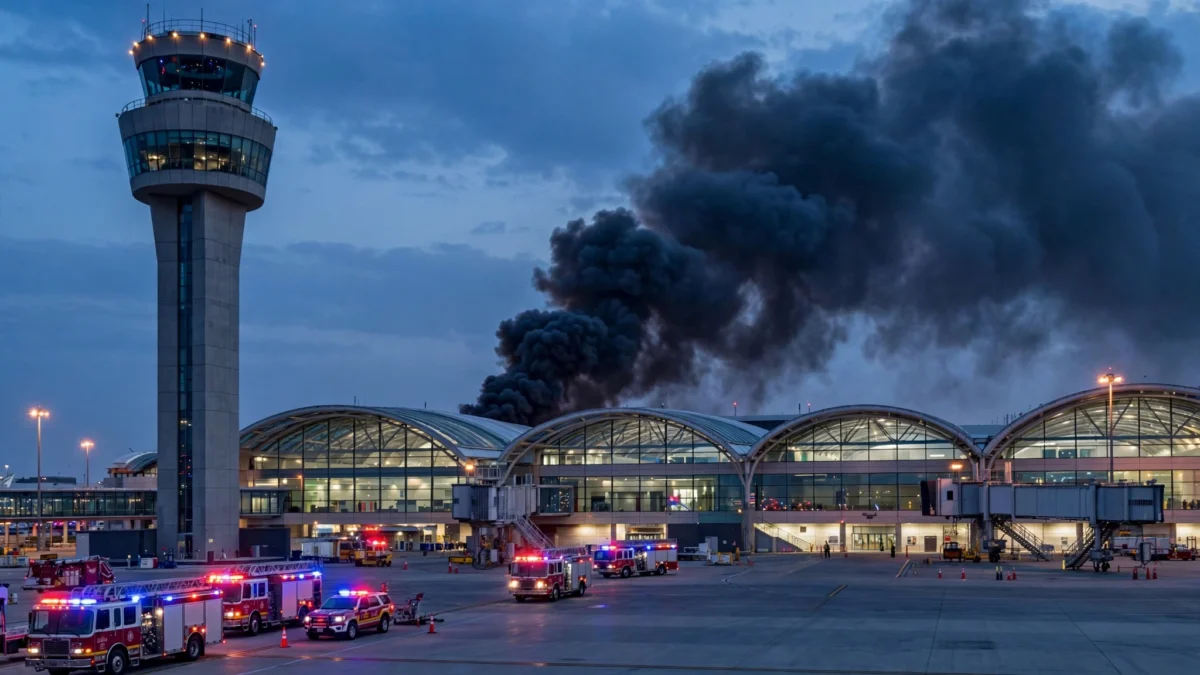
A missile slammed into a passenger-terminal complex at Riyadh’s King Khalid International Airport on Saturday afternoon, killing 12 people and wounding 309 more, Saudi aviation authorities announced early Sunday — the deadliest attack on any Gulf Arab country since the start of the Iran war, and a sharp escalation of the confrontation between the kingdom and Yemen’s Houthi rebels.
The strike hit a complex housing Terminals 3 and 4, which handle domestic flights, a regional official told the Associated Press on condition of anonymity because they were not authorised to speak to the media. The Saudi General Authority of Civil Aviation said in its statement that the dead included four Saudi citizens, two Bangladeshi nationals, a Palestinian, a US citizen, an Egyptian, a Jordanian, a Syrian and a Sudanese national. Some of those injured are in critical condition, the authority said, and are being treated at several hospitals in the capital.
The authority’s statement did not assign blame for the attack. But the head of the Houthi media office wrote in a post on X after the strike that the group had “shut down Riyadh international airport,” according to CNN. The Iran-backed rebels had already claimed responsibility for two earlier attacks on the same airport this week, which killed three Saudis — including a pilot — and damaged a commercial aircraft parked on the tarmac. Before the attacks, the Houthis had warned global airlines, in their words “for the last time,” about the consequences of operating in Saudi airspace.
Saturday’s strike was the third on the airport in a single week, and it unfolded with no warning. Saudi Arabia’s threat warning system issued no alert, CNN reported. Residents heard at least two loud blasts that shook parts of the capital, and plumes of black smoke rose from the airport complex. More than a dozen ambulances raced through the streets as the airport was evacuated, and entrances to the complex were blocked. “Everyone was running,” a witness told Agence France-Presse as the terminal was emptied.
Operations at the airport serving a city of roughly eight million people were temporarily suspended, and all flights were diverted, the civil aviation authority said. The airport later said air traffic was gradually resuming, with the flight-tracking site flightradar24 showing carriers from the Middle East returning to the schedule. Even so, several international carriers — including Germany’s Lufthansa Group and Air India — had suspended flights to the Saudi capital after the earlier strikes this week, according to earlier reporting on the campaign.
The attack drew an immediate response from Washington. Shortly after the strike, US President Donald Trump said he was evaluating whether the United States should join Saudi strikes against the Houthis. “We may. We’re going to look at it,” Trump told reporters. “We just found out about the recent attack. So we’ll make a decision. We move very quickly,” he said, according to the Associated Press. Trump added that he planned to speak to Saudi Crown Prince Mohammed bin Salman, CBS News reporter Jennifer Jacobs posted on X. US Secretary of State Marco Rubio condemned the attack, saying the United States stands with the kingdom. “These reprehensible attacks demonstrate a blatant disregard for innocent civilian life. They must stop now,” Rubio said in a statement on X.
A Saudi-led military coalition vowed to respond to the attack, and Saudi officials have in recent days described the Houthi campaign as an escalation of a wider war. The strikes came in the week since a Saudi-led coalition launched a major military offensive against the Houthis in Yemen, and since the Saudi-backed Yemeni government began a ground offensive against the rebel group. The Houthis, for their part, accused Saudi Arabia earlier Saturday of striking Sanaa International Airport in the rebel-held Yemeni capital.
The latest attack is expected to increase Saudi pressure on its allies — including the United States — to provide military support for the kingdom, the Associated Press noted. It also confronts Washington with a decision that could draw the United States deeper into the fighting on the Arabian Peninsula, months after a US-Israeli attack on Iran in February opened a new front of regional conflict.
Analysis: Why It Matters
A civilian airport — not a military base, not an oil facility — was hit in the heart of a Gulf capital, and twelve civilians from nine different nationalities are dead. That distinction matters, because it resets the stakes of a conflict that has been steadily spilling out of Yemen’s borders for years. An American was among the dead. That fact alone converts a regional security problem into a Washington problem overnight, and it is the single most likely reason the president’s response this time arrived within hours rather than days.
There are three things worth watching closely here, because each of them will decide whether this strike marks a peak or a beginning.
The first is the air-defence question. Saturday’s attack came without any warning from the kingdom’s threat warning system, according to CNN. The kingdom has spent billions of dollars on some of the most sophisticated air-defence systems in the world, and the Houthis have now hit the capital’s main airport three times in a single week. Each successful strike chips away at the deterrent value of those systems — and at the confidence of the international airlines, oil executives and investors the kingdom has spent years courting. Riyadh is due to host a major meeting of global oil chiefs; the timing of the campaign, deliberate or not, maximises the economic pressure. A government that cannot protect its own capital’s airport will find its ambitions — tourism targets, foreign investment, the very identity of a post-oil economic hub — priced differently by the market.
The second is the American decision. Trump’s “We may” is deliberately ambiguous, but it carries real weight. The United States has struck Houthi targets before, and it ran an air campaign against the group for years. The difference now is the request: a direct ask from Riyadh, an ally with a fresh pile of civilian casualties, for the United States to join a Saudi-led offensive. Joining would entangle Washington in an Arab-led air war against an Iran-backed group at a moment when the February US-Israeli strike on Iran is still reverberating. Staying out would signal to Riyadh — and to the region — that American security guarantees have limits precisely when they are being tested. Either choice sets a precedent, and the White House knows it. The president’s call with Crown Prince Mohammed bin Salman will be the first indicator of which way he leans.
The third is the escalatory logic on both sides. The Houthis’ declaration of Saudi airspace as a “zone of military operations” and their warning to airlines is designed to do economic damage without occupying a single inch of territory. Saudi Arabia’s answer — hundreds of strikes on Houthi-held territory, according to the kingdom and the Yemeni government, which the rebels say have killed civilians including women and children, claims Reuters said it could not independently verify — is designed to punish and degrade. Each side’s logic feeds the other’s. The rebels struck Sanaa airport; the kingdom struck Sanaa airport. Civilians keep paying the price in both directions, and the cycle has now produced the deadliest day the Gulf has seen since the Iran war began.
One more thread deserves attention: the nationalities of the dead. Four Saudis, two Bangladeshis, an American, a Palestinian, an Egyptian, a Jordanian, a Syrian and a Sudanese. That list reads like a snapshot of the Gulf’s labour force and its transit traffic — the workers and travellers who pass through Riyadh every day. It is a reminder that “the Houthi-Saudi war” is not really a bilateral affair at all. It runs through the lives of migrant workers, airline passengers, oil markets and the travel advisories of half a dozen governments. The United States, Britain, Germany, Australia and Canada all told their citizens to stay away from the area after the strike, according to NPR. When an attack on a single terminal redraws the travel plans of five countries, the label “regional conflict” has already stopped describing reality.
What to Watch Next
First, the president’s conversation with the Saudi crown prince. Any shift from “we may” to a commitment — or a clear refusal — will define the next phase of the campaign. Watch for movement of American assets in the region, which tends to precede such decisions.
Second, the Saudi response. The coalition has vowed to answer, and its recent pattern — hundreds of strikes on Houthi-held territory — suggests the retaliation could be heavier this time. Whether it targets launch platforms, as it did after Thursday’s attack when it said it destroyed three missile launch platforms, or goes further into leadership and infrastructure targets will say a lot about how Riyadh reads the moment.
Third, the air-defence and aviation picture. Whether international carriers extend their suspensions, whether the threat warning system is overhauled, and whether the kingdom can credibly promise safety ahead of the oil chiefs’ meeting will determine the economic cost of the Houthis’ campaign.
Fourth, the Houthi posture. The group has been explicit about its intentions: shut down Saudi airspace, force airlines out, make the war felt in the kingdom’s economic centres. Its next claim — or its next strike — will test whether Saturday was the culmination of this week’s campaign or its loudest chapter.
Fifth, the humanitarian and diplomatic dimension. With civilian casualties mounting on both sides and verification of competing claims thin, international calls for restraint are likely to grow — even as the logic of retaliation makes restraint harder. The UN and regional mediators have stayed largely quiet so far; that silence may not hold.
Sources
- Associated Press: “Attack on Riyadh airport killed 12 people and wounded over 300 more, Saudi authorities say” (via Reflector)
- CNN: “Attack on Saudi airport leaves at least 12 dead, 309 wounded”
- Reuters: “Houthi strikes on Riyadh airport killed three Saudis as war escalates” (background on Thursday’s earlier attack)

About the Author — Abdul Mannan
Related Articles
Israeli Strikes Kill at Least Five in Gaza on First Anniversary of US-Brokered Ceasefire
Israeli strikes killed at least five Palestinians in Gaza City on Saturday — the first anniversary of the…
Missile Strike Hits Terminal 3 at Riyadh Airport, Many Wounded, as Saudi-Houthi Conflict Escalates
A missile struck Terminal 3 of King Khalid International Airport in Riyadh on Saturday, wounding many and forcing…
Gaza Ceasefire at One Year: Promises Unfulfilled as Strikes and Suffering Continue
One year after the 10 October 2025 US-brokered ceasefire was meant to end the Gaza war, its political…