DOJ Opens Antitrust Investigation of Five Major TV Networks Over White House Press-Pool Boycott

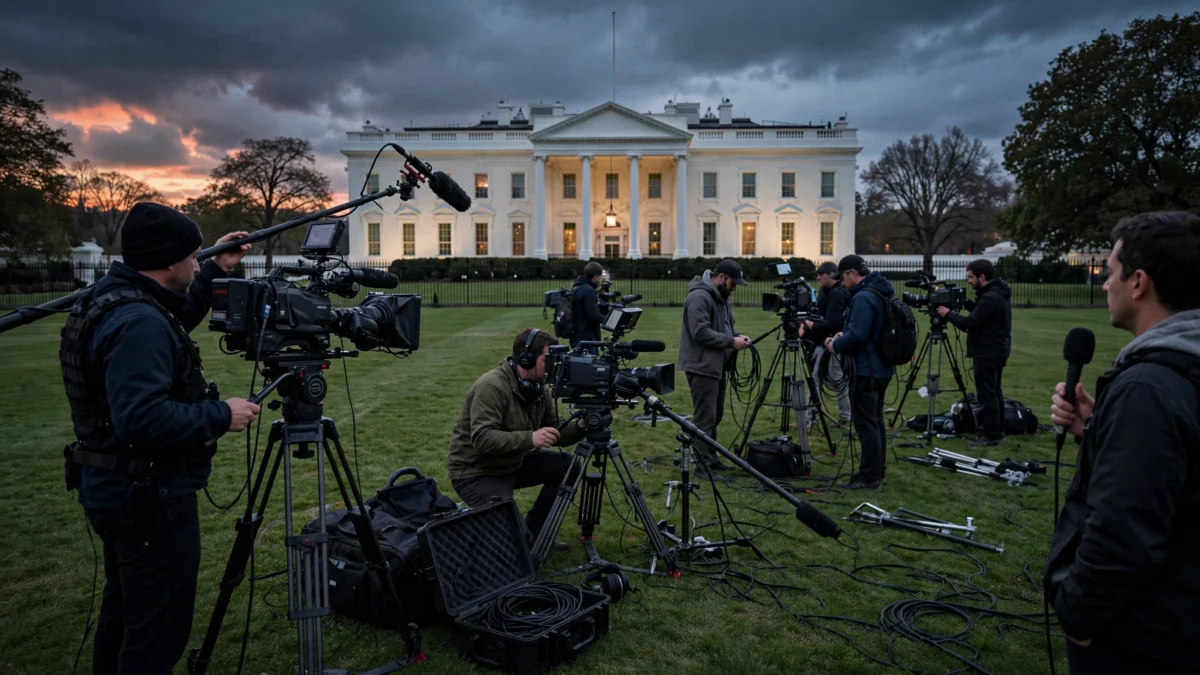
The United States Department of Justice is investigating whether five major television networks violated federal antitrust laws when they briefly suspended their shared coverage of the White House last month, opening what one First Amendment group has called a highly unusual — and politically charged — new front in the Trump administration’s confrontation with the press.
The networks under scrutiny are ABC, CBS, CNN, Fox News and NBC, the five broadcasters that together make up the primary White House television pool, according to Reuters. The New York Times first reported the existence of the probe on Saturday, and a Justice Department spokesperson later confirmed its contours to multiple outlets.
The investigation concerns the networks’ decision last month to withhold pooled coverage of President Donald Trump after the White House barred reporters from CNN, MS NOW and Politico from the White House complex in mid-September, revoking their credentials. The television pool — a rotating arrangement through which a small group of broadcast journalists covers the president on behalf of the wider press corps — then announced it would suspend coverage in solidarity with CNN. Pool coverage was halted for several days before being restored.
“Group boycotts among commercial competitors can violate the Sherman Act,” Justice Department spokeswoman Emily Covington said in a statement, according to the Associated Press. “The Antitrust Division is simply investigating to determine whether these news organizations have violated the antitrust laws.”
The department’s statement frames the networks’ coordinated withdrawal from the pool as a potential group boycott — a category of conduct that antitrust law treats with seriousness because it involves competitors acting in concert to refuse to deal with someone, in this case the White House.
According to the Wall Street Journal, executives at the networks learned of the probe on Friday, with Justice Department officials seeking records of communications among the networks about the pool arrangement. Representatives for the five networks either declined to comment or did not respond to requests for comment on Saturday, according to CNN and Reuters.
The move marks the latest escalation in a protracted and bitter fight between the administration and the news organisations that cover it. For more than a year, the White House has steadily increased pressure on outlets whose coverage the president dislikes — and Saturday’s announcement effectively puts the Justice Department on two sides of the same dispute at once: defending the White House’s decision to exclude the three outlets, while simultaneously investigating the networks that protested it.
The ban that triggered the standoff
The confrontation began in the third week of September, when the White House moved against three news organisations in quick succession. Trump said on September 18 that he was banning CNN, MS NOW and Politico from the White House complex, complaining about their coverage of him, according to USA Today. The following day, the White House blocked reporters from the three outlets from entering the building and revoked their credentials, declaring that covering the president was a “privilege — not a right,” according to Reuters.
For a press pool built on rotation and shared burden, the exclusion created an immediate practical and principled problem. CNN was scheduled to provide pool coverage at least once during the period in question, and the television pool’s chair said in an email on September 21 that with the White House “preventing CNN from fulfilling its assigned pool duties,” there would be “no replacement pool put in place,” according to CNN.
The result was a coverage gap: there was no pooled television coverage of the president’s events for several days, a highly unusual interruption of a decades-old arrangement. The impasse broke only after a federal judge intervened. On September 24, a judge issued a temporary restraining order requiring the White House to reinstate the outlets’ press passes, according to USA Today. The order remains in effect through Tuesday, and the underlying litigation — in which CNN, MS NOW and Politico argue the exclusion violated their constitutional rights to free speech — is still pending. The Justice Department is defending the administration’s action in that court case, CNN reported.
Television pool coverage of the White House has since resumed, though the administration has increasingly invited right-leaning outlets, such as Real America’s Voice, to travel with the president at a higher rate than before the boycott, according to The Desk.
What the investigation alleges — and why it is unusual
At its core, the department’s case rests on the argument that the five networks are commercial competitors, and that competitors who jointly refuse to provide a service can run afoul of the Sherman Act’s prohibition on restraints of trade. From that vantage point, the brief halt in pool coverage looks like a textbook concerted refusal to deal: several rival news organisations, acting together, stopped supplying coverage to the same counterpart.
But antitrust lawyers and press-freedom advocates see it very differently — and that is precisely what makes the probe so contentious. The White House press pool is not a market in any ordinary sense. It is a logistical cooperative: the networks share the cost of covering the president, take turns organising coverage, and share the resulting footage with outlets around the country, according to Reuters. The pool exists because space around a president is limited — only a handful of cameras can fit into the Oval Office or aboard Air Force One — not because the networks are fixing prices or dividing territories.
One leading First Amendment group called the inquiry nonsensical, CNN reported. Jose Zamora, the Committee to Protect Journalists’ regional director of the Americas, criticised the administration’s decision to investigate, according to the Associated Press. The networks themselves did not immediately respond to requests for comment from Reuters on Saturday.
The probe also arrives with an unmistakable political backstory. Two weeks before the investigation was disclosed, Trump ally Laura Loomer publicly encouraged the Justice Department to challenge the networks on antitrust grounds, according to CNN. And the investigation fits a broader pattern of pressure on the media: the Wall Street Journal noted that Trump said in July that ABC and NBC should lose their broadcast licenses for not carrying one of his speeches, that he has described unfavourable coverage as treasonous, and that his administration has subpoenaed journalists and limited access to government spaces.
Analysis: Why It Matters
Strip away the legal terminology, and this is a dispute about the terms on which the press is allowed to act collectively — and about what happens when solidarity itself becomes the subject of a federal investigation.
That matters for three reasons, none of which depend on taking a side in the underlying September standoff.
First, the antitrust theory being floated here is genuinely novel when applied to journalism. The Sherman Act’s group-boycott doctrine was built for markets: cartels of retailers strangling a supplier, trade associations locking out a rival. Press pools are cooperatives created to solve a physical problem — you cannot fit fifty cameras in a room built for five. Applying competition law to how news organisations organise shared access to the president turns a tool designed to protect consumers into a tool that polices newsroom coordination. Even if the probe never produces charges, the signal to newsrooms is clear: coordinated pushback against White House access decisions carries legal risk. That is a precedent any administration could reach for, against any press corps, over any grievance.
Second, the department’s posture exposes a structural tension that will be hard to sustain in court and harder to explain in public. The same Justice Department that is arguing — in one courthouse — that the White House had every right to strip three outlets of their credentials is now arguing — in its own corridors — that the networks’ collective protest over that very exclusion may have been an illegal boycott. One of those positions treats the press’s access to the president as a revocable privilege; the other treats the press’s coverage of the president as a commercial service owed to him. The administration is, in effect, asking to have it both ways: the White House may exclude whom it likes, and the networks may not collectively object.
Third, the timing concentrates attention on the calendar. The judge’s temporary restraining order reinstating the three outlets’ passes is in effect through Tuesday. The underlying First Amendment litigation is ongoing. A federal investigation hovering over the five networks in the middle of that fight does not just look like legal analysis — it functions as pressure on the participants while the case is live. Whether or not that is its intent, it is its effect, and press advocates are reading it that way.
What to Watch Next
The next hard data point arrives Tuesday, when the restraining order reinstating the three outlets’ credentials expires and the court decides how the First Amendment challenge proceeds. The Justice Department’s own statement says the antitrust inquiry is “simply investigating,” which is language designed to keep expectations low — but the department has already asked the networks for their internal communications about the pool, which is not how preliminary peeks normally behave.
Watch, too, whether the probe stays civil or hardens into something more formal, whether any of the five networks chooses to push back publicly rather than through lawyers, and whether the press corps — print and radio outlets, which also declined to provide substitute coverage during the boycott, according to The Desk — draws the investigation’s attention as well. For now, the pool is functioning and the cameras are rolling. But the question of what the press is permitted to do together, and at what cost, is now an open federal file.
Sources
- Reuters — Justice Department probes TV networks over Trump pool coverage (via WIXX)
- Associated Press — DOJ says it’s investigating whether White House TV pool’s coverage halt violated antitrust law
- Wall Street Journal — Justice Department Probes TV Networks Over Suspension of Trump Press-Pool Coverage
- CNN — Trump’s DOJ probes major TV networks over response to White House ban of CNN
- USA Today — DOJ launches antitrust probe of TV networks over Trump pool coverage

About the Author — Abdul Mannan
Related Articles
Trump Tells Ukraine to “Get a New President” as Rift With Zelensky Deepens Over Russian Diesel Deal
Trump says it is "time for Ukraine to get a new president" as he clashes with Zelensky over…
Trump Says US May Join Saudi Strikes Against Houthis After New Riyadh Airport Attack
President Donald Trump said on Saturday that the United States may join Saudi Arabia's strikes against Yemen's Houthi…
Trump Turns Syracuse Rally Into Midterm Closing Argument: $5,000 ‘Trump Dividend,’ Troop Pledge for New York and a Ban on Sanctuary Cities
At a Friday-night rally in Syracuse, Donald Trump promised a $5,000 payment to every adult citizen if Republicans…