Trump Turns Syracuse Rally Into Midterm Closing Argument: $5,000 ‘Trump Dividend,’ Troop Pledge for New York and a Ban on Sanctuary Cities

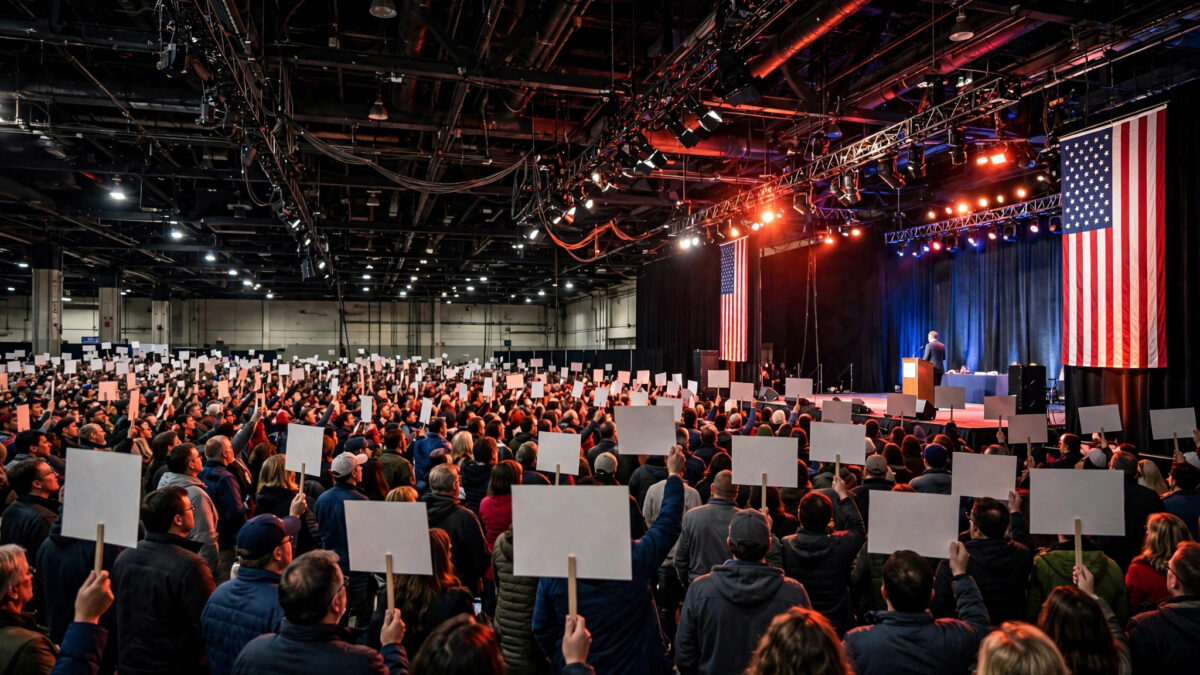
SYRACUSE, New York — Twenty-five days before the midterm elections, President Donald Trump took his closing argument to a packed house at Syracuse’s Oncenter convention center on Friday night, delivering a roughly 90-minute rally that mixed a conditional cash promise, a pledge to send federal forces into New York, and an endorsement of Republican gubernatorial nominee Bruce Blakeman’s bid to unseat Democratic Governor Kathy Hochul.
“Please pretend I’m on the freaking ballot,” Trump told the crowd, according to a New York Post account of the speech. “And in a really, in a certain way, I am on the ballot because they can take away everything that we got.”
The rally, held Friday evening, was Trump’s most direct intervention yet in the New York governor’s race, and it doubled as a preview of the national message Republicans will carry into November 3: lower taxes, cheaper energy, tougher immigration enforcement and safer streets.
The $5,000 ‘Trump dividend’ — now conditional on a Republican Congress
The headline economic promise of the night was one Trump has been sharpening for weeks: if Republicans retain control of both the House of Representatives and the Senate on November 3, every adult American citizen would receive a $5,000 payment — what Trump calls a “Trump dividend.”
“If Republicans win the House of Representatives and the Senate, I am going to give all adult citizens in the United States of America $5,000 each,” Trump told supporters, according to the Indo-Asian News Service (IANS), which covered the rally.
Trump put the total cost at approximately $1 trillion and said it would be financed through tariff revenues and economic growth, adding a single caveat: “The only caveat on the Trump dividend is that you must spend your money in the United States of America.” The payment, as he described it, would go only to adult citizens — green-card holders and temporary visa workers would be excluded.
The proposal did not originate in Syracuse. Trump first unveiled the $5,000 pledge in September at the 2026 Republican midterm convention in Dallas, framing it as a shareholder-style distribution of what he calls record economic success. He repeated it days later in a Truth Social video and at a rally in Vandalia, Ohio, warning that a Democratic victory would instead bring “an economic depression, much like 1929.”
There are significant caveats that Trump himself has acknowledged must be resolved. The White House confirmed in September that the payments “would require congressional approval,” since the president cannot unilaterally direct more than a trillion dollars in spending. House Speaker Mike Johnson has said the plan would need a congressional vote, and most spending legislation requires 60 votes in the Senate. Senate Majority Leader John Thune has raised the budget-reconciliation route as a possibility, while House Appropriations Chairman Tom Cole has expressed skepticism.
The arithmetic is also contested. The nonpartisan Committee for a Responsible Federal Budget puts the single-year cost at roughly $1.2 trillion, while net tariff revenue in the first 11 months of fiscal 2026 was only about $167 billion, according to Treasury data. Polling from Strength in Numbers/Verasight found 53 percent of Americans support the payments in principle, but support drops to 35 percent — with 54 percent opposed — when the payment is tied to a Republican victory. Only 13 percent of respondents said they believed Trump genuinely intends to send the money, 62 percent said the promise is mainly intended to win votes, and 71 percent said it was inappropriate to tie payments to an election result.
Legal analysts have also begun scrutinizing the conditional framing. An analysis published by Just Security argued that a promise explicitly conditioned on voters electing a particular party’s candidates sits in tension with federal election law, including 18 U.S.C. Section 594’s prohibition on intimidating or coercing voters — though the same analysts acknowledge that other election-law experts argue campaign promises of benefits are core political speech protected by the First Amendment. No charges have been filed, and the debate remains academic. But the fact that a sitting president’s signature campaign promise is drawing this kind of legal attention underscores how far outside the ordinary campaign playbook the dividend pitch sits.
‘I’ll be there within 24 hours’: the troop pledge for New York
The most striking security pledge of the night was directed at New York itself. Trump told the crowd that if Blakeman is elected governor and asks for federal help tackling crime in New York City, he would send the National Guard or federal troops — and arrive himself quickly.
“If Bruce Blakeman, as your governor, calls me to help straighten out in New York City or pretty dangerous parts of this state that I know and love so much, I’ll be there within 24 hours, Bruce,” Trump said, according to the New York Post.
Trump claimed that with Blakeman in the governor’s mansion, “within two months you’ll go from a high crime city to almost no crime at all — just like I did in Washington D.C., Memphis and New Orleans,” referring to the federal deployments his administration has ordered in those cities.
He paired the pledge with a defense of Immigration and Customs Enforcement officers involved in the shooting of suspected gang member Oscar Belgal in the Bronx earlier in the week, describing Belgal as a dangerous criminal who had been released under sanctuary policies. “If you want to stop illegal alien criminals from being released into your communities, you must elect Bruce Blakeman and a Republican Congress and we will ban sanctuary cities and sanctuary states at long last,” Trump promised.
The troop pledge follows an interview with Time magazine two weeks ago in which Trump refused to rule out invoking the Insurrection Act of 1807 or declaring a national emergency around the election, saying he was “not committing to anything” and would “see how it plays out in court.” The 1807 law allows a president to deploy the military or take control of a state’s National Guard in cases of insurrection or obstruction of law; it was last used by President George H. W. Bush during the 1992 Los Angeles riots. Trump has previously threatened troop deployments to Minneapolis and Los Angeles during unrest connected to immigration enforcement.
Immigration, voter ID and the death penalty
Beyond New York, Trump laid out pieces of a national agenda he said a Republican Congress would enact: voter identification requirements, with proof of citizenship to cast a ballot; an end to sanctuary-city and sanctuary-state policies; and an expansion of the death penalty to additional categories of offenders.
He praised ICE and border enforcement repeatedly, criticized Democratic positions on transgender policies in schools, and restated his claim that his administration has helped end eight wars and prevented wars in many other countries — a claim he has made frequently and that fact-checkers have challenged.
On energy, Trump argued that New York is sitting on vast untapped reserves. “You are sitting on some of the greatest oil reserves anywhere in the world, and you’re not allowed to touch it,” he said, predicting that Blakeman would cut New Yorkers’ electric bills by 70, 80 and even 90 percent — figures he offered without evidence, according to the Post. Blakeman warmed up the crowd by pledging that New York would be opened up to fracking and would cease being a “sanctuary state,” telling supporters: “We’ve got to tap into that Marcellus Shale. It’s drill baby drill.”
The theater: Tyson, protesters and a ‘Lake America’ joke
The rally was pure campaign theater. Trump traveled to Syracuse aboard Air Force One with boxing legend Mike Tyson and New York Yankees president Randy Levine, along with Energy Secretary Chris Wright, EPA Administrator Lee Zeldin and Republican Representatives Claudia Tenney and Nick Langworthy, according to the New York Post.
Tyson took the stage briefly. “I’m just happy to be here with my president, President Trump,” he said, according to the Democrat and Chronicle, which ran a live blog from the event.
About ten minutes into Trump’s speech, a protester interrupted, prompting boos and a “U-S-A” chant from the crowd as the demonstrator was led out. Trump dismissed the protesters as “paid political actors” and “losers,” according to the Democrat and Chronicle. Another protester was later removed.
Trump also drew wild applause with a joke renaming Lake Ontario as “Lake America,” telling the crowd: “Here we are, not far from the shores of Lake America.”
Senator Kirsten Gillibrand, New York’s senior Democrat, criticized the trip before it began. “Nothing Donald Trump says tonight can distract from his chaos, corruption, and cost increases hurting New Yorkers every single day,” she said in a statement quoted by the Democrat and Chronicle, criticizing the administration on affordability, health care and its remake of Washington.
Trump also used the stage to vent about the Nobel Peace Prize — reprising criticism of the Norwegian committee’s decision to award this year’s prize to former ICC judge Navi Pillay, a subject covered in this site’s earlier reporting — and attacked Governor Hochul and Attorney General Letitia James by name.
The other side of the money fight
While Trump was promising checks, Democrats were scrambling for cash of their own. The Democratic Congressional Campaign Committee sent donors an urgent memo this week setting an October 22 deadline to raise $17 million for four House districts that Trump carried by double digits in 2024 — Florida’s 27th, Nevada’s 2nd, South Carolina’s 1st and New York’s 21st — according to Politico, as reported by Newsmax and the Associated Press.
DCCC executive director Julie Merz warned donors they “could be leaving winnable races on the table” without the money, while conceding that “the Republican ecosystem has amassed a massive war chest that is significantly greater than ours and is spending it.” The nonpartisan Cook Political Report rates Florida’s 27th as leaning Republican and the other three as likely Republican, though internal Democratic polling, cited in the memo, suggests the races are within reach.
The memo also identified Republican-held seats in Arkansas and North Carolina — held by Representatives French Hill and Richard Hudson — as Democratic targets. Hudson, who chairs the National Republican Congressional Committee, mocked the Democrats’ plea.
Analysis: Why It Matters
Strip away the rally theatrics, and the Syracuse night contained three ideas that will shape the final three and a half weeks of the campaign — and possibly well beyond it.
First, the dividend makes the election itself the product. American campaigns have always promised benefits: tax cuts, programs, checks in the mail. But those promises have traditionally been framed as policies a candidate will pursue in office. Trump’s framing is different and deliberately so — the payment arrives only if his party wins both chambers. That conditionality is what has legal analysts reaching for the statute books and pollsters finding that voters, by wide margins, view the linkage as inappropriate even when they like the money itself. Whether or not the payments ever materialize, the pledge converts a midterm — an election the president is not personally contesting — into a direct transaction between the voter and the White House. “Pretend I’m on the freaking ballot” is not a throwaway line; it is the entire strategy. Trump is nationalizing an election that was supposed to be fought in 435 separate districts, and making himself the referendum question.
Second, the numbers are the campaign’s weakest flank. A $1 trillion promise funded by $167 billion in tariff revenue is a gap of more than a trillion dollars, and that is before the constitutional reality: the president cannot spend money Congress has not appropriated. The administration’s own allies have admitted as much — the White House says congressional approval is required, the Speaker says a vote is needed, and a leading House appropriator is openly skeptical. That leaves the dividend in an unusual position: simultaneously the centerpiece of the closing argument and, by the administration’s own account, something that may never happen. The political logic is that the promise does not need to be payable to be powerful. The 53-percent approval of the idea itself suggests Trump is betting that voters will remember the offer, not the legislative mechanics. Democrats, meanwhile, will spend the next three weeks doing the math out loud — a fight Trump appears happy to have, since every headline about the dividend is a headline not about the deficit, the war or the courts.
Third, the New York troop pledge is the clearest preview of a second-term domestic-security doctrine. Threatening to deploy the National Guard or federal troops to an American state at a governor’s invitation is not new in itself — but the context is. The deployments in Washington, Memphis and New Orleans are being held up as the template, the Insurrection Act was left explicitly on the table two weeks ago in the Time interview, and the Syracuse formulation (“within 24 hours”) turns a conditional federal power into a campaign promise. For supporters, it is the strongest possible signal that federal force will be used against urban crime and sanctuary jurisdictions. For critics, it is the normalization of military deployment as ordinary campaign rhetoric. Either way, it is no longer a hypothetical discussed in interviews — it is a promise made to a cheering arena, attached to a specific candidate and a specific state.
Fourth, watch the state races underneath the national noise. The rally was nominally about Blakeman versus Hochul, and New York’s governor’s race — alongside the House seats the DCCC is desperately funding in districts Trump won by double digits — will test whether Trump’s personal gravitational pull can move races in territory where his party is structurally disadvantaged. If Blakeman keeps it close, Republicans will read it as proof that the nationalized closing argument works everywhere. If he does not, Democrats will read it as proof that money and maps still matter more than rallies.
What to watch next: whether the DCCC hits its October 22 fundraising deadline; whether Senator Bernie Moreno or anyone else introduces dividend legislation before November 3; how the White House answers the legal and fiscal critiques of the conditional payment; whether the Nobel committee or European allies respond further to the Syracuse remarks; and whether Trump’s closing argument — money, troops and immigration — moves the needle in the districts both parties are now openly fighting over.
Sources
- IANS: Trump outlines sweeping agenda ahead of midterms
- New York Post: Trump pledges to partner with Blakeman to ‘straighten out’ New York
- Democrat and Chronicle (USA Today network): live updates from the Syracuse rally
- WRGB/Fox 49 (Sinclair/NBC affiliate): rally report, voter ID and death penalty pledges
- QNC News: Trump vows National Guard or troops for New York
- Just Security: legal analysis of the $5,000 ‘dividend’ promise
- Newsmax/AP: House Democrats’ urgent $17 million fundraising plea

About the Author — Abdul Mannan
Related Articles
Federal Judge Rules Justice Department’s Nationwide Voter-Roll Audit Unlawful
A Washington federal judge has struck down the Justice Department's nationwide campaign to collect state voter lists and…

Trump Announces Russian Diesel Deal With Putin; Zelenskyy Condemns It as a “Gift” That Will Fund the War
President Trump says Vladimir Putin agreed to supply up to 4.8 million tonnes of Russian diesel to world…
Trump Picks Katie Zacharia as New White House Press Secretary, Ending Weeks-Long Search After Leavitt’s Exit
President Donald Trump has chosen conservative commentator and former Homeland Security spokeswoman Katie Zacharia as the next White…