National March for Palestine in Central London Ends in 20 Arrests After Battle of Britain Memorial Climb

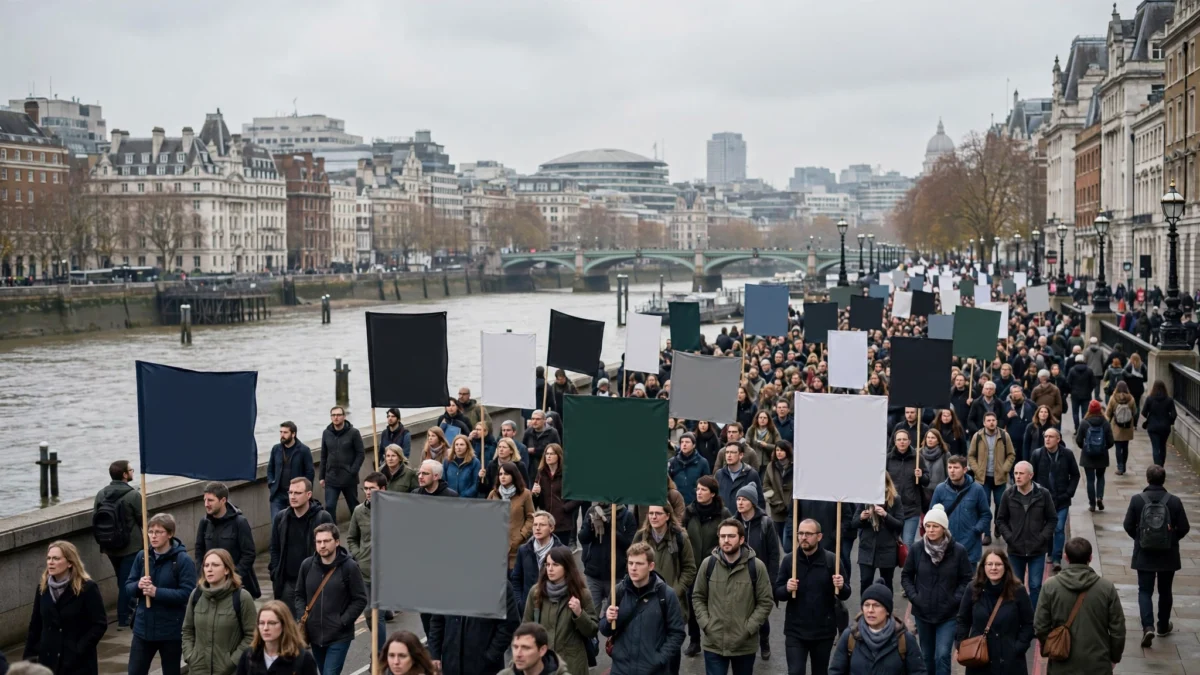
Thousands of pro-Palestinian demonstrators marched through central London on Saturday in the National March for Palestine, an event that ended with 20 arrests after six protesters climbed onto the Battle of Britain memorial on Victoria Embankment, according to the Metropolitan Police.
The march, organised by the Palestine Coalition umbrella group, formed up on Victoria Embankment at midday before proceeding across Westminster Bridge, along York Road, over Waterloo Bridge and down The Strand to a rally on Whitehall near Parliament, which concluded shortly before 5pm, according to reporting from the PA news agency.
The demonstration was timed for the weekend of the third anniversary of the October 7, 2023 attacks on Israel, and was the first national Palestine march since the UK government declared last month that Israeli settlements in the occupied West Bank are unlawful, according to the Evening Standard. Demonstrators carried Palestinian flags and placards condemning Israel’s military operations in Gaza, and marchers called for an end to British arms sales to Israel, according to The Media Line.
Police confirmed that 20 people had been arrested during the day. Six were detained on suspicion of criminal damage after climbing the Battle of Britain memorial. Seven were arrested for breach of conditions imposed on the event, two of whom were also held for refusing to remove face coverings when asked by police. Two more were arrested for displaying placards expressing support for Palestine Action, an organisation proscribed under British counter-terrorism legislation. Other arrests related to suspected public order offences and assaulting police officers, according to the Metropolitan Police statement published on Saturday evening.
The policing operation
The Metropolitan Police had imposed conditions on both the Palestine march and a smaller counter-demonstration under the Public Order Act, in an effort to “minimise the risk of serious disruption to communities,” the force said before the event.
Deputy Assistant Commissioner Carl Galvin, who led the policing operation, said officers anticipated a significant presence on the ground. “We know Saturday’s event, so close to the third anniversary of the terror attack on Israel, has the potential to have a greater impact on communities than the previous national marches,” he said in a statement issued before the march.
Galvin also warned that police would use powers under Section 60AA of the Public Order Act, which allows officers to require people in a designated area to remove face coverings worn to conceal identity, and that refusal could lead to arrest. “We will do so if we see groups of people who refuse and are covering their faces with the intention to hide their identity, intimidate and commit offences. That is unacceptable,” he said. “But for individual cases, officers must carefully assess why a person is wearing a mask and respond in a measured way.”
Two of Saturday’s arrests came from exactly that power: demonstrators who refused to remove their face coverings after being asked by police.
A dispute over numbers
How many people marched is contested. The Palestine Coalition estimated that 250,000 people took part, according to the PA news agency. The Metropolitan Police had estimated before the event that between 7,000 and 10,000 demonstrators would attend. No independently verified attendance figure was available, The Media Line reported.
Crowd-size disputes have become a fixture of the London Palestine demonstrations, which have drawn sharply different estimates from organisers and police since they began after October 2023. What is not in dispute is that the march filled the planned route from the Embankment to Whitehall over the course of the afternoon, with the rally on Whitehall ending shortly before 5pm.
Corbyn addresses the rally
Among the speakers at the Whitehall rally was Jeremy Corbyn MP, the former Labour leader, who was greeted with loud cheers from the crowd, according to the PA news agency.
Corbyn claimed that recent British government sanctions against illegal West Bank settlements were a product of the protest movement. The demonstrations had brought the issue to the fore, he said, describing the sanctions as a result of “our demonstrations, our marches.”
The claim referred to recent moves by the UK government toward Israel’s settlement enterprise in the occupied West Bank, which the government declared unlawful last month — a designation the Evening Standard noted made Saturday the first national march under the new position. Labour MP John McDonnell was also among those who attended, and he shared a photograph of a bride and groom who joined the demonstration, the Standard reported.
A small counter-demonstration kept apart
A counter-demonstration organised by the group Stop The Hate took place on the same day, drawing around 30 people, according to The Media Line. Conditions were also imposed on that event: demonstrators had to remain within a designated area outside the Metropolitan Police’s New Scotland Yard headquarters, with the assembly concluding at 2.30pm.
Police officers and barriers kept the two groups separated as the much larger pro-Palestinian procession passed, and the counter-demonstration ended without incident being reported.
Background: three years of marches
Saturday’s demonstration was the latest in a long series of national marches that began after the Hamas-led attacks of October 7, 2023, in which around 1,200 people were killed in Israel and 251 taken hostage, and the subsequent Israeli military campaign in Gaza, where health officials in the territory say more than 74,000 people have been killed.
The anniversary context gave Saturday’s event particular charge. The march took place on the same weekend that marked one year since the US-brokered Gaza ceasefire took effect on October 10, 2025 — a truce that has held uneasily, with more than 1,400 Palestinians killed by Israeli fire since it began, according to Gaza health officials cited by Reuters.
In Britain, the political ground beneath the movement has shifted over the past year. The government has moved from largely rhetorical positions to concrete measures: declaring West Bank settlements unlawful, imposing sanctions on the settlement enterprise, and continuing the proscription of Palestine Action under terrorism legislation — a designation that has itself become a recurring source of arrests at demonstrations, including Saturday’s, where two people were detained for placards expressing support for the banned group.
The climbing of the Battle of Britain memorial — the national monument on the Embankment to the airmen of the Second World War — was the most contentious incident of the day and drew the largest single group of arrests. The image of protesters atop a war memorial has, at previous demonstrations, provoked fierce public and political reaction well beyond the march itself, and Saturday’s incident is likely to dominate the aftermath.
Analysis: Why It Matters
The movement claims the policy is moving its way. Corbyn’s central argument on the Whitehall stage — that the sanctions and the illegality declaration flow from three years of marching — is the movement’s foundational claim about itself: that persistence in the streets translates into movement in Whitehall. The truth is more complicated. Governments rarely credit demonstrations for policy shifts, and Britain’s evolving position on settlements has been driven by a mix of factors, from international court rulings to alliance politics. But the direction of travel is real, and Saturday’s turnout — whatever the precise number — was a demonstration that the organisers still have the infrastructure to fill central London three years on. Movements that survive past the initial burst of outrage are the ones that learn to sustain that infrastructure; the Palestine Coalition’s ability to stage large national events repeatedly is itself the political fact, regardless of which specific decisions it can take credit for.
The policing playbook is hardening. The Met’s approach on Saturday — pre-announced conditions, publicised Section 60AA face-covering powers, and a senior officer’s unusually explicit warning about arrests — reflects a force that has learned from three years of high-tension demonstrations and has gradually expanded the range of interventions it is willing to make in advance. The face-covering arrests are the newest instrument: Section 60AA had been authorised relatively sparingly before, and its visible use on Saturday marks a small but real escalation in how the Met manages large protests. Expect the civil liberties argument to follow in the coming days — the tension between preventing intimidation and preserving the right to anonymous protest is not new, but each new arrest under the power gives the debate fresh material.
The memorial incidents are the political afterburn. Six arrests for criminal damage on the Battle of Britain memorial will, in terms of headlines, likely matter more than everything else that happened on the march. At previous demonstrations, incidents involving national monuments have travelled far beyond the communities that attended, reshaping how the wider public views the entire movement and giving its critics their most shareable footage. The Coalition’s challenge is that it cannot fully control the fringes of a quarter-million-strong event — and that its opponents do not need it to. Each memorial incident is converted into a referendum on the march itself. How the organisers respond — whether with swift condemnation, an internal enforcement effort, or silence — will shape the story of Saturday for days.
The Palestine Action proscription is now part of every protest. Two more arrests for displaying support for a proscribed organisation is a reminder that the ban has not shrunk the issue but relocated it: into every subsequent demonstration, where officers must decide in real time what counts as “displaying support,” and where organisers must manage placards they may not have printed. The proscription was intended to draw a bright line. In practice it has created a rolling series of legal boundary disputes at every large gathering, each one producing defendants, headlines and court cases that keep the group in the news.
What to watch next: whether the Metropolitan Police releases a final arrest tally and any footage of the memorial incident; how ministers and opposition figures respond to the climbing of the Battle of Britain memorial; whether the 250,000 turnout claim triggers any independent estimate; the court outcomes for those arrested on Saturday, particularly the two detained over Palestine Action placards; and whether the Coalition announces another national march — and whether the government advances any further policy on arms sales, the movement’s central unmet demand.
Sources
- PA news agency (via The Oldham Times): Several arrests made as thousands descend on London for pro-Palestine protest
- The Media Line: London Pro-Palestinian March Draws Thousands, Police Arrest 20
- Evening Standard (via Ghanamma): Twenty arrested at pro-Palestine march in central London
- Particle News: Thousands March in London for National March for Palestine

About the Author — Abdul Mannan
Related Articles

Man Dies After Entering Tiger Enclosure at Yorkshire Wildlife Park Near Doncaster
A man has died after being attacked by a tiger at Yorkshire Wildlife Park near Doncaster, police say,…
Thousands March Through Central London in Palestine Protest Under Strict Met Conditions
Thousands of pro-Palestine demonstrators are marching through central London today under strict police conditions, with the Met expecting…
Jewish Greens Chair Calls for Polanski to Resign Over “Dereliction of Duty” as Party Crisis Deepens
Vivien Lichtenstein says Zack Polanski should quit as Green leader over the "Zionism is racism" motion, as Caroline…