Jewish Greens Chair Calls for Polanski to Resign Over “Dereliction of Duty” as Party Crisis Deepens

A resignation call from inside the house
The chairwoman of the Jewish Greens has publicly called on Zack Polanski to resign as leader of the Green Party of England and Wales, accusing him of a “dereliction of duty” over a controversial conference motion that declared Zionism to be racism, according to the Press Association.
Vivien Lichtenstein, speaking on Times Radio on Friday, said Polanski had committed a “big mistake” by failing to intervene in the debate over the motion at the party’s conference last weekend — a vote he did not take part in because he was campaigning in the Holborn and St Pancras by-election.
“It was a big mistake for Zack not to find a place, a quiet place, where he could have gone online for the motions debate, where he could have spoken to the two amendments that he supported,” she said, according to PA. “He should have done that. And I think that was a big mistake on his part.”
Asked whether Polanski should remain as leader, Lichtenstein was blunt: “No, I think he should resign.”
She also said she was now considering leaving the party herself, and expressed surprise at reports that Polanski had been working with Jewish members of the party. “It certainly hasn’t been with the Jewish Green committee,” she said, according to PA.
The intervention is the most direct challenge to Polanski’s leadership from within the party’s own Jewish caucus, and it landed hours after he conceded defeat in the Holborn and St Pancras by-election to Labour’s Sagal Abdi-Wali — a contest he had made the centrepiece of his leadership pitch.
Caroline Lucas: “huge issues” and an entryism warning
Lichtenstein’s call was echoed — in more measured terms — by Caroline Lucas, the party’s first MP and former leader, whose standing with the membership has made her interventions impossible to ignore.
Appearing on the BBC’s Any Questions programme, Lucas said Polanski should apologise for missing the vote and “for the hurt that has been caused to so many people,” according to PA. She stopped short of calling for his resignation but said there were “huge issues” in the party that he should help to resolve.
Lucas also raised a concern that could haunt the party’s internal investigation into the vote: the possibility of “entryism”, with activists joining the Greens solely to back the motion rather than because they supported the party.
Earlier, on Thursday evening, Lucas had told BBC Newsnight that Polanski had failed to “show leadership” against the motion, which she described as “flawed from top to bottom” as well as “divisive” and “dangerous”. Pressed on whether he should stand down, she declined to answer directly: “Let’s see what happens in the coming days and weeks.”
But on Friday she struck a more conciliatory note in a post on X, saying Polanski had indicated he shared some of her concerns about the motion. “Today he’s indicated he shares some of my concerns on the Zionism motion and I welcome that,” she wrote. “Now the party needs to come together to make the urgent changes needed to take us forward.”
The motion that detonated the crisis
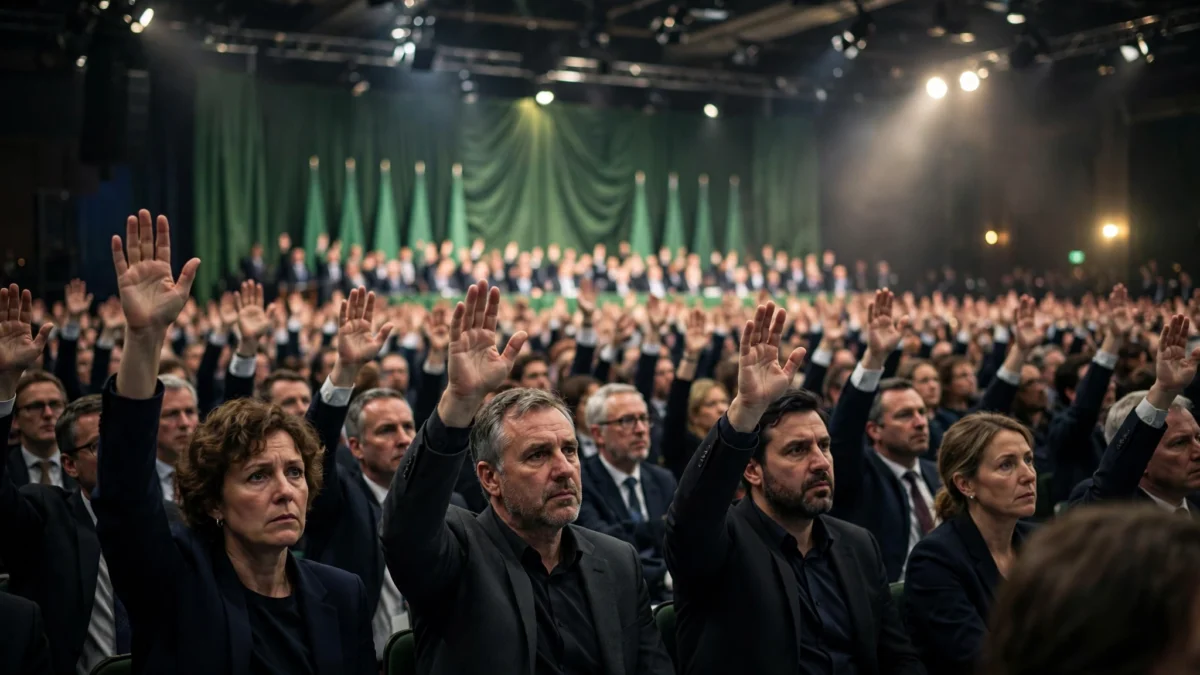
The crisis traces to a vote taken at the Green Party conference last Sunday, where members adopted a motion — proposed by members of the Greens for Palestine group — that declared Zionism should be “treated as any other form of racism” by the party. The motion passed with 1,022 votes in favour and 813 against, according to The Times.
The motion defined Zionism as an ideology supporting “an ethnonationalist Jewish state” and backed a “single democratic Palestinian state in all of historic Palestine”, a formulation that includes modern-day Israel, according to the Observer. It also described Israel as “committing genocide” and advocated a single Palestinian state with Jerusalem as its capital.
Two amendments failed: one that would have protected Green Party members from disciplinary action for attending or being affiliated with Zionist venues such as synagogues or Jewish community institutions, and another that would have watered down the language on a single democratic Palestinian state.
Lucas had urged members in a closed-door session to reject the motion, warning against “the oversimplification at the heart of this motion” and saying it was leaving “so many Jewish members feeling scared and unwelcome in our party,” according to The Times. Four of the party’s five current MPs — including Westminster leader Ellie Chowns — also opposed it, along with former co-leader Adrian Ramsay and Bristol Central MP Carla Denyer.
The motion’s supporters inside the hall argued a different case. Mothin Ali, the party’s deputy leader and a Leeds councillor, urged members to vote for it, telling delegates, according to a Times account from a source in the hall: “At its heart racism is creating a hierarchy of human worth. The belief that one group is entitled to greater rights, greater security, greater freedom or greater power than another.”
Polanski did not cast a vote. A Green Party spokesman said he was on the campaign trail for the Holborn and St Pancras by-election, in which he was standing as a candidate. In a Friday interview with Sky News, Polanski said he would only have supported an amended motion. “Ultimately, I agree with the substance of the motion,” he said. “Where I disagree is the idea the Green Party should be deciding what the future of the region looks like,” according to PA syndication.
Israel bans the Green leader; US to make representations
The international fallout has been swift and severe. Israel’s foreign ministry announced on Sunday that it had barred Polanski from entering the country in response to the conference vote.
“Today, the Green Party in Britain adopted a resolution equating Zionism with racism, legitimising armed struggle against Israel, and calling for the establishment of a Palestinian state ‘from the river to the sea’ — meaning the destruction of the state of Israel,” the ministry said in a statement quoted by The Times.
“The resolution constitutes a clear antisemitic text according to the IHRA [International Holocaust Remembrance Alliance] definition, as it denies the Jewish people’s right to self-determination. Therefore, as a first step, foreign minister Gideon Sa’ar has decided this evening to declare Green Party leader Zack Polanski barred from entering Israel. The decision has been co-ordinated with the relevant authorities.”
The Times separately reported that the United States will make “representations” about the Greens’ Zionism policy — a diplomatic signal that the motion’s reverberations are not confined to domestic British politics.
Equalities watchdog referral and resignations
At home, the legal and institutional pressure is mounting. The Campaign Against Antisemitism (CAA) said it had written to the Equality and Human Rights Commission (EHRC) because of the policy’s “real potential to embolden expressions of antisemitism,” according to The Times. The CAA is the same organisation that successfully reported the Labour Party for antisemitism under Jeremy Corbyn’s leadership in 2018 — a case that ended in a landmark EHRC investigation and a formal action plan.
Gideon Falter, the CAA’s chief executive, said the campaign “will not stand idly by as extremists hijack a political party and make antisemitism its openly stated policy,” according to The Times.
The vote has already prompted several members to resign, including at least one serving councillor, the Observer reported. On BBC Radio 4’s Today programme, Lichtenstein said it was “quite possible” she would leave the party over the vote: “I haven’t decided yet … It is quite possible that I will leave the party. I’m giving it a little time and to talk with colleagues.”
Prime Minister Andy Burnham has also intervened, calling on Polanski to reverse the policy. Speaking on a visit to Berlin, Burnham said, according to The Times: “I think [the passing of the motion] was a completely wrong decision, a terrible judgment on the part of the Green Party of England and Wales. In effect, ruling out a two-state solution between Israel and Palestine, and for that reason it shouldn’t be supported in any way, shape or form.”
He added that all UK political parties should do everything they can to support the two-state solution, and that “certainly will remain the government’s position.”
Polanski’s response: stay on, members decide
For his part, Polanski has insisted he will carry on as leader, while acknowledging that Green Party members would ultimately decide his fate, according to PA.
In a joint statement issued after the vote, Polanski, the Green Party’s MPs and the co-deputy leaders said: “As Green Party leaders and MPs, we will always uphold universal human rights. We will never tolerate any form of discrimination or harassment. We will continue to stand in opposition to genocide, ethnic cleansing, apartheid and the illegal occupation. We will continue to call out the heinous crimes of the Netanyahu government. And we will continue to work to ensure that the Green Party is an anti-racist party in every way. We know there is no conflict between supporting the rights of Palestinians and the rights of Jewish people,” according to The Times.
On Friday, speaking to the BBC, Polanski described the motion as “imperfect” and said he would not have voted for it in its final form — a shift from his earlier position that he agreed with its substance, and the concession Lucas welcomed in her X post.
Analysis: Why It Matters
A leadership crisis manufactured in one week
Zack Polanski’s week began with him chasing the most ambitious prize in Green Party history — a parliamentary seat held by a former prime minister — and ended with his own party’s Jewish caucus chair demanding his resignation, a foreign government banning him from its territory, and Britain’s equalities machinery potentially grinding into gear. That arc did not happen by accident: it is the product of a single decision, taken on a conference floor last Sunday, that the party’s leader chose not to attend.
The motion itself was always going to be explosive. Declaring an ideology — one embraced by many Jews worldwide as central to their identity — to be racism was guaranteed to trigger the IHRA-definition machinery that governs how British institutions treat antisemitism claims. The proposers surely knew that. What is striking is that the party leadership appears not to have anticipated it: Polanski stayed away on the campaign trail, the amendments designed to defuse the worst consequences were voted down, and the motion passed by a margin — 1,022 to 813 — that suggests a genuinely divided membership rather than a fringe ambush.
The Lucas dilemma: entryism or membership will?
Caroline Lucas’s warning about “entryism” is the most consequential accusation in this affair, and the least proven. Entryism — outsiders flooding a party to capture its structures — carries a specific, toxic history in British left politics, from Militant in Labour to the suspicions that dogged Corbyn’s membership surge. If activists joined the Greens primarily to pass this motion, the conference vote reflects not the party’s settled will but a hijacked hall, and reversing it becomes a matter of institutional self-defence.
But there is a competing reading that should worry the leadership just as much: that the 1,022 votes represent a real, mobilised constituency within a party that has been shifting left on Palestine for years. If the vote is authentic, then the problem is not entryists but the gap between the membership and the parliamentary party — four of five MPs opposed the motion — and no amount of procedural review will close it.
Lucas’s dual intervention captures the bind. On Newsnight she indicted the motion as “dangerous” and “divisive”; on Any Questions she flagged entryism; on X she welcomed Polanski’s partial retreat. She is simultaneously disciplining the membership, protecting the institution, and keeping the door open for the leader. That is what the Greens’ most respected elder does when she believes the party can still be saved — and her reluctance to say “resign” outright, even as she demands an apology, suggests she thinks it can.
Why Lichtenstein’s call cuts deeper than the foreign ban
Israel’s entry ban is dramatic but largely symbolic: British opposition leaders are routinely uninvited by governments they criticise, and the ban’s “first step” framing is theatre aimed at a domestic Israeli audience. The US “representations” are vaguer still.
Lichtenstein’s demand is different in kind. The chair of the Jewish Greens calling the leader of the party a “dereliction of duty” man is an internal verdict, not an external attack, and it cannot be dismissed as pro-Israel lobbying. Her complaint is precisely about representation: she says the Jewish Greens committee was not the Jewish voice Polanski claimed to have consulted, and she says she is considering leaving. If the people the policy purports not to harm are walking out, the party’s claim — in its own post-vote statement — that “there is no conflict between supporting the rights of Palestinians and the rights of Jewish people” becomes very difficult to sustain.
The Burnham dimension
The prime minister’s intervention adds a layer of political strategy to the moral argument. By calling the motion a ruling-out of the two-state solution, Burnham has done something useful for himself: positioned Labour as the adult in the room on the Middle East, distanced his government from a position many voters find extreme, and — days after his party held Holborn against the Greens — framed the result as a verdict on Green extremism rather than Labour weakness.
There is also a trap embedded in Burnham’s framing. The Green motion did not explicitly mention the two-state solution; it backed a single democratic Palestinian state. Burnham’s characterisation — that this “in effect” rules out two states — is a political gloss, not a textual reading. But in the court of public opinion, glosses become facts, and the Greens now carry a reputation for opposing the two-state consensus that underpins British foreign policy.
The Polanski calculation
Polanski’s survival strategy is visible in his Friday retreat: concede the motion is “imperfect”, agree with Lucas that he shares “some concerns”, promise the membership decides. It is the standard playbook of a leader trying to outlast a news cycle. The question is whether he has a party left to lead in the form he wants.
He has now alienated, in different ways, the three constituencies he needs: the Jewish Greens and the parliamentary party on one side, who wanted him to kill the motion; and the motion’s supporters on the other, who will remember that he agreed with its “substance” and then called it “imperfect” once the heat arrived. Leaders can usually survive anger from one direction. Anger from all directions at once is the definition of untenable — the word The Times is already using.
His one asset is the by-election result he can spin: tripling the Green vote share in a seat Labour has held for decades. But votes won on a protest platform do not automatically translate into an institutional settlement, and the party’s democratic structures — which Polanski himself invoked when he said members decide — can remove him as easily as they elected him.
What to watch next
First, the EHRC. The Campaign Against Antisemitism’s letter is a referral, not a ruling, and the Commission will decide whether the policy warrants investigation. An investigation — or even a preliminary assessment — would put the Greens in the same category Labour occupied in 2019: a party under formal scrutiny for antisemitism. That prospect alone may force a special conference to revisit the motion.
Second, the resignations. One councillor has gone; Lichtenstein is “giving it a little time”. A drip of high-profile Jewish resignations would be politically fatal in a way that a single CAA letter is not, because each one is a human story the press will tell in full.
Third, the parliamentary party. Four of five Green MPs opposed the motion. If Chowns, Ramsay, Denyer and their colleagues begin speaking publicly rather than through statements, Polanski’s position as the face of a united Green front collapses — and MPs, unlike conference delegates, do not need a vote to make their distance felt.
Fourth, the special conference question. The fastest route out of this crisis is a democratic one: reconvene, revisit, amend or reverse. Lucas has explicitly asked for “the urgent changes needed to take us forward”. Whether Polanski calls one — and what the same membership then does — is the test of whether this week was a detour or a destination for the Green Party of England and Wales.
Sources
- Press Association (via The Oldham Times): “Jewish Greens leader calls for Polanski to resign over ‘dereliction of duty'”
- The Observer: “Jewish Greens urge Zack Polanski to quit over anti-Zionism motion”
- The Times: “Zack Polanski under mounting pressure after Holborn by-election defeat”
- The Times: “Israel bans Zack Polanski after Green Party’s ‘Zionism is racism’ vote”
- Press Association (via Clacton and Frinton Gazette): “Polanski under pressure over by-election defeat and ‘Zionism is racism’ motion”

About the Author — Abdul Mannan
Related Articles
Ann Widdecombe’s Murder ‘Politically and Ideologically Motivated’ and ‘Inextricably Linked’ to Farage Terror Plot, Court Hears
Prosecutors told the Old Bailey that the alleged murder of Ann Widdecombe and a suspected terrorist plot against…

Britain Renames 187-Year-Old Jerusalem Consulate “UK Mission” in Last-Minute Compromise With Israel
Britain and Israel struck a last-minute deal to keep the 187-year-old Jerusalem mission open under a new name,…

Labour Holds Starmer’s Old Seat as Green Leader Polanski Falls Short in Holborn and St Pancras By-Election
Labour's Sagal Abdi-Wali has won the Holborn and St Pancras by-election with a majority of 3,364 over Green…