They Prayed to the God of War on the Edge of an Empire — and the Forest Kept Their Temple

What do you pray for when your empire is crumbling at the edges?
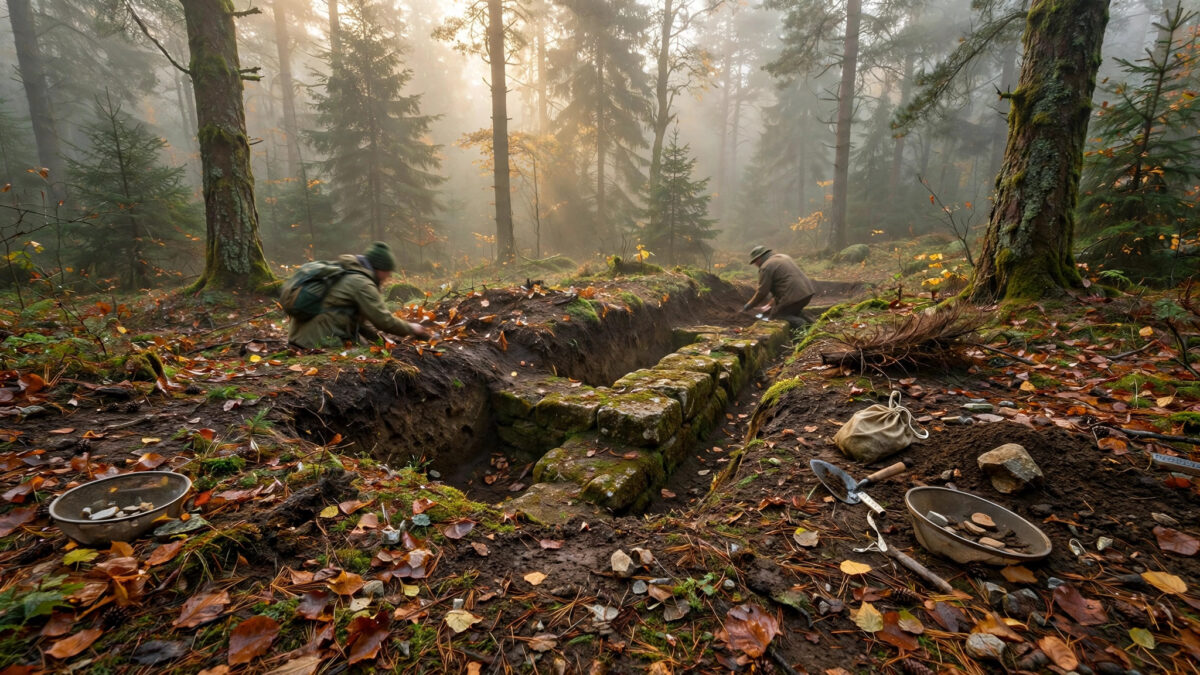
Put that question aside for a moment, reader, and walk with me into a German forest. The Taunus Mountains, just north of Frankfurt. The trees are old here — older than the roads, older than the towns that cling to the foothills. Beneath their roots, for nearly eighteen hundred years, a secret lay waiting: a temple to Mars, the god of war, buried only a few inches below the forest floor. Men walked over it. Storms broke trees above it. Empires rose and fell around it. And the earth kept it, silent and patient, the way time always keeps the truths we would rather forget.
This is not a legend, and it is not a rumour carried on forwarded messages. The Hesse State Office for Monument Preservation announced it on 25 September 2026, and in the days since, the discovery has travelled around the world — from Smithsonian Magazine to Archaeology Magazine — because it touches something ancient and uncomfortably familiar in all of us.
A Temple Inches Below the Leaves
Archaeologists led by district archaeologist Dr Kai Mückenberger, in their third excavation season near the Roman fort of Kapersburg, uncovered the rectangular foundations of a small sanctuary: about sixteen feet long, with an inner prayer chamber of three thick stone walls, entered through a wooden gate and ringed by covered walkways. It was the kind the Romans called an ambulatory temple. Inside, they found what soldiers carry when they are afraid: an inscription naming Mars, a broken fragment of a statue that may have been the war god himself, two carved votive stones, and — this is the detail I cannot shake — a small bronze statuette of Victoria, the goddess of victory, wings folded, palm branch in hand, a laurel wreath still upon her head.
Stop and sit with that image. A soldier, eighteen centuries ago, on the far frontier of the mightiest empire the world had ever seen, kneeling before Mars and laying down an offering to Victoria. Praying for victory. In a forest. On the edge of the map.
Mars Rules Where Fear Rules
The Romans called their frontier the Limes — a line of walls, forts, and watchtowers stretching across Europe, meant to keep the wild world out and the orderly world in. Kapersburg was one of its forts, and the auxiliary unit stationed there, the Numerus Nidensium, held it for some hundred and fifty years before the whole line collapsed in the middle of the third century, in what historians call the Fall of the Limes. The soldiers left. The empire’s maps were redrawn. And yet the ground remembered everything the empire’s historians did not bother to write down: the archaeologists found the remains of a forge and craft workshops in the civilian settlement beside the fort — the vicus — ordinary men mending weapons and shoeing horses while the god of war sat in his small stone room, receiving prayers.
I have spent my life reading history, and I have learned one bitter craft from it: the past is never past. It is a mirror, and if you hold it honestly, it shows you your own face.
Consider what the forest preserved here, layer upon layer. The temple was not in Rome. It was not in the capital, where emperors built marble shrines to be photographed and admired. It was here — at the frontier, where the empire was weakest and most afraid. Notice the pattern, reader: gods of war are always worshipped most fervently on borders. In Rome itself you will find temples to Jupiter and Venus, to money and love; but on the edge, where young men stand guard through winter nights listening for sounds in the dark, there Mars rules alone. Fear is the most faithful congregation any god has ever had.
We Stopped Carving Him in Stone
And here is the mirror turning toward us. The Roman Empire is gone — its legions dust, its marble broken, its Latin a language of gravestones. Mars himself is a myth now, a word in crossword puzzles. But tell me: has the worship stopped, or has it only changed its architecture? We no longer carve the god of war in stone. We build him in steel. We do not lay bronze statuettes of Victoria at his feet; we print victory in press releases and measure it in defence budgets. Every great nation of this century keeps a shrine to Mars — it simply calls it a ministry of defence, a military-industrial complex, a deterrent. The prayers are the same. Only the liturgy has been modernised. The soldiers at Kapersburg lit incense and whispered for victory; our soldiers carry different weapons, but in the trench, in the cockpit, in the submarine running silent beneath the sea, do you imagine the prayers are so different? The human heart has not changed its furniture in two thousand years. We only repainted the walls.
And look — the archaeologists tell us the temple stood beside the civilian settlement, not apart from it. The forge was there. The workshops. The blacksmith’s hammer and the war god’s shrine shared the same ground. That is the whole history of civilisation in one excavation grid: the economy and the altar, the hammer and the prayer, the making of weapons and the begging of mercy, side by side, always side by side. We manufacture the sword and then we pray it will not be turned on us. We built this habit at Kapersburg, and we have practised it ever since.
The Barbarians Kept Praying
There is another layer in this discovery, and it is the one the history books will remember longest. In the soil around the temple, the archaeologists found something they did not expect: a late-antique brooch, a fibula, and fragments of handmade pottery — evidence that someone was using this ground after the Roman military left, likely the Alamanni, the Germanic peoples the Romans called barbarians. This is the first archaeological proof that life continued at Kapersburg after the Fall of the Limes, and it complicates the tidy chronology of an empire that simply “ended.” Read it properly and it is devastating in its simplicity: the Romans left, the walls fell, the flags were folded — and the people who remained still came to this ground. Perhaps they buried their own dead here. Perhaps they looked at the broken stones of a foreign god and built their own fires over them. The empire’s borders moved, the empire’s gods were forgotten, but human beings stayed, and human beings kept praying. The forest does not care whose temple it was. It preserves the prayers of the conquered and the conqueror with perfect indifference.
That, reader, is the verdict the earth always delivers, and it is the same verdict it has delivered over every fallen empire from Seringapatam to Babylon: the walls fall, the gods are renamed, the soldiers go home — and life goes on in the ruins. The Romans believed their frontier would hold forever. Every empire believes that. The forest knew better. The forest waited.
Whom Do You Worship?
I wonder what our grandchildren’s grandchildren will dig up from our century. Not temples — we are too sophisticated for temples now. They will find the foundations of our shrines to Mars and puzzle over our strange rituals: the runways, the silos, the bunkers with their blast doors, our sixteen-foot temples poured in concrete and steel. And perhaps, buried in the rubble, they will find our own little bronzes — the medals, the ribbons, the laurel wreaths we still hand out, exactly as the Romans did, to men who survived the wars the temples promised them victory in. Victoria has never been out of work. She simply changed her uniform.
The discovery at Kapersburg is a gift, then — but not the kind of gift the headlines think it is. It is not merely a charming relic for museum cabinets. It is a question, eighteen hundred years old, dug out of the dark and laid at our feet: whom do you worship, and what are you building at the edges of your own empire? The soldiers of the Numerus Nidensium are gone. The Alamanni are gone. Rome is gone. The temple remains — not because it was strong, but because it was buried, and the forest, in its mercy, kept what the empire could not.
Remember this the next time you hear men speak of permanent victories and eternal borders. Beneath every confident empire there is a forest floor, and beneath the forest floor there are the foundations of the last empire’s prayers. Time is the only honest historian. And Mars — poor, patient Mars, god of a war that never ends — is still receiving his offerings. We just stopped bothering to carve his name on them.
Sources & References

About the Author — Abdul Mannan
Related Articles
The City That Chose Fire Over Chains: Paris’s Rediscovered Celtic Fort and the Price of Freedom
Beneath a Paris hospital courtyard, archaeologists have uncovered the fire-scarred wall of Lutetia — the Celtic town its…