The City That Chose Fire Over Chains: Paris’s Rediscovered Celtic Fort and the Price of Freedom

What would you do if the greatest army the world had ever seen was marching toward your home — and you knew, with cold certainty, that you could not defeat it? Would you open the gates and live on your knees, or would you strike the first match yourself?
Two thousand and seventy-eight years ago, a small tribe of farmers and warriors living on an island in the River Seine looked at the Roman legions approaching their town and chose fire. They set their own homes ablaze. They cut down their own bridges. They chose to erase Lutetia from the earth rather than hand it to Julius Caesar intact.
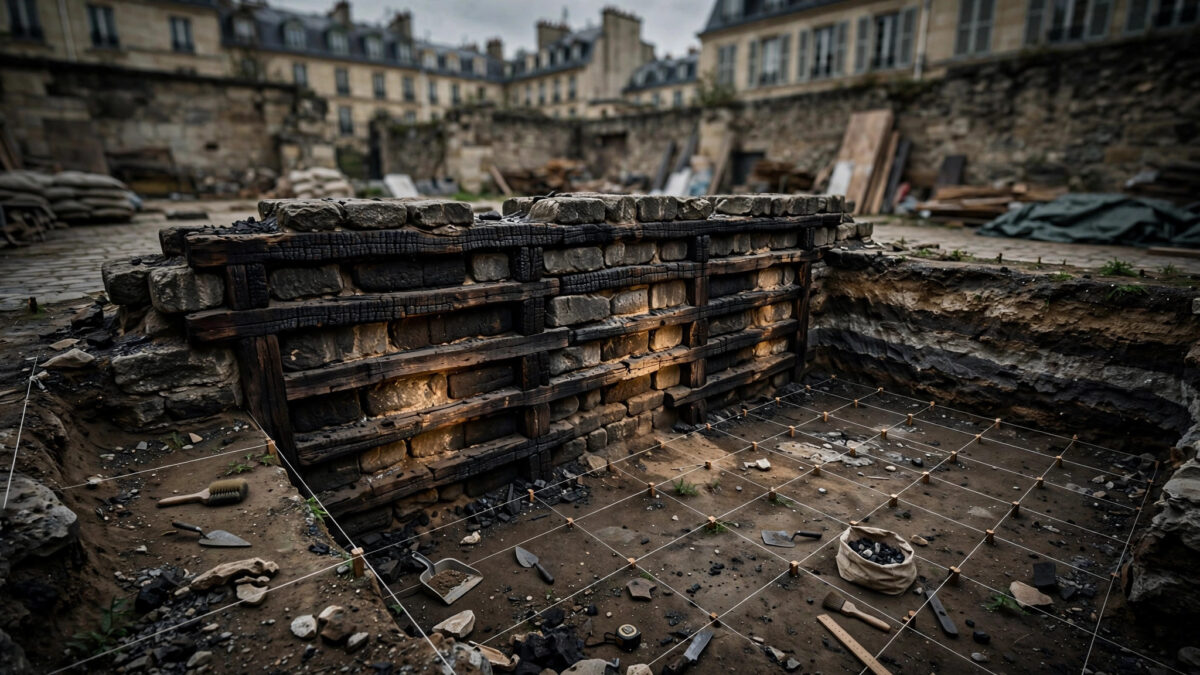
This week, the earth gave it back. Beneath the courtyard of the Hôtel-Dieu — Paris’s oldest working hospital, a stone’s throw from Notre-Dame — archaeologists have uncovered a sixty-five-foot stretch of charred stone-and-timber wall, built in the unmistakable Celtic manner, scarred by ancient flames. France’s Ministry of Culture announced the discovery with a sentence that should make every student of history pause: “This discovery fills an archaeological gap.” Stéphane Deschamps, regional curator of archaeology for the Île-de-France, went further: “For centuries, the location of Lutetia has been debated. Today, with this wall and its context, we may hold the key to the mystery.” (Smithsonian Magazine)
The Conqueror’s Pen and the Conquered’s Fire
Let me tell you how history remembers this story — because the irony begins with who wrote it down. Our only written account of Lutetia’s burning comes from the man who wanted it. In his Commentaries on the Gallic War, Julius Caesar describes Lutetia in a single, almost offhand line: “This is a stronghold of the Parisii, situated on an island in the River Seine.” While Caesar himself marched against other tribes, he sent his lieutenant Titus Labienus with four legions toward the island town. Hearing of the Roman approach, the Parisii did what desperate free men do: they burned Lutetia and broke up its bridges before the legions could arrive. So says Caesar’s own account of the Gallic War, Book VII.
Read that again. The winner wrote the book. The losers are remembered only for the sentence the winner gave them. For two millennia, scholars debated whether Lutetia even stood on the Île de la Cité at all — some argued for Nanterre, in the western suburbs, where excavations in the 1990s uncovered a Gallo-Roman necropolis. The conqueror’s pen had drawn a map too vague to follow, and the earth kept its secret for two thousand years.
Until February 2026, when preventive archaeologists working in the hospital courtyard began pulling history out of the ground: traces of ancient dwellings, roads, medieval layers — and then the wall. Stone blocks bound with horizontal wooden beams, the classic Gallic murus gallicus construction. Behind it, a platform of sand and gravel nearly seven feet thick — a rampart built to absorb the shock of Roman siege engines. A Gallic spearhead at its base. Charred seeds. The remains of a wooden building, burned where it stood. And carbon-14 dating of the charred timbers: between 200 BCE and 10 BCE — a range that holds 52 BCE inside it like a secret. (Discover Magazine)
The scorch marks on that wall are the signature of a decision. Someone, two thousand years ago, decided that a city in ashes was worth more than a city in chains.
When Nations Burn Their Own Homes
History, if you listen to it honestly, is a mirror — and this mirror has been held up before. The Parisii were not the first people to choose the flame over the yoke, and they were not the last.
When Napoleon’s Grande Armée marched into Moscow in 1812, the Russians set their own holy city burning rather than let the French emperor dine in it. Napoleon took Moscow and gained nothing but ashes; he left with an army of ghosts. The scorched-earth resistance of the Russian winter did what no army could: it taught an emperor that some victories are just funerals with better music.
We in South Asia know this instinct in our bones. When the East India Company’s armies closed in on Seringapatam in 1799, Tipu Sultan — the Tiger of Mysore — refused every offer of a dishonourable peace. He died fighting at the breach in his own fortress rather than sign away his kingdom’s freedom. The Company’s clerks wrote the history of that war, just as Caesar’s clerks wrote the history of Lutetia; in both accounts, the conqueror is reasonable, inevitable, civilised — and the conquered man who chose death over submission is a footnote with a sword.
Do you see the pattern, dear reader? Empires do not only conquer land. They conquer the story. They arrive with legions and leave with libraries, and the libraries all say the same thing: resistance was futile, submission was wisdom, and the empire was a gift. The Parisii burned their town so that Caesar could not have it; Caesar wrote a book so that the Parisii could not have their story. Which theft was greater?
The Name That Refused to Die
And yet — here is the part of the story that no conqueror’s pen could erase. Look at the name of the city that grew over those ashes. Paris. It is not named for a Roman emperor. It is not called Caesaria or Labienia or Augusta. It carries, two thousand years later, the name of the Parisii — the very tribe Caesar defeated. The conquered named the capital of the conqueror’s province. Rome fell. Lutetia endures — in the name, in the soil, and now, unmistakably, in the wall.
When Paris Mayor Emmanuel Grégoire and France’s culture minister Catherine Pégard descended into the excavation on 22 September 2026, officials described feeling “dizzy” looking down at what one report called Paris’s “zero point in time” — a wall still bearing the scars of Caesar’s conquest. (Good News Network) I understand the dizziness. It is the vertigo of standing on the exact spot where a people decided their dignity was worth more than their roofs. Every modern Parisian who walks the Île de la Cité walks over a decision. The boulevards, the cafés, the lights that made this city famous — all of it is built on ground where free men once chose fire.
A Question for Our Own Century
I am not writing this column to praise arson. I am writing it because the question those charred stones ask has not expired. In our century, empires no longer always arrive with legions; they arrive with loans, with trade terms, with “structural adjustments,” with algorithms that decide what your children are allowed to know. The modern siege is quieter. There are no bridges to cut — the bridges are fibre-optic now. But the question is the same one the Parisii faced in 52 BC: when the powerful offer you survival at the price of your dignity, what do you choose?
There is a particular courage in destroying what you love so that no one else can own it. It is the courage of a people who understood that a nation is not its buildings. Buildings can be rebuilt — and Lutetia was rebuilt, grander than its burners could have dreamed. What cannot be rebuilt is the moment you bowed. The Parisii never bowed. Their town burned, their walls fell, their name was written down by their enemy — and still, two thousand years later, the greatest city of the West answers to their name.
So the next time someone tells you that resistance is futile, that the powerful always win, that history belongs to whoever holds the pen — take them to Paris. Take them to a hospital courtyard where a burned wall is rising out of the earth. And tell them: the pen wrote that the Parisii lost. The ground says they never surrendered. And the city still carries their name.
Empires pass. The fire they lit becomes light.
Sources & References
- Smithsonian Magazine — “Two Thousand Years Ago, Julius Caesar Conquered the Settlement That Eventually Became Paris. Archaeologists May Have Just Found It.”
- Discover Magazine — “Charred 2,000-Year-Old Wall Found Beneath Paris May Reveal the Location of Ancient Lutetia.”
- Gizmodo — “Ancient Parisians Torched Their Own City to Stop Caesar. Archaeologists May Have Found the Scorch Marks.” (Reporting France’s Ministry of Culture announcement; quoting Stéphane Deschamps, DRAC Île-de-France.)
- Good News Network — “This Stone Wall Seems to Have Finally Settled Debate About The Town That Became Paris.”
- Julius Caesar, Commentarii de Bello Gallico, Book VII — the primary-source account of Lutetia and the Parisii.
