After Deadly Riyadh Airport Strike, Trump Signals US Response as Houthis Warn Airlines of More Attacks

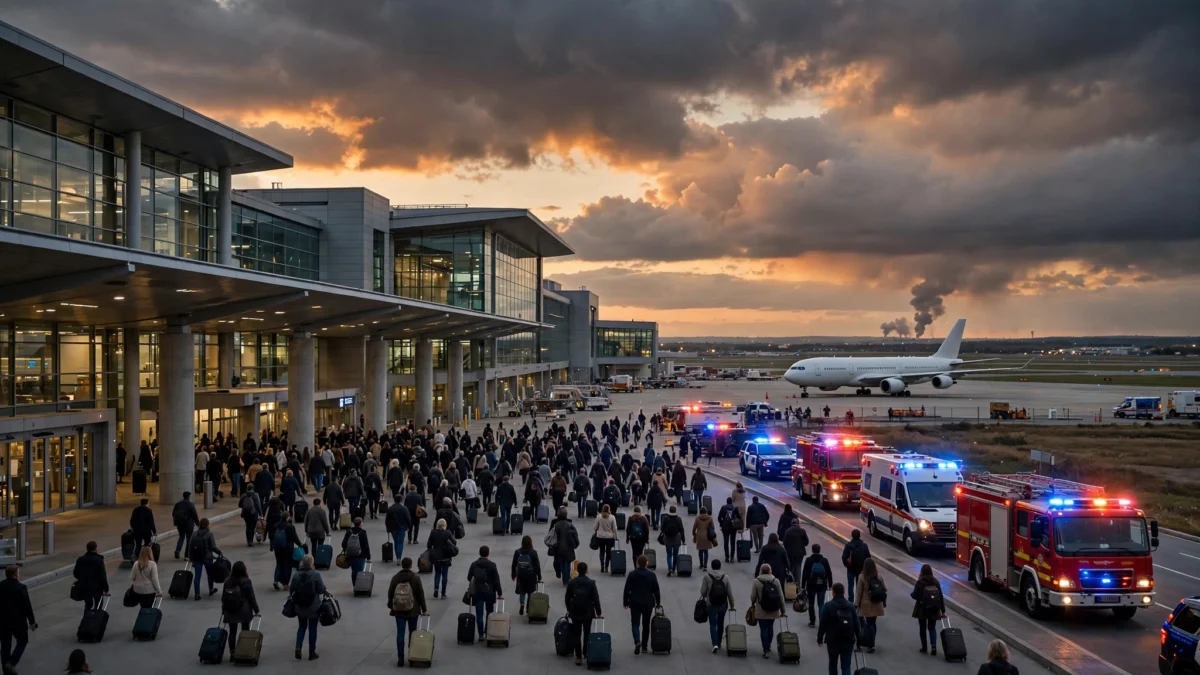
US President Donald Trump warned that Washington could take action against the Houthis after Saturday’s missile strike on Riyadh’s King Khalid International Airport, telling reporters “you’re gonna find out” when pressed on a possible American response to the attack that killed 12 people, including an American citizen.
The cryptic remarks, made at Joint Base Andrews after Trump’s return from a campaign rally in Tennessee, capped a day of rapidly escalating fallout in which the Houthis renewed warnings to airlines and passengers against using Saudi airports and key allies condemned what European Commission President Ursula von der Leyen called “the deadliest Houthi attack so far” on the facility.
“I think it’s terrible,” Trump said when asked for his reaction to the strike, according to a report by the Indian news agency IANS. Asked whether he had spoken to Saudi Crown Prince Mohammed bin Salman during his flight back, Trump said: “No, but I will be speaking to him and what happened in Saudi Arabia is not acceptable.”
According to the Saudi General Authority of Civil Aviation, 12 people were killed and 309 injured when the missile hit a passenger terminal at the airport on Saturday afternoon. The dead included four Saudi citizens, two Bangladeshi nationals and one person each from the United States, Egypt, Jordan, Syria, Palestine and Sudan, the authority said. Saturday’s attack was the third on the airport in a week and the deadliest on a Gulf Arab country since the war with Iran began in February, according to the Associated Press.
Trump’s comments marked a notable hardening in tone from earlier in the day, when he had already indicated that the United States was reconsidering its refusal to intervene directly. “We may. We’re going to look at it. We just found out about the recent attack, so we’ll make a decision. We move very quickly,” he told reporters on Saturday, according to the Associated Press.
Asked at Joint Base Andrews whether Saudi Arabia could defend itself, Trump said: “They’re able to defend. Look, the Saudis are good fighters, but I think the attack was a terrible thing.” On whether Washington was in contact with the Houthis, he added: “We have communication with the Houthis and we’ll see what happens.”
The remarks land in an unusually volatile diplomatic moment. In September, Axios reported that Trump had turned down a request from the Crown Prince for US strikes on the Houthis, offering intelligence and targeting data instead. But the Saturday attack, which killed an American among its victims, appears to have reopened a debate the White House had been avoiding. According to the Times, the United States has already sent military and intelligence personnel to Saudi Arabia to assist with targeting.
Secretary of State Marco Rubio formally condemned the strike on Saturday night. “The United States strongly condemns the recent attacks on the Kingdom of Saudi Arabia by the terrorist Houthis, including today’s strike on King Khalid International Airport in Riyadh that took numerous innocent lives, including an American citizen,” Rubio wrote on X. “These reprehensible attacks demonstrate a blatant disregard for innocent civilian life. They must stop now.”
Houthi Warning: Airports “Exposed to Targeting”
While Washington weighed its response, the Houthis doubled down. In a statement issued on Sunday, the Yemeni group renewed its warning to airlines, airport workers and travellers against using Saudi Arabian airports and airspace, urging them to take the threat seriously and claiming the kingdom “bore responsibility for failed interceptions” during the latest attack, according to LN24 International.
Houthi military spokesman Yahya Saree said airports and airspace “are exposed to targeting and constitute a theatre of operations for our forces,” adding that the group was pursuing “airport for airport, siege for siege, and escalation for escalation,” according to UKPulse. The airports in Mecca and Medina were excepted from the warning. According to JFeed, the group said the warning would remain in force until the “aggression and blockade on Yemen ends.”
The statement did not directly claim responsibility for Saturday’s attack, though the group had claimed separate strikes on the same airport on Thursday, which killed three Saudi nationals including a Saudia pilot.
The escalating threat has already disrupted civilian aviation. The Associated Press reported on Friday that Air India, FlyDubai, Lufthansa Group and Pakistan International Airlines had suspended flights to and from Riyadh and other Saudi airports, and according to the Times, Emirates has also cancelled flights to the capital. Embassies of the United States, Britain, Canada, Germany and Spain warned their nationals to avoid Riyadh’s international airport and obey local security instructions, according to BBC reporting.
Schools across Riyadh were ordered to switch to remote learning for a week following the attacks — the second time in less than a month that schools in the capital have moved lessons online, the Times reported.
Allies Condemn, but Britain Rules Out Joining Strikes
The diplomatic response revealed a widening gap between Washington’s escalatory signals and the more cautious posture of its allies. Britain’s defence secretary Wes Streeting described the attack as a “dangerous escalation” but said Britain was not considering offensive military operations against the Houthis “at this stage,” the Times reported.
Streeting said the UK was already supporting Saudi Arabia with “defensive” air-to-air refuelling — a reference to the RAF Voyager tanker mission agreed in September — and that he had spoken to his Saudi counterpart on several occasions in recent weeks about further assistance. “We’ve always been clear that there isn’t a military solution to this conflict,” he said.
Von der Leyen was blunter in her condemnation. “The deadliest Houthi attack so far on Riyadh’s airport marks a dangerous escalation,” the European Commission president wrote on X. “Our thoughts are with the victims and their families. We stand in solidarity with Saudi Arabia and its people. These attacks by Iran’s proxies are pushing the region into a spiral of violence. They are destabilizing crucial global transport and energy nodes with shockwave sent through the world. These murderous attacks at civilians must stop at once.”
UN Secretary-General António Guterres also condemned the strike, the Times reported.
Regional reactions followed swiftly on Sunday. Pakistan’s Prime Minister Shehbaz Sharif “strongly” condemned the attack. “Attacks targeting civilians and critical infrastructure are completely unacceptable and constitute a serious threat to regional peace and stability,” Sharif said. “Such acts of violence, which are a flagrant violation of international law, must cease immediately.” India’s Ministry of External Affairs also condemned the Houthi strikes, calling the targeting of civilian infrastructure “completely unacceptable,” according to Nation Press.
The Saudi-led coalition, which had earlier called the attack a “war crime,” has vowed a firm response. The coalition also said a projectile fell near Dammam’s international airport hours after the Riyadh attack, raising the prospect that the campaign against Saudi aviation infrastructure is widening beyond the capital.
Analysis: Why It Matters
1. Trump Is Running Two Channels at Once — and That Is the Policy
The most revealing line of the day was not the threat but the admission: “We have communication with the Houthis and we’ll see what happens.” Washington is simultaneously threatening to bomb the Houthis and negotiating with them — a dual-track approach that mirrors the administration’s handling of Iran itself, where military strikes in February gave way to back-channel talks. This is not confusion; it is leverage-building. By keeping the threat of strikes alive while talking, Trump maximises his bargaining position before the call with the Crown Prince — and before Riyadh retaliates unilaterally.
2. The Alliance Is Splitting Between “Defensive” and “Offensive”
Britain’s position is now sharply defined: refuelling tankers for interception missions, but no offensive strikes “at this stage.” The European Commission condemns but commits nothing militarily. The United States, by contrast, is openly weighing joining the Saudi bombing campaign. This three-way split matters because it shapes what escalation looks like. If Washington strikes and London and Brussels stay out, the conflict becomes a bilateral US-Houthi war rather than a Western one — which is precisely what the Houthis have been demanding through their “blockade for blockade” messaging: isolate the Americans, not unite the alliance.
3. Civilian Aviation Has Become the Battlefield
The Houthi strategy is unmistakable: make Riyadh’s airports unusable and watch airlines, insurers and travellers make their own decisions. With Lufthansa, Emirates, Air India, FlyDubai and PIA suspending flights, the group has achieved through threats what missiles alone could not — a de facto siege of Saudi airspace. The “airport for airport, siege for siege” formula is the language of a campaign designed to be calibrated and sustained, not symbolic. Every cancelled flight is a data point in the group’s deterrence logic, and every airline suspension makes the next warning more credible.
4. The MBS Call Is the Decision Point
Everything now hinges on Trump’s conversation with the Crown Prince. In September, the Crown Prince asked for American strikes and was refused. This time, Riyadh comes to the call with a deadlier attack, an American victim, and a public coalition vow of retaliation — while Trump’s own advisers, according to earlier reporting, had opposed joining the Saudi fight given the strain on US forces from the Iran war. The call is not just about condolences; it is the moment the US decides whether the “we may” becomes a plan.
5. The Oil and Energy Shadow
Markets reopen on Monday with Brent crude averaging around $104 a barrel in recent weeks, according to US Energy Information Administration figures. The Houthis’ stated goal of targeting “global transport and energy nodes” means the real question is whether the campaign spreads from airports to energy infrastructure. Saudi Arabia hosts the Future Investment Initiative later this month — “Davos in the Desert,” which draws some of the world’s leading financiers and senior American officials, according to the Times. A kingdom that cannot keep its main airport open is a kingdom investors watch with alarm.
What to Watch Next
- The Trump-MBS call. Timing, readout and whether it yields commitments — intelligence-sharing, refuelling, or strikes.
- Whether the US actually moves. Commanders, air assets in the region and any Pentagon leak will be the first concrete signs.
- The Houthi threat’s next test. If a fourth attack on Riyadh airport follows the warning, the “airport for airport” doctrine is in full operation.
- Airline and embassy moves. Further flight suspensions or travel advisories would signal that aviation security, not military response, is driving decisions.
- Riyadh’s own retaliation. The coalition’s promised “firm” response — whether it targets Houthi launch sites, leadership, or ports — will set the next escalation rung.
Sources
- The Times — Saudi Arabia attacks latest: Houthis warn of further airport strikes
- The Times — Houthi missile attack on Saudi Riyadh airport kills 12 and injures over 300
- IANS — Trump to call Saudi Crown Prince after Houthi strike on Riyadh airport
- LN24 International — Houthis Renew Warning to Airlines and Travellers Against Using Saudi Airports
- AnewZ — Yemen’s Houthis warn airlines and travellers

About the Author — Abdul Mannan
Related Articles

Zelensky Rallies European Leaders as Burnham Pledges ‘Complete Solidarity’ After Trump’s Diesel Deal With Putin
Volodymyr Zelensky held phone calls with Britain's Andy Burnham, France's Emmanuel Macron, Finland's Alexander Stubb and Norway's Jonas…
Houthi Missile Strikes on Riyadh Airport Kill Three as Regional War Escalates Into Its Deadliest Phase
Three Saudis were killed and a Saudia aircraft struck in two Houthi missile attacks on Riyadh's King Khalid…
Ukraine Hits Russian Oil Terminal in Rostov Hours After Trump’s Diesel Deal With Putin
A fire erupted at the Yug Rusi oil-loading terminal in Rostov-on-Don overnight amid a reported Ukrainian drone attack,…