SpaceX Launches 21 US Military Satellites After Five-Day Delay, Building Out Pentagon’s Orbital Mesh Network

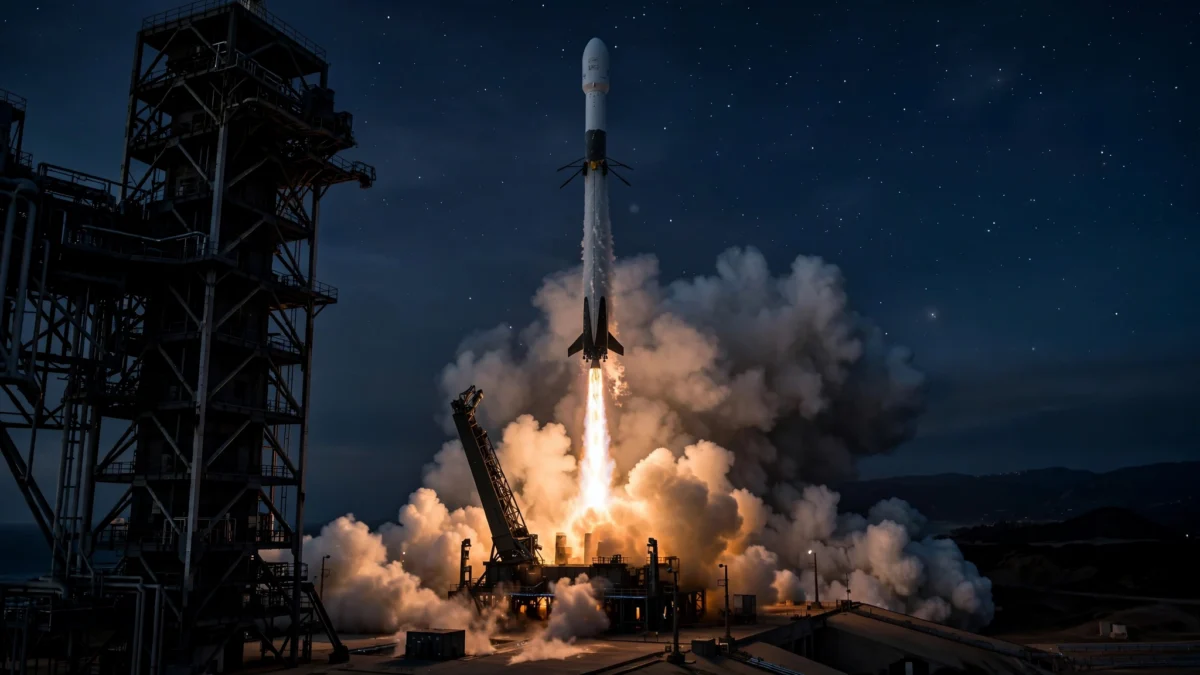
A SpaceX Falcon 9 rocket roared off the pad at Vandenberg Space Force Base in California on Saturday morning, carrying 21 data-transport satellites into orbit for the United States military after a five-day delay, according to Space.com. The liftoff took place at 3:39 a.m. EDT (12:39 a.m. local time), and the launch advances the Pentagon’s ambitious plan to assemble a mesh network of hundreds of low-Earth-orbit satellites that would carry military communications and track incoming missiles.
The mission is the fourth of nine planned SpaceX launches supporting the US Space Force’s Space Development Agency (SDA) Tranche 1 deployment, the agency said in an official press release on October 10. The satellites, built by aerospace contractor Northrop Grumman, will form part of the Proliferated Warfighter Space Architecture (PWSA) — the Pentagon’s layered constellation designed to provide secure, resilient, low-latency communications and data transport from low Earth orbit, connecting warfighters with missile-tracking satellites across an interoperable mesh network.
Saturday’s launch had originally been scheduled for Monday, October 5, but SpaceX halted that attempt in the countdown’s final minute after the Falcon 9’s automated systems detected off-nominal data, according to Space.com and independent launch coverage. The vehicle was rolled back to a horizontal position for troubleshooting while engineers worked through the anomaly; after several daily delays, the countdown finally held on Saturday and the rocket left Space Launch Complex 4 East at Vandenberg on schedule.
Shortly after liftoff, the mission followed a familiar and by now routine script: the Falcon 9’s first stage separated and returned to Landing Zone 4 at Vandenberg, touching down a little over seven minutes after launch. It was the sixth flight for booster B1103, whose earlier missions included the NROL-179 national security launch, a previous SDA Tranche 1 mission in July, and three Starlink deployments, according to Space.com. SpaceX ended its public webcast shortly after booster touchdown at the SDA’s request — standard practice for national security launches — and the satellites were later confirmed deployed in their target orbit, Northrop Grumman announced on October 10.
The numbers behind the constellation are striking. Tranche 1 is designed to become the “initial warfighting capability tranche” of the proliferated architecture, and when complete it will consist of 154 operational satellites in low Earth orbit: 126 data-transport spacecraft and 28 missile-tracking vehicles, plus four missile-defense test satellites carrying a higher-fidelity infrared sensor, according to the SDA. With Saturday’s 21 spacecraft, 84 of the 126 planned data-transport satellites have now reached orbit — two-thirds of the transport backbone — all of them carried by Falcon 9s launched from Vandenberg in September 2025, October 2025, July 2026, and now October 2026.
The agency framed Saturday’s flight as a milestone of its acquisition philosophy. “This launch marks the delivery of satellites built by the third of four vendors selected to field Tranche 1 of the proliferated LEO architecture,” said GP Sandhoo, the SDA Director, in the agency’s October 10 statement. “SDA’s model emphasizes regular industry competition and vendor diversity. Our focus remains on rapid delivery of capabilities to support warfighter needs.” Northrop Grumman, for its part, said the satellites “will provide secure, resilient, low-latency communications and data transport in low Earth orbit,” helping to connect warfighters with the missile-tracking spacecraft that form the architecture’s other layer. The company is under contract to deliver roughly 150 space vehicles spanning Tranches 1, 2, and 3.
Saturday’s mission was also the 111th Falcon 9 flight of the year, according to Space.com — a cadence that illustrates how central SpaceX’s workhorse rocket has become to both commercial and government spaceflight. The vast majority of those flights, more than 70 percent, have gone toward building out the company’s Starlink broadband megaconstellation, which now numbers more than 11,000 satellites. The SDA missions, by contrast, are a small slice of that manifest — but they are among the most strategically significant payloads SpaceX carries.
Why It Matters
To understand what the Pentagon is building, it helps to set aside the older mental image of military satellites. For decades, American military space power rested on a small number of large, expensive, exquisitely capable spacecraft — the kind that take years to design and billions to replace. The SDA’s architecture flips that logic. Its name says it all: “proliferated.” By distributing functions across hundreds of small, relatively inexpensive satellites flying in low Earth orbit and linked by optical (laser) communications and Ka-band radio, the network is designed to keep working even if individual spacecraft fail, are jammed, or are destroyed. No single satellite is load-bearing. The resilience is in the numbers.
That doctrine did not arrive by accident. It is the product of a decade in which the security calculus of space changed. As rival powers — notably China and Russia — have developed and in some cases tested anti-satellite capabilities, the old model of a handful of glittering targets in high orbit began to look like a liability. A constellation of 154, then several hundred, then potentially thousands of networked spacecraft presents a profoundly different problem to an adversary: destroying one node routes traffic around it. The October 10 launch pushes that resilience doctrine from slideware toward hardware, with the transport layer now two-thirds deployed and the agency publicly committing to an initial warfighting capability beginning in 2027.
There is a second, quieter story here about industrial policy. The SDA was created in 2019 with an explicit mandate to break with the Pentagon’s traditional acquisition rhythms — years-long competitions, single-prime contractors, cost-plus contracts — and instead behave, in its own leadership’s words, more like a commercial customer. Tranche 1’s four transport-satellite vendors (Northrop Grumman being the third to fly, per the SDA) exemplify the approach: compete regularly, keep multiple suppliers alive, deliver in two-year increments, and improve each tranche as technology matures. “Spiral development,” the agency calls it, with a new generation of the architecture arriving roughly every two years. Whether this model actually survives contact with the Pentagon’s budgetary gravity over the next decade is one of the central questions of American military space policy — but the launch cadence so far suggests the model is working at least at Tranche 1’s scale.
The five-day delay also deserves a sober read. A scrubbed launch in the final minute, a horizontal rollback, five days of daily holds — in an earlier era, that would have been a minor embarrassment. In 2026, with the Falcon 9 fleet flying every few days, it reads more like evidence of the safety culture that commercial launch cadence makes possible. The abort was the automated system doing exactly what it was designed to do, and the margin to absorb a week of troubleshooting is precisely what a high-tempo launch provider has and a low-tempo one does not. Cadence, in other words, is not just a statistic for press releases; it is operational slack.
And there is the matter of what “data transport” actually means. These satellites are not spies in orbit and they are not missile detectors — those are the 28 tracking spacecraft, which carry infrared sensors to hunt the heat signatures of missiles in flight. The transport layer is the nervous system: it moves information — sensor data, command orders, tactical data links such as Link 16 — between the eyes of the architecture and the people and weapons that need what they see. A military that can see a threat but cannot pass the warning around the world in seconds has only half a capability. Saturday’s 21 spacecraft add more of the pipes.
The scale of what is being attempted invites comparisons. China’s military is pursuing its own proliferated low-Earth-orbit constellations, and the US intelligence community has been explicit that space is now a contested domain rather than a sanctuary. The PWSA’s answer is not superiority in any single exquisite system but superiority in deployment speed and numbers. The 111 Falcon 9 launches this year — most of them Starlink — are the engine room of that answer: a launch industry that can absorb national security missions into an already furious commercial tempo. No other country currently fields anything close to that combination of cadence and capacity.
None of this means the architecture is proven. A successful deployment is not a working service. The SDA must still establish communications with the new spacecraft, check out their systems, and — the hard part — demonstrate that 84 transport satellites plus their tracking counterparts actually behave as a coherent mesh network, with optical links holding steady across hundreds of kilometers of vacuum at orbital velocities. The agency’s own statement points to 2027 for the beginning of initial warfighting capability, and that date is where the promises will be tested. Five more Tranche 1 missions remain, and Tranche 2 — larger and more capable — waits behind it. The risk in any spiral-development model is that problems discovered in the operational tranche require redesigns that slip the schedule; the SDA’s credibility rests on avoiding exactly that.
What to Watch Next
The next Tranche 1 missions will tell the story of whether the deployment tempo holds. Five of the nine contracted SpaceX launches remain, and each will add another orbital plane of transport spacecraft until the 126-satellite backbone is complete. Watch for the first announcements of network-level testing — the agency will eventually need to show that the mesh behaves as advertised, not just that individual spacecraft survive deployment.
The 2027 milestone matters most. “Initial warfighting capability” is the SDA’s own phrase for when Tranche 1 begins delivering real operational value to combatant commands: persistent regional tactical data links, enhanced missile tracking and warning, beyond-line-of-sight targeting. If that date holds, the proliferated model will have passed its first true test.
Finally, keep an eye on the vendor story. Northrop Grumman was the third of four Tranche 1 transport vendors to reach orbit, and its contract covers roughly 150 spacecraft across three tranches. How the remaining vendor’s launches go — and how the competition shapes up for Tranche 2 and Tranche 3 awards — will show whether the SDA’s multi-vendor doctrine is a durable feature of American military space acquisition or a one-tranche experiment.
Saturday’s dawn launch from Vandenberg, five days late and six flights deep into a reused booster’s career, was in that sense both utterly routine and quietly remarkable: routine in the cadence of a rocket that flies more than a hundred times a year, remarkable in what its payload represents — a Pentagon that is rebuilding its space power not around a few crown jewels, but around a swarm.
Sources
- Space Development Agency (official press release, Oct. 10, 2026): “PAE for Missile Warning and Tracking and Space Development Agency Successfully Deliver Fourth Orbital Plane of Tranche 1 Satellites to Orbit”
- Space.com (Oct. 10, 2026): “SpaceX launches 21 satellites to orbit for the US military after 5-day delay”

About the Author — Abdul Mannan
Related Articles
James Webb Telescope Traces Farthest-Ever Fast Radio Burst to a Tiny Galaxy From 3 Billion Years After the Big Bang
A flash of radio light that crossed more than ten billion years of expanding universe to reach Earth…
NASA’s SPHEREx Telescope Unveils a Menagerie of Brown Dwarfs with Chemically Rich Atmospheres
NASA's SPHEREx telescope has analysed 37 nearby brown dwarfs, finding atmospheres rich in water, carbon dioxide, carbon monoxide…

First-Ever Radio Signal Detected From a Planet Beyond Our Solar System — and It’s Coming From a Giant Aurora
Astronomers have directly detected radio waves from an exoplanet for the first time — auroral bursts from the…