James Webb Telescope Traces Farthest-Ever Fast Radio Burst to a Tiny Galaxy From 3 Billion Years After the Big Bang

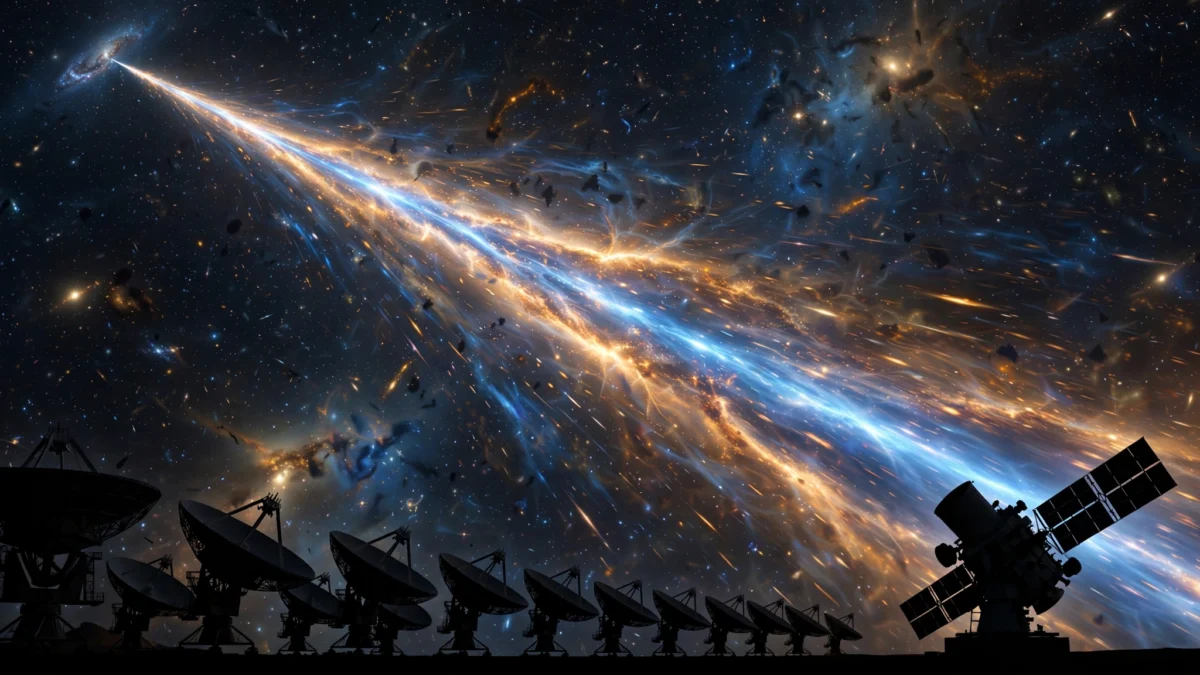
A flash of radio light that crossed more than ten billion years of expanding universe to reach Earth has become the most distant fast radio burst ever detected — and the galaxy it came from has upended astronomers’ expectations. According to a study published on 8 October in the journal Science, the burst, designated FRB 20240304B, was fired when the universe was only about three billion years old, roughly a quarter of its present age. More strikingly, its home galaxy is a thousand times less massive than the kind of galaxy researchers assumed would produce such an event.
The discovery was led by Dr. Manisha Caleb of the University of Sydney, working with the MeerTRAP project on South Africa’s MeerKAT radio telescope and NASA’s James Webb Space Telescope. It more than doubles the previous distance record for a fast radio burst and, crucially, supplies one of the strongest pieces of evidence yet that at least some of these mysterious flashes come from young, violently magnetic neutron stars known as magnetars — not from the collision of two dead stars spiralling into each other.
“What makes fast radio bursts interesting is that we don’t know what generates them. We have theories for what objects produce them, but we don’t have conclusive proof,” Caleb said in a statement released by NASA. This latest burst does not settle the debate outright, but it narrows the field considerably.
A millisecond-long flash, invisible to every ground telescope
The story of the detection begins on 4 March 2024, when the MeerTRAP instrument on MeerKAT — an array of 64 radio dishes spread across the Karoo region of South Africa’s Northern Cape — caught a burst of radio waves at frequencies between roughly 900 and 1,700 megahertz. The flash itself lasted only about a millisecond in its natural frame, though its signal was stretched to several milliseconds by the time it arrived, smeared out by its interaction with the matter it had passed through on its journey across the cosmos.
The radio data suggested something extraordinary: this could be the most distant fast radio burst yet recorded. MeerKAT had localised it precisely, but to confirm the distance, astronomers needed to find its host galaxy. That proved impossible from the ground. According to the South African Radio Astronomy Observatory (SARAO), the galaxy was invisible even to the world’s largest ground-based optical telescopes.
The team therefore turned to the James Webb Space Telescope. Webb’s NIRCam instrument, its near-infrared camera, detected a faint smudge of light at exactly the right position — and its NIRSpec spectrograph then measured a redshift of 2.148, give or take a thousandth. That number placed the event at a time when the universe was just three billion years old, at an epoch astronomers call “cosmic noon,” when star formation across the cosmos was at its peak.
Not the galaxy anyone expected
The host galaxy turned out to be a surprise in every respect. Most fast radio bursts found so far have been traced to large, massive, star-forming galaxies resembling the Milky Way. This one lived in a low-mass, clumpy dwarf galaxy estimated to hold only about ten million suns’ worth of stars — roughly a thousand times less massive than a typical FRB host. Its star-formation rate was modest in absolute terms, about two-tenths of a solar mass per year, but its chemistry was primitive: its gas carried only 10 to 20 per cent of the metal content of the Sun, marking it as a youthful, unenriched system.
Webb’s NIRCam placed the faint galaxy just 0.3 arcseconds from the burst’s radio position, and the team’s analysis gave a 97.5 per cent probability that it is the true host.
“We thought it would be a big, nicely formed galaxy with lots of stars, and instead it was a little dwarf galaxy, although it was actively forming stars,” Caleb said. Her colleague Ben Stappers of the University of Manchester, who leads the MeerTRAP project on MeerKAT, put it more bluntly: “The host sticks out in the whole galaxy sample that we have. And it definitely was not what we were expecting.”
The galaxy’s youth appears extreme even by cosmic-noon standards. According to SARAO, its star-formation history suggests that the majority of its stars may have formed within just 30 million years — an eyeblink in galactic terms.
Why a young dwarf favours a magnetar
That youth is exactly why the result matters for the long-running debate over what makes fast radio bursts. Two leading models have competed since these millisecond flashes were first discovered in 2007.
One model holds that a burst can be triggered by the merger of two neutron stars. But two stellar corpses need to spiral together over billions of years before they collide — a slow process that, as NASA explains, means such events should mostly be found in older galaxies whose stellar populations have had time to evolve.
The second model proposes that a burst can come from a single, young, highly magnetic neutron star — a magnetar — through a mechanism akin to an earthquake on a star, sometimes called a starquake. In that picture, a massive star explodes as a supernova, leaves behind a magnetar, and the burst can follow relatively quickly, with no long delay. Such events should track active star formation — exactly the environment of the tiny dwarf galaxy Webb found.
Because the host is so young, and because its stars formed so recently, the merger channel looks improbable for FRB 20240304B. “Our work suggests that it’s very unlikely that this FRB was produced by a merger,” Caleb said. The result therefore strengthens the magnetar case — a line of evidence that gained its strongest support in 2020, when a magnetar inside our own galaxy, SGR 1935+2154, produced a burst with FRB-like properties, the first such link ever observed.
A cosmic flashlight
Beyond the record and the origin question, the burst has served as what the researchers describe as a cosmic flashlight. Because a fast radio burst’s signal is shaped by everything it passes through, it carries an imprint of the otherwise invisible matter along its path — the thin gas of the cosmic web that is extraordinarily difficult to detect directly.
“This is an extraordinary glimpse into the distant universe,” Caleb said. “We have caught a fast radio burst from a time when the universe was only about 3 billion years old, and we have used that brief flash of radio light to learn about the matter it has traveled through over billions of years.”
The analysis picked up the imprint of two cosmic structures on the signal: one previously unknown galaxy cluster at a redshift of 0.3, about 3.5 billion light-years from Earth, and the nearby Virgo Cluster, roughly 54 million light-years away. The burst was also highly linearly polarised — about 49 per cent, with negligible circular polarisation — suggesting the magnetic fields along its line of sight are either weaker than expected or more complex than current models assume, according to the study’s analysis reported by phys.org.
“A fast radio burst is almost like a cosmic flashlight. It lights up everything along the path. It carries an imprint of everything that it travels through, so you can use it to trace the ‘cosmic web’ — the otherwise invisible matter and structures that it encounters along the way,” said co-author J. Xavier Prochaska of the University of California, Santa Cruz.
A new era of telescope teamwork
The team emphasises that this result is a template for what comes next. MeerKAT’s combination of sensitivity and precise localisation means it could detect and pin down several fast radio bursts per year from beyond a redshift of one — events from more than halfway back to the beginning of the universe. And the SKA-Mid telescope of the SKA Observatory, currently under construction in South Africa and incorporating MeerKAT itself, is expected to find larger numbers of even more distant bursts. Webb, meanwhile, will be essential for characterising their host galaxies — the faint, early-universe systems that ground telescopes cannot reach.
“The next step is to push this frontier further and see how close we can get to the first generations of stars,” Stappers said. Adrian Tiplady, the acting managing director of SARAO, called the result “beautiful work” and said the observatory looked forward to years of further discoveries, first with MeerKAT and then with the SKA.
“Our results further show the amazing capability of Webb where we can push boundaries beyond what was previously possible,” added co-author Themiya Nanayakkara of the University of Sydney. “What is particularly exciting about our result is that we’ve now demonstrated that we can identify and study an FRB from when the universe was young,” Caleb said.
Analysis: Why It Matters
The most important thing about FRB 20240304B is not that it broke a distance record. Records in astronomy are made to be broken, and this one surely will be — the team itself expects MeerKAT and the SKA to push the frontier toward the first generation of stars. What makes this burst genuinely significant is how it was used: as an age test for competing theories of what these flashes are.
Astronomy has a recurring trick — using the clock as a laboratory. Neutron-star mergers are slow; magnetars are fast. So the age of the neighbourhood where a burst went off discriminates between the two. This is a clever inversion of the usual logic: instead of asking what object could possibly produce such an energetic flash, the team asked what kind of universe could produce it so quickly after the Big Bang, in a galaxy whose stars were barely formed. The answer leaves little room for the merger channel in this case.
There is a second, subtler significance. FRBs remain unsolved phenomena nearly two decades after the first was found — a reminder that the universe still keeps whole categories of explosions that have no agreed explanation. The steady accumulation of case studies, each tightening the constraints a little, is how such mysteries actually get solved: not with a single eureka, but with records like this one, which rule out whole classes of explanations. The 2020 galactic magnetar event gave astronomers a smoking gun; this burst extends the magnetar story to the young universe, where, tellingly, it fits even better.
Third, consider the “cosmic flashlight” payoff. Some of the universe’s most important substance — the thin ionised gas between galaxies, which holds a large fraction of all ordinary matter — is nearly impossible to see directly. FRBs are becoming one of the few tools that can map it. The discovery of a previously unknown galaxy cluster sitting in this burst’s path is the proof of concept in miniature: a record-breaking signal that also did census work on the side. As more distant bursts are found, that census scales up, and with it our map of the cosmic web across time.
Finally, the result is a showcase for a particular style of modern astronomy: the relay race between instruments. MeerKAT found and localised the flash; the largest ground telescopes on Earth could not see the host at all; Webb stepped in and nailed the distance in the infrared. No single observatory could have done this. The science of the 2020s increasingly belongs to such partnerships — and to the teams, like Caleb’s, that know how to chain them together. The SKA, now rising in the same South African desert, will multiply this game by orders of magnitude.
What to watch next: whether MeerKAT finds bursts at still greater redshifts within the year, whether SKA-Mid’s early operations deliver the expected flood of distant localisations, whether Webb time is allocated to characterise their hosts, and whether the next distant FRB turns up in another youthful dwarf — which would begin to turn this single data point into a population, and the magnetar theory from the leading explanation into the settled one.
Sources
- NASA Science, “Webb Measures Distance to Farthest Fast Radio Burst, Suggesting Origin”
- South African Radio Astronomy Observatory, “South Africa’s MeerKAT combines with NASA’s Webb to pinpoint the most distant cosmic Fast Radio Burst”
- Manisha Caleb et al., “A fast radio burst at redshift 2, three billion years after the Big Bang, Science (2026)”
- phys.org, “Astronomers pinpoint the most distant fast radio burst ever detected, October 2026”

About the Author — Abdul Mannan
Related Articles
NASA’s SPHEREx Telescope Unveils a Menagerie of Brown Dwarfs with Chemically Rich Atmospheres
NASA's SPHEREx telescope has analysed 37 nearby brown dwarfs, finding atmospheres rich in water, carbon dioxide, carbon monoxide…
First-Ever Radio Signal Detected From a Planet Beyond Our Solar System — and It’s Coming From a Giant Aurora
Astronomers have directly detected radio waves from an exoplanet for the first time — auroral bursts from the…

Nvidia-Backed Upscale AI Launches Token Fabric, the Networking Platform That Lets Data Centres Mix AI Chips From Rival Suppliers
Backed by Nvidia, Salesforce and Temasek and valued at $2 billion, startup Upscale AI has unveiled Token Fabric…