Second Tanker Struck in Two Days as Iran Steps Up Strait of Hormuz Attacks to Regain Shipping Leverage

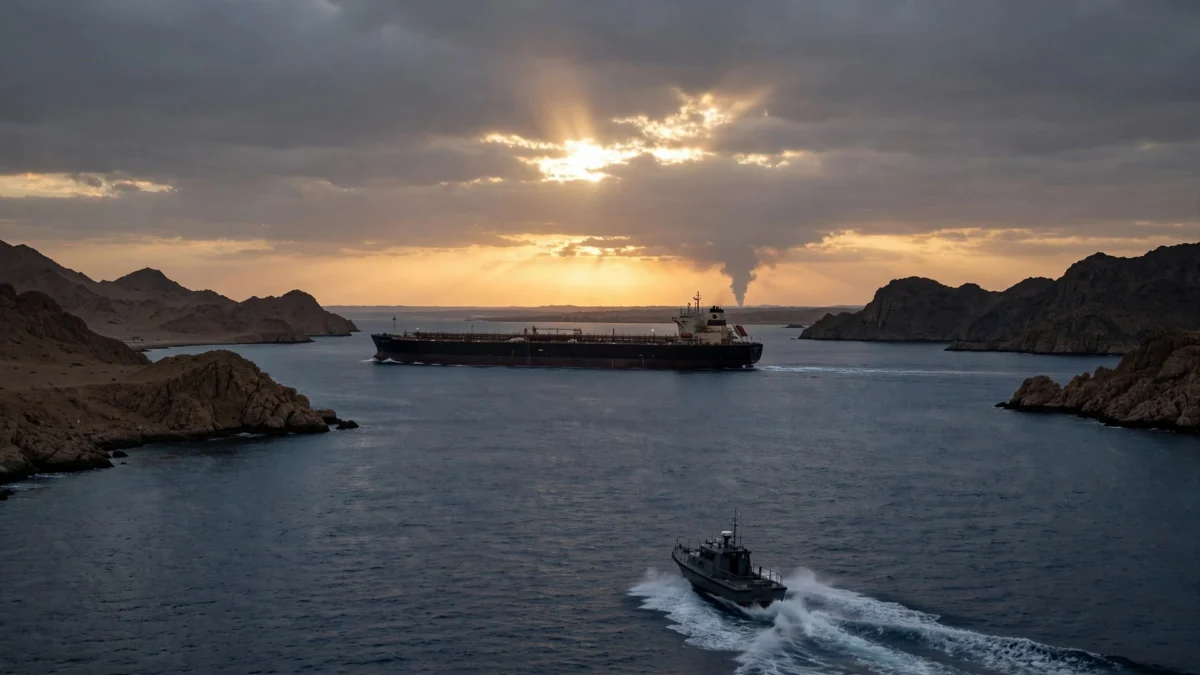
An outbound oil tanker was struck by an unidentified projectile in the Strait of Hormuz on Sunday, the second such attack in as many days, as Iran intensifies its campaign against commercial shipping through the world’s most important oil chokepoint while the United States tightens its naval blockade on Iranian ports.
The British maritime security body UK Maritime Trade Operations (UKMTO) said the master of the outbound tanker reported being struck on the port side, causing damage to the vessel. All crew members were reported safe, and authorities were investigating, according to reporting by JFeed and CNN.
The Sunday incident followed a near-identical attack on Saturday, when the master of another outbound tanker reported being struck on the port side by an unknown projectile that started a fire on board. The crew were reported safe, with damage and environmental impact unknown at the time of that report, UKMTO said.
A Second Strike in 48 Hours
The back-to-back strikes mark an escalation of a campaign that has seen more than a dozen attacks on shipping since the end of September, according to CNN. The United Nations’ International Maritime Organization has said at least 11 tankers came under attack during the week that ended October 4, the most strikes on commercial ships in the strait since the war began on February 28, according to the New York Post.
Neither vessel has been publicly identified by UKMTO, and no one has independently claimed responsibility for either the Saturday or Sunday strikes. But Iran’s Islamic Revolutionary Guard Corps moved quickly to attach a message to the violence.
The IRGC Navy claimed on Saturday that a crude-laden supertanker suffered a massive explosion after hitting a naval mine while attempting to leave the strait through what Tehran called an unauthorised route. According to the IRGC, the vessel had switched off its navigation and positioning systems, and the fire was large enough to be seen from the shoreline. The Guards declined to name the ship, and none of its account has been independently confirmed, JFeed reported.
Then came the warning. “A devastating fire is the fate of any tanker that violates the rules and disregards security in the Strait of Hormuz,” the IRGC said in a statement, sharing video of a tanker ablaze in the water as it reiterated its threats against any ship attempting to cross the strait without its permission, according to the New York Post.
The claim matters less for what it proves than for what it signals. UKMTO described the Saturday and Sunday incidents as projectile strikes; the IRGC described an explosion from a naval mine. The two accounts are not obviously the same event. But Tehran’s interest is not in forensic precision — it is in ensuring every master in the Gulf understands that passing through Hormuz without Iranian permission carries a price.
Iran’s Leverage Campaign
CNN’s analysis of the campaign’s logic is stark: with oil increasingly flowing out of the Gulf under US military escort, Iran is trying to regain its stranglehold over the waterway. Tehran treats the southern route near the coast of Oman as illegal and demands that vessels sail along the Iranian coast instead — a claim with no standing under international law, since the Strait of Hormuz is an international waterway that before the war carried close to a fifth of the world’s oil.
The rhetoric has escalated in step with the attacks. The head of the IRGC, Ahmed Vahidi, declared on X: “No extra-regional power has the right to threaten, maintain a domineering presence, or interfere in it. The Strait of Hormuz is Iran’s strategic red line.”
On Friday, the IRGC Navy said its forces had hit what it called a “giant” liquefied petroleum gas carrier, identified as NV Sunshine, as it sought to cross the strait through what Tehran called an illegal route south of the waterway. That claim, too, was presented as an IRGC assertion rather than a verified fact.
Sunday brought another new tactic. UKMTO said it had received reports from several ships in UAE waters that they had been directed via VHF radio messages to move from their anchorages. Shipping analysts Ambrey said the IRGC Navy had issued a warning to six vessels anchored around 16 miles (25 kilometres) from the port of Ras al Khaimah in the UAE, advising them to heave up anchor, exit the area immediately and transit to the Dubai anchorage.
Iran has avoided targeting the UAE itself recently, CNN noted — but the radio warnings make clear the campaign is no longer confined to the strait’s narrow channel. The net is widening.
The campaign’s political logic was laid out by Iran’s chief negotiator, Mohammed Bagher Ghalibaf, late in September: “As we have said before, in a region where we cannot sell oil, no one else will be able to sell oil either. And if our security is not guaranteed, no infrastructure will be safe.”
The US Blockade Bites
The context for Tehran’s fury is a blockade that is visibly working. The US military continues to enforce a naval blockade on Iranian ports, part of a strategy of maintaining economic pressure on Iran. According to CNN, September was the first month in which Iran loaded no crude onto tankers since maritime data tracking service Kpler began monitoring Iranian exports in 2013.
Last week, Mohsen Rezaei, the secretary of Iran’s Supreme National Security Council, described the current economic situation as one of the most difficult periods the country has faced.
Washington enforced the blockade again over the weekend. US Central Command said on Saturday it had disabled a cargo vessel in the Gulf of Oman after the ship’s crew ignored warnings and attempted to run the blockade against Iran. “A US military fighter jet struck the stern of Panama-flagged M/V Ocean Molica (also known as the ‘Arika Sun’) with a precision munition, fully disabling the ship’s propulsion without harming the crew,” CENTCOM posted on X.
Tehran’s response — setting a supertanker ablaze hours after the American strike, in the New York Post’s framing — reads as the second half of a trade: if Washington chokes Iran’s exports, Iran will make everyone else’s exports costlier and riskier.
Meanwhile, the political ceiling on American action shifted again this week. President Donald Trump announced on Thursday that the United States has no plans to strike Iran before the midterm elections, where rising energy costs could play a part in his Republican Party losing the House, the Senate — or both.
“We will not be attacking Iran at any time prior to the Midterm Elections to be held in the United States on November 3rd,” Trump declared on Truth Social, adding that the administration was “having productive discussions” with Tehran and that his main goal was to ensure the country did not obtain a nuclear weapon, CNN reported.
That pledge may explain the timing of Tehran’s escalation: with American offensive action publicly off the table until November, Iran has a window in which to raise the cost of the blockade without fear of immediate retaliation.
Oil Flows Slow, Prices Hold Above $100
The campaign is measurably denting the flow of oil through the strait. Analysts say the rise in attacks and threats is a response to higher volumes of oil and petroleum products moving through Hormuz — they averaged about 13.1 million barrels per day at the end of September, according to Kpler, just under 80% of the 17.1 million barrels that travelled through the strait each day before the war broke out.
But flows appear to have slowed this month. Just seven tankers transited the strait on Tuesday, less than half the seven-day average and the lowest number since July 23, Kpler data showed. Figures are at times revised higher after ships have moved through, since many switch off their identification systems to try to avoid detection — a practice the IRGC itself cited when it claimed the mined supertanker had gone dark.
Crude prices, meanwhile, remain above $100 a barrel, CNN reported — a level that keeps energy costs at the centre of American midterm politics and sharpens the dilemma Trump described: the blockade that squeezes Iran also squeezes American drivers.
The human cost of the tanker war is rising too. Earlier on Sunday, the UAE’s National Guard said its coastguard had rescued 22 people — all Indian citizens — following an oil tanker fire in the Gulf. The Consulate General of India in Dubai confirmed that the 22 rescued were the Indian crew of the crude tanker MT Gem No. 2 off the Ras Al Khaimah coast, and said all were safe and the consulate was in touch with UAE authorities, IANS reported. The Gem No. 2 had been struck by a drone at the Sharjah anchorage on Friday — the incident this publication reported earlier today — and India’s seafarers’ federation has since demanded a crisis team led by the prime minister to protect Indian crews caught in the crossfire.
Analysis: Why It Matters
Three separate pressure systems are now grinding against each other in the Gulf, and the Sunday strike is the point where they meet.
First, there is Iran’s economic desperation. A state that for the first time since 2013 cannot load a single crude cargo onto a tanker in a full month has, by its own chief negotiator’s admission, decided that if it cannot sell oil, no one else will. The tanker campaign is not terrorism for its own sake; it is the one lever Tehran still controls — the ability to tax, threaten or block the passage of everyone else’s oil. The IRGC’s theatre — the video of the burning tanker, the broadcast warnings to anchored vessels, the public threat of “devastating fire” — is designed for an audience of shipowners and insurers as much as for Washington.
Second, there is the American constraint. The blockade is working — perhaps too well. It has reduced Iranian crude exports to zero, which is precisely what has driven Tehran toward the tanker campaign. And Trump’s Thursday pledge not to strike Iran before the midterms binds the enforcement strategy to an electoral calendar: the administration is relying on economic pressure alone, while Iran exploits the window to raise the cost of that pressure. The diesel deal with Russia and the midterm energy-price anxiety show the same bind — Washington wants Iranian oil off the market and American petrol cheap at the same time.
Third, there is the market’s quiet verdict. Thirteen million barrels a day still move through Hormuz — the system has not broken. But the seven-tanker Tuesday, the switch to dark transits, and crude above $100 a barrel show the margin of safety shrinking. Markets are pricing not a closure of the strait but the steady accumulation of friction: higher insurance, slower transits, rerouted voyages. That friction is exactly what Iran wants — a pain dial it can turn up or down while keeping the oil flowing just enough to avoid the kind of outright closure that would unite the world against it.
The attribution fog is part of the weapon. UKMTO reports projectiles; the IRGC claims mines; vessels go unnamed; the same hulls may appear in multiple reports. For shipowners making routing decisions, the uncertainty is itself a cost — and cost is the point.
What to Watch Next
- US retaliation signalling. Will Washington respond to the weekend’s tanker attacks with force against IRGC naval assets, or stay within the blockade-enforcement frame Trump described on Thursday?
- The identity of the struck vessels. Naming the Saturday and Sunday tankers — and confirming whether the IRGC’s “mine explosion” describes one of the UKMTO-reported strikes or a separate incident — will clarify the scale of the campaign.
- Anchorage warnings. If the VHF broadcast orders spread from Ras al Khaimah to other Gulf anchorages, the campaign will have formally expanded from the strait to the region’s ports.
- Transit volumes. Kpler’s daily figures will show whether the Sunday strike pushes flows back toward the seven-tanker low — or whether escorts and rerouting keep oil moving.
- Crude prices and the midterm clock. With oil above $100 a barrel and the November 3 midterms approaching, each new attack feeds directly into American domestic politics — and into Trump’s stated reason for holding off on strikes.
Sources
- CNN: “After oil increasingly left the Gulf, Iran is trying to regain its stranglehold on shipping”
- New York Post: “Iran sets supertanker ablaze after US takes out ship breaking blockade”
- JFeed: “Supertanker Ablaze in the Strait of Hormuz as Iran Threatens Any Ship That”
- IANS: “22 Indian crew members rescued from a vessel off Ras Al Khaimah coast: Indian Consulate in Dubai”

About the Author — Abdul Mannan
Related Articles
Tanker War Spreads Beyond Hormuz: Drone Strike Hits Indian-Crewed Supertanker at Sharjah Anchorage
A drone strike on the Panama-flagged supertanker Gem No.2 at Sharjah Anchorage left all 22 Indian crew safe,…

Trump Administration Bars Microsoft, Adobe and Six IT Firms From Green-Card Pipeline in Sweeping Visa-Fraud Crackdown
The White House has suspended Microsoft, Adobe and six major IT outsourcing firms from the federal green-card program,…

SoftBank’s Masayoshi Son Seeks Up to $100 Billion From Gulf Investors for New AI Buyout Fund, FT Reports
Masayoshi Son has been sounding out Gulf investors for up to $100 billion to build a new fund…