Tanker War Spreads Beyond Hormuz: Drone Strike Hits Indian-Crewed Supertanker at Sharjah Anchorage

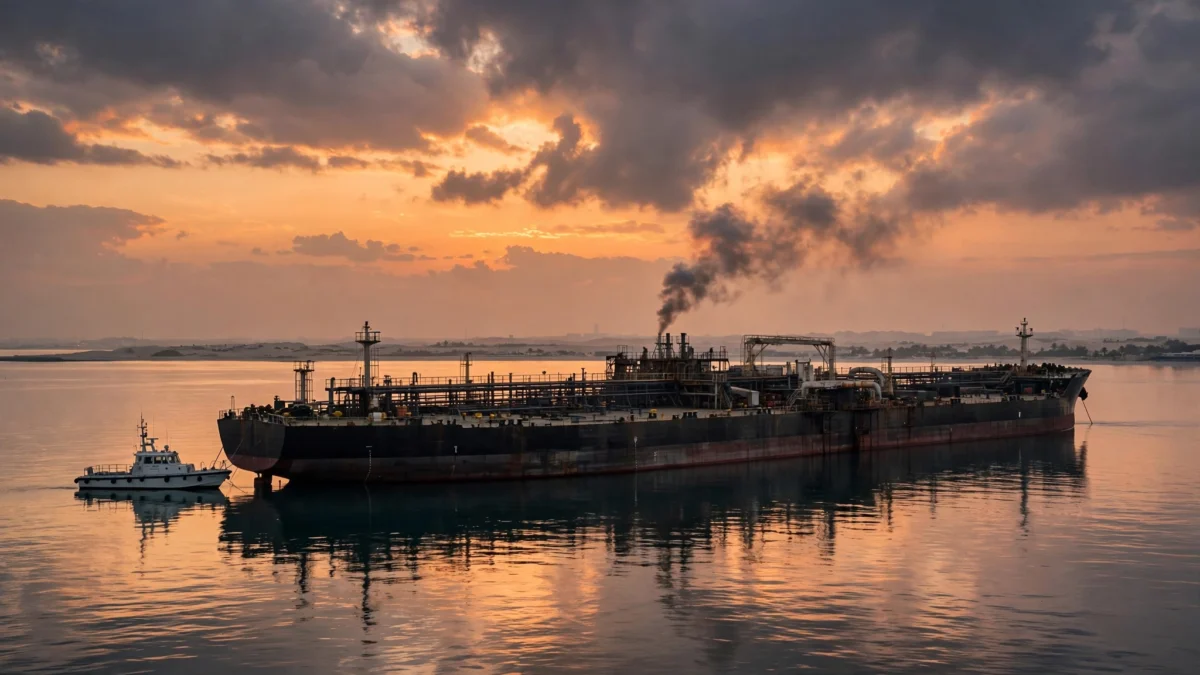
The campaign against commercial shipping in the Gulf has reached inside the harbour itself. On Friday 9 October, the Panama-flagged crude oil supertanker MT Gem No.2 was struck by a drone at Sharjah Anchorage, off the coast of the United Arab Emirates, sparking a fire on board a fully laden vessel of more than 300,000 deadweight tonnes.
All 22 crew members aboard — every one of them an Indian national — were reported safe. India’s Minister for Ports, Shipping and Waterways, Sarbananda Sonowal, confirmed the attack and the crew’s safety in a post on X late on Friday, adding that the government was continuously monitoring the situation and in direct contact with the ship’s management company to safeguard the seafarers, according to TBS News.
Maritime security firm Vanguard identified the vessel and said it was struck by an unidentified projectile at around 10am GMT on Friday, after which it sent a distress message reporting a fire, according to Reuters reporting carried by Iranianuae.ae. The British naval monitoring centre, UK Maritime Trade Operations (UKMTO), also reported that a projectile had struck a vessel in UAE waters, with the resulting fire brought under control. Two shipping and security sources told Reuters the vessel was the Panama-flagged crude oil supertanker Gem No.2, and vessel-tracking data showed the fully laden tanker was anchored off the UAE coast at the time.
The vessel is managed in Taiwan and linked to U-Ming Marine Transport, according to Vanguard, as reported by maritime outlet Splash247. The extent of the damage to the ship remains unclear.
On Saturday 10 October, the UAE National Guard said the country’s Coast Guard had rescued 22 crew members from an oil tanker that caught fire in Gulf waters, describing all those rescued as Asian nationals in stable condition, according to the Emirates News Agency (WAM) as reported by Iranianuae.ae. The Guard did not disclose the tanker’s name, the cause of the fire, or when exactly the operation took place — and UAE authorities have not confirmed whether the reported rescue involved the same vessel struck at Sharjah Anchorage.
A Week of Escalation Across the Gulf
The Sharjah attack did not happen in isolation. It followed another tanker strike off Qatar earlier in the week, according to Splash247, and came as Iran’s Revolutionary Guards warned they would pursue ships taking what Tehran considers unauthorised routes anywhere in the region — not just inside the Strait of Hormuz.
The violence continued on Saturday. UKMTO reported that an unidentified outbound tanker was struck on its port side by a projectile within the Strait of Hormuz itself, triggering another fire, with its crew reported safe, according to Splash247. Iran separately claimed that a supertanker had exploded after hitting a naval mine while exiting the strait through an unauthorised route. The vessel was not named and the account remains unverified. The Guards also claimed to have struck the Vietnamese LPG carrier NV Sunshine, though independent confirmation of that claim remains elusive, Splash247 reported.
Meanwhile, in the Gulf of Oman, US forces struck the stern of the Panama-flagged bulker Ocean Molica, also known as Arika Sun, disabling its propulsion after it allegedly ignored warnings under Washington’s blockade of Iranian ports, according to Splash247. No crew injuries were reported. The incident shows the pressure on commercial shipping is now two-sided: vessels risk attack from Iranian forces on one side and interdiction by US forces enforcing the port blockade on the other.
Maritime analysts tracking the campaign say the pace of attacks has quickened sharply. Vanguard has recorded at least 14 attacks around Hormuz since 20 September, according to the Financial Times reporting carried by Marine Insight, while maritime intelligence firm Eagle Intel put the documented tally at 11 commercial-ship attacks in and around the strait since the beginning of October.
India Demands a PM-Led Crisis Response
For India, the Gem No.2 attack has become a domestic political issue, because India supplies a large share of the world’s tanker crews and its seafarers keep appearing in the casualty figures. At least ten Indian seafarers have been killed in Gulf attacks since February, according to analysis carried by Tech Times, while the International Maritime Organisation estimates that 24 seafarers in total have died in the region since the war began, according to the Financial Times reporting carried by TBS News.
On Saturday, the Federation of Seafarers’ Unions of India (FSUI) called for a high-level crisis management team under the Prime Minister to assess the threats facing Indian seafarers operating in conflict-affected maritime regions, according to The HinduBusinessLine. FSUI General Secretary Manoj Yadav, speaking to ANI in Mumbai, said the team should bring together the defence establishment, the Navy and the shipping industry. He cited what he described as multiple vessels attacked over the last ten days — naming the vessel MV Royad Mammadov among incidents in the Black Sea and the Hormuz Strait and Persian Gulf — all carrying Indian crews.
“If you want to be at sea, if you want to be in the global market, then I believe it is the high time that one high-level management crisis team under the Prime Minister has to be constituted, including all the defence and Navy and the industry together,” Yadav said, according to The HinduBusinessLine. “Then only we can analyse the potential threat of the seafarers who all are in those areas.”
The demand points to a shift: crew safety in the Gulf is no longer being treated as a shipping-industry problem, but as a matter of state. India’s External Affairs Ministry has also been building diplomatic cover. During the 81st United Nations General Assembly, India and Liberia established a Group of Friends on Safety and Security of Shipping and Seafarers, which held its inaugural meeting in New York with 25 countries participating, according to TBS News. The group is co-chaired by India’s External Affairs Minister S. Jaishankar and Liberian Foreign Minister Sara Beysolow Nyanti. Ministry spokesperson Randhir Jaiswal said the coalition aims to bring commercial shipping nations and seafaring communities together to place seafarer security at the centre of global discourse. India and Liberia issued a joint statement condemning attacks on vessels as indefensible, expressing condolences to the families of seafarers who had lost their lives, and calling for an immediate end to actions disrupting maritime trade.
India is a major supplier of international seafarers, while Liberia holds the world’s largest shipping registry by tonnage, according to TBS News — a pairing that gives the new group both the people and the flags at stake in the crisis.
The Price of Sailing: $100,000 Captains and Soaring Premiums
The business dimension of the tanker war is now visible in every line of the shipping ledger. The Financial Times, citing three sources, reported that tanker captains are being offered about $100,000 a month plus a $50,000 bonus for each transit through the Strait of Hormuz, according to TBS News and Marine Insight. A captain normally earns about $15,000 a month; ordinary sailors start at around $1,500. Crews now receive double pay in the southern Red Sea and the Gulf of Oman, and four to six times their normal wages during actual Hormuz transits.
One person cited by the Financial Times said some seafarers were “almost being viewed as mercenaries” because of the risks involved, Marine Insight reported.
Freight markets are reflecting the same risk premium. Daily charter rates for tankers using the strait have reached about $1.3 million a day, up from roughly $20,000 to $50,000 a day before the crisis, according to the Financial Times reporting carried by TBS News. War-risk insurance premiums have climbed to between 6 and 10 per cent of a vessel’s hull value, adding as much as $20 million in insurance costs to a single supertanker voyage into the Gulf — compared with about 0.25 per cent before the war, when cover for a $100 million vessel cost roughly $250,000 per voyage, according to TBS News and LiveMint’s earlier reporting of broker estimates. Some operators are reducing exposure by shipping crude to waters off Fujairah in the Gulf of Oman, where cargo is transferred to other vessels for onward delivery.
Bunker fuel costs have followed. Supertanker fuel prices in Fujairah have reached $686 per tonne, a 67 per cent increase from a year earlier, according to TBS News. For oil, the direct cost of crew bonuses is negligible — a $50,000 transit bonus spread across a supertanker’s roughly two-million-barrel cargo adds only a couple of cents per barrel, far less than owners are paying in freight and war-risk insurance, according to analysis carried by InvestingLive.
Yet flows have proved remarkably resilient. Tanker traffic through the strait is back to about 81 per cent of pre-war levels, according to the National Security Journal, with Aramco moving almost 60 million barrels back through Hormuz in September and October — though Goldman Sachs has flagged the 70 per cent range as the new normal if attacks continue at their current pace, the journal reported.
Analysis: Why It Matters
The Sharjah attack matters less for what it destroyed — the fire was extinguished, nobody died — than for what it proved: there is no longer a safe address in Gulf shipping. Striking a fully laden supertanker at anchorage, inside the sheltered waters of a UAE port, moves the campaign out of the contested Strait of Hormuz and into ordinary commercial operations. If vessels are not safe while stationary, the entire premise of war-risk pricing — that danger is a function of route, not location — starts to break down. Underwriters will notice, and their notices will show up in premiums long before any hull is lost.
Second, the campaign’s arithmetic is brutally asymmetric, and that is precisely why it works. A drone costs thousands; a supertanker costs $150 million; a single voyage’s war-risk cover can cost $20 million. Iran does not need to sink tankers to achieve its effect — it only needs to hit enough ships, often enough, that owners and underwriters do the maths and stay home. Every struck vessel makes the case. This is pressure calibrated for the spreadsheet rather than the battlefield, and it converts directly into higher energy costs for consumers far from the Gulf.
Third, the real bottleneck may be human rather than physical. Crude is still flowing at more than four-fifths of pre-war levels, but the flow now depends on crews willing to sail into a shooting gallery. India supplies a huge share of the world’s seafarers, and at least ten of them have died in these waters since February. If Indian crews — or the unions and government that speak for them — begin refusing Gulf assignments, tanker availability would contract far faster than any amount of hull damage could manage. The FSUI’s demand for a PM-led crisis team is the first sign that this labour risk is becoming a state-level problem, and New Delhi’s diplomatic response — the Group of Friends with Liberia — shows the government is already treating seafarer security as foreign policy, not just an industry concern.
Fourth, the attribution fog itself is now a market force. Official statements from the UAE and India do not name a perpetrator; Iran’s Revolutionary Guards claim some attacks while others go unclaimed; US forces are simultaneously disabling vessels themselves under the port blockade. Insurers price ambiguity: the less certain the attribution, the wider the risk band. Until there is clarity — either about who is attacking or about what would make them stop — premiums will stay elevated regardless of how many transits complete safely.
Finally, the two-sided pressure on shipping marks a genuine escalation. The US disabling of the Ocean Molica in the Gulf of Oman shows Washington is willing to use kinetic force against vessels that defy its blockade, even as Iran’s forces attack vessels that comply with commercial routes. Shipowners are now caught between two armed campaigns with incompatible rules, and the safest commercial decision — staying out of the Gulf — is also the one that would cut global energy supply. That is the trap the current campaign is designed to spring, and it will hold until either diplomacy or deterrence changes the calculation.
What to Watch Next
- Whether UAE authorities publicly identify the vessel involved in the Coast Guard rescue or formally attribute the Sharjah attack — naming would sharpen both the diplomatic and insurance picture.
- The next round of war-risk pricing: whether underwriters raise rates further after a week with multiple strikes, or pause cover for Gulf transits entirely.
- New Delhi’s response to the FSUI demand: whether a Prime Minister-led crisis team on seafarer safety actually materialises, and what it would do.
- Crew dynamics: whether pay offers climb further or seafarers begin refusing Gulf assignments — the labour question that could decide flows.
- The pass-through to energy prices: whether sustained premium levels push crude and diesel prices higher in the weeks ahead.
Sources
- All 22 Indian crew members safe after drone attack on tanker off UAE — TBS News
- Tanker war spreads across Gulf — Splash247
- “High-level crisis team under PM needed”: Seafarers’ Union petitions Govt after Sharjah tanker attack — The HinduBusinessLine
- Hormuz crisis drives tanker crew pay, freight and insurance costs higher — TBS News

About the Author — Abdul Mannan
Related Articles

Trump Administration Bars Microsoft, Adobe and Six IT Firms From Green-Card Pipeline in Sweeping Visa-Fraud Crackdown
The White House has suspended Microsoft, Adobe and six major IT outsourcing firms from the federal green-card program,…

SoftBank’s Masayoshi Son Seeks Up to $100 Billion From Gulf Investors for New AI Buyout Fund, FT Reports
Masayoshi Son has been sounding out Gulf investors for up to $100 billion to build a new fund…

SpaceX’s $8 Billion Spectrum Deal Sends Telecom Giants Reeling as Starlink Mobile Aims for the US Wireless Market
SpaceX has agreed to buy Grain Management's nationwide 800 MHz spectrum portfolio in a deal worth about $8…