Ukraine Reports Russian Strikes on Energy Sites After Trump’s “Energy Ceasefire” Announcement

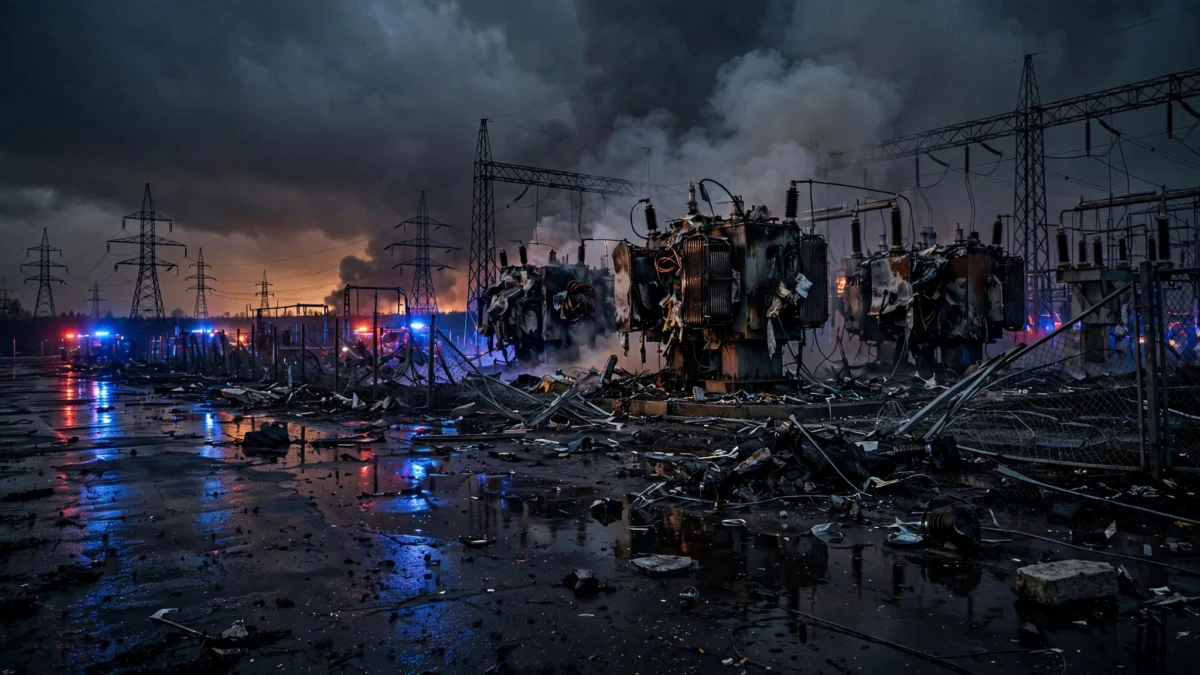
Ukraine reported Russian strikes on its energy infrastructure on Sunday, hours after United States President Donald Trump declared an “energy ceasefire” between Russia and Ukraine that Kyiv said caught it completely by surprise, according to the Associated Press.
President Trump announced the truce in a post on his Truth Social platform on Sunday morning. “Effective immediately, there is an ENERGY CEASEFIRE in the War between Russia and Ukraine. Both parties have agreed. Do not break it!” he wrote, according to CNN, which reported that a source close to Ukrainian President Volodymyr Zelensky said the announcement was a surprise to the Ukrainian leader.
Asked about Trump’s post, a senior Ukrainian official told CNN: “We just read it as you did.”
Zelensky himself said the announcement had been “news” to him. “The ceasefire announcement was news for me,” Zelensky told Axios journalist Barak Ravid, according to multiple outlets. “But if Russians agree to an energy ceasefire, Ukraine will agree.”
Later in the day, Zelensky struck a more supportive tone in a public statement. “Ukraine supports the ceasefire, and it is important that Russia support it as well,” he wrote on X. “We are awaiting details from the American side. For our part, Ukraine always FULLY supports steps toward de-escalation, the protection of lives, and the decisions needed to end the war and guarantee lasting peace.”
But by Sunday evening, Zelensky said in his nightly address that Russian attacks had not stopped. “Unfortunately, Ukrainian skies have been infested with Russian ‘shaheds’ all day today,” he said, referring to the drones Moscow has used extensively against Ukrainian cities, according to the Associated Press. “There have been glide bomb strikes and strikes on our energy infrastructure too. A power plant in Kharkiv was attacked this evening.”
The Ukrainian presidential office confirmed that the Kharkiv attack took place after Trump’s ceasefire post, the Associated Press reported. Kyiv’s mayor, Vitali Klitschko, also said the Ukrainian capital’s water and power grid remained under attack despite the announcement, according to The Times.
Zelensky said Ukraine was “ready to refrain from striking Russian energy infrastructure — and we count on the same readiness from Russia.”
Moscow did not immediately comment on Trump’s announcement, according to CNN and the Associated Press.
The development capped a remarkable weekend in the diplomacy of the nearly five-year-old war. Days before the announcement, Trump spoke with Russian President Vladimir Putin, and the two leaders unveiled a controversial arrangement under which Russia would supply diesel fuel to international markets, according to CNN. At the same time, talks between senior Ukrainian and American officials — including Trump’s son-in-law Jared Kushner and special envoy Steve Witkoff — got underway in Miami, according to CNN.
Zelensky had publicly criticised the diesel arrangement, saying it would prolong the war, and Trump responded by suggesting Ukraine should “get a new leader who can make a deal,” according to CNN. In an interview on Sunday, Zelensky also called for a ceasefire and said he would hold elections if Russia agreed to a 60-day truce.
In his Sunday evening address, Zelensky said Ukraine had proposed many de-escalatory steps but that Russian President Vladimir Putin “had one answer to all of them — ‘nyet.'” He added, according to the Associated Press: “We do hope that he will finally say something different to America, Ukraine, and the entire world.”
The response from Europe was swift. British Prime Minister Andy Burnham said Russia had stepped up its attacks on Ukraine’s energy infrastructure, plunging civilians “into cold and darkness,” and endorsed the ceasefire effort, The Times reported. “The UK strongly supports President Trump’s call today for a sustained energy ceasefire to start now,” he wrote on X. “Ukraine is ready if Russia stops its attacks. This is the best route to get energy and fuel back into world markets.”
Zelensky said he had discussed the announcement with Canadian Prime Minister Mark Carney, Finnish President Alexander Stubb and NATO Secretary-General Mark Rutte, according to the Associated Press.
The clash between the two sides’ energy campaigns has defined much of this year of the war. Kyiv has carried out strikes on Russian energy infrastructure — particularly oil refineries — in retaliation for Moscow’s campaign against Ukraine’s grid, according to the New York Post. Ukraine has dubbed those strikes its “long-range sanctions.” The Trump administration has blamed Ukraine’s refinery campaign for driving up diesel prices: according to data from the American Automobile Association cited by the New York Post, diesel was sitting at $6.28 a gallon nationally.
Russia, for its part, has spent the war seeking to deny Ukrainian civilians power, heat and running water, hoping to wear down public resistance to Moscow’s full-scale invasion, according to the Associated Press. Ukrainian officials describe the strategy as “weaponizing winter.”
Notably, this is not the first time Trump has announced an energy truce in the conflict. According to Bloomberg’s Javier Blas, cited by CoinDesk, it is the second time the president has made a similar announcement. A similar declaration in September was followed by Russian strikes on Ukrainian fuel infrastructure and Ukrainian strikes on Russian refineries, leaving the arrangement without visible effect.
Euronews reported that Kyiv would agree to a halt only if Russia stopped all of its strikes on Ukrainian energy, while the two sides define energy differently — Moscow focused on its oil exports and Kyiv on electricity and heat for civilians.
Analysis: Why It Matters
A ceasefire that one side announces and the other side learns about from the news is not a ceasefire — it is a test of who wants one. Sunday’s events put that test to both sides in public, and the early returns were not encouraging. Within hours of the American president’s declaration, Ukraine’s presidential office was confirming that a power plant in Kharkiv had been attacked. Whatever the diesel deal or the Miami talks achieved behind closed doors, the front line of the energy war did not move on Sunday.
The deeper problem is that the two sides are not even talking about the same “energy.” For Moscow, energy means the oil and diesel it exports — the revenue stream that funds the war and the asset Ukraine has been burning in Russian refineries for months. For Kyiv, energy means the transformers, substations and power plants that keep civilians alive through winter. An agreement that each side reads differently is not an agreement at all; it is a disagreement deferred. Zelensky’s conditional offer — Ukraine will hold fire only if Russia holds fire on all of its energy strikes — exposed that definitional gap rather than closing it.
The September precedent matters because it is the control group for this experiment. An earlier Trump energy-truce claim dissolved within days as both sides resumed strikes. If this round ends the same way, the lesson will not be that ceasefires are impossible; it will be that announcements unattached to verification — no monitoring mechanism, no defined duration, no confirmed Russian consent — dissolve on contact with the war.
What has changed since September is the European posture. Britain’s prime minister publicly endorsed Trump’s call while simultaneously pledging to strengthen sanctions, and Zelensky’s calls with Carney, Stubb and Rutte show a coordinated diplomatic push to lock in whatever the announcement was worth. Europe appears to have decided that even an unconfirmed ceasefire is a better platform than the status quo — a pragmatic bet that public commitment creates pressure for private compliance.
There is also a domestic American clock ticking. With midterm elections days away and diesel at $6.28 a gallon nationally, according to AAA data cited by the New York Post, the president has a strong incentive to show progress on energy prices and on the war he once claimed he could end quickly. Whether that incentive produces a durable truce or another headline that evaporates by morning is the question Sunday’s strikes left hanging over the announcement.
Finally, the winter horizon gives this story its gravity. Russia’s energy campaign against Ukrainian civilians — the “weaponizing winter” strategy the Associated Press describes — becomes exponentially more dangerous as temperatures fall. A genuine energy ceasefire would be the single most consequential humanitarian step in months. The fact that it was announced, and then immediately doubted by the very people it was supposed to protect, tells the full story of this war’s diplomacy: hope declared in Washington, verification awaited in Kyiv and Kharkiv.
What to Watch Next
- Moscow’s response. Russia has not confirmed the ceasefire. Whether the Kremlin accepts, ignores or publicly rejects the announcement will determine whether Sunday’s declaration was diplomacy or theatre.
- Verification of the strikes. Ukraine says a power plant in Kharkiv and energy facilities in Kyiv were hit after the announcement. Independent confirmation of the damage — and whether the attacks continue in the coming days — will show whether the ceasefire has any operational reality.
- Ukraine’s own refinery campaign. Zelensky has offered to halt Ukrainian strikes on Russian energy infrastructure if Russia reciprocates. Whether Ukrainian long-range strikes pause will signal how seriously Kyiv treats the arrangement.
- The Miami talks. Discussions involving Kushner and Witkoff were underway as the diesel deal was announced. Any readouts from those talks could reveal what, if anything, was actually agreed beyond the Truth Social post.
- The diesel question. Trump’s arrangement with Moscow on fuel supplies sits at the centre of this story. Watch whether diesel prices move, whether European sanctions policy shifts in response, and whether the legal questions around importing Russian fuel resurface.
Sources
- CNN — “Trump claims Ukraine and Russia have agreed to energy ceasefire” — https://www.cnn.com/2026/10/11/politics/trump-ukraine-russia-energy-ceasefire
- The Times — “Trump’s Russia-Ukraine truce is ‘news to me’, says Zelensky” — https://www.thetimes.com/world/europe/article/trump-announces-ukraine-russia-energy-ceasefire-vxbz3lddz
- Associated Press (via WVLT) — “Trump says Russia and Ukraine agree to an ‘energy ceasefire’ but Kyiv says attacks continue” — https://www.wvlt.tv/2026/10/11/trump-says-russia-ukraine-agree-an-energy-ceasefire-kyiv-says-attacks-continue/
- New York Post — “Russia, Ukraine reach energy cease-fire ‘effective immediately,’ Trump reveals — catching Kyiv off-guard” — https://nypost.com/2026/10/11/us-news/russia-ukraine-reach-energy-cease-fire-effective-immediately-trump-announces/

About the Author — Abdul Mannan
Related Articles
Trump Declares ‘Effective Immediately’ Energy Ceasefire Between Russia and Ukraine; Zelensky Says It Was “News for Me”
Donald Trump has announced that Russia and Ukraine have agreed an immediate "energy ceasefire", but Ukrainian President Volodymyr…
Pope Leo XIV to Undergo Lung Surgery This Week After Doctors Find Small Early-Stage Nodule
Pope Leo XIV told pilgrims in St. Peter's Square that doctors found a small, localized nodule in his…
After Deadly Riyadh Airport Strike, Trump Signals US Response as Houthis Warn Airlines of More Attacks
Donald Trump said the United States "may" join Saudi strikes against the Houthis and vowed to call Crown…