Pope Leo XIV to Undergo Lung Surgery This Week After Doctors Find Small Early-Stage Nodule

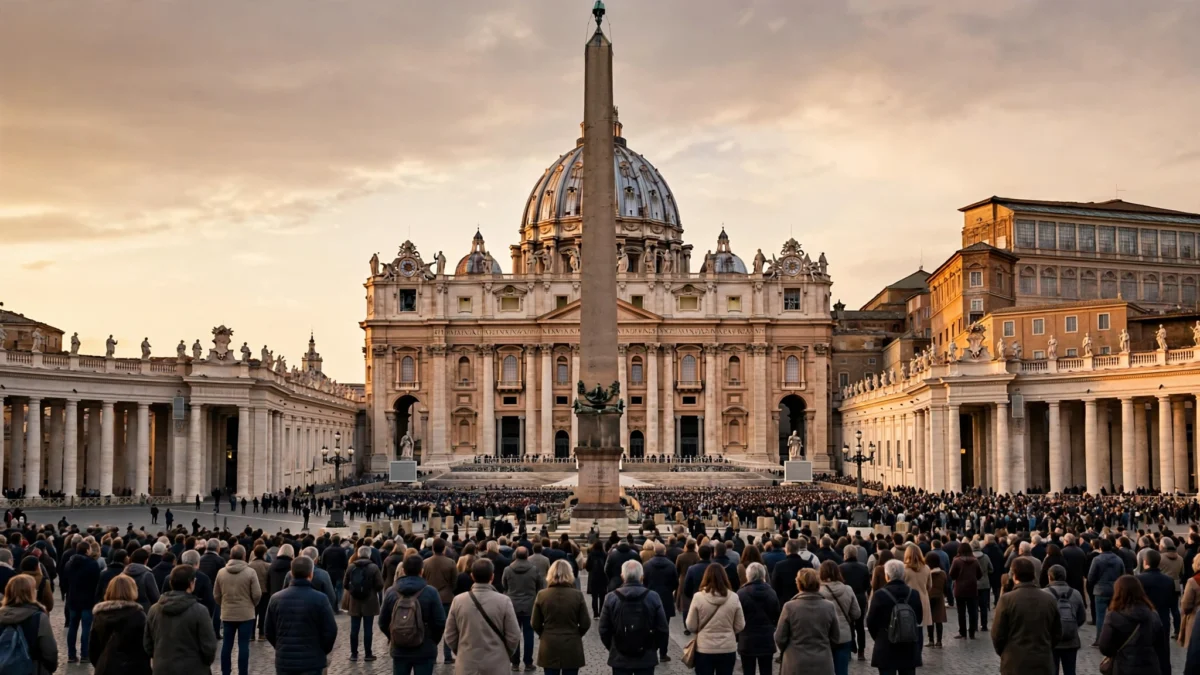
Pope Leo XIV announced on Sunday that he will undergo surgery in the coming days to remove a small nodule found in his lung, the first significant health episode of his 17-month papacy and a moment that immediately drew global attention to the 71-year-old pontiff.
The American-born pope made the disclosure himself during his weekly Sunday Angelus address in St. Peter’s Square, telling the gathered pilgrims that recent medical examinations had revealed what he described as a “localized nodule” in one of his lungs. He said the growth had been detected at a very early stage and was well contained, and that his doctors had advised him to have it removed.
Speaking in Italian, the pope told the crowd: “The operation is already scheduled for the coming days.” He then thanked the faithful for their support, saying: “I thank you for your spiritual closeness and entrust myself to your prayers.”
Vatican spokesman Matteo Bruni confirmed after the address that the surgery would take place in the first days of the week, and that the estimated hospital stay and post-operative recovery time would be about one week. Vatican News reported that the operation will be performed at Rome’s Gemelli hospital, the institution that has long served as the medical home of popes and whose top floor contains a dedicated eight-room papal suite, including a private chapel, living rooms, a kitchen, a meeting room for doctors, offices, and quarters for security staff.
The Vatican has not disclosed whether the nodule is cancerous. According to the American Cancer Society, lung nodules are small abnormal areas, generally measuring three centimetres or less, that show up on chest scans and are most often the result of old infections, scar tissue, or other non-cancerous causes; imaging alone cannot determine whether a nodule is malignant, and only a laboratory examination of the tissue can say for certain. The pope himself offered no speculation about the nature of the growth, choosing instead to emphasise that it was caught early and that the decision to operate followed his doctors’ advice.
The announcement marks the first publicly known health issue of Leo’s pontificate. He has had no previously disclosed medical problems and is regarded as physically active: according to the Associated Press, he plays tennis weekly and swims regularly at the papal summer retreat in Castel Gandolfo. The vigour of the 71-year-old had, until Sunday, been something the Vatican appeared to take for granted rather than to discuss.
An engaged papacy, briefly interrupted
The surgery will force the pope to clear his calendar in the days ahead. Engagements scheduled for the coming week will be cancelled or postponed, including the closing Mass of a Vatican meeting on the family — marking the tenth anniversary of “Amoris Laetitia,” the apostolic exhortation of Pope Francis — which he had been due to lead on Wednesday, October 14, according to reports carried by Catholic media outlets. The Vatican has not yet published a revised schedule.
One question hanging over the announcement is whether the operation and recovery will affect the pope’s most important upcoming commitment: an 11-day trip to Uruguay, Argentina, and Peru scheduled for November 6 to 17, which would be the longest international journey of his pontificate and his first return to Peru since his election. Earlier in his Sunday remarks, before disclosing the surgery, Leo indicated that he still planned to make the trip. The Vatican has not said whether the itinerary might be adjusted in light of the operation.
The Sunday in which Leo chose to make the announcement was, until that moment, an ordinary one in his papacy’s busy calendar. In the same Angelus address, according to NPR, he renewed his appeals for peace in Ukraine, urging the warring parties to allow the safe transport of grain across the Black Sea and warning that “the daily bread of millions of people cannot be held hostage by war.” A day earlier, on Saturday, he used his X account to call for the worldwide abolition of the death penalty, calling it “inadmissible because it is an attack on the inviolability and dignity of the person.”
Those interventions are characteristic of a pontiff who, in his first year and a half, has positioned himself as an outspoken moral voice on international affairs. Leo has repeatedly criticised President Donald Trump’s prosecution of the Iran war, including during a four-country tour of Africa in April, where he delivered one of the most pointed condemnations by any global religious leader of the conflict. His words drew public rebukes from Trump and Vice President JD Vance — himself a Catholic — and set off a debate among conservative American Catholics about the Church’s relationship with the administration.
The first American pope
The global interest in Leo’s health is inseparable from the unprecedented figure he cuts in the history of the Catholic Church. Born Robert Francis Prevost on September 14, 1955, in Chicago, he was elected on May 8, 2025, becoming the 267th pope and the first ever born in the United States.
His biography blends American roots with a deeply Latin American formation. After entering the Order of Saint Augustine and being ordained in 1982, he spent roughly two decades in Peru, first as a missionary and later as bishop of Chiclayo, taking Peruvian citizenship along the way. In 2023, Pope Francis brought him to Rome to lead the powerful Dicastery for Bishops, the office that vets candidates for bishoprics worldwide — a role that made him known to, and respected by, a large share of the cardinals who would later elect him. From the balcony of St. Peter’s Basilica on the night of his election, he greeted the world with the words “Peace be with all of you” and quoted Saint Augustine: “For you, I am a bishop; with you, I am a Christian.” His choice of the name Leo is widely read as a tribute to Leo XIII, the late-19th-century pope who engaged the Church with modern social questions, from workers’ rights to the role of faith in industrial society.
Leo leads a Church of roughly 1.4 billion people, and any interruption in his activity — even a brief, routine one — registers across continents. That is one reason the announcement, delivered with deliberate calm on a Sunday afternoon, carried a particular weight: the faithful in St. Peter’s Square fell silent as he spoke, and messages of support began arriving within the hour.
Italian Prime Minister Giorgia Meloni was among the first to respond, expressing her own support and that of the Italian government as the pope “faces this challenge in the coming days.” In a statement, she said the serenity and calm with which he had spoken about the surgery were reassuring. Meloni had been one of the few outsiders permitted to visit Pope Francis during his long final hospitalisation, a connection that gave her words a personal resonance.
A hospital with papal history
Gemelli hospital occupies a singular place in the modern story of the papacy. Pope John Paul II was admitted there repeatedly, most memorably in July 1992, when he told pilgrims at the Angelus that he was going in for tests and, three days later, surgeons removed a benign colon tumour along with his gallbladder. Pope Francis was hospitalised at Gemelli multiple times, including the long respiratory crisis in early 2025 that developed into double pneumonia and preceded his death on April 21, 2025, at the age of 88. Francis had suffered from chronic lung disease since youth — part of one lung had been removed when he was a young man — a history that makes any papal lung diagnosis land with a particular gravity for those who remember his final months.
That memory shaped much of Sunday’s coverage, though the two situations differ sharply. Francis’s final illness was a prolonged, compounding crisis in a pope of 88 with a lifetime of respiratory frailty. Leo, at 71, is facing a single, small, early-detected lesion, discovered through screening rather than through symptoms, in a man with no known health history. The Vatican’s own language — “very early stage,” “well localized,” a recovery measured in days — is the vocabulary of precaution, not emergency.
Analysis: Why It Matters
The transparency shift is the story inside the story. For most of the modern papacy, a pope’s health was treated as a state secret. When John Paul I died in 1978, 33 days into his pontificate, the Vatican said his secretary had found the body; it later emerged that the nuns who brought his morning coffee had found him, no autopsy was performed, and the discrepancies fed decades of conspiracy theories. John Paul II’s decline played out in public view while officials rarely uttered the word Parkinson’s by name — a cardinal’s mention of it to an Italian newspaper in 2003 was reported as an embarrassing slip. Benedict XVI resigned in 2013 saying the ministry required “strength of mind and body” that his own had lost; only afterward did the Vatican acknowledge that he had quietly had his pacemaker battery replaced months earlier.
Against that history, Sunday’s announcement is striking: a pope standing in the square, on a Sunday, telling the world himself about a nodule in his lung and the date of his operation. Leo has chosen disclosure over the institutional instinct for silence. That choice may owe something to his American formation — a culture in which public figures’ health is debated openly — but whatever its source, it resets expectations for how this pontificate will handle the subject. If the Vatican maintains this candour through the surgery and recovery, it will be a departure from centuries of practice. If it retreats into vagueness — about what the pathology shows, about the precise timeline — the suspicion that shadowed his predecessors will return.
A pope’s body is never just a body. The Catholic Church’s centralised governance means that a pope’s schedule is the schedule of 1.4 billion people’s shepherd, and a hospitalization, however brief, is a logistical event: audiences cancelled, messages undelivered, a diplomatic calendar frozen. Leo’s November South America trip is not a ceremonial tour; it is his first return to the continent where his pastoral identity was formed, and its postponement would carry real symbolic cost. The Vatican’s handling of the coming days will therefore be watched not only by the faithful but by governments and diplomats who calibrate their own timetables around the pope’s.
The geopolitical pope. It is worth noting what kind of pontiff is going into the operating theatre: the most geopolitically engaged American pope in history, one who has publicly crossed the Trump administration over the Iran war and who has made Ukraine’s suffering a weekly theme of his addresses. A pope’s illness concentrates minds; it also, historically, has a way of reshaping the final chapters of pontificates. Nothing about Sunday’s announcement suggests such a chapter is being written — the pope is 71, active, and the nodule small. But the lesson of the modern papacy is that health is the quiet variable in every calculation of what a pontificate can achieve, and Leo’s own candour has now placed that variable on the public record.
What remains unknown. The Vatican has said nothing about the nodule’s nature, the exact day of surgery, the surgical approach, or the medical team. That reticence is normal; what matters is whether it is temporary. The pathology report, when it exists, will answer the one question every Catholic is quietly asking. Until then, the facts are what the pope told the square: a small nodule, found early, being removed on his doctors’ advice. The discipline of the coming week will be to hold to those facts and resist the speculation that fills every papal silence.
What to Watch Next
- The pathology report. The single most important unanswered question is what the removed tissue turns out to be. Only the laboratory examination can answer it, and the Vatican’s willingness to share the result will be the first test of its new transparency.
- The surgery date and the cancelled calendar. The Vatican said the operation falls in the first days of the week; which engagements survive and which are dropped will indicate how much margin the doctors are allowing.
- The November 6–17 trip. Uruguay, Argentina, and Peru are still on the calendar, but a week of recovery is the Vatican’s estimate, not a guarantee. Watch for any itinerary adjustments in the coming fortnight.
- The October 14 Mass. Whether Leo leads the closing Mass of the Vatican family meeting will be the first public signal of his recovery pace.
- The broader message. Leo’s Sunday announcement may set the tone for how this pontificate handles personal vulnerability — a subject that, for a pope, is never only personal.
Sources
- USA Today: Pope Leo will undergo surgery to remove nodule from lung
- NPR/KNKX: Pope Leo XIV to undergo lung surgery this week
- The Times: Pope to have surgery after lump found on his lung
- AP (WVLT): Pope Leo XIV says he will undergo surgery in the coming days
- NBC Palm Springs: Cardinal Robert Prevost becomes first American pope, takes name Leo XIV

About the Author — Abdul Mannan
Related Articles
After Deadly Riyadh Airport Strike, Trump Signals US Response as Houthis Warn Airlines of More Attacks
Donald Trump said the United States "may" join Saudi strikes against the Houthis and vowed to call Crown…
Zelensky Rallies European Leaders as Burnham Pledges ‘Complete Solidarity’ After Trump’s Diesel Deal With Putin
Volodymyr Zelensky held phone calls with Britain's Andy Burnham, France's Emmanuel Macron, Finland's Alexander Stubb and Norway's Jonas…
Houthi Missile Strikes on Riyadh Airport Kill Three as Regional War Escalates Into Its Deadliest Phase
Three Saudis were killed and a Saudia aircraft struck in two Houthi missile attacks on Riyadh's King Khalid…