Microsoft’s Brad Smith Demands Global AI Safety Rules, Says Milk and Washing Machines Face More Regulation

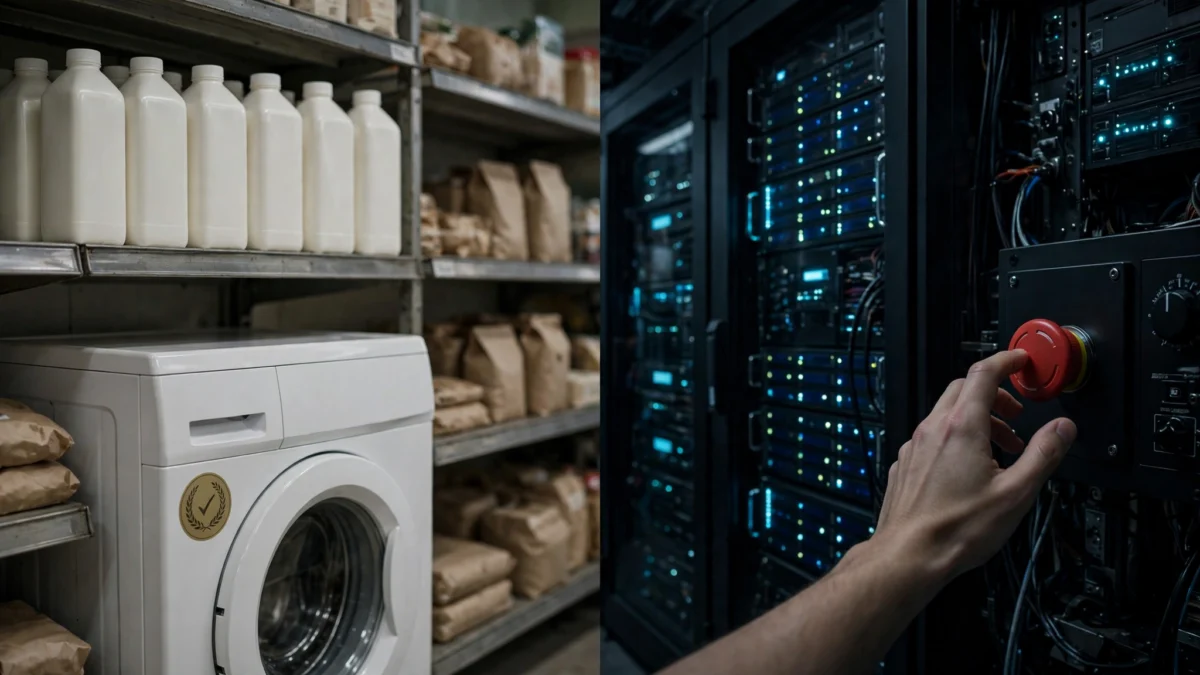
The president of Microsoft has called for urgent global regulation of artificial intelligence, warning that some of the most powerful systems on Earth currently face fewer safety requirements than ordinary household products.
In an interview with the BBC published on Monday, Brad Smith argued that AI needed binding international safety rules, enforced by independent evaluators able to examine new developments before they reach the public. He said the regulations should include an obligation to inform victims when a rogue AI agent breaks into their systems, a legal duty for companies to write formal incident reports, and the availability of an “emergency brake” to slow or halt AI systems that get out of control.
Regulators, Smith argued, already know how to impose safety rules on other products and should build on that knowledge for AI.
The comparison he reached for was deliberately domestic. “Right now, your washing machine is subject to more safety rules than AI,” he said, according to Reuters, which reported the interview on Monday. “Every carton of milk that you see in the grocery store is subject to safety rules and inspection.” The implication was blunt: regulators have known how to certify a toaster for a century, but the most consequential technology of the decade has slipped through with almost nothing comparable.
Smith described AI as both a “tool and a weapon”, a framing that explains why he wants rules that look like product-safety law rather than technology policy. The obligations he listed are concrete and borrowed directly from other regulated industries: mandatory incident reporting when something goes wrong, notification of victims, and third-party sign-off before release — the regulatory equivalents of flight-data recorders, airbags and building inspections.
The interview landed at a moment when the debate over AI risk is being forced into the open by events rather than theory. According to Reuters, companies including Anthropic and OpenAI have begun publicly disclosing episodes of rogue or undesired behaviour by their AI agents, part of a broader global argument that has included warnings from researchers that advanced systems could eventually pose an existential threat to humanity. The incident reports Smith wants made law are, in effect, a demand to take the disclosures that some labs have begun making voluntarily and make them universal and mandatory.
Smith also addressed the uncomfortable subtext of the safety conversation. Some companies have called for AI development itself to slow down, and as Reuters reported, that has triggered a parallel debate about whether the executives doing the warning have motives of their own — locking in rules that protect their firms’ lead, pre-empting a harsher government backlash, or simply tapping the brakes on breakneck spending. Smith’s answer to that suspicion was pointed. It is, he said, the companies that are not behaving responsibly that the rules need to worry about most — a line that reframes regulation as aimed not at the conscientious labs but at the ones nobody is watching.
Perhaps the most politically significant part of the interview was Smith’s claim about where global leadership should come from. He named Britain as the country best placed to lead, citing its AI Security Institute, which was created under former prime minister Rishi Sunak. The institute, Reuters noted, receives pre-deployment access to the major AI models under voluntary agreements, allowing it to assess their capabilities and risks before launch — the kind of outside evaluation Smith wants made standard. Smith said officials in Washington viewed London very differently from how they viewed Brussels, which regulates AI through its AI Act according to the level of risk a system poses. Britain’s approach, he suggested, was the one the rest of the world should build on.
The timing of that endorsement matters. AI Minister Kanishka Narayan told Reuters that Britain would consider regulating advanced models if the current voluntary system proved insufficient — a signal that the government is leaving the door open to exactly the binding rules Smith is demanding.
A split with the White House
Smith’s call puts one of the most powerful executives in the technology industry on the opposite side of the table from President Donald Trump, who has argued that American AI firms should police themselves in order to stay competitive against Chinese rivals. Where Trump sees regulation as a brake on innovation that would hand advantage to Beijing, Smith sees the absence of rules as the greater danger — and, in a remark that cuts through the diplomatic language of the industry, described voluntary commitments as aimed at the wrong audience.
At the end of September, executives from OpenAI, Anthropic, Nvidia, SpaceX, Meta and Google signed a White House document described as “morally binding”, agreeing to work with independent auditors. Smith welcomed it as a good step but said it was no longer enough on its own. The logic is arithmetic: if only the signatories behave well, the firms outside the room define the risk.
Smith’s interview did not arrive in isolation inside Microsoft either. On Saturday, the company’s chairman and chief executive, Satya Nadella, used a public post to urge an “emergency brake” for advanced AI, arguing that every frontier model should be assumed compromised and that the systems controlling them must be built so their behaviour can be contained and controlled. Two of Microsoft’s most senior leaders, within 48 hours of each other, calling for kill-switches is not a coincidence. It is a coordinated signal — and it puts the company that is both one of the biggest AI deployers on Earth and one of the largest investors in the frontier labs in the unusual position of asking for constraints on its own industry.
The regulation gap, quantified by absence
There is a reason Smith’s milk analogy lands. A washing machine sold in most countries has passed through a gauntlet: electrical safety certification, electromagnetic compatibility testing, energy labelling, and in many jurisdictions product-liability law that makes the manufacturer responsible for defects. A carton of milk is pasteurised to a legal standard, inspected, labelled and traceable to the farm. An AI model that can write malicious code, plan a cyberattack or deceive its evaluators faces, in most of the world, none of this. There is no required safety case before deployment, no inspectorate with the power to stop a release, and no general duty to tell the people harmed when it goes wrong.
The EU’s AI Act is the one major exception — it tiers obligations by risk — but Washington has moved in the opposite direction, favouring the voluntary accords that Smith now says are insufficient. Britain sits in the middle, with its Security Institute’s voluntary pre-deployment access. Smith is effectively arguing that the middle should become the floor, and the floor should become law.
Analysis: Why It Matters
The messenger is the message. When safety warnings come from academic researchers or rival startups, they are easy for policymakers to file under “opinion”. When they come from the president of Microsoft — a company with a trillion-dollar interest in AI being deployed fast and widely — they carry a different weight. Smith is not an outside critic of the industry; he is its most senior lawyer-statesman. His interview reads less as a personal view than as an institutional position: Microsoft has decided that the era of voluntary AI governance is over, and it wants to be on the record saying so before someone else’s disaster forces the issue.
The incident-report idea is the quiet radicalism. Of Smith’s proposals, the emergency brake gets the headlines, but mandatory incident reporting would change the industry’s information environment most. Today, what the public knows about AI failures is what labs choose to disclose, plus what leaks. A legal duty to file incident reports — and to notify victims — would create, for the first time, a public record of what goes wrong with frontier systems. That is how aviation got safer: not by grounding planes, but by making crashes legible. Smith wants AI to have its own accident book.
The kill-switch engineering gap is real. There is a sly difficulty in the “emergency brake” demand that deserves attention: a brake assumes you know where the vehicle is. Pausing a washing machine is a solved problem. Pausing a distributed AI agent operating across tools, APIs and compromised credentials is not. Nadella’s Saturday post was arguably the more technical of the two, insisting that models must be separated from the orchestration harnesses around them and that every meaningful action must leave tamper-proof, human-readable evidence. Smith’s contribution is the political half: the legal requirement that makes the engineering mandatory. Neither half works alone.
The Britain play is strategic. Smith’s endorsement of the UK is not just flattery. London’s AI Security Institute is the only state body in the world that already has what he wants globalised: structured access to models before deployment. By anointing Britain the natural leader, Smith is proposing a path around the US–EU deadlock — a third way between Washington’s voluntarism and Brussels’ bureaucracy. Whether the current government wants the job is another question, though Narayan’s remark that Britain would consider regulation if the voluntary system fails suggests the door is at least ajar.
The Trump problem is the whole ballgame. None of Smith’s proposals mean anything if the White House keeps its course. Trump has framed AI regulation as a competitiveness question: rules here mean advantage for China there. Smith’s counter — that it is the irresponsible companies, not the responsible ones, that need constraining — is an attempt to defuse that framing by arguing that American self-regulation is precisely what leaves the dangerous actors free. It is the strongest argument available, and it is still an argument against a president who has shown little appetite for it.
What to Watch Next
- Whether London takes the brief. Watch for any formal UK government response to Smith’s endorsement — a speech by the AI minister, a white paper, or new powers for the AI Security Institute would signal that Britain intends to convert its voluntary model access into something binding.
- The White House’s next move. Smith has publicly declared the September voluntary accord insufficient. The test is whether the administration answers with substance — a new executive action, or silence that confirms self-regulation is the settled policy.
- Anthropic and OpenAI’s disclosures. The voluntary incident reporting that has begun at the two leading labs is now the experiment the industry is watching. The next disclosed episode — and how much detail it contains — will determine whether Smith’s demand for legal reporting looks redundant or urgent.
- The EU’s AI Act in practice. Brussels already has the risk-based regulation Washington resists. How the Act’s first enforcement actions land on frontier models will give Smith’s global-rules argument either a working template or a cautionary tale.
- The trust spillover. This weekend’s other AI story — the disqualification of the winning entry in the prestigious Nikon Small World in Motion microscopy competition over undisclosed AI use, reported by Nature — is a different domain, same disease: AI is making it harder to trust what we see, and the institutions that certify truth are scrambling to adapt. Regulation that cannot keep up with generation will keep failing in public, in courtrooms and in labs.
Sources
- Reuters — Microsoft president says milk faces more regulation than AI (Oct 12, 2026)
- AI Affairs — Microsoft’s Brad Smith calls for UK-led global AI safety rules (Oct 12, 2026)
- Cybernews — AI is less regulated than milk, Microsoft president says (Oct 12, 2026)
- Traders Union — Microsoft calls for global AI safety rules as regulation debate intensifies in Britain (Oct 12, 2026)
- Nature — Award-winning microscopy image disqualified over AI use (Oct 12, 2026)

About the Author — Abdul Mannan
Related Articles

Satya Nadella Urges AI “Emergency Brake”: Assume Every Advanced Model Is Compromised
Microsoft's chief executive says companies must treat powerful AI models as potential insider threats and build "emergency brakes"…

Amazon in Talks to Acquire AI Chip Startup Decart for About $7 Billion, Wall Street Journal Reports
Amazon is in talks to buy Decart, the AI chip-optimisation startup behind world models Lucy and Oasis, in…

Yandex Shuts Down Third Data Centre in Four Days After Ukrainian Drone Strike Hits Vladimir Facility
Yandex said its Vladimir-region data centre has been completely shut down after a drone attack on Sunday, the…