NASA May Already Hold Proof of Life Beyond Earth — Sealed Inside a Tube on Mars Nobody Can Retrieve

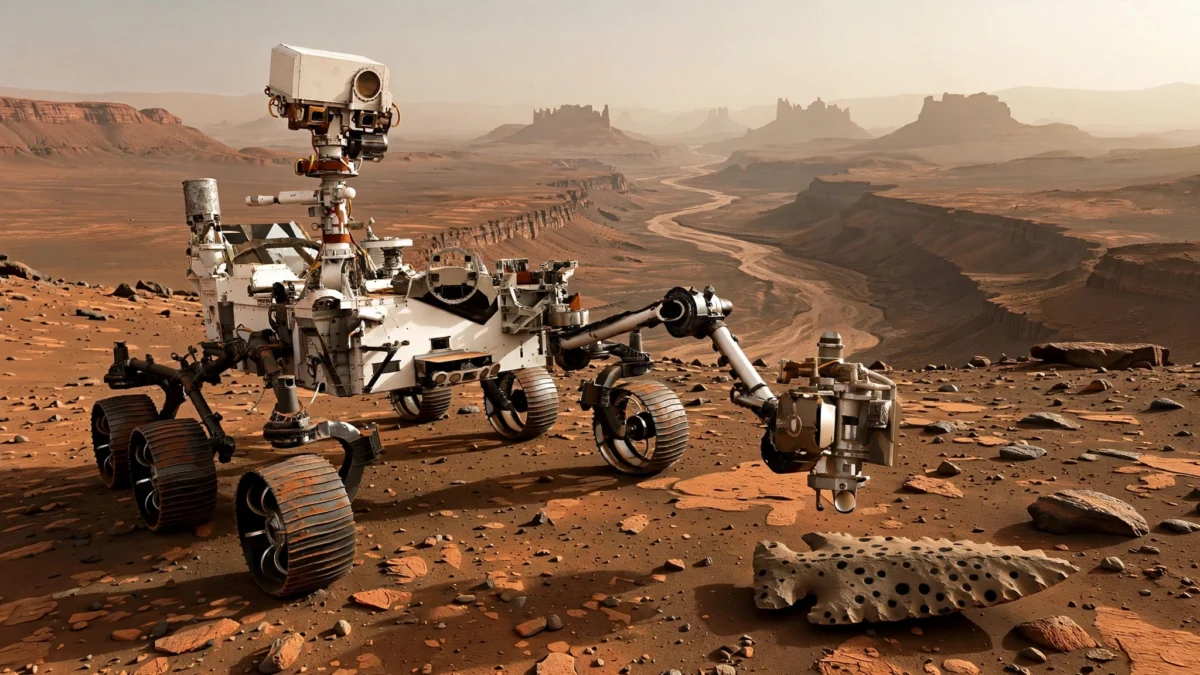
The rock sits in a sealed titanium tube on another world, waiting. According to CNN, NASA scientists now believe the sample collected by the Perseverance rover in July 2024 — a chalk-stick-sized core nicknamed Sapphire Canyon — could be the most important object the space agency has ever touched. It may contain evidence that life once existed on Mars. And there is a real chance it will never come back to Earth.
The story of Sapphire Canyon is, at its core, a story about what happens when scientific discovery collides with budgets, politics and geopolitics. On one side stands the strongest lead yet in humanity’s search for life beyond Earth; on the other, a cancelled multibillion-dollar retrieval programme with no replacement in sight — and a rival, China, quietly assembling the machinery to win the race NASA seems to have forfeited.
The sample was drilled from an arrowhead-shaped rock the mission team named Cheyava Falls, sitting on the edge of Neretva Vallis, an ancient river valley that once carried water into the dried lakebed of Jezero Crater more than three billion years ago. When Perseverance landed at Jezero in February 2021, its entire mission was built around one goal: to find rocks created or altered by ancient water, the kind most likely to have preserved traces of life, and to seal them up for eventual return to Earth.
Cheyava Falls turned out to be exactly what the team was hoping for. The rock is flecked with tiny dark spots — scientists call them reaction fronts or reduction spots — that closely resemble markings formed on Earth when microbes digest organic matter buried in sediment. As Adrian Broz, a member of the Perseverance science team at Purdue University, told CNN, the sample represents the first thing on Mars that he believes qualifies as a “potential biosignature.”
That word — potential — carries enormous weight. A potential biosignature is not proof of life. It is a substance, structure or pattern that might have a biological origin but could equally have been produced by chemistry or geology alone. The mudstones surrounding the rock are covered with hundreds of thousands of similar spots, and the team’s study of the sample, published in September 2025, reported evidence of ancient water, organic carbon, and chemical reactions that could have powered microbial metabolisms. But as Broz cautioned, the only way to tell whether life or lifeless chemistry made those spots is to study the rock in Earth laboratories.
That caution has a history. In 1996, a team announced that a Martian meteorite found in Antarctica, Allan Hills 84001, appeared to contain fossilised microbial life. It became one of the most famous scientific claims of the century — and then unravelled, as researchers showed that non-biological geological processes could create strikingly similar signatures. The lesson, as Ashwin Vasavada, project scientist for the Curiosity rover at NASA’s Jet Propulsion Laboratory, told CNN, is that even with every laboratory on Earth studying a rock, determining ancient life is extraordinarily difficult. You want every technique available.
Perseverance itself cannot provide that answer. The rover cost NASA about $2.4 billion to build and launch, but its instruments were selected on the assumption that the samples it chose would eventually come home. They were designed for reconnaissance and geological context, not for the definitive analysis of ancient life. Dr. Briony Horgan, a Purdue professor and Perseverance team member, has said the rover’s studies can only produce hints — certainty will require the samples to come back to Earth.
So far, Perseverance has sealed 33 tubes of Martian rock, dust and air. Ten of those have been deposited at a designated cache site on the surface, ready for pickup. The plan, developed hand in hand with the rover’s mission, was Mars Sample Return: an audacious multi-spacecraft relay in which a lander would deliver a fetch rover and an ascent vehicle to the cache, launch the tubes into Mars orbit in a container the size of a football, and have a European orbiter catch the container and bring it home. The earliest return date was 2031.
Then the programme collapsed under its own weight. Independent reviews flagged an unwieldy, ballooning design; the estimated cost swelled to as much as $11 billion and the return date slipped to 2040. NASA paused the programme in 2024, asked industry for cheaper and simpler concepts, and in early 2025 shortlisted two strategies that leaned on commercial partners or proven landing technology. Then came the fiscal year 2026 budget request, which stated plainly that NASA “plans to terminate the Mars Sample Return Program given that current architecture options remain unaffordable.” The 2027 budget request did not mention it at all. According to Casey Dreier of The Planetary Society, NASA had spent about $2.5 billion on the programme by the time it was cancelled. NASA administrator Jared Isaacman has said publicly that he wants the samples retrieved — there is no question we are going to go get samples, he told reporters in August, whether by robot or by astronauts — but no concrete path forward has been announced. Lockheed Martin has proposed a streamlined lander concept to collect the abandoned tubes, and NASA says it is exploring simpler and cheaper options including commercial or international contributions. Nothing is funded; nothing is scheduled.
While Washington hesitates, Beijing is building. China’s Tianwen-3 mission aims to return Martian samples to Earth around 2031, according to its chief scientist, Zengqian Hou of the Chinese Academy of Sciences. Hou told the International Deep Space Exploration Conference in September that engineers are already building a prototype, and a 2025 paper in Nature Astronomy laid out the plan in detail: two launches in 2028, a lander equipped with a two-metre drill and a small helicopter to gather surface material, and a goal of at least 500 grams of rock and soil. China has already demonstrated the essential choreography with Chang’e-6, which in 2024 returned the first samples ever collected from the far side of the Moon. As the independent space outlet NASA Spaceflight reported in September, the Tianwen-3 design is arguably simpler than NASA’s cancelled architecture, because a stationary lander collects its own samples rather than chasing down a rover’s scattered cache. A planetary-protection laboratory to receive the samples is also under construction, according to Hou.
There is an irony here that American scientists have not missed. NASA’s Perseverance cache — painstakingly assembled over five years, including the most promising potential biosignature ever found on Mars — is sitting there, ready for pickup. “It’s remarkable that the US has abdicated its leadership in this area of space exploration and just handed China the win,” Dr. Melissa Rice of Western Washington University, a veteran of NASA rover missions, told CNN. NASA’s administrator has leaned hard into “space race” framing against China, telling Congress that “American exceptionalism is being challenged in the high ground of space.” Yet in the one race that could answer whether life is abundant or unique in the universe, the United States has, for now, stopped running.
The scientific stakes are difficult to overstate. Since the first budget line for Mars sample return appeared in 1978, scientists have ranked it as the top priority for planetary exploration in survey after survey. Only Earth laboratories can run the battery of tests that a potential biosignature demands: isotope-ratio analysis that biology tends to skew, mass spectrometry, and experiments that test whether lifeless chemistry can reproduce the observed mineral pairings. The Sapphire Canyon study team itself is now running laboratory experiments and field analogues to see whether non-biological reactions can make the leopard spots, and they are using a formal Confidence of Life Detection scale to stage their claims carefully. As NASA’s announcement noted, the rock contains vivianite and greigite — minerals associated with iron and sulphur cycling in oxygen-poor environments — embedded in fine-grained sedimentary rock that settled from water. On Earth, microbes leave similar traces. On Mars, the verdict remains suspended, waiting on a ride home that no longer exists.
Analysis: Why It Matters
The Sapphire Canyon saga is best understood as three interlocking stories: a scientific near-miss, an institutional failure, and a geopolitical transfer of leadership.
First, the science. Cheyava Falls is the closest humanity has come to a real answer on the question that has driven planetary exploration for half a century. But the story also shows how careful science has to be about hope. The Allan Hills meteorite debacle taught planetary scientists that enthusiasm without rigorous, Earth-lab-grade evidence produces headlines, not knowledge. The Sapphire Canyon team’s deliberate, staged approach — a published paper, a formal confidence scale, explicit testing of non-biological explanations — is the model for how a life-detection claim should be handled. The real risk is not that the spots turn out to be chemistry; it is that the world loses the ability to check at all.
Second, the institutional failure. Mars Sample Return did not die because the idea was bad; it died because it was engineered without discipline. An $11 billion estimate and a 2040 return date made it, in Isaacman’s phrase, “too costly to succeed.” NASA’s own independent review boards saw the unwieldiness years before cancellation. The programme’s defenders will point to budget cuts in the 2024 and 2025 fiscal years and to waning political support, but the deeper problem was design: a multi-mission relay of extraordinary complexity, built at a moment when commercial spaceflight was proving that simpler approaches could do more for less. The tragedy is that the failure stranded the samples it was created to retrieve. The ten-tube depot on Mars is the physical embodiment of a sunk cost: everything worked except the plan.
Third, the geopolitical shift. China’s Tianwen-3 is not a copy of the cancelled American programme; in important respects it is a better-designed one — fewer moving parts, no rover chase, a drill and a helicopter. If it launches in 2028 and returns samples in 2031, China will have answered, or begun to answer, the question NASA spent five years preparing to ask. The samples will come from a different region of Mars than Jezero Crater — China’s team has narrowed 86 candidate landing sites, favouring ancient lake beds with iron oxides and thick aquatic clays — so the two datasets would complement rather than duplicate each other. But prestige does not care about complementarity. The first nation to return material from Mars will own the narrative, and the scientists, the instruments and the discoveries that follow.
There is also a quieter warning embedded in this story about how space exploration gets funded. Programmes survive when they connect to a constituency — human spaceflight has astronauts and spectacle; Mars Sample Return had a promise. When costs spiral and schedules slip, a programme with no near-term payoff becomes politically defenceless. The commercial partnerships NASA now says it is exploring may yet rescue the Perseverance cache, but partnerships take years to negotiate and fund, and every year of delay is a year in which the Chinese programme moves from prototype to launch pad.
Finally, there is the question the sample itself raises: is life abundant and common, or is Earth truly unique? That is not a scientific question alone. It is a philosophical one, and for centuries it has been answered only by speculation. Sapphire Canyon offers the first credible chance at an evidence-based answer — a chalk-stick-sized piece of another world, sitting in a tube, waiting. Whether humanity gets to read what it says depends less on science now than on whether someone is willing to go and get it.
What to Watch Next
- NASA’s next move. Administrator Jared Isaacman has repeatedly said the samples will be retrieved, but no funded plan exists. Watch for any formal announcement — a commercial partnership, an international agreement or a new programme line — that turns rhetoric into a budget.
- Lockheed Martin’s proposal. The company’s streamlined lander concept is the most concrete alternative on the table. Any NASA decision to advance it toward development would signal the cache has a realistic path home.
- Tianwen-3 milestones. With prototype construction reportedly underway, the next markers are hardware tests, the final landing-site selection and confirmation of the 2028 launch window. Any slip there reopens the race.
- The laboratory results. The Sapphire Canyon team’s experiments testing whether non-biological chemistry can reproduce the leopard spots will shape how seriously the biosignature claim is taken — and how much political urgency attaches to retrieving the sample.
- China’s landing-site decision. The final choice among the 86 candidate sites will reveal whether China is targeting the same class of ancient lake-bed environments as Jezero, or betting on a different geological setting with different biological prospects.
Sources
- CNN — “NASA may already have proof life once existed on another planet. Scientists might never get to find out” (Oct 12, 2026): CNN report
- NASA Spaceflight — “China progresses plans for Mars sample return” (September 2026): NASA Spaceflight
- Xinhua via the State Council — “Chinese scientist details first planned Mars sample-return mission Tianwen-3” (July 2025): Xinhua/State Council
- Notebookcheck — “China aims to procure Mars samples in 2031 while NASA’s mission remains in limbo” (September 2026): Notebookcheck

About the Author — Abdul Mannan
Related Articles

New Injection Targets ‘Hidden’ Belly Fat by Triggering Fat-Cell Death, Early Trial Data Show
An experimental injection called CBL-514 that destroys fat cells instead of shrinking them cut "hidden" visceral fat by…
SpaceX Launches 21 US Military Satellites After Five-Day Delay, Building Out Pentagon’s Orbital Mesh Network
A SpaceX Falcon 9 lifted 21 Northrop Grumman-built data-transport satellites into orbit from Vandenberg on Saturday, marking the…

James Webb Telescope Traces Farthest-Ever Fast Radio Burst to a Tiny Galaxy From 3 Billion Years After the Big Bang
A flash of radio light that crossed more than ten billion years of expanding universe to reach Earth…