Pakistan Confirms Detention of Ousted KP Chief Minister Sohail Afridi and Cabinet Members in “Preventive Custody”

Pakistan’s interior ministry confirmed on Monday that Sohail Afridi, the ousted chief minister of Khyber Pakhtunkhwa, and several members of his cabinet were taken into “preventive custody” following the imposition of emergency rule in the province, a move that deepens the country’s most serious constitutional crisis in years and removes the last vestiges of the only elected government that Imran Khan’s party still controlled.
Minister of State for Interior Talal Chaudhry confirmed the detentions to Reuters on Monday, saying: “Yes, I can confirm that the chief minister (Sohail Afridi) and some of his cabinet members have been taken into preventive custody.” He said those detainees facing pending legal cases would be charged and tried, while the others would be released, and added that the detentions took place on Sunday, according to reporting carried by the Express Tribune.
The confirmation ended a day of confusion. On Sunday, Khyber Pakhtunkhwa’s information minister, Shafi Jan, had publicly claimed that Afridi had been arrested and urged people across the province to gather in Peshawar. At the time, no government official confirmed the claim, leaving PTI supporters and journalists unsure whether the chief minister was in custody, in hiding, or free. Monday’s ministerial confirmation — and a parallel briefing by police in Peshawar — settled the question, at least partly.
The Deputy Inspector General of Police in Peshawar told the Express Tribune that Afridi remained in “police protective custody” and that eight senior PTI leaders had been taken into protective custody following the imposition of emergency measures and governor’s rule in Khyber Pakhtunkhwa. Those detained, the DIG said, included Afridi, PTI’s provincial president Junaid Akbar — a Member of the National Assembly — and Khyber Pakhtunkhwa Assembly Speaker Babar Saleem Swati. The whereabouts of Afridi had not been publicly disclosed, according to separate reporting.
Alongside the leadership detentions, police in the province launched a widening crackdown on the party’s street apparatus. The DIG said 169 PTI workers were arrested in a crackdown in Swabi district, naming areas including Shewa Adda, Yar Hussain, Razar, Swabi Khas, Topi, Lahor and Gadoon. Those arrested included several local office-bearers and active PTI workers, he said, taken into custody over concerns that preparations for the party’s long march, which began on October 4, could disrupt law and order. A heavy police contingent was deployed across Swabi, and the DIG added that further arrests were expected.
PTI immediately framed the detentions as political. Party spokesperson Sheikh Waqas Akram said Afridi’s “arrest” could not be viewed in isolation from the federal government’s decision to impose emergency and governor’s rule. “These measures are not directed at addressing security challenges; they are intended to weaken [the] PTI, undermine the elected government of Khyber Pakhtunkhwa and disregard the democratic will of its people,” he said, according to IANS.
The detentions are the sharpest escalation since President Asif Ali Zardari signed off on emergency rule in Khyber Pakhtunkhwa on Sunday, suspending the elected provincial government led by Khan’s Pakistan Tehreek-e-Insaf. Acting on the advice of Prime Minister Shehbaz Sharif and a federal cabinet decision, the president invoked Articles 232 and 234 of the Constitution — the emergency provisions and the provision for assuming provincial functions — after the cabinet cited the provincial government’s “deliberate disengagement from the fight against terrorism” and a deteriorating law-and-order situation, according to TBS News reporting of the official statement.
The proclamation said the provincial government had failed to take adequate measures against terrorism and referred to the governor’s report highlighting a breakdown in the constitutional machinery. It empowered the federal government to direct the governor to assume some or all provincial government functions, while the powers of the provincial assembly would be exercised by Parliament or under its authority. With immediate effect, the chief minister, provincial ministers, advisers, special assistants and the advocate general ceased to hold office. The federal government also authorised the deployment of Pakistan Army troops and assets under Article 245 to protect citizens, property and government installations for the duration of the emergency proclamation, according to the Express Tribune.
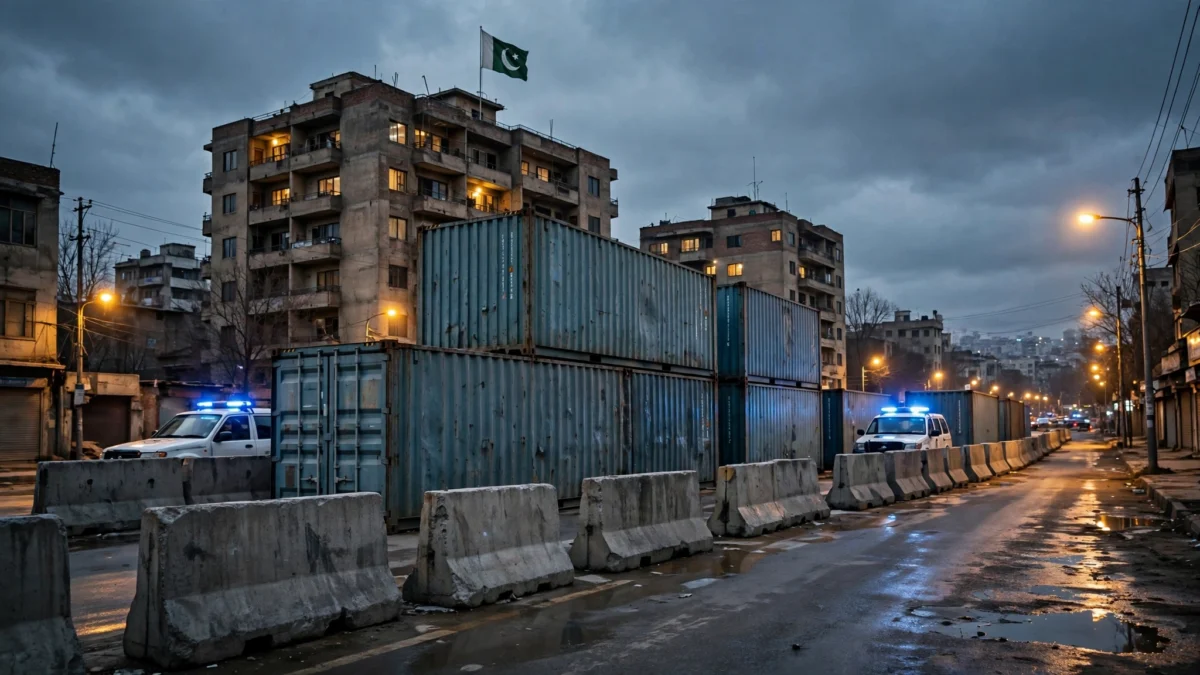
On the ground in Peshawar, the emergency has been visible. TBS News reported that shipping containers were placed to block roads amid a heavy police deployment, and targeted disruptions to mobile and internet services were reported in parts of the province. The federal government formed an 11-member technocratic advisory council to assist Governor Faisal Karim Kundi, who chaired its first meeting in Peshawar on Sunday with security, counterterrorism and anti-corruption declared as top priorities. Dr Muhammad Fakhr Alam Irfan was appointed chief secretary of the province, while senior Pakistan Administrative Service officer Muhammad Yahya Akhunzada was transferred to the provincial administration.
PTI leaders condemned the detentions and the emergency as twin blows against the party. Chairman Barrister Gohar Khan called the imposition of emergency and governor’s rule a “grave political mistake,” warning it would undermine democratic rights and provincial autonomy, according to Abb Takk News. The party announced plans to challenge the decision in court, in assemblies and through public forums, according to TBS News.
The strongest words came from former president Arif Alvi, a PTI figure, who on Monday condemned the emergency as the “demolition of democracy.” In a post on X, Alvi said the province had been taken over by what he described as an “unrepresentative, fraudulent set-up in Islamabad,” asserting that only the people of Khyber Pakhtunkhwa had the right to remove their government. All reports suggested, he wrote, that the only sticking point in the failed talks between the federal government and PTI had been a meeting with Khan, the party’s incarcerated founder. Personal animosity, he said, was consuming Pakistan — with poverty and elite capture rising while “plotocracy and fascism rise,” according to IANS.
The detentions land in the middle of a standoff over the party’s long march. Afridi had been leading PTI’s protest march toward Islamabad, which began in Lakki Marwat on October 4, demanding Khan’s release and access to medical treatment for him. On Saturday, addressing supporters in Mardan on the seventh day of the march, Afridi said he would not accept any “illegal move,” including the imposition of governor’s rule or emergency, according to IANS. He warned that if such measures were imposed, the march would redirect to Peshawar and Swabi and then move toward D-Chowk in Islamabad. The federal government had been urging Afridi since last month to call off the march, citing a surge in attacks by the Pakistani Taliban in the northwest — a demand PTI rejected.
Dawn noted that the governor’s rule coincides directly with the long march, which had been led by Afridi himself — a timing the government defends as a security necessity and the opposition calls proof of political motive. The opposition alliance Tehreek-e-Tahafuz-e-Ayin-e-Pakistan (TTAP) also condemned the imposition of governor’s rule as unconstitutional and questioned why similar extraordinary measures had not been taken in Balochistan despite its severe security challenges, according to TBS News.
Emergency arrangements cover 12 districts of the province, and the president’s office did not specify exactly how the province would be administered beyond the governor’s authority, according to Reuters reporting. The government also announced that sessions of the National Assembly and the Senate would be convened on October 13 to endorse the measures — setting up a collision between parliament and the street, with PTI vowing to continue its protest plans and police directed to thwart them.
The Detentions Are the Story — Not Just the Decree
Emergency rule, on paper, suspends a government. Detaining that government’s elected leadership converts a constitutional instrument into a police operation — and that is the line this crisis has now crossed. The distinction matters because Pakistan’s political system has seen emergencies before, but the detention of a sitting — now deposed — chief minister and his cabinet, plus the provincial assembly speaker, within 24 hours of the proclamation, changes the character of what happened in Khyber Pakhtunkhwa this weekend. It moves the crisis from the register of legal abstraction to the register of physical power: the people who led the province on Saturday were in custody by Sunday, and the minister confirming it chose to do so to Reuters, not at a domestic press conference.
Why the Timing Around the Long March Is the Crux
Both sides agree on the sequence — emergency proclamation, detentions, crackdown — and disagree entirely on what it means. The government’s case is that Afridi’s march created an unacceptable security risk in a province the cabinet says the PTI administration had already abandoned to militants. The party’s case is that the march was precisely the reason: the government used the march as the trigger and counterterrorism as the language, because the real objective was to behead the only elected government PTI still controlled before its supporters could reach Islamabad.
What is verifiable is this: the march began October 4; marathon talks on October 2 and 3 failed; Afridi said Saturday he would not accept emergency or governor’s rule; the emergency was signed Sunday; Afridi was in custody Sunday. The proximity is tight enough that the burden of the government’s security argument will be tested not in press statements but in what happens on the streets of Khyber Pakhtunkhwa this week — and whether the police crackdown that has already swept up 169 workers in Swabi stops at leaders or keeps expanding.
Preventive Custody vs Arrest: A Deliberate Vocabulary
The government is being careful with words. “Preventive custody,” “protective custody” and “detention” have all been used — by Chaudhry, the DIG and the police — while “arrest” came only from PTI’s information minister and the party’s own framing. The distinction is not semantic. Arrest implies charges and due process; preventive custody is an administrative tool that can be held in the grey zone between protection and punishment. PTI’s spokesperson chose the word “arrest” deliberately, because arrest makes the political-victimisation argument; the government chose “custody,” because custody keeps the door open to release without trial. Watch which word survives the week: if Afridi is released within days, the government’s vocabulary wins; if charges follow, PTI’s does.
The Council, the Parliament Sittings and the Road Ahead
Meanwhile, the federal government is moving fast to make the new order look permanent. The 11-member advisory council has already met under Governor Kundi; a new chief secretary has been appointed; army deployment under Article 245 is in effect; and parliament sits on Tuesday, October 13, to provide the constitutional endorsement the emergency requires. Each step is designed to create facts on the ground — administrators in place, soldiers deployed, resolutions passed — before PTI’s legal challenge or street response can gather momentum. The party’s counter — court petitions, assembly protests, and the threatened redirection of the march toward Peshawar and Islamabad — is a slower game, and the government appears to be counting on that.
Analysis: Why It Matters
The detention of Sohail Afridi marks the point at which Pakistan’s Khyber Pakhtunkhwa crisis stopped being a debate about constitutional clauses and became a test of whether political power in the country still changes hands through votes. Since 2023, the country’s central political story has been the systematic dismantling of Imran Khan’s movement — his imprisonment, the pressure on his party, the fracturing of its leadership. The emergency in Khyber Pakhtunkhwa removed the last institution PTI governed; the detention of the chief minister and his cabinet removed the people who governed it.
There is a genuine security argument underneath this, and it should not be dismissed. Khyber Pakhtunkhwa borders Afghanistan; the Pakistani Taliban’s campaign there is real; the cabinet’s claim that the provincial government disengaged from counterterrorism is at minimum a contested factual question that deserves scrutiny rather than instant rejection. But the government’s choice of instrument — emergency plus governor’s rule plus immediate detention of the elected leadership — is the most maximal response available, and maximal responses invite a simple question: if the province’s security was the problem, why was its elected leadership the solution?
The answer the government will not give, and PTI will not stop giving, is that the two were inseparable from the start. Afridi was not merely the chief minister; he was the man leading the march to Islamabad. The emergency solved the march problem and the governance problem at once — which is why PTI calls it a pretext and the government calls it coincidence, and why neither framing can be settled by rhetoric. It will be settled by outcomes: whether security in Khyber Pakhtunkhwa measurably improves under the new order, and whether the promised court challenges produce anything beyond procedure.
There is also a deeper institutional stake. Article 232’s emergency powers and Article 234’s assumption of provincial functions were designed as last resorts for genuine breakdowns, with parliamentary endorsement as the democratic check. If this emergency survives the courts and the parliament sits on Tuesday to bless it, the precedent will be set: a federal government can remove an elected provincial government it dislikes, provided it can articulate a security case. That precedent will outlive this crisis, this cabinet and this president — and every future opposition will remember it.
Finally, there is the human arithmetic. One hundred and sixty-nine workers detained in one district in one crackdown; eight senior leaders in protective custody; a chief minister whose location has not been publicly disclosed; mobile and internet disruptions; containerised roads. Each of these is a data point in a familiar Pakistani pattern: the state demonstrates its capacity to control the street faster than the opposition can demonstrate its capacity to fill it. PTI’s bet is that this time the street will not stay empty. The government’s bet is that it will. Tuesday’s parliament sittings — and whatever the march becomes — will tell us which side read the country correctly.
What to Watch Next
- The parliament sittings on Tuesday, October 13: Both houses are expected to take up the emergency proclamation for endorsement. The size of the majority, the tone of the debate and any PTI walkout or protest inside the chambers will set the constitutional trajectory of the crisis.
- Whether charges follow the detentions: Chaudhry said detainees with pending cases would be charged and tried and the rest released. The release-or-charge decision on Afridi himself will reveal whether “preventive custody” was a holding measure or the start of a legal offensive.
- The long march’s next move: PTI has vowed to continue the march as planned, and police have been directed to stop it. With Afridi in custody and 169 workers detained in Swabi, the question is whether the party can reorganise the march under new leadership — and whether the threatened redirection to Peshawar and D-Chowk materialises.
- The court challenge: PTI has promised to contest the emergency in court. The judiciary’s willingness to hear the case quickly — and to question the security rationale behind Articles 232 and 234 — will determine whether the legal route is real or symbolic.
- Security outcomes in Khyber Pakhtunkhwa: The government’s justification is counterterrorism. If attacks continue in the province under army deployment and the advisory council, the security case weakens; if the situation stabilises, the government’s narrative hardens. Either way, the metric is violence, not statements.
Sources
- Express Tribune — “Afridi, some of his cabinet members have been taken into preventive custody,” confirms Talal (with Reuters)
- IANS — Pakistan detains Khyber Pakhtunkhwa CM, cabinet members as tensions escalate
- TBS News — Pakistan imposes emergency, governor’s rule in Khyber Pakhtunkhwa
- IANS — ‘Demolition of democracy’: ex-Pakistani president on emergency imposition in Khyber Pakhtunkhwa
- Reflector — Pakistan’s president suspends provincial government led by Khan’s party ahead of march
- Abb Takk News — CM Sohail Afridi, cabinet members taken into preventive custody: Talal Chaudhry

About the Author — Abdul Mannan
Related Articles
Governor Kundi Chairs First Advisory Council Meeting in Peshawar, Makes Security and Anti-Corruption Top Priorities
A day after President Asif Ali Zardari imposed an emergency and governor's rule in Khyber Pakhtunkhwa, Governor Faisal…
President Zardari Imposes Emergency and Governor’s Rule in Khyber Pakhtunkhwa, Suspending PTI-Led Government
President Asif Ali Zardari has imposed emergency rule and governor's rule in Khyber Pakhtunkhwa under Articles 232 and…
Decision on KP Emergency Moves to “Final Stage”: Federal Cabinet Meets Sunday as Parliament Sessions Set for October 13
The federal government has decided to impose emergency in Khyber Pakhtunkhwa following a Saturday-night meeting at the Presidency,…