Britain Sanctions Two Iranian Nationals and Summons Tehran’s Envoy After Blaming IRGC for RAF Fairford Terror Plot

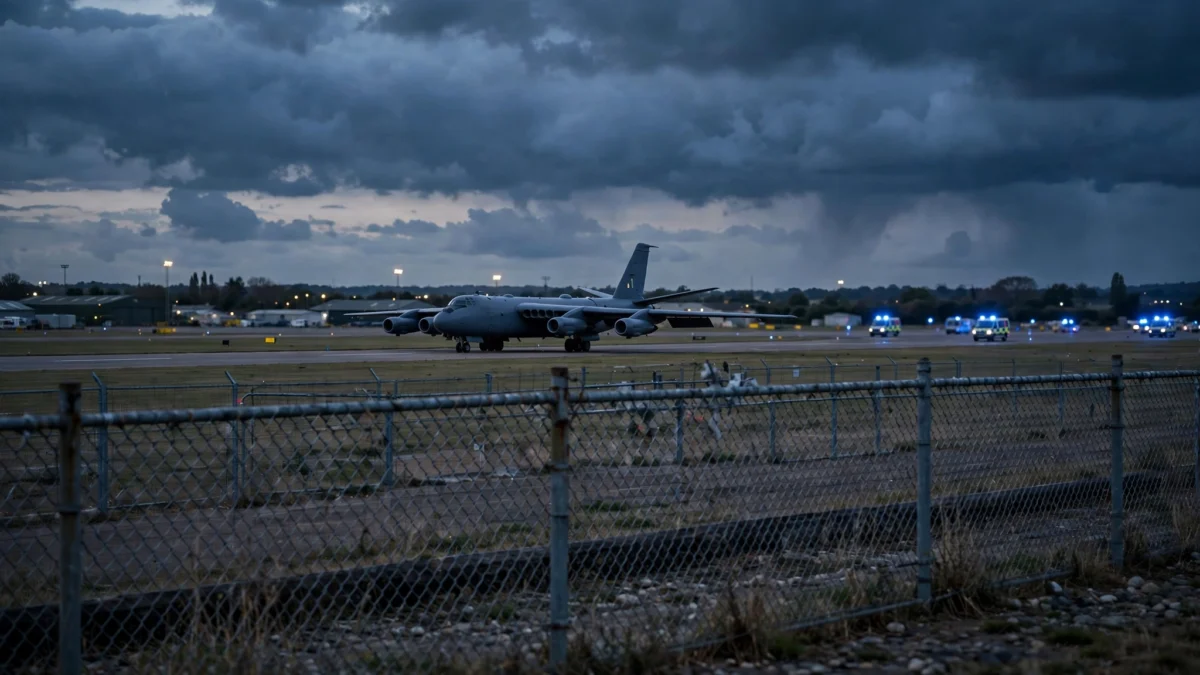
Britain on Monday accused Iran’s Islamic Revolutionary Guard Corps of directing a suspected terror plot targeting an RAF air base used by American bombers, as the government summoned Iran’s ambassador to London and imposed sanctions on two Iranian nationals it said were engaged in hostile activity on behalf of the Iranian regime.
Prime Minister Andy Burnham told the House of Commons that a suspected plot targeting RAF Fairford in southwest England was “highly likely” to have been coordinated in Iran, and almost certainly directed by the IRGC, according to Reuters. Foreign Secretary Ed Miliband simultaneously announced that Britain had summoned Iran’s ambassador to Britain and designated two Iranian nationals for sanctions, escalating a confrontation that has been building for months.
The two men now subject to an immediate asset freeze, travel ban and director disqualification are Ruhollah Bazghandi, whom the government described as the IRGC’s head of counterespionage operations, and Shahram Ali Reza Tamarzadeh Jakki, described as a facilitator of the Zindashti criminal network that Britain says has been involved in several plots against Iranian dissidents. The designations were made under the 2023 Iran Sanctions Regulations, according to the Foreign Office statement.
The ambassador’s summons was carried out by the Minister for the Middle East, Stephen Doughty, who told Iran’s envoy that Britain would not accept intimidation, threats or hostile activity, and called for it to stop immediately.
The Fairford Plot: What Is Known
RAF Fairford, in Gloucestershire, had been used by US bombers to carry out strikes on Iran, making it a focal point of attention. In the early hours of September 27, five British men were arrested near the base on suspected terrorism and explosive offences. All five were later released without charge on police bail under what police described as stringent conditions, and two other men arrested in the same operation, including a British-Iranian national, were also released.
Detectives said petrol, but no viable explosive, was found in vans seized alongside the five men. Despite the thin physical evidence, both police and the government have pointed towards the involvement of a foreign state.
US officials told Reuters there had been a suspected plot involving Iran to launch a drone attack on the base, and last week President Donald Trump said a threat linked to Iran had prompted a decision to withdraw American bombers from Fairford. Burnham’s assessment in Parliament on Monday was the government’s clearest public attribution yet.
Iran has rejected any connection with the Fairford incident. Iran’s ambassador to Britain, Seyed Ali Mousavi, said Tehran had no involvement in the matter and that if the British government possessed documents or evidence to support its claims, it should present them, according to Iran’s state news agency IRNA.
Home Secretary Shabana Mahmood told Parliament that a known individual, whom she did not name, who was based in Iran, was believed to be behind what had happened.
Two Names, Two Networks
The sanctions designations target two distinct layers of what Britain says is Iran’s overseas operations apparatus.
Bazghandi’s identification as the IRGC’s head of counterespionage operations places a named senior intelligence official on the UK sanctions list — a step beyond the government’s existing blanket measures against the IRGC itself. Britain used new state-threat powers in July to ban support for the IRGC, and has sanctioned more than 550 Iranian individuals and entities in total, according to the Foreign Office.
Jakki, meanwhile, represents the second track: criminal networks used as proxies. Britain says Jakki facilitated the Zindashti network, a criminal organisation it describes as involved in several plots against Iranian dissidents. The designation of the network’s facilitator signals London’s focus on what Western intelligence agencies have described as Tehran’s practice of outsourcing hostile operations to organised crime figures to maintain deniability.
Miliband said Iran’s “continued attempts to undermine the security of the United Kingdom and international partners through its criminal networks, proxy groups and state-backed malign activity is unacceptable,” and added that the government “will never waver in our commitment to tackling Iran’s unacceptable actions and protecting our national security.”
An Alliance-Wide Response
The dispute is not confined to Britain. The foreign ministries of almost 30 countries, including the United States, Canada, France and Germany, issued a joint statement condemning “Iran’s use of violent attacks, including the acts of lethal plotting, arson, sabotage, cyber-attacks, and other hybrid activities against us and our partners.”
The statement added that Britain had concluded the Fairford event demonstrated the IRGC’s “continued willingness to project hostile activity beyond its borders through covert networks and proxy actors.”
Burnham told MPs that Britain would crack down on Iran’s use of criminal networks using its “full range of powers” to target them and their funding streams, and would bring further sanctions “to restrict the capacity of Iran and the IRGC to do us harm.”
A Long-Simmering Pattern
British authorities have for a number of years accused Iran of being involved in numerous plots and attempted assassinations in Britain using criminal networks and proxies — accusations Tehran has repeatedly denied.
The scale of the concern has been rising. Britain identified at least 15 credible Iranian-backed threats to kill or kidnap individuals in the UK between 2022 and 2023; by 2025, that figure had risen to more than 20, according to the Foreign Office.
In July, Britain used new powers to ban support for the IRGC and a linked group, Harakat Ashab al-Yamin al-Islamiya (HAYI), which had claimed responsibility for seven attacks earlier this year at locations linked to Jewish and Israeli communities, and Persian-language media.
The Fairford episode is also entangled with the wider US-Iran confrontation. Fairford’s role as a staging post for US bomber operations against Iran — Washington’s strikes earlier this year were part of a broader campaign — made the base an obvious target in any Iranian retaliation calculus. Trump’s decision to withdraw the bombers in response to the threat underscores how seriously US officials took the intelligence.
Analysis: Why It Matters
Monday’s announcements mark a shift in how Britain confronts Iran — from general warnings about hostile activity to public attribution naming a specific incident, a specific intelligence agency and specific individuals. That shift matters for several reasons.
First, the attribution language itself. Intelligence assessments rarely speak in the register Burnham used. “Highly likely” is the standard formulation for a judgment made with strong but incomplete evidence; “almost certainly directed by” the IRGC is the sharper edge. By stating both in Parliament, Burnham has spent some of the government’s intelligence credibility in public. That is a deliberate choice: it signals to Tehran that London is prepared to close the gap between what it knows privately and what it says publicly — a move that raises the political cost for both sides if the claim is later contested.
Second, the choice of targets reveals the doctrine. Sanctioning an IRGC counterespionage chief alongside a criminal-network facilitator mirrors how Western agencies describe the Iranian playbook: a state intelligence core that outsources the operational layer to criminal proxies. Targeting both ends of that chain — the handler and the intermediary — is an attempt to make the deniability model unprofitable. The question is whether asset freezes and travel bans against individuals who likely hold little in Britain and travel rarely to the West impose any real cost, or whether they function mainly as political theatre. The honest answer is probably both: limited direct pain, but a genuine constraint on the international mobility and banking access of Iran’s operational network.
Third, the near-30-country joint statement is the part Tehran should worry about most. Iran has historically weathered Western pressure by playing capitals off against each other. A coordinated condemnation spanning Washington, Ottawa, Paris, Berlin and others makes that harder. Whether it translates into coordinated action — aligned sanctions, shared intelligence, joint designations — remains the open question, and it is where this episode will be judged in hindsight.
Finally, there is the escalation logic. Naming the IRGC as the director of a plot against a base hosting US bombers raises the stakes beyond a bilateral UK-Iran dispute. It draws Washington into the frame — Trump has already moved bombers off the base — and it invites the question of what an appropriate response to state-directed terrorism planning looks like when the sponsoring state is already under maximum sanctions pressure. Burnham promised further sanctions, but the diminishing returns of sanctioning an economy that has been cut off for years are well understood. The government’s “full range of powers” rhetoric will be tested against the reality that many of its tools have already been used.
What to Watch Next
- Whether further sanctions materialise. Burnham told Parliament more measures were coming to restrict the capacity of Iran and the IRGC. The scale and targets of any follow-on package — whether it extends to individuals, entities or economic sectors — will show how seriously London is pursuing this track.
- Iran’s diplomatic response. Tehran has denied involvement and demanded evidence. The question is whether the summons of its ambassador and the sanctions produce a retaliatory move — expulsion of diplomats, harassment of British interests, or a rhetorical escalation.
- The Fairford investigation. The case against the five arrested men remains unresolved; they were released on bail without charge. Whether charges eventually follow, and what evidence surfaces in court, will determine how much of the government’s attribution holds up under public scrutiny.
- The coalition’s next step. Almost 30 countries condemned Iran’s hybrid activities. Watch for whether any of them — particularly the US, France or Germany — announce their own designations or coordinated measures in the coming weeks.
- IRGC criminal-network operations in Europe. Britain’s focus on the Zindashti network reflects a broader European concern about Iranian use of organised crime for hostile operations. Expect more attention — and possibly more designations — aimed at these intermediary networks across the continent.
Sources

About the Author — Abdul Mannan
Related Articles

Hall and Woodford Win 2026 Nobel Economics Prize for Models That Help Tame Boom-and-Bust Cycles
The Royal Swedish Academy of Sciences has awarded the 2026 Nobel Prize in economics to two American academics…
Deloitte Helped Abramovich Conceal $10 Billion Through Falsified Documents, Joint Investigation Finds
A joint BBC Panorama, Bureau of Investigative Journalism, Guardian and OCCRP investigation found Deloitte's Cyprus branch backdated more…
Zelensky Accuses Putin of Tearing Up Trump’s “Energy Ceasefire” as Fresh Strikes Hit Ukraine’s Power Grid
Volodymyr Zelensky accused Vladimir Putin of violating Donald Trump's declared "energy ceasefire" within hours, reporting fresh Russian strikes…