Zelensky Accuses Putin of Tearing Up Trump’s “Energy Ceasefire” as Fresh Strikes Hit Ukraine’s Power Grid

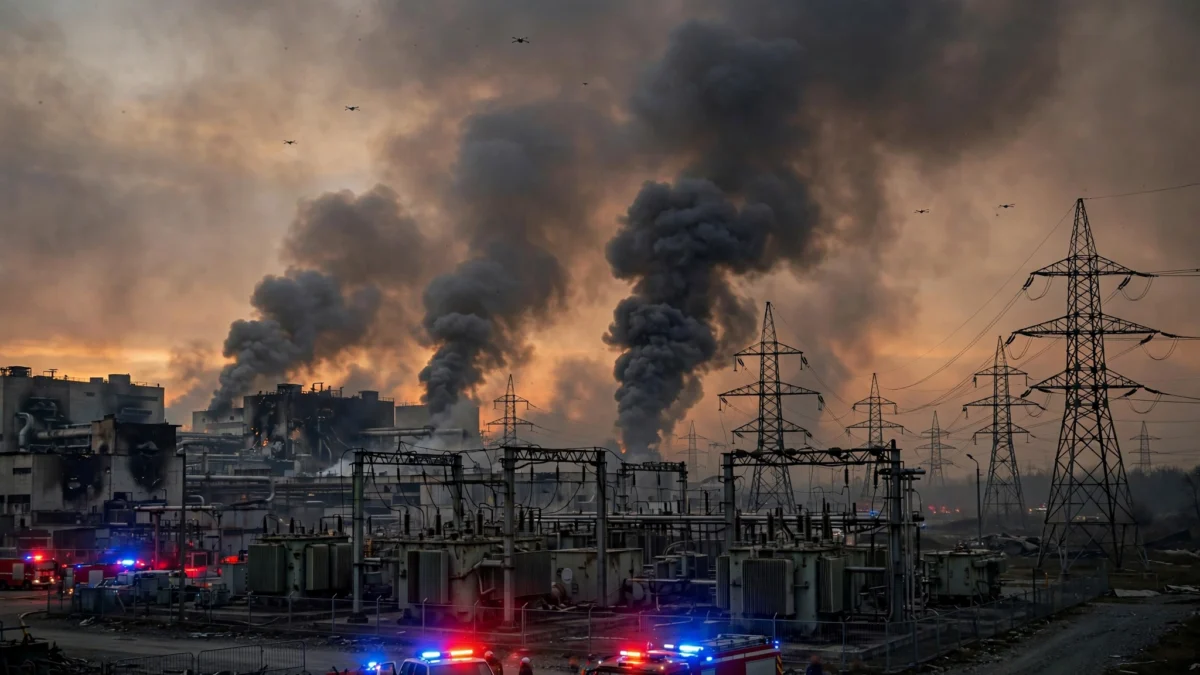
Ukrainian President Volodymyr Zelensky has accused Russian President Vladimir Putin of tearing up the “energy ceasefire” declared by United States President Donald Trump within hours of its announcement, reporting fresh Russian strikes on power plants in Kyiv and the Kharkiv region that killed three people and left thousands facing new power cuts.
Speaking at a conference on Monday, Zelensky repeated his allegation that Putin had violated the ceasefire Trump claimed was in place, saying jet-powered drones had hit Ukrainian gas facilities overnight. “The Russians struck a power plant in Kyiv with a ‘shahed’ drone, and many districts experienced power outages,” Zelensky said, according to reports of his remarks. “Later, there were strikes on energy facilities in the Kharkiv region. … And all of this happened AFTER the President of the United States made his statement about an energy ceasefire.”
The accusation lands less than a day after Trump took to his Truth Social platform on Sunday to declare: “Effective immediately, there is an ENERGY CEASEFIRE in the War between Russia and Ukraine. Both parties have agreed. Do not break it!” No terms, timeline, or enforcement mechanism accompanied the post, and there was no indication that either Moscow or Kyiv had signed anything before it appeared.
Trump’s Sunday declaration — and Kyiv’s surprise
According to CNN, Trump announced the purported agreement on Sunday morning, prompting a visibly caught-off-guard reaction in Kyiv. Zelensky told the US outlet Axios that the announcement was “news to me,” saying he had learned of it from the media. He added, in remarks reported by several outlets, that if Trump had negotiated the deal with Putin, he would welcome being told when it began — because Ukraine was ready to accept it.
Within hours, Zelensky’s tone shifted from surprise to conditional support. Writing on X, he said Ukraine backed the ceasefire and that it was important Russia support it too, adding that Kyiv was awaiting details from the American side. “For our part, Ukraine always FULLY supports steps toward de-escalation, the protection of lives, and the decisions needed to end the war and guarantee lasting peace,” he wrote. He said he had discussed the development with Canadian Prime Minister Mark Carney, Finnish President Alexander Stubb, and NATO Secretary-General Mark Rutte.
By Sunday evening, that qualified support was already colliding with events on the ground. In his nightly address, Zelensky said Ukrainian skies had been “infested” with Russian drones all day, alongside glide-bomb strikes and attacks on energy infrastructure. “A power plant in Kharkiv was attacked this evening,” he said. Ukraine’s presidential office later confirmed that the Kharkiv attack came after Trump’s ceasefire post.
The strikes: Kyiv, Kharkiv and the Pisochyn toll
The overnight picture painted by Ukrainian officials on Monday was one of continued, wide-ranging bombardment. Ukraine’s Air Force said in a Telegram post that Russia had launched 121 drones overnight — including 76 jet-powered Shahed-type drones — along with one Kh-59 guided air-to-surface missile. Air defences shot down or suppressed 89 of the drones, the statement said, with strikes recorded at 15 locations and falling debris from downed drones at four more, according to an Associated Press report carried by British regional outlets.
The heaviest reported human toll came from the village of Pisochyn in the Kharkiv district, where a Russian drone attack on Sunday evening struck a densely populated area near apartment buildings and grocery stores, sparking a fire. The Kharkiv regional prosecutor’s office said three people were killed — a 16-year-old boy and two women aged 19 and 51 — and the number of injured, including children, was later reported at around two dozen. Among the injured were two girls aged 9 and 13, according to the updated regional reports.
Attacks continued into Monday morning. Residents on several streets in Izyum, south-east of Kharkiv, lost power, and at least 12 people were injured in Kharkiv city, according to Ukrainian reports compiled by EA WorldView. In the south-eastern Dnipropetrovsk region, Russia attacked three districts more than ten times with artillery and drones, causing fires, while in the northern Zhytomyr region, Russian forces repeatedly shelled targets including railway and energy infrastructure from Sunday evening onward.
Russia, for its part, offered no comment on the ceasefire claim — the Kremlin did not immediately respond to requests for comment, according to multiple outlets. But Moscow’s Defence Ministry did describe its own overnight operations on Monday, saying Russian air defences had intercepted 151 Ukrainian drones over Russian regions, annexed Crimea, and the Black Sea, and that Russian forces had carried out drone strikes on Ukrainian port infrastructure and a bulk carrier heading for Odesa that it said was carrying military cargo. Those claims, like all battlefield assertions, could not be independently verified.
Zelensky’s election pledge and Europe’s sceptical embrace
In a striking political move, Zelensky tied the ceasefire question to Ukraine’s own democratic future, saying he would organise elections if Putin agreed to a genuine 60-day ceasefire — a direct answer to Trump’s Saturday suggestion that Ukraine needed “a new leader who can make a deal.” Le Monde reported his formulation: a total ceasefire for 60 days, “and we will organize elections.”
European leaders offered a carefully calibrated response: support for the idea of an energy truce, open doubt about Moscow’s intentions. British Prime Minister Andy Burnham said on X that Russia had stepped up attacks on Ukraine’s energy infrastructure, plunging civilians “into cold and darkness,” while backing Trump’s push. “The UK strongly supports President Trump’s call today for a sustained energy ceasefire to start now,” Burnham wrote. “Ukraine is ready if Russia stops its attacks. This is the best route to get energy and fuel back into world markets.”
In Luxembourg on Monday, EU foreign policy chief Kaja Kallas said the bloc would welcome a truce on striking energy infrastructure “when it holds” — but warned Russia might not “stick” to any agreement. “Russia has started this war,” Kallas told reporters. “We should put the pressure on Russia so that they will stop, because if they stop, Ukrainians also don’t have to take any steps to defend their country.” She also pushed back on the elections question, saying now was not the time to hold elections in Ukraine, at least not without a ceasefire: “If the pressure is put on Russia so that they will stop this war, I’m sure that Ukraine will have elections.”
French President Emmanuel Macron, writing on X on Sunday evening, said Russia “continues to refuse [the ceasefire] and has even intensified its strikes on Ukrainian infrastructure in recent hours,” and expressed his support for Ukraine and Zelensky. Several EU foreign ministers meeting on Monday also dismissed the parallel US-Russia diesel arrangement as unlikely to lower energy prices, with Estonian Foreign Minister Margus Tsahkna telling reporters it appeared “much more connected to the domestic situation in the US” than to fuel markets.
The diesel deal and Washington’s shifting line
The ceasefire declaration did not arrive in isolation. Days earlier, Trump had announced a controversial deal under which Russia would supply diesel fuel to American and global markets — a move that drew bipartisan condemnation on Capitol Hill. A group of seven senators, four Republicans and three Democrats, released a joint statement calling the plan illegal and contrary to a 2022 law that banned Russian energy imports, arguing it would hand Moscow a financial lifeline while Russian strikes on Ukrainian civilians continued.
Nor is this the first time an “energy ceasefire” has been declared by announcement. Trump issued a similar declaration in mid-September, but Putin rebuffed the proposal and both sides continued exchanging strikes, according to The Wall Street Journal’s reporting. An earlier energy ceasefire agreed in March 2025 was likewise broken by Russia, according to Ukrainian officials.
The weekend’s whiplash has been extreme even by the standards of this diplomacy. On Saturday, Trump suggested Zelensky had not done enough to end the war and that Ukraine should “get a new leader.” Days earlier, US officials were threatening to suspend intelligence sharing and weapons purchases for Kyiv if Ukraine continued deep strikes on Russian refineries. Zelensky, for his part, pleaded on ABC: “Don’t attack us. Don’t kill our children. We will stop attack your diesel.” And Finnish President Stubb, in his Sunday call with Zelensky, promised to deliver munitions “in the coming days” to arm the F-16 fighter jets Ukraine uses to shoot down Russian drones.
Analysis: Why It Matters
Strip away the capital letters, and Sunday’s episode reveals a pattern that has now repeated twice in a month: diplomacy by declaration. A ceasefire is announced on social media as a completed fact — “both parties have agreed” — before either party has confirmed the terms, or even been consulted. The September 14 version collapsed because Moscow never signed on. The October 11 version collapsed, in Kyiv’s account, within hours. The method itself has become the story, and each repetition makes the next declaration harder to take at face value.
The timing is not incidental. The US midterm elections are roughly three weeks away, and high gasoline and diesel prices — driven by the Iran war and the Russia-Ukraine conflict — are weighing on voters. The diesel deal and the ceasefire claim form a single political package: cheaper fuel at home, a peacemaker’s headline abroad. But as European ministers noted on Monday, Russian diesel is unlikely to move prices much, and a ceasefire that exists only in a social-media post does not keep the lights on in Kharkiv.
That is the credibility trap Washington now sits in. When a president declares a deal that one side calls “news to me” and the other side ignores, the cost is not just embarrassment — it is leverage. Zelensky has learned to respond with calibrated generosity: yes to the principle, please send the details, and meanwhile keep the air defences firing. His elections pledge is the shrewdest move on the board — it takes Trump’s “new leader” jab and converts it into a challenge to Putin. If Moscow truly wants a different Ukrainian president, here is the path: stop shooting for 60 days and let Ukrainians vote. The onus, suddenly, is on the Kremlin.
Europe’s response is the other tell. Burnham’s endorsement is careful — support for “Trump’s call,” conditioned on Russia stopping. Kallas’s “when it holds” is diplomacy’s way of saying: we have seen this film before. Nobody in Brussels or London is betting that this ceasefire survives the week, because the last one did not survive the day.
And then there is the winter. Russia’s energy campaign has a season, and it is approaching. Strikes on power plants, gas facilities, and heating infrastructure in October are not random — they are the opening moves of a strategy Ukrainian officials call “weaponising winter”: degrading the grid now so that January does the rest. The jet-powered Shaheds and the targeting of gas facilities reported overnight suggest an adversary refining its tools, not winding down. A real energy ceasefire would be the single most consequential humanitarian step available in this war. A fake one is worse than none, because it teaches civilians to hope.
What to Watch Next
- The Kremlin’s formal response. Moscow’s silence is itself a signal, but a formal yes, no, or counter-proposal will define whether this episode ends as a misunderstanding or a deliberate snub.
- Tonight’s strike tempo. The truest test of any ceasefire is the night sky over Kyiv and Kharkiv. Another wave of Shaheds on energy targets would bury the declaration for good.
- The diesel deal’s mechanics. Whether Russian diesel actually ships, how Congress’s bipartisan opposition hardens, and whether the administration can legally route around the 2022 import ban.
- The 60-day offer. Zelensky has put a concrete proposal on the table — a real ceasefire in exchange for elections. Watch whether Washington picks it up and whether Moscow even acknowledges it.
- European defence deliveries. Finland’s promised F-16 munitions, Ukraine’s plea for anti-ballistic missiles, and the slow development of European alternatives like the next-generation SAMP/T air-defence system, unlikely to arrive before 2027.
Sources
- The Times — “Trump’s Russia-Ukraine truce is ‘news to me’, says Zelensky”
- CNN — “Trump claims Ukraine and Russia have agreed to energy ceasefire”
- Le Monde — “Ukraine and Europe seek to keep pressure on Putin after Trump deal on Russian diesel”
- Associated Press (via The Oldham Times) — “Russian strikes on Ukrainian energy facilities continue despite ‘ceasefire'”
- Sky News (via Capital FM) — “Putin has already broken Trump’s ‘energy ceasefire’ with attack on power plant, says Zelenskyy”
- The Hindu BusinessLine — “Trump says Russia, Ukraine agree to ‘energy ceasefire’ but Kyiv says attacks continue”

About the Author — Abdul Mannan
Related Articles
US Threatens to Suspend Ukraine Intelligence Sharing and Weapons Purchases if Refinery Strikes Continue
Washington has warned Kyiv and European capitals that American intelligence sharing and the mechanism for European purchases of…
Ukraine Reports Russian Strikes on Energy Sites After Trump’s “Energy Ceasefire” Announcement
Hours after President Trump declared an "effective immediately" energy ceasefire between Russia and Ukraine, Kyiv reported strikes on…
Trump Declares ‘Effective Immediately’ Energy Ceasefire Between Russia and Ukraine; Zelensky Says It Was “News for Me”
Donald Trump has announced that Russia and Ukraine have agreed an immediate "energy ceasefire", but Ukrainian President Volodymyr…