
IMF Lifts Global Growth Forecast to 3.1% on AI Boom as G24 Warns Debt Crisis Is Choking Developing Nations

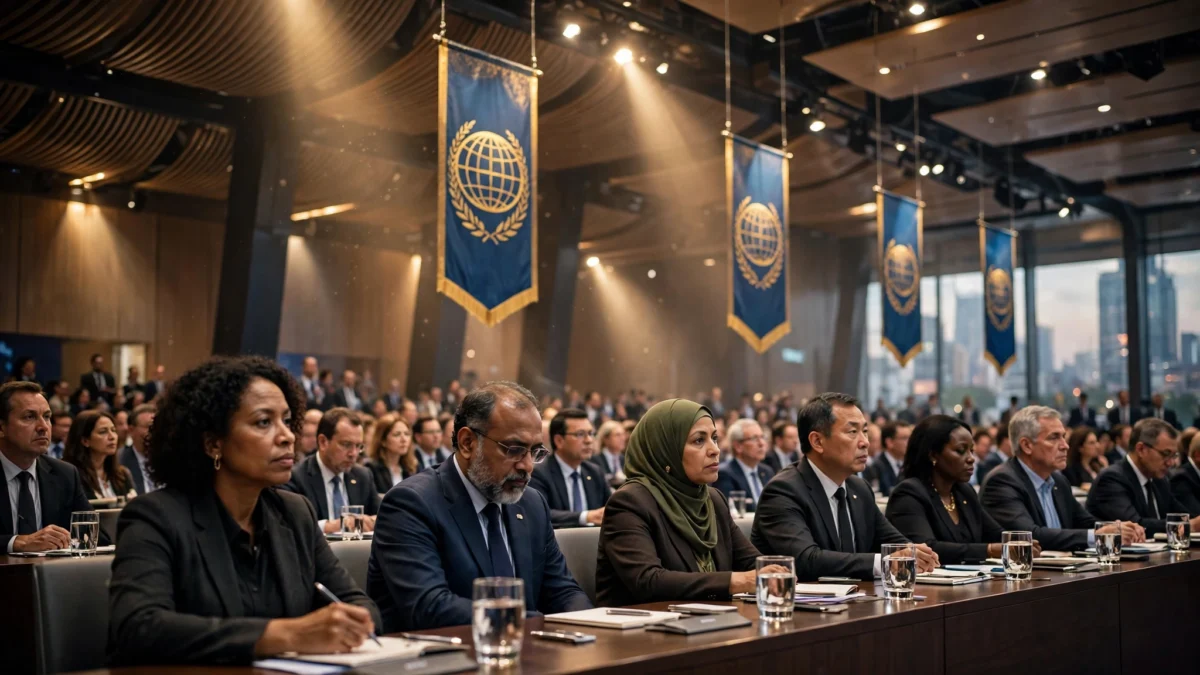
The International Monetary Fund upgraded its forecast for global economic growth this year to 3.1 per cent on Tuesday, 13 October, saying a surge of investment in artificial intelligence infrastructure is offsetting the energy-price shock from the protracted war in the Middle East — while warning that the world economy’s resilience is nearing its limits.
According to the fund’s latest World Economic Outlook, released as finance ministers and central bank governors gathered in Bangkok for the IMF and World Bank Annual Meetings, growth in 2026 will still slow from the 3.5 per cent recorded in 2025. The 3.1 per cent projection is a slight increase from the 3.0 per cent forecast in July, and roughly matches the most optimistic scenario the IMF set out in April. For 2027, the fund held its growth forecast at 3.4 per cent, up 0.2 percentage points from April’s baseline, according to Reuters.
The upgrade rests heavily on the AI investment boom. Continued heavy spending on AI data centres and computing hardware prompted the IMF to raise growth forecasts for advanced economies building AI platforms and, crucially, for the countries supplying AI hardware — South Korea, Malaysia, Mexico and Thailand, which is hosting this week’s meetings, the fund said. The meetings run from 12 to 18 October at Bangkok’s Queen Sirikit National Convention Center, with Thai government registration data putting attendance at 17,380 participants from 186 countries, including some 4,750 official delegates and 1,585 accredited journalists, according to the World Today Journal.
But beneath the headline number, the IMF painted a picture of an increasingly split world. Just 32 countries now account for 95 per cent of global growth, down from 54 in April, and nearly half of all economies — 47 per cent — have had their forecasts downgraded since the April outlook. The hardest-hit are countries battered by the Middle East war and bypassed by the AI boom. Gulf economies directly affected by the conflict have been downgraded sharply: Saudi Arabia’s GDP is now expected to contract 3.3 per cent in 2026, against the 1.7 per cent growth predicted in July, according to TBS News. Iran, Iraq, Kuwait, Qatar and the United Arab Emirates are also expected to fall into deep recessions in 2026, with contractions of 7.6, 16, 16.7, 15.6 and 3.9 per cent respectively.
Among major economies, the IMF forecasts US growth of 2.3 per cent for both 2026 and 2027, supported by private consumption, tax cuts and AI investment, according to Reuters. Euro-zone growth for 2026 was upgraded to 1.1 per cent from 0.9 per cent in July, reflecting stronger AI-related investment and higher defence spending across EU member states. China’s growth was trimmed by 0.1 percentage point to 4.5 per cent for 2026 and 4.0 per cent for 2027, as higher oil prices compound weak domestic demand despite strong exports. India remains the fastest-growing major economy at 7 per cent for both years, upgraded on robust domestic demand, services activity and AI investment.
Global headline inflation is forecast at 4.7 per cent for 2026 and 4.1 per cent for 2027, the IMF said — uncomfortably high, and a key reason financial markets remain on edge.
The fund’s chief economist, Silvana Tenreyro, struck a cautious note at the Bangkok news conference. “The global economy has been resilient, but that resilience is reaching its limits,” she said, urging governments to “restore fiscal space” and “rebuild supply-side resilience.”
She listed the downside risks: a prolonged and intensified Middle East war that spikes inflation, rising bond yields that raise government borrowing costs, El Niño-driven extreme weather, and a reassessment of AI profitability that could crater investment and asset prices.
The IMF’s forecasts assume the Strait of Hormuz reopens in March 2027 with a broad return to pre-war shipping conditions by October 2027, with average oil prices of 96 dollars a barrel in 2026 and 87 dollars in 2027. But under an adverse scenario in which a worsening war keeps oil at 130 dollars a barrel through the first quarter of 2027, growth would be cut by 0.2 percentage points in 2026 and 0.5 percentage points in 2027, and 2027 inflation would surge to 5.2 per cent.
AI itself is a major source of uncertainty in the report. In a scenario of faster AI adoption and accelerated investment, global GDP could rise a further 0.6 per cent by 2029, with most benefits flowing to the US and China. But if expected productivity gains fail to materialise and investment collapses, US GDP could fall 0.8 per cent directly, with spillovers to Asian technology exporters producing a total direct GDP impact of up to 0.4 per cent by 2028 — plus a sharp fall in asset prices and tighter financial conditions that would drag consumption down, particularly in the US. Higher global bond yields would compound the damage, cutting global output by a combined 1.1 per cent by 2028, including a 1.8 per cent drop in US output.
Countries and companies have so far blunted the oil shock by drawing down strategic reserves, substituting suppliers and energy sources, and cutting oil demand, Petya Koeva Brooks, the IMF’s deputy research director, told Reuters in a separate interview. She said global growth would have fallen to 2.5 per cent this year without those measures — but their protective effect is fading as the war drags on.
While the fund debated the global outlook, developing nations delivered the week’s sharpest political message. Speaking to reporters in Bangkok on Tuesday, Taiwo Oyedele — Nigeria’s finance minister and chair of the Group of 24 developing nations — said the debt vulnerabilities of developing economies are a “major barrier” to inclusive growth, according to Reuters.
Oyedele said estimates showed developing nations were paying roughly 500 billion dollars more to service their debt than developed countries. “What we have seen by members of the G24 and across particularly the developing countries such as those in Africa, is an increasing body of not just high debts, but high costs of debts,” he said.
Heavily indebted developing countries have come under immense pressure this year, strained by supply shocks from the Middle East war, rising food prices triggered by a “super El Niño”, and surging borrowing costs, according to the Reuters report. “These developments impact emerging markets and developing economies’ progress towards achieving inclusive and job-rich economic transformation,” Oyedele said.
Together, developing countries face an estimated 400 billion dollars in external debt payments to creditors in 2026, with interest accounting for roughly one-third, according to World Bank figures reported by Reuters. Interest payments already consume more than 10 per cent of government revenue on average across developing nations — money that cannot be spent on health, education or infrastructure.
The G24 urged the IMF and World Bank to provide more accessible and affordable concessional financing to vulnerable countries in the near term, while members work to mobilise private capital and reduce public spending. “Debt is something that restrains growth, because countries then do not have enough resources to finance further growth,” Iyabo Masha, director of the G24 secretariat, told Reuters. Masha added, however, that recent improvements to the sovereign debt architecture should help countries resolve debt crises more quickly, citing Senegal as an example: the West African nation is “quite close” to a final resolution with its creditors, two years after misreported debt estimated at 13 billion dollars triggered a crisis.
Masha also warned that developing economies risk being left behind in the AI boom. The IMF earlier on Tuesday trimmed its growth forecasts for Latin America and the Caribbean for this year and next, saying most of the region was getting little lift from AI. “It is a concern that AI will widen the digital divide,” Masha told Reuters. Countries without reliable electricity, she noted, cannot hope to attract data-centre investment or benefit from the technology any time soon.
The debt warning echoes the IMF’s own alarm bells. In her traditional curtain-raiser speech before the meetings, managing director Kristalina Georgieva warned that public debt is at its highest level since the Second World War and will exceed 100 per cent of GDP before 2030, with advanced economies led by the United States carrying the largest debt burdens relative to output. “Winter is coming,” Georgieva told her audience, urging governments to adopt credible medium-term plans to control deficits.
World Bank President Ajay Banga, for his part, has highlighted the combined pressure of rising diesel and fertiliser prices and climate risks on developing economies, according to the Daily Riverine, citing Reuters.
Pakistan is represented in the Bangkok discussions: its finance minister and central bank governor were scheduled to join the MENAP regional session — covering the Middle East, North Africa, Afghanistan and Pakistan — with the IMF managing director, according to The Arabian Post. Pakistan’s engagement matters beyond symbolism: the country remains in an IMF programme and its delegation’s bilaterals in Bangkok will be closely watched for signals on the next review.
The week’s agenda also saw outside pressure. More than 200 civil-society organisations and movements launched an International Peoples’ Assembly in Bangkok alongside the official meetings, demanding immediate cancellation of unsustainable public debt, the scrapping of IMF surcharges and structural-adjustment conditions, and the creation of a binding UN framework convention on sovereign debt, according to the Asian Peoples’ Movement on Debt and Development.
Analysis: Why It Matters
Tuesday’s double message from Bangkok — a growth upgrade and a debt alarm — captures the central paradox of the 2026 global economy: the headline numbers are surviving on one spectacularly narrow engine while the foundations underneath are cracking.
The engine is AI investment. That is remarkable, but it is also fragile in ways the IMF report itself spells out. When 95 per cent of global growth comes from just 32 countries, the “world economy” is a statistical average that describes almost nobody’s lived experience. For the Gulf, the war has turned forecast surpluses into double-digit contractions. For Latin America and much of Africa, the AI boom is something happening on another planet — they face the energy shock’s costs without its offsetting benefits. This is not a rising tide lifting all boats; it is a tide lifting a few yachts while the harbour empties.
The developing-world debt story deserves to be the week’s lead. The numbers are stark — 400 billion dollars in external payments this year, interest eating more than a tenth of revenues on average, half a trillion dollars in extra debt-service costs versus developed countries. But the politics are even more telling. The G24’s core demand is not charity; it is fairer access to finance and a workable system for resolving crises. Senegal’s near-resolution shows the machinery can work, but the absence of any appetite among G20 leaders for a repeat of the pandemic-era debt-service suspension — reported by Reuters diplomats — shows how far the creditor politics have shifted. The IMF’s own new guidance calling for “fewer but deeper” reforms as conditions for lending has many lower-income countries fearing harsher austerity, not relief.
There is a deeper structural point that Tenreyro’s phrase “reaching its limits” glosses over. The buffers that have absorbed the shocks so far — strategic oil reserves, supply substitution, fiscal stimulus, corporate margins — are depletable. The IMF’s own arithmetic says the oil-shock mitigation alone was worth 0.6 percentage points of global growth this year, and that effect is fading. Meanwhile, public debt above 100 per cent of GDP leaves governments with shrinking room to respond to the next shock. The next crisis will hit economies that are more indebted, more exposed to high bond yields, and more dependent on a single investment theme — AI — whose financial risks the IMF compares, in tone if not in name, to a classic boom-bust cycle. When the chief economist of the IMF flags the “reassessment of AI profitability” as a formal downside risk in the flagship outlook, it is worth taking seriously.
For the Middle East war’s economic geography, the forecasts are a reminder that wars now transmit through markets faster than through battlefields. The Gulf’s swing from projected growth to deep contraction, the 100-dollar-plus oil prices, the assumption that Hormuz reopens on a precise timetable — all of it shows how completely the global economy’s stability now hinges on a single shipping strait. The adverse scenario (130-dollar oil through early 2027, half a point off growth, inflation back above 5 per cent) is not a tail risk in the statistical sense; it is the continuation of what is already happening.
What to watch is whether Bangkok produces anything beyond warnings. Annual meetings rarely deliver breakthroughs — the Eurodad network of civil-society organisations noted in advance that this one would be “less a moment for decisive action than a temperature check.” The real tests are concrete: whether the sovereign-debt restructuring machinery accelerates for the next Senegal, whether concessional finance commitments materialise for countries paying a half-trillion-dollar premium on their debt, and whether the AI investment boom keeps running long enough for its promised productivity gains to arrive before its financial risks do. Tenreyro’s call to “move from just coping to rebuilding” is the right diagnosis. The question Bangkok leaves hanging is whether anyone has the fiscal room left to do the rebuilding.
What to Watch Next
- The IMF board and communiqué: whether the annual meetings produce any concrete commitment on debt restructuring or concessional finance, or end with communiqués alone.
- Senegal’s debt resolution: if a final agreement in principle materialises by December, it becomes the template — and the test case — for the faster debt machinery the G24 cites.
- Hormuz and oil prices: the IMF’s entire forecast hinges on the strait reopening in March 2027; any slippage would force mid-cycle downgrades.
- AI capex data: quarterly earnings from the major AI infrastructure spenders will show whether the investment boom underpinning 2026 growth is holding — or turning.
- Latin America and Africa outlooks: whether the trimmed regional forecasts deteriorate further, confirming the AI digital-divide warning from the G24 secretariat.
Sources
- Reuters — IMF says AI investment propping up global growth, but war and debt threaten outlook (13 Oct 2026)
- Reuters — Growing debt burden poses significant risk to developing nations, G24 chair says (13 Oct 2026)
- TBS News — AI investment lifts global growth to 3.1% this year, but war and debt cloud outlook: IMF (13 Oct 2026)
- Reuters — Middle East war, high debt levels to dominate IMF-World Bank meetings in Bangkok (11 Oct 2026)
- Reuters — Thailand prepares to host IMF-World Bank meetings (10 Oct 2026)
- The Arabian Post — UAE delegation heads to Bangkok for IMF meetings (10 Oct 2026)
- World Today Journal — Thailand hosts 2026 IMF-World Bank meetings in Bangkok

About the Author — Abdul Mannan
Related Articles
Drones Hit Two Merchant Ships in the Black Sea Off Bulgaria, Sinking One as Sofia Turns to NATO and the EU
Bulgaria's prime minister says drones hit two merchant ships in the Black Sea on Tuesday, sinking one and…
Russia Says Europe Paid $320.7 Billion for Russian Energy Since 2022 — More Than EU Aid Given to Ukraine
Moscow says EU countries bought $320.7 billion in Russian hydrocarbons since 2022; Sweden's foreign minister says the bloc…
Britain Sanctions Two Iranian Nationals and Summons Tehran’s Envoy After Blaming IRGC for RAF Fairford Terror Plot
Prime Minister Andy Burnham told Parliament the suspected terror plot near RAF Fairford was "highly likely" coordinated in…