
Drones Hit Two Merchant Ships in the Black Sea Off Bulgaria, Sinking One as Sofia Turns to NATO and the EU

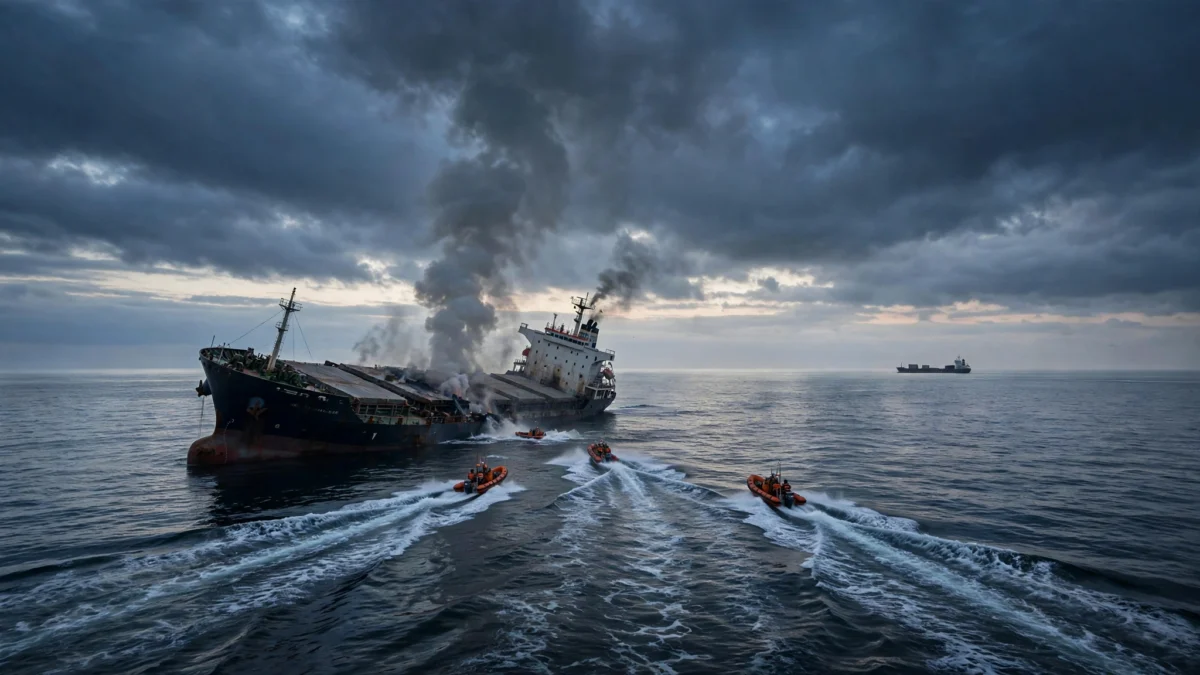
Drones struck two merchant ships in the Black Sea off Bulgaria’s coast on Tuesday, sinking one of the vessels and triggering emergency rescue operations, Prime Minister Rumen Radev said, in the second such attack inside Bulgarian waters in seven days.
The strikes took place in the early hours of the morning, with Bulgarian authorities receiving a distress call at about 1:30 a.m. local time from the merchant vessel Chelsea 3, roughly 18 nautical miles east of the coastal town of Byala, according to EU Perspectives’ account of the Bulgarian report. The crew reported that three aerial drones had struck the ship’s deck and hull. All 15 crew members — seven Ukrainians and eight Azerbaijanis — were evacuated to the port of Varna by a Border Police team, with five receiving medical attention for minor injuries, the Associated Press reported.
The Malta-flagged coastal freighter is Ukrainian-operated, registered in Odesa and owned by a Ukrainian company, according to EU Perspectives.
A second vessel, the Guinea-Bissau-flagged cargo ship Dignity, sank after being hit by what Varna district governor Mario Smrkov described as a military strike, the AP reported. Five sailors were rescued, and a search continued for the other 11 crew members, according to Smrkov. In his own statement, Radev said only that one crew member from the sunken vessel had been rescued and gave no details on the others. The second ship went down about 17 nautical miles east of Krapets, off Bulgaria’s northern coast, according to EU Perspectives. Distances reported by different outlets vary slightly — the AP put the two strikes 20 and 21 miles from the coast — figures that appear to still be settling as the rescue operation continues.
Speaking at an emergency meeting of Bulgaria’s Security Council convened on Tuesday, Radev described the attacks as “absolutely unacceptable” and said Bulgaria was seeking assistance from NATO and the European Union, according to the AP and Reuters.
Nobody has claimed responsibility for the attacks, and Bulgarian authorities say they have no clear evidence identifying who launched the drones. But Radev pointed to the balance of advantage. During a meeting on Tuesday with the Russian ambassador in Sofia, he said “it makes no sense for Ukraine to destroy its own ships in the Black Sea, and the results of these strikes favor Russia’s interests,” according to a report from the government’s press office cited by the AP. The ambassador replied that she had no information from the Russian defense ministry related to the attacks but did not rule out the possibility that “these attacks represent a provocation by a third party.”
Von der Leyen and Rutte Respond
European Commission President Ursula von der Leyen condemned the attacks in a statement posted on social media. “The Black Sea has become another front of escalation of the Russian war in Ukraine,” she wrote. “This is unacceptable. I strongly condemn the drone attacks on merchant ships near Bulgaria’s coast. Putting the lives of the crew in grave danger and threatening security in the Black Sea,” EU Perspectives reported her as saying.
After a phone call with Radev, NATO Secretary General Mark Rutte said the alliance would continue working with its Black Sea allies and stood ready to adjust its military presence in the region as needed, according to EU Perspectives.
Sofia has asked the EU and NATO to support the investigation aimed at establishing where the drones came from, and has requested help strengthening surveillance of the airspace and waters in the area, EU Perspectives reported.
A Pattern, Not an Incident
The strikes came exactly a week after drones hit two other commercial vessels in Bulgaria’s exclusive economic zone on October 6. In that attack, the Togo-flagged Alfa Watan sank, and Bulgaria ended the search for its crew on October 7 without finding any of the sailors. Nine of the ten missing sailors are Syrian citizens, according to Syria, which has called for an independent inquiry. The Palau-flagged vessel Able caught fire in the same attack; all 18 of its crew members were picked up by a Bulgarian ferry that diverted to the scene, according to Brussels Signal.
Ukrainian President Volodymyr Zelenskyy said Ukraine’s military had conducted no operations near the sites of last week’s attacks and blamed Russia, while the Russian embassy in Sofia has denied any Russian involvement, Brussels Signal reported.
Bulgaria’s response has been diplomatic as well as operational. On October 12 — a day before the latest strikes — Radev wrote to European Council President António Costa, European Commission President von der Leyen, and NATO Secretary General Rutte asking for the October 6 attacks to be treated as a priority, according to a Bulgarian government statement carried by the state news agency BTA and reported by Brussels Signal. Sofia has also sought help from the European Maritime Safety Agency, after its own efforts failed to locate any drone debris that could indicate where the weapons came from. The aim, the outlet reported, is to examine all physical evidence, satellite data and other information gathered since the attacks.
Radev has been careful not to assign blame outright. After the October 6 attacks he said the drones were either Russian or Ukrainian, and he has since said Bulgaria cannot blame Russia without proof, according to Brussels Signal.
Analysis: Why It Matters
The pattern is now the story. A single drone attack on commercial shipping is an incident; two strikes in seven days, inside a NATO member’s exclusive economic zone, is a campaign. Whoever is behind them — and the evidence remains officially inconclusive — has discovered that the western Black Sea is a place where damage can be done without attribution, and where each unanswered attack lowers the cost of the next one. Bulgaria’s emergency Security Council meeting and its letters to NATO and EU leadership are the markers of a state that has understood this is not over.
Attribution by logic versus attribution by evidence. Radev’s formulation — that Ukraine destroying its own ships makes no sense, and that the strikes favor Russian interests — is striking because it is doing diplomatic work that evidence cannot yet do. It allows Sofia to point without accusing. The risk is that “logic” becomes a substitute for proof in a theater where Russia has denied involvement and the only physical evidence — drone debris — has apparently not been recovered. Brussels Signal’s report that Sofia turned to the European Maritime Safety Agency after failing to find debris is telling: attribution here is hostage to the sea, which does not keep exhibits.
The Black Sea is becoming a second front of commercial pressure. With the eastern Mediterranean and the Red Sea already reshaped by conflict, the Black Sea’s western corridor was one of the routes shippers could still price with some confidence. Two attacks on merchant vessels inside Bulgaria’s waters in a week change that calculation. Insurance premiums, routing decisions and the willingness of crews to sail these waters are now in motion — and Moscow, whether or not it ordered the drones, benefits from every shipowner who recalculates. Von der Leyen’s framing of the Black Sea as “another front of escalation” is the EU’s first admission that this is now a theater, not a series of accidents.
Rutte’s “adjust its military presence” is the sentence to watch. NATO secretaries-general choose words carefully. “Continue working with its Black Sea allies” is routine; standing ready to “adjust its military presence in the region as needed” is an open door. The alliance already conducts air policing over the Black Sea; what adjustment means — more surveillance aircraft, a naval presence, or simply the threat of one — will be the measure of whether Brussels treats this as a Bulgarian policing problem or a NATO credibility problem.
The crews are the least powerful people in this story and the most harmed. Ukrainian and Azerbaijani sailors on the Chelsea 3, missing Syrian sailors from the Alfa Watan, eleven missing from the Dignity. Commercial crews have become the front line of grey-zone warfare — civilian, multinational, unprotected — and they are absorbing the risks that navies and governments are unwilling to spell out. Syria’s call for an independent inquiry on behalf of its missing sailors is a reminder that the human cost of unattributed warfare falls on people whose governments cannot escalate.
What to Watch Next
- The search for the Dignity’s missing crew: Whether Bulgarian rescuers find the eleven sailors still unaccounted for will determine whether this attack claims lives beyond the sinking itself.
- The NATO and EU responses: Whether Rutte’s promise to adjust the alliance’s military presence produces visible deployments in the western Black Sea, and whether Brussels treats the incidents as a priority as Sofia has asked.
- The attribution investigation: Whether the European Maritime Safety Agency’s technical assistance turns up drone debris, satellite tracks or launch signatures that identify where the weapons came from.
- The October 12 letters: Whether Costa, von der Leyen and Rutte give the attacks the priority treatment Radev requested, and what concrete assistance follows.
- The pattern itself: Whether a third attack follows in the coming days — which would confirm a campaign — or whether the NATO/EU attention forces a pause.
Sources
- Reuters: Drone sinks ship off Bulgaria coast, prime minister says
- Associated Press (via TBS News): Drone attacks hit two ships in Black Sea off Bulgaria, sinking one
- EU Perspectives: Von der Leyen condemns Black Sea attacks as drone strikes sink merchant ship off Bulgaria
- Brussels Signal: Bulgaria asks EU and NATO to help identify drones that sank ship in Black Sea

About the Author — Abdul Mannan
Related Articles
Russia Says Europe Paid $320.7 Billion for Russian Energy Since 2022 — More Than EU Aid Given to Ukraine
Moscow says EU countries bought $320.7 billion in Russian hydrocarbons since 2022; Sweden's foreign minister says the bloc…

IMF Lifts Global Growth Forecast to 3.1% on AI Boom as G24 Warns Debt Crisis Is Choking Developing Nations
The IMF has nudged up its 2026 global growth forecast to 3.1% as AI investment blunts the energy…
Britain Sanctions Two Iranian Nationals and Summons Tehran’s Envoy After Blaming IRGC for RAF Fairford Terror Plot
Prime Minister Andy Burnham told Parliament the suspected terror plot near RAF Fairford was "highly likely" coordinated in…