The Emperor of the Sky: When One Man Holds a Nation’s War in His Hand

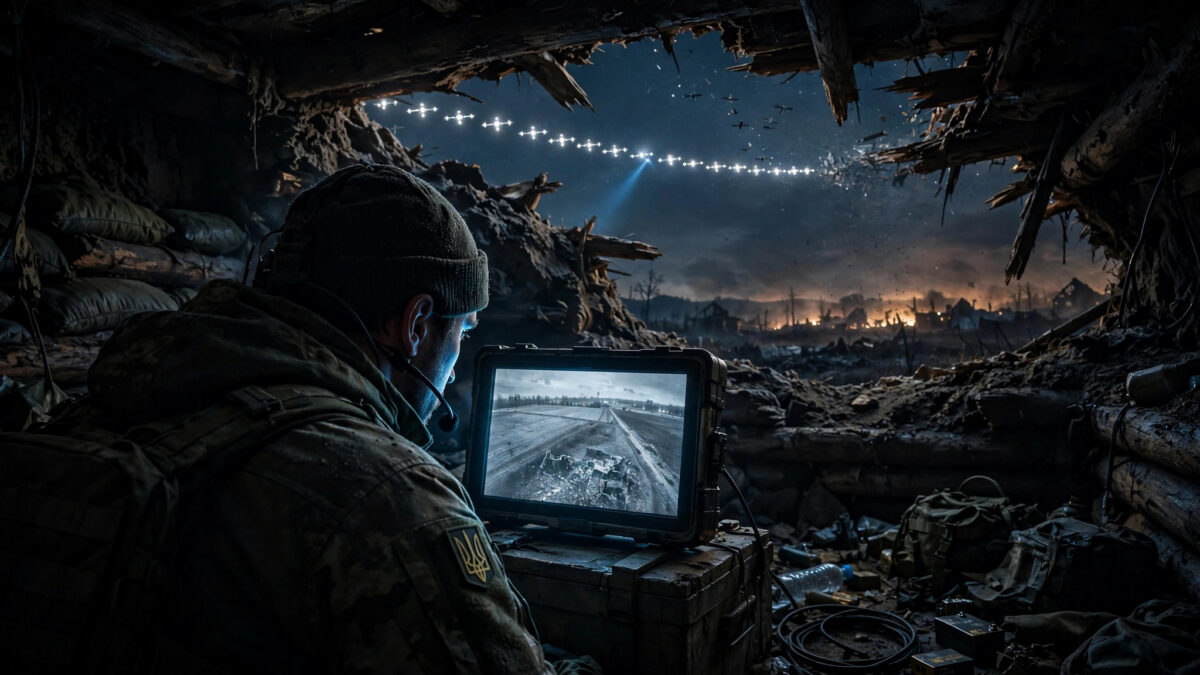
The Night the Signal Slowed
Picture a young Ukrainian drone operator on the night of Tuesday, 13 October 2026. He sits in a dugout somewhere along the eastern front, his face lit by the pale glow of a monitor. His drone — an interceptor, hunting the Russian Shahed drones that have been terrorising Ukrainian cities — streaks through the darkness at a speed no human pilot could endure. And then, without warning, the screen stutters. The image freezes. For ten, fifteen, twenty seconds, the machine he was guiding with his hands is blind and deaf, flying on nothing but momentum into a sky full of enemies.
He did not lose the signal to Russian jamming. He lost it, it appears, to a decision made thousands of kilometres away — by a man who owns the satellites, or by a president who owns the switch, depending on whose account you believe. And I ask you, dear reader, the question that has been circling my mind since I read the news: in the history of warfare, has a nation’s army ever before depended for its survival on the good mood of a single civilian sitting behind a keyboard in another country?
The facts first, because facts are the foundation on which every honest argument must stand. On the night of Tuesday 13 October, restrictions were imposed — without any advance notice to Kyiv — on Starshield, the military-grade version of Elon Musk’s Starlink satellite system that Ukraine relies on for battlefield communications and drone guidance. A speed limit of roughly 100 miles per hour (160 kilometres per hour) was set on terminals in motion: anything travelling faster lost its connection. Ukraine’s 7th Rapid Reaction Corps told Reuters that connections dropped out for ten to twenty seconds even at speeds well below that limit — around 68 to 75 mph — making drones harder to control at the very moment Russia was unleashing one of its heaviest attacks of the war: 39 ballistic missiles and more than 120 attack drones, according to President Volodymyr Zelensky, leaving some 600,000 people without electricity. “Our defence forces did not receive a warning about this limitation, and this led to the disruption of several missions,” wrote presidential adviser Serhiy Beskrestnov on Telegram, adding that he believed the restrictions were linked to the recent strains between Kyiv and Washington.
Now consider the timing, because timing is the soul of this story. The throttling arrived while Ukrainian interceptor drones were needed most — and according to the Institute for the Study of War, the restriction could make it all but impossible for Ukrainian drones to intercept jet-powered Russian drones, since Shahed-type drones can fly faster than 198 miles per hour. A 100 mph ceiling does not merely slow Ukraine’s drones. In practical terms, it grounds the very machines that shield Ukrainian cities from the night sky. Zelensky himself said Ukraine received no warning before Russian ballistic missiles struck Kyiv for two consecutive nights. So I ask you again: what do you call it when a nation’s air defences are dimmed from orbit, by remote control, on the eve of a bombardment?
Whose Finger Is on the Switch?
Here the story forks into two versions, and you must hold both in your mind at once, because the truth of our age usually lives in the fork. When Ukraine’s former defence minister Mykhailo Fedorov publicly appealed to Elon Musk to remove the limit, Musk answered on X with a sentence that has now travelled around the planet: “Starshield systems are owned and controlled by the US government. Any limits on speed or usage are decided by the US military and ultimately POTUS.” He drew a sharp line between the two systems: Starshield, he said, belongs to the Pentagon; commercial Starlink, which SpaceX controls, is “limited to civilian or defensive activities and cannot be used for offensive military action.” In other words — not my finger on the switch.
But a senior United States official told Axios that the Trump administration was not responsible for the restriction either. So the switch, apparently, pressed itself. The reader will forgive me for raising an eyebrow. When the world’s richest man and the world’s most powerful president both point at each other over a decision that crippled a friendly nation’s drones in the middle of a missile barrage, someone is telling less than the whole truth — and it is Ukraine’s cities that pay the price of the ambiguity.
And there is a third voice in this chorus that cannot be ignored, because it is the voice of the man himself. On 11 October, days before the throttling, Musk posted on X that “Zelensky has gone too far” — and then, in a separate post: “I agree, time for Ukraine to get a new leader.” Let those words sit with you a moment. The richest civilian on Earth, the owner of the satellite constellation through which Ukraine fights its war, publicly calling for the removal of a wartime president — days before that president’s drones start falling out of the sky. Musk has said Kyiv has “gone too far” with its strikes on Russian oil infrastructure, and President Donald Trump has been applying the same pressure for weeks, reportedly even threatening to suspend intelligence-sharing and halt European purchases of American weapons unless Kyiv stops attacking Russian refineries, citing spiking global energy prices. Trump has also agreed to waive sanctions on Russian oil — a move that left Zelensky, visiting London this week, telling Piers Morgan in an interview that he felt “betrayed” by the United States, adding, in words no leader utters lightly, that “people will die” as a result of the reduced access.
Do you see the architecture of this now? It is not one decision. It is a squeeze: a president demanding that Ukraine stop striking the refineries, a billionaire declaring the Ukrainian president must go, and then — as if on cue — the satellites dimming. Each man denies pressing the switch. But the drones, dear reader, do not read press statements. They simply fell silent.
The Company Returns
And now, as is my habit, let me hold up the mirror of history — because I have long believed that nothing happening today is truly new; it is only the past, wearing new clothes.
Four centuries ago, a group of London merchants obtained a royal charter and sailed east, and within a century their “company” commanded an army larger than most nations, minted its own coins, collected its own taxes, and decided the fate of kings. The East India Company was not a government. It was a business — and that was precisely what made it terrifying. When the people of a subcontinent rose in 1857, they were not fighting the British Crown alone; they were fighting a corporation that had swallowed a civilisation. I have written before that the old East India Companies never really died; they simply changed their letterheads. Now look up at the night sky and tell me I am wrong.
For what is Starlink if not the East India Company of the heavens? More than ten thousand satellites — a private constellation, larger than the space programmes of most nations, owned by one man, deciding who may speak to the sky and who may not. The old Company controlled the sea lanes and the trade winds; the new company controls the signal. And just as the old Company once decided which Indian prince would keep his throne, we have now watched a private citizen declare, from his own social media pulpit, that a wartime president of a sovereign nation should be replaced — while the satellites his firm built were dimming over that nation’s battlefields. The charter has changed. The handwriting is the same.
History offers a second mirror, darker and more precise. On the night of 4–5 August 1914, as the First World War began, one of Britain’s very first acts was to send a cable ship into the North Sea to dredge up and sever Germany’s undersea telegraph cables — cutting an empire off from the world before a single great battle had been fought. The lesson the empires learned a century ago was simple: whoever controls the cables controls the war. Today the cables have moved to the sky, and they are owned not by an empire but by a man — a man who can, with a keystroke or a contract clause, do to a nation in 2026 what the Royal Navy did to Germany in 1914. The difference is that in 1914 the act was committed by a state at war, answerable — however imperfectly — to parliaments and treaties. In 2026 it may have been committed by a private individual, answerable to no one but his shareholders and his timeline.
And here I must address you directly, my friend, because this is where the story stops being about Ukraine and starts being about you. If the war of one nation can be dimmed from a boardroom in California, what security does any smaller nation possess? The generals of the world have spent a decade building doctrines around satellites they do not own, launched by rockets they did not build, controlled by contracts they did not write. Every developing country that dreams of a modern army is now, in effect, a tenant farmer on someone else’s sky — and the landlord has just shown the tenants what happens when the rent of obedience is not paid. Remember this the next time someone tells you that technology has made power democratic. It has not. It has made power private.
A President Feels Betrayed
While the satellites dimmed, Volodymyr Zelensky was in London. He spent twenty-five minutes with the King at Buckingham Palace, was welcomed at Downing Street by Andy Burnham, and watched Britain announce it would speed up the delivery of the lightweight missiles Ukraine uses to bring down Russian drones — missiles that, in a cruel irony, are guided by the very satellite network now under restriction. And in his interview with Piers Morgan, the word he chose was “betrayed.”
Weigh that word carefully. Betrayal is not the complaint of an enemy; it is the wound of a friend. Ukraine gave its trust — and, a generation ago, its nuclear arsenal — to Western promises of protection. It built its entire modern way of war on American satellites, American intelligence, and American goodwill. And now the sitting American president publicly suggests Ukrainians should choose a new leader, waives sanctions on the oil of the invader, and — according to Kyiv’s account — allows the dimming of the very network Ukraine’s defenders breathe through. You may agree or disagree with Zelensky’s war. But you cannot deny the moral geometry: a nation that surrendered its ultimate weapons on a promise is now watching the conventional weapons it was given being throttled from afar.
Nor is Ukraine’s fury confined to Kyiv. Poland’s foreign minister, Radosław Sikorski, addressed Musk directly on X in words that have since been shared millions of times: “Hey, @elonmusk, big man, are you playing politics with your products again? As your European customers, we are watching you.” Note the phrase — “your European customers.” Poland pays some $50 million a year for the Starlink service Ukraine uses. Let that sink in: a sovereign European nation is a paying customer of a private American citizen, begging him on social media not to switch off another country’s war. This is the new diplomacy, ladies and gentlemen: foreign ministers reduced to replying to a billionaire’s posts.
What the Off-Switch Means for the Rest of Us
By Thursday, a source in Ukraine’s defence ministry told the Kyiv Independent that Starshield service while on the move had been restored and remained operational — though the ministry continued pressing for the reasons behind the restriction to be clarified. The immediate crisis, then, has eased. But I would be failing you as a columnist if I treated the restoration as the end of the story. A switch that can be flipped off without warning and flipped on without explanation is not a resolved problem. It is a loaded weapon, now demonstrated to work.
Consider what has actually been established this week, as precedent, before the eyes of every general staff on Earth. First: a private satellite network is now a recognised instrument of coercion between allies — the threat to dim it can be used to discipline a friendly government, as visibly as any sanctions regime. Second: the line between a company’s commercial policy and a superpower’s foreign policy has dissolved entirely; when Musk says the Pentagon decides and the Pentagon says it didn’t, accountability evaporates into the space between them — and that evaporation is the point. Third: the wartime leader of a democracy can be publicly marked for replacement by a foreign billionaire, and the world will treat it as content rather than as the scandal it is.
And now the question I promised you at the start, the one that concerns your country and mine. Every nation that cannot launch its own constellation — which is to say, nearly every nation — must now ask what its sovereignty is worth when its armies, its banks, its hospitals and its elections may one day route through a constellation owned by one man. The answer the strategists are already giving is a scramble: Europe talks of its own satellite independence, nations hoard alternatives, and the sky fills with rival constellations the way the seas once filled with rival fleets. We are watching, in real time, the enclosure of the heavens — the moment the sky stopped being the province of all mankind and became property. The East India Company needed two centuries to swallow a subcontinent. Its successor needed barely a decade to hold a continent’s war in its hand.
The Verdict
I began with a young operator staring at a frozen screen in a Ukrainian dugout. Let me end with him — because he is the only honest measure of everything I have written. He did not vote for Elon Musk. He did not elect Donald Trump. He never signed a contract with SpaceX or the Pentagon. He simply picked up a weapon his country was given and pointed it at the drones coming to kill his neighbours — and discovered that between his hands and the sky stood a man he had never met, in a country he had never visited, who had decided, for reasons of politics or profit, that his signal should slow.
This is the moral of our week, and I deliver it as a verdict, not a summary: no man should hold the off-switch of another nation’s survival. Not a king, not a president — and certainly not a merchant. The East India Company taught the world what happens when a business is allowed to wield the powers of a state; it took the blood of millions to unlearn that lesson. We are relearning it now, one frozen drone screen at a time. The satellites will keep rising over our heads, silent and glittering, and each one will whisper the same question to the nations below: who owns the sky above your children? Until we can answer that question with something better than the name of one man, none of us — not Ukraine, not Europe, not you, not I — is truly sovereign. We are all, once again, tenants. And the landlord has shown us the switch.
Sources & References
- New York Post — “Ukraine fumes after military version of Starlink gets throttled while Russians launch brutal attacks” (14 Oct 2026)
- The Times (London) — “Ukraine ‘has run out of Patriot interceptor missiles'” / Starlink limits coverage (15 Oct 2026)
- Associated Press via Newsmax — “Starlink Restrictions Disrupt Ukraine Drones, Adding to US Tensions” (14 Oct 2026)
- EnviroLink — “Musk Says US Military Sets Starshield Limits as Ukraine Reports Drone Connectivity Problems” (15 Oct 2026)
- EnviroLink — “Why Starlink Speed Limits Could Disrupt Ukraine’s Drone Defences” (15 Oct 2026)
- KeepTrack Space Brief — “Musk Says US Government, Not SpaceX, Sets Starshield Speed Limits Hitting Ukrainian Drones” (15 Oct 2026)

About the Author — Abdul Mannan
Related Articles

A Crown on the Pavement: What a Fallen Royal in London Teaches About Power
An Abu Dhabi royal, found slumped unconscious on a London street while a barefoot three-year-old played near traffic,…
When the Pope Wears a Hospital Gown: What Leo XIV’s Cancer Teaches the Powerful About Dying
On Sunday, Pope Leo XIV told the world that surgeons would open his chest. Two days later, Rome's…
Who Owns the Sky? SpaceX’s 456 Launches a Year and the New Scramble for the Heavens
On the day the FAA opened comment on SpaceX's plan for 456 Starship launches a year, Mars stood…