Who Owns the Sky? SpaceX’s 456 Launches a Year and the New Scramble for the Heavens

On the night of 14 October 2026, if you had stood in a field in northern Sweden and looked up, you would have seen something that no king, no emperor, and no company could ever have arranged. Mars hung in the very heart of the Beehive cluster, a swarm of young stars, while above them both a curtain of aurora rippled across the sky, set alight by an eruption on the Sun four days earlier. NASA’s Astronomy Picture of the Day called it a cosmic coincidence. I call it a reminder. While we were busy filing papers and counting launches down here, the heavens were putting on a show that belonged to no one — and therefore to everyone.
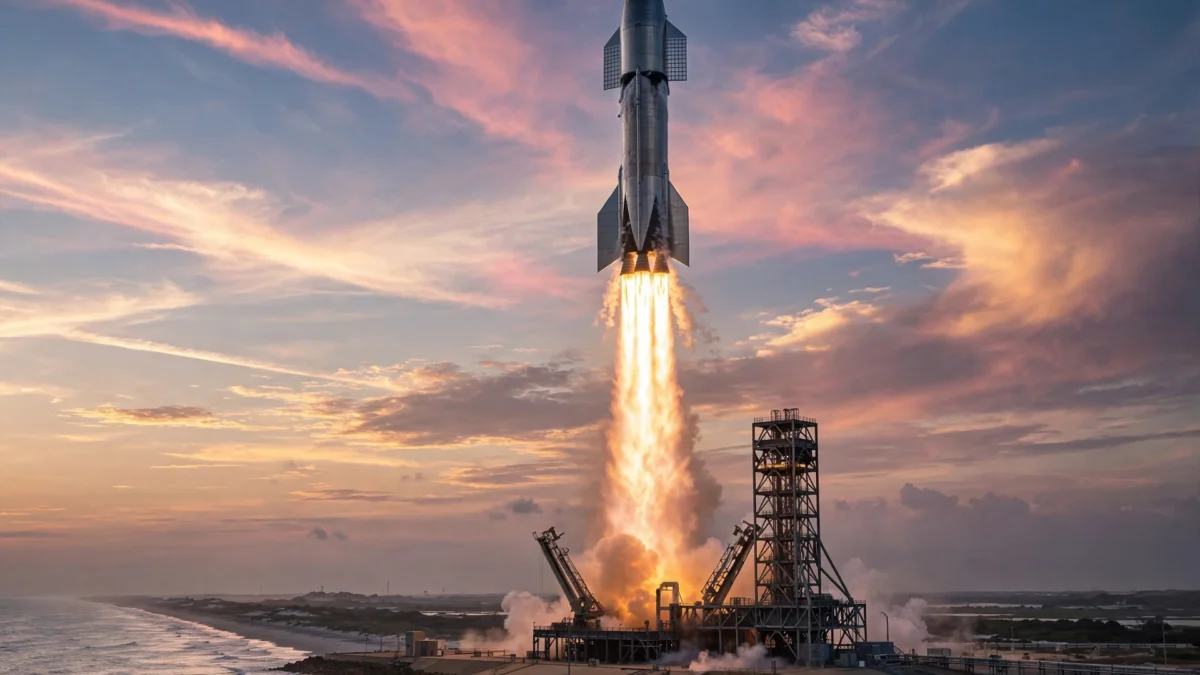
For on that very same day, a notice appeared in the United States Federal Register that may change the sky above your head more than any single event since the first satellite. SpaceX has asked the American Federal Aviation Administration for permission to fly its giant Starship rocket up to 456 times a year from a single launch site at Boca Chica, in Texas — with up to 912 landings a year at the same site. More than one launch every single day, from one patch of coastline, by one company.
And so I ask you the question that has been circling my mind since I read the filing: who owns the sky? Who owns the great blue vault above your village and mine, the darkness through which the stars still travel, the high road by which humanity reaches the Moon and Mars? For most of human history the question would have sounded absurd, like asking who owns the wind. Today it is the most practical question on Earth. And the answer we give in the next few years will decide whether the heavens remain the province of all mankind, or become the private property of whoever gets there first and fastest.
456 Launches: What the Number Actually Means
Let us begin with the facts, because facts are the foundation on which every honest argument must stand. The Federal Aviation Administration published a Notice of Intent announcing that it will prepare a programmatic environmental impact statement — a full, formal study of the consequences — for SpaceX’s proposal to vastly expand Starship and Super Heavy operations at the Boca Chica Launch Site at Starbase, Texas. The public has until 30 November 2026 to submit comments on what that study should cover, and the FAA will hold four public meetings beginning on 17 November, plus one virtual meeting.
The proposal comes in two phases. Phase 1 would allow up to 100 launches and 200 landings a year, on any day and at any hour. Phase 2, the mature phase arriving within several years, would allow up to 456 launches originating from Boca Chica and up to 912 landings at the site — launches at any hour, but only Monday through Friday. In human terms: roughly 1.7 launches and 3.5 landings every working day. Rockets going up and coming down like buses on a city route.
For comparison, SpaceX is currently authorised for up to 25 orbital launches and 50 total landings a year at Starbase. The new proposal is an eighteen-fold leap. The FAA, for its environmental analysis, assumes half of the launches and landings would occur between 7 a.m. and 10 p.m., and half between 10 p.m. and 7 a.m. — the sky, in other words, would no longer sleep. And a word of precision, because precision is a form of honesty: the FAA has not approved anything yet. A Notice of Intent is the beginning of a process, not its end.
From One Orbit to 456: How We Got Here
Only sixteen days before this notice appeared, on 28 September 2026, Starship flew into Earth orbit for the very first time. Flight 14 lifted off from Starbase, climbed to an orbit of roughly 275 kilometres, and released 26 next-generation Starlink satellites — the first payload Starship has ever delivered to orbit, and the first revenue-earning mission of its life. The flight was not perfect: engines shut down on both stages, the flight team cut the mission short after about three hours instead of the planned ten, and the ship came down in a controlled splashdown in the Pacific north of Hawaii. But the mission worked. The machine that had flown thirteen suborbital test flights had finally done the thing it was built to do.
Sixteen days from first orbit to a filing for 456 launches a year. That is the tempo of a company that believes the future will not wait. Reports say SpaceX intends to invest as much as 100 billion dollars to build a massive new launch site in southern Louisiana, and the money is following: according to a report by the investment firm Seraphim, carried by Reuters, space start-ups attracted a record 20.8 billion dollars in funding in the third quarter of 2026 alone — nearly triple the previous quarter. The world, it seems, has decided that the sky is open for business. I do not mock this ambition. I admire parts of it deeply. But admiration is not the same as surrender, and there is a question that ambition alone cannot answer.
The East India Company Went to Space
Here, then, is my history-as-mirror, and I ask you to stay with me, because this is the heart of the matter. In the year 1600, a group of London merchants received a royal charter to trade in the East Indies. The East India Company was, on paper, a business. It had ships, shareholders, and a profit motive — nothing more. But trade needed protection, protection needed forts, forts needed soldiers, soldiers needed revenue, and revenue needed territory. Within a century and a half, a company had become a sovereign. It collected taxes. It fielded armies. It decided the fates of princes. The people of the subcontinent learned, at a terrible price, that when a private enterprise grows larger than the states that are supposed to govern it, the difference between a company and an empire becomes a matter of spelling.
Now look at the heavens and tell me you do not see the same play unfolding, only faster and higher. First came the satellites — a company’s constellation, launched for profit, that now carries the internet of nations and, in wartime, the communications of armies. Then came the rockets — a company’s machines, flying more often than many nations’ entire fleets. Now comes the request for a launch cadence that no government on Earth has ever possessed. The ocean was once the highway of empires; today orbit is the highway of everything — navigation, weather, war, finance, the daily bread of information. Whoever controls the highway writes the tolls.
The Treaty That Promised the Sky to Everyone
There is, praise be, already a law. In 1967, in the shadow of the Cold War, the nations of the world signed the Outer Space Treaty, and its words are among the noblest ever written into international law. The exploration and use of outer space, it declares, shall be carried out for the benefit and in the interests of all countries, and shall be the province of all mankind. Outer space is not subject to national appropriation, by claim of sovereignty, by means of use or occupation, or by any other means. Astronauts shall be regarded as the envoys of mankind. States shall be responsible for their national space activities, whether carried out by governments or by private companies, and shall be liable for the damage their space objects cause.
But here is the wound in the treaty, and I will not hide it from you. The treaty binds states. It says nothing, directly, about companies. It forbids a nation from claiming the Moon — but what does it mean when a single company’s rockets fly more often than all the world’s governments combined, when a single company’s launch schedule can close the airspace over a coastline? No flag is planted. No sovereignty is claimed. And yet the sky begins, in practice, to answer to one address. This is the new form of appropriation, and it is more dangerous than the old kind precisely because it does not look like appropriation at all. It looks like progress. It looks like 456 launches a year, each one legal, each one licensed, each one a marvel — and all of them adding up to something no treaty ever contemplated: a commons enclosed not by conquest, but by cadence. When one actor flies more than once a day and everyone else flies once a month, the commons is still legally open and practically occupied. The law says the sky belongs to everyone. The schedule says otherwise.
The Honest Case for Going Fast
Now let me be fair, because a column that only preaches is a sermon, and sermons change no one’s mind. There is a genuine, honourable case for flying fast. First, cadence is what makes space affordable. A rocket that flies once a month is a jewel; a rocket that flies every day is a truck. And trucks change civilisations in a way jewels never do. If Starship flies hundreds of times a year, the cost of carrying a kilogram to orbit collapses, and things that are today fantasies — great telescopes, orbital factories, a permanent base on the Moon, the first human footprints on Mars — become engineering problems instead of miracles. The poorest university in the poorest country could one day afford to put an experiment in orbit. That is the democratisation of the heavens, and it deserves to be celebrated.
The Price Is Paid on Earth
For the price of every launch is paid down here, on the ground, by people who will never ride a rocket. The FAA’s environmental study will have to weigh it all: the air quality around the launch site, the wildlife and coastal resources of Boca Chica, the sonic booms that roll across the shore, the roads closed, the beaches closed, the airspace closed while airlines re-route their passengers around the falling debris of the occasional explosion. And who are the people who pay? Not the shareholders. Not the subscribers. The fisherman who cannot reach his waters on launch day. The family whose home rattles with the boom. The sea turtle that nested on that beach long before any rocket arrived. These are not arguments against spaceflight. They are the ledger that honest spaceflight must keep.
There is a deeper price, too, measured not in dollars but in darkness. Every satellite added to the sky is a small new star that never sets, and the astronomers — the quiet, patient watchers who taught us what the universe is — now report that the night itself is getting crowded, that their telescopes catch streaks of reflected sunlight where once there was only the ancient dark. The Beehive cluster that Mars visited this week has been watched by human eyes for thousands of years. Will our grandchildren still be able to see it, or will they see it through a lattice of machines? The sky is not only a highway. It is a heritage. It is the one museum that every child on Earth can enter for free, on any clear night, without a ticket. If we pave it over with traffic, we will have stolen from the poorest child the one treasure that was truly hers.
A Small Door Called Public Comment
And so we come to the smallest, most unglamorous, and most important fact in this entire story: you have until 30 November 2026 to say something about it. The FAA is not a court, and a public comment is not a vote. But it is a door, and doors matter. The environmental study must consider the comments it receives. The four public meetings beginning on 17 November, and the virtual meeting beside them, are places where a fisherman’s testimony stands on the same record as an engineer’s report. That is democracy at its least photogenic and most real: not the drama of an election, but the slow, stubborn insistence that the public’s sky cannot be rearranged without the public being heard.
The Sky Remembers Who Looked Up
The rockets will fly. Let them fly — I am not afraid of the future, and neither should you be. Let Starship fly 456 times a year, if the Earth can bear it and the law can bless it and the public has had its say. Let us go to the Moon and to Mars, and let us go together, carrying with us the best of what we are: our reason, our courage, and our memory. But let us go as the envoys of mankind, as the treaty says — not as the tenants of a landlord. For the sky remembers. It remembered the shepherds of Babylon who first mapped its wanderers. It remembered the sailors who steered by its stars. And it will remember what we did in this decade, when we stood at the threshold of the heavens and had to decide: would the sky be the province of all mankind, or the property of the few who got there first?
Four hundred and fifty-six launches a year. That is a number. But the question behind the number is as old as humanity itself, and it is yours to answer: who owns the sky? I say the sky owns us — it holds our dreams, it carries our dead, it shelters our future. And what owns us can never be owned by us. We are its stewards, not its masters. If we remember that, the rockets will be our servants, and the heavens will remain what they have always been: the one possession of the human race that no one can steal, because it belongs to everyone — and therefore to you.
Sources & References
Advanced Television — “SpaceX wants 456 launches per year” (14 October 2026)
NeoTeo — “Starship Flight 14: First Orbit and 26 Satellites” (September 2026)
United Nations Office for Outer Space Affairs (UNOOSA) — The Outer Space Treaty (1967)
NASA — Astronomy Picture of the Day: “Mars and the Beehive Under an Aurora” (14 October 2026)

About the Author — Abdul Mannan
Related Articles
They Fired the General Who Counted the Missiles: America’s Empty Quiver in the Iran War
In December 2025, Army Chief of Staff Gen. Randy George warned the Pentagon that America's missile-defense arsenal would…

The Emperor of the Sky: When One Man Holds a Nation’s War in His Hand
When SpaceX throttled Ukraine's Starshield access at 100 mph during Russian missile strikes, one private man's network dimmed…

A Crown on the Pavement: What a Fallen Royal in London Teaches About Power
An Abu Dhabi royal, found slumped unconscious on a London street while a barefoot three-year-old played near traffic,…