When the City of Lights Could Not See the Sky: Delhi’s Smog and the Price of Our Own Fire

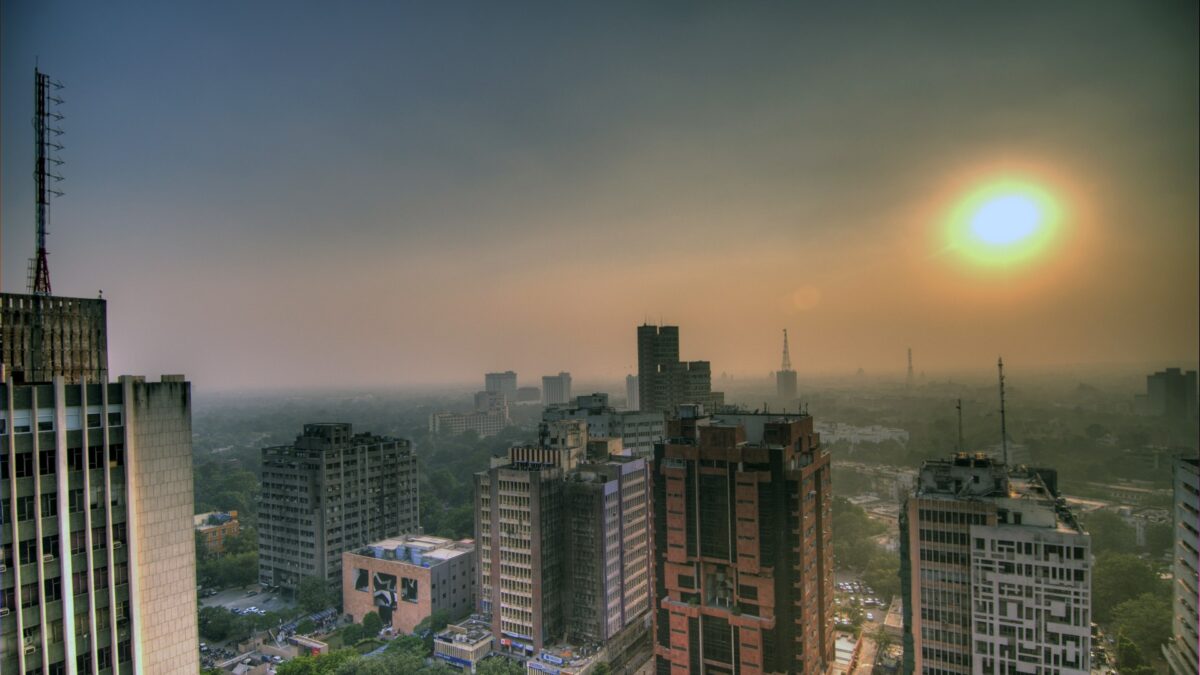
What happens when the festival of lights cannot see its own sky? I ask you this question on the evening of 7 November 2026, and I ask it not as a poet reaching for a metaphor, but as a man staring at a fact. Tomorrow is Diwali. Across India, a billion lamps are being cleaned and filled, and in Delhi — the old capital, the city of a thousand years, the city that has outlived empires — the air itself has turned against the people who breathe it. The Air Quality Index stood at 382 on Friday afternoon and 391 through the morning, and at monitoring stations in Rohini and at IIT Delhi it touched 474. Four hundred and seventy-four. On a scale where anything above 400 is officially called “severe”, where the air is no longer weather but a warning. And the festival of lights is about to begin in a city that cannot see its own sun.
Stop for a moment and hold that image in your mind, because it is not a statistic. It is a city of more than thirty million souls preparing to celebrate the victory of light over darkness while breathing darkness into their lungs. The lamps will be lit. The sky will not answer. And somewhere in that contradiction — between what Diwali promises and what Delhi breathes — lies a question that belongs not to India alone, but to every one of us who lives in a city, drives a car, burns a field, or lights a fire and calls it progress.
The City That Outlived Empires
Delhi has always been the city that refuses to die. They say seven cities have risen and fallen on this ground, one upon the bones of the other — the Tomars, the Slave Dynasty, the Khiljis, the Tughlaqs, the Mughals, and then the British, who built their New Delhi in white stone and believed it would last forever. Shah Jahan raised the Red Fort in 1648 and called it the seat of the world. In 1857, the city rose against the East India Company and paid for it in blood. In 1947, it watched trains arrive carrying the wounded of Partition and became the capital of a free India. Invaders came with swords and left with nothing. Famines came. Plagues came. Delhi endured them all, and it endured because its people believed, with every generation, that the city was larger than any disaster that visited it.
And now, I wonder, what would the builders of those seven cities say if they could see the eighth? Not a city conquered by an army, but a city conquered by its own breath. Not an enemy at the gates, but an enemy in the air — invisible, odourless, patient, and more persistent than any invader in Delhi’s long history. For this is the terrible novelty of our age: the danger no longer arrives on horseback. It arrives with the morning, in the smoke of our own making, and it does not leave when the battle is over, because there is no battle, and no one to surrender to.
History, that stern teacher who is never truly absent from the present, has a word for this. The ancients believed that a city’s air was its soul — that when the air turned foul, the city itself was sick. The Romans drained their marshes. The Persians built their gardens as lungs for their cities. And in Delhi, the Mughal emperors planted their gardens along the Yamuna so that the river’s breeze would carry the smell of flowers through their courts. Today the Yamuna is a sewer in places, and the air that once carried the scent of roses carries the ash of burning fields and the exhaust of twelve million vehicles. We did not lose Delhi to an enemy. We paved it, we crowded it, we filled it with smoke — and then we acted surprised when it could no longer breathe.
The Numbers That Shame Us
Do not let me hide behind poetry. The numbers are here, and they are merciless. On Friday, 6 November, the Commission for Air Quality Management invoked Stage III of the Graded Response Action Plan across Delhi and the National Capital Region — two full days before Diwali, a precaution that tells you everything about how bad the air already was. Stage III means the banning of non-essential construction and demolition, the barring of older BS-III petrol and BS-IV diesel vehicles from the capital, and hybrid classes for the youngest schoolchildren. It is the third of four stages on a scale that runs from “poor” to “severe plus”, and we are already standing at its door.
The city’s average index hovered between 360 and 390 for days. At Punjabi Bagh, at Jahangirpuri, at Rohini, the readings crossed 440. The India Meteorological Department has forecast “severe” air for 7 to 9 November — the whole Diwali weekend. And in the neighbouring state of Haryana, the town of Rohtak recorded an index of 1,108 — a number so far beyond the scale that it ceases to be a measurement and becomes an accusation. Even Delhi, ranked only eighteenth in the country that morning, was breathing air that would be a crisis anywhere else on earth.
And then there is the detail that should haunt every reader of this column. Two days before Diwali, several of Delhi’s own air-monitoring units went blank. The instruments that were supposed to measure the poison stopped reporting, at the very moment the poison was at its worst. I do not claim to know why. Perhaps it was a technical failure. Perhaps it was the weight of the smog itself. But there is something almost biblical about a city that has lost the ability even to count its own suffering — as if the smoke had grown so thick that even the machines that watch it have gone blind.
What is in that smoke? The fine particulate matter the scientists call PM2.5 — particles so small that thirty of them could sit side by side on the width of a human hair, small enough to slip past the lungs and into the bloodstream. On Wednesday, monitors in parts of the city recorded PM2.5 above 461 micrograms per cubic metre. The World Health Organization’s safe daily limit is 15. Thirty times the limit. Thirty times. And this is not a spike caused by one festival or one fire. India’s own environment ministry attributes 23 per cent of Delhi’s winter pollution to vehicles and 20 per cent to biomass burning, including the stubble fires of the surrounding farms. The Supreme Court was told on Friday that stubble burning accounted for about 14 per cent of that day’s pollution alone. The rest is us — our cars, our construction dust, our factories, our waste. The smoke has a thousand fathers, and every one of them is us.
The Children Are Paying First
And who pays? Always, in every crisis of this kind, the same people pay first: the children, the old, and the poor. A survey by India’s Central Pollution Control Board found respiratory problems in 32 per cent of Delhi’s schoolchildren, against 18.2 per cent among children in the villages — and reduced lung function in 43.5 per cent of the capital’s children, against 25.7 per cent in rural areas. Read that again. Nearly half the children of one of the world’s great capitals are growing up with lungs that do not work as they should. Their bodies are still being built, and the air is building them wrong.
A study published in The Lancet Planetary Health estimated that 11.5 per cent of all daily non-accidental deaths in Delhi were attributable to short-term PM2.5 exposure above the World Health Organization’s guideline. Another study in the same journal estimated that 3.8 million deaths in India between 2009 and 2019 were linked to air pollution. The Lancet Countdown reported that toxic air killed more than 1.7 million Indians in 2022 alone — a figure 38 per cent higher than the estimate for 2010. And the World Health Organization’s cancer agency classified outdoor air pollution as a proven human carcinogen more than a decade ago. In April of this year, the Union for International Cancer Control, working with the George Institute for Global Health, reported that long-term exposure to elevated PM2.5 is linked to an 11 per cent rise in overall cancer incidence and a 12 per cent rise in cancer mortality.
These are not abstractions. These are children who will carry weaker lungs into adulthood, old men and women whose hearts will fail a little earlier, workers who will cough through winters that never seem to end. Doctors in Delhi have reported a 15 per cent surge in respiratory cases in recent weeks. And yet, on the eve of Diwali, the conversation in the capital is not about the children. It is about the crackers.
The Court, the Crackers, and the Old Tools
On Friday, the Supreme Court of India sat in judgment on this crisis, and what it said should be read by every government on earth. A bench led by Chief Justice Surya Kant, with Justices Joymalya Bagchi and V. Mohana, looked at the roads of Delhi and its surrounding cities — Ghaziabad, Greater Noida, Gurugram, Faridabad — and named the truth. “Look at the roads in Delhi and the roads connecting Delhi with the NCR,” the Chief Justice said. “Take a look at any road and the kind of vehicles moving on them. That is the major problem.” The court called the banning of vehicles and construction “old, tried, failed tools” — measures that are wheeled out every winter and fail every winter, while the air grows worse.
The court also did something rarer, and braver. It spoke about the festival itself. It said that the “commodification and commercialisation” of Deepavali by affluent, status-driven people worsens pollution, while the poorest — who cannot afford the splurge — bear the worst consequences. Think about that sentence, because it is the moral heart of this whole story. The rich buy the biggest crackers, light the brightest sky, and retreat behind their air purifiers. The poor breathe the smoke and cannot afford the machine that would clean it. The festival of lights has become, for the poorest of Delhi, a festival of other people’s smoke.
The court has permitted certified green crackers on 7 and 8 November, but only in two narrow windows — six to seven in the morning, and eight to ten at night — and from 9 November the ban returns in full. It has asked for the procurement price of crop stubble to be announced well in advance, so that farmers are paid to keep their fields rather than burn them. It has asked for traffic and long-term answers, and it will sit again after the Diwali break. These are serious steps, and they deserve respect. But the court’s own words hang over them: the old tools have failed. The question is not whether the judges are sincere. The question is whether anyone — any government, any city, any of us — is willing to do what has never yet been done.
The Mirror Delhi Holds Up to the World
And here, dear reader, is where Delhi stops being India’s problem and becomes yours. Because the smoke over Delhi is not a local failure. It is the clearest mirror our century holds up to itself. Every great city on earth is breathing some version of this air. Lahore, across the border, chokes in the same season on the same smoke. My own Faisalabad knows the winter smog. Beijing fought this battle and spent a fortune to win it back. London once had its Great Smog of 1952, which killed thousands in a week and finally forced the Clean Air Act. Los Angeles, the city of the freeway, invented the word “smog” itself. The difference is only one of degree. Delhi is simply the place where the bill has come due first, and loudest.
What is that bill, really? It is the price of a way of life that treats the air as free and the sky as a dustbin. We built cities for cars and called it freedom. We burned our fields because it was cheaper than clearing them. We built towers of concrete and glass and called it development, and we measured our progress in the number of vehicles sold, never in the number of breaths taken cleanly. And every winter, the sky sends back its verdict — in the form of a grey wall that swallows the sun, and a cough that does not leave, and a child who cannot run without wheezing.
There is an old story in Delhi, told about the Sufi saints who are buried in its soil. They say that when a saint dies, his city remembers him in its air — that the breeze over Nizamuddin still carries something of the man who prayed there. I do not know whether that is true. But I know this: a city is remembered by what it leaves in the air. The Mughals left the scent of roses and the sound of water. The British left the smell of coal smoke and new-cut timber. And what are we leaving? A haze so thick that the sun looks like a pale coin, and monitoring stations go dark, and the judges of the highest court in the land call our remedies failed. That is our signature on the sky. That is the history we are writing, in smoke, for the generations who will breathe after us.
Light, and What It Costs
Tomorrow the lamps will be lit. In millions of homes, the diyas will be placed in rows, and the old story will be told again — of Rama returning to Ayodhya after fourteen years of exile, and the people lighting lamps to guide him home through the dark. It is one of the most beautiful stories any civilisation has ever told: that light is a homecoming, that darkness is only exile, and that a small flame, faithfully kept, can guide a king back to his throne.
But I ask you — I ask myself — what does it mean to celebrate the return of light by filling the sky with smoke? What does it mean to light a lamp for Rama while the child next door cannot see the lamp from his own window? The story of Diwali is the story of a city that lit lamps so that a good man could find his way home. If our lamps now make the air unbreathable, then we have kept the ritual and lost the meaning. The lamp was meant to guide. It was never meant to blind.
I do not write this to condemn a festival. Diwali is not the cause of Delhi’s poison — it is a few days of fire laid upon a year of smoke. The vehicles run all year. The fields burn all year. The dust rises all year. To blame Diwali alone would be the easiest lie of all, and the most convenient, because it lets the other 360 days off the hook. No. Diwali is the mirror, not the crime. It is the moment when the smoke becomes visible, when the whole country looks up and sees what it has been breathing all along.
So what is to be done? The court has said the old tools have failed, and the court is right. Bans that last a week, fines that are never collected, plans that are announced every November and forgotten every February — these are the rituals of a system that has confused activity with action. What Delhi needs, and what every choking city needs, is what no one has yet had the courage to pay for: clean public transport that the rich will actually use, a price paid to farmers for their stubble so that burning is never the cheapest choice, dust-free construction enforced all year rather than all November, and — hardest of all — an honest admission that a city of thirty million cannot be built around the private car and still expect to breathe.
That is a long road, and it will take years, and it will cost money, and it will ask the comfortable to change how they live. But consider the alternative, which is already here: a city where the sun is a rumour, where the children grow up with half a lung, where the judges call the remedies failed, and where the festival of lights is celebrated in darkness. That is not a future. That is tonight.
Delhi has survived seven cities. It has survived invaders, famines, plagues, and the partition of a subcontinent. The question before it now is whether it can survive us — whether the people who love it most can learn to love it enough to stop poisoning it. The lamps will be lit tomorrow. Let them be lit not as an excuse, but as a promise: that the light we celebrate is the light we will protect, in the air as well as in our homes. For a city that cannot breathe cannot celebrate. And a festival that cannot see its own sky has already begun to lose the very thing it was created to honour.
Light the lamp. Then clear the air. The order matters.
Sources & References
- The Hindu BusinessLine — “Delhi’s air pollution moves near ‘severe’ category as AQI close to 400” (6 November 2026)
- Asia Daily — “Delhi-NCR invokes GRAP Stage III before Diwali” (6 November 2026)
- Power Corridors — “Delhi Braces for Post-Diwali Toxic Air Surge as AQI Soars” (7 November 2026)
- Tabla (AFP) — “Toxic Air Pollution Surges in Indian Capital” (7 November 2026)
- Phys.org (AFP) — “New restrictions kick in as Delhi battles pollution” (1 November 2026)
- Dialogue Earth — “Air pollution causing irreversible damage to India’s urban children” (CPCB schoolchildren study)
- Health and Family / The Indian Express — “Delhi’s Toxic Air Raises Cancer Concerns” (4 November 2026; Lancet Planetary Health and UICC findings)
- EaseMyPrep — “SC calls vehicle, construction bans ‘old, tried, failed tools’ as GRAP-3 kicks in over Delhi-NCR” (7 November 2026)

About the Author — Abdul Mannan
Related Articles
The Jester, the Guru and the Verdict: What Russell Brand’s Conviction Really Means
A jury at Southwark Crown Court found Russell Brand guilty of rape and three sexual assaults. This is…

The Day the Number 7 Shirt Came Home: Cristiano Ronaldo, Portugal, and the End of Football’s Greatest Era
On 5 November 2026, Cristiano Ronaldo handed back Portugal's number 7 shirt after 23 years. This is not…

Cristiano Ronaldo Retires From Portugal: The Day the Number 7 Shirt Came Home
After 234 caps and a record 146 goals, Cristiano Ronaldo has handed back Portugal's No. 7 shirt. A…