Cristiano Ronaldo Retires From Portugal: The Day the Number 7 Shirt Came Home

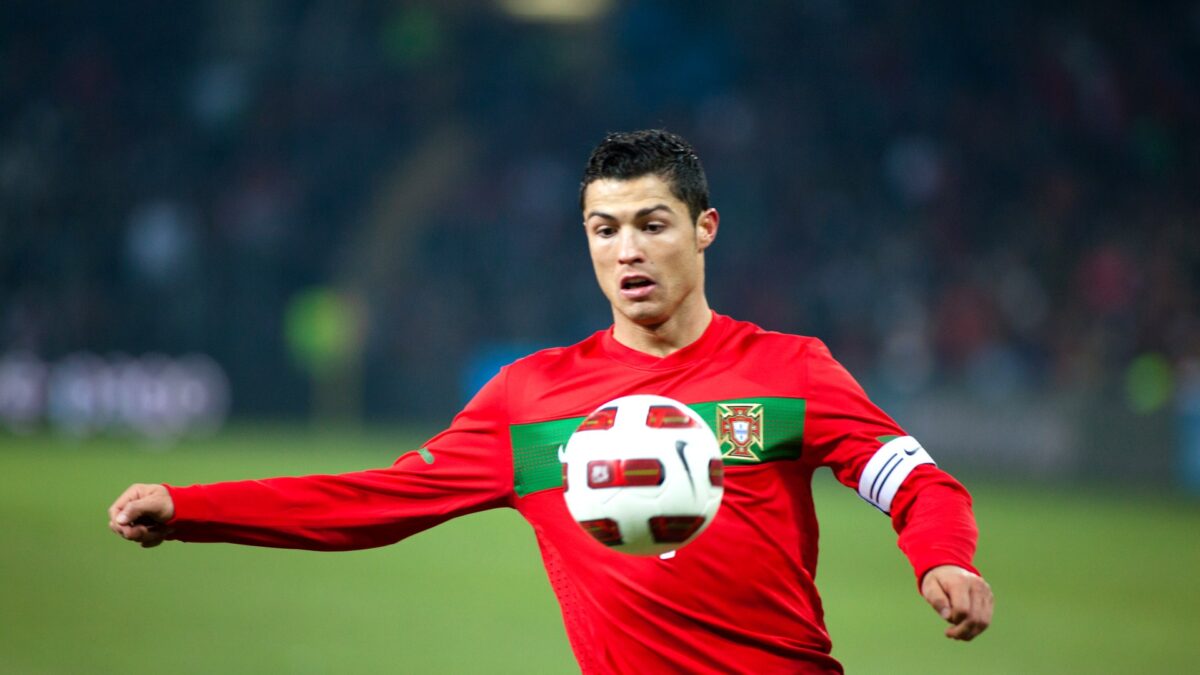
What do you do when the man who became the flag decides to fold it?
Not the flag of a club. Not the flag of a sponsor, or a league, or a brand stitched onto a sleeve for a season. The flag of a country. For twenty-three years, whenever the red shirt of Portugal walked onto a football pitch, the world did not ask who was wearing it. It already knew. And on Thursday, the 5th of November 2026, the man inside that shirt sat down in front of a camera, read a letter aloud, and handed it back.
“The day has come for me to hand back the number 7 shirt of our national team.”
That was how Cristiano Ronaldo said goodbye. No stadium. No farewell match with fireworks and a guard of honour. No final ninety minutes in Lisbon with sixty thousand voices singing his name one last time. Just a video, a letter, and a sentence that stopped the world mid-scroll. Within hours his farewell reel had drawn twenty-five million likes and more than two and a half million comments on Instagram alone, and I sat there wondering — as millions of others must have — how something so large could end so quietly.
I have spent my life watching men rise and fall, in politics and in sport, and I have learned one thing: history never announces its endings with trumpets. It announces them with a door closing softly, in a room where nobody was watching. That is what happened on Thursday. The greatest international goalscorer the men’s game has ever known walked out of the Portugal dressing room for the last time, and the door closed behind him without a sound.
The Boy From Madeira Who Carried a Country
Understand first what this shirt meant, because without that, the numbers are only arithmetic. Portugal is a small country — ten million people, a strip of Atlantic coastline, a nation whose greatest sons were sailors who sailed off the edge of the known map because they refused to believe the world ended where the charts stopped. For most of its footballing history, Portugal was a beautiful footnote: Eusébio’s tears at the 1966 World Cup, the golden generation of Luís Figo and Rui Costa that promised everything and delivered almost nothing, a country that produced genius the way other countries produce coal, and watched the great prizes go elsewhere.
Then came a boy from Funchal, Madeira, born on the 5th of February 1985, who joined Sporting’s academy in 1997 and made his senior debut for Portugal against Kazakhstan in August 2003, aged eighteen. He was not yet the statue. He was thin, raw, all step-overs and fury, a winger who seemed to be running away from something. Nobody watching that debut — not even the most romantic scout in the stadium — could have told you that this boy would one day own the two records that matter most in international football: the most appearances any man has ever made for his country, and the most goals any man has ever scored for his.
Two hundred and thirty-four appearances. One hundred and forty-six goals. Read those numbers again, slowly, because they are not records; they are a lifetime. No man in the history of the game has played more times for his nation. No man has scored more. He scored for Portugal in twenty-three consecutive calendar years, from 2004 to 2026 — a span so long that a child born in the year of his first international goal is old enough today to vote, to marry, to have a child of his own.
And here is the thing the statisticians will never capture: for most of those twenty-three years, Portugal was not a team with a star. Portugal was a star with a team. He carried the expectation of an entire nation on his back the way Atlas carried the sky — not for a tournament, not for a season, but for a generation. When Portugal finally won their first major title, the European Championship in 2016, he lifted the trophy with his knee strapped and his face streaked with tears, having been forced off the pitch injured in the final. He won it from the touchline, shouting, coaching, living every second — because that is what he had become: not just a player, but the country’s heartbeat in a red shirt.
Two Nations League titles followed, in 2019 and 2025. Six World Cups — and he remains the first and only player to score at six editions of the tournament. Five Ballons d’Or. Five Champions League titles. More than 980 official senior goals for club and country, the highest tally in men’s football. These are the facts, and the facts are staggering. But the facts are not the story. The story is what happens when the man who was the story decides the story is over.
The Wound That Made the Ending Bitter
And yet — and here I must be honest with you, because honesty is the only tribute worth giving — this ending is not the ending he deserved. That is the wound at the centre of this farewell, and no honest column can walk past it.
Ronaldo had said he planned to retire from international football after the 2026 World Cup, where Portugal lost to Spain in the round of sixteen. The Portuguese Football Federation persuaded him to continue. He played on. And then, in the space of a few autumn weeks, the whole thing curdled into a public quarrel with the national coach, Jorge Jesus — the same Jorge Jesus who had managed him at Al-Nassr.
On the 27th of September, Ronaldo was left an unused substitute in the Nations League game against Norway, despite — by his own account — having been promised thirty minutes. He walked out of the team camp on the 30th of September, a day before the match in Denmark. The Federation suspended him for thirty days and fined him €255. On the 6th of October he published a 1,966-word statement accusing the coach of “broken promises”. And on Thursday, he retired — not in a stadium, not with a trophy, but with a video on social media, while the Federation issued a statement saying it “refuses to let this farewell take place without due tribute”.
Jesus, for his part, said on Thursday that the decision was Ronaldo’s, and that he had wanted the forward to keep playing. Whether a farewell on the pitch will still happen remains unclear. His last appearance, if no tribute match is arranged, was the 24th of September: a 1-0 Nations League win over Wales in Lisbon.
Now compare that with the farewell his great rival received. Lionel Messi retired from international football with Argentina only last month, and he did it the way legends are supposed to do it: a farewell match, a stadium full of love, a public embrace from his country. Ronaldo got a video and a quarrel. Tell me, reader — is that how a nation says goodbye to the man who gave it its only European Championship?
History has seen this before, and that is why it stings. Nations are magnificent at using their heroes and clumsy at honouring them. Ask the old kings. Alexander wept because there were no more worlds to conquer — but at least Alexander died a king. The tragedy of the modern hero is smaller and crueller: he does not die a king; he is managed out of the room by a committee, fined €255, and left to announce his own ending on his own phone. The €255 fine will be a footnote. But the image will last: the greatest scorer in international history, leaving his national team the way a man leaves a house after an argument — quietly, through the back door, with his dignity intact and his heart, one suspects, in pieces.
The End of an Era That Had Two Kings
There is a larger ending here, and we must name it plainly: the Ronaldo-Messi era is over. Not the era of two players — the era of a question. For nearly two decades, the whole footballing world was divided into two camps, two faiths, two answers to the same question: Ronaldo or Messi? It was the greatest rivalry in the history of the sport, and it was greater than either man, because it gave every child on every street in the world a side to choose and a hero to defend.
Within the space of a few weeks, both men have now walked away from international football. Messi first, with his farewell match. Ronaldo now, with his letter. The 2026 World Cup — where Portugal fell to Spain in the round of sixteen, and where Ronaldo’s only knockout-stage goal was a penalty against Croatia — was the last World Cup for both of them. The argument is finished. The camps can put down their banners. And I find myself thinking of what always happens when a great argument ends: not triumph, but a strange, hollow silence, the way a stadium sounds after the last whistle of the last match of the season.
I have watched this before, in other arenas. Every age has its two kings, and every age believes the kings will last forever. They never do. What lasts is what they taught us while they reigned. And what Ronaldo taught — what the boy from Madeira taught, with a ferocity that his more naturally gifted rival never needed — is that greatness is not only a gift. It is a decision, remade every morning. Messi was born with the game in his feet. Ronaldo built himself, rep by rep, sprint by sprint, header by header, into the most complete goalscoring machine the sport has ever seen. Talent is a gift; obsession is a choice. And for twenty-three years, he chose it every single day.
What Remains: 985 Goals and the Thousand
Do not mistake this for a full retirement. Ronaldo is not hanging up his boots. He continues to play for Al-Nassr in Saudi Arabia, where he has played since January 2023, and he is expected to finish his club career at the end of this season. He stands on 985 career goals. The thousandth goal — the number that has haunted him, driven him, defined the final chapter of his career — is fifteen goals away.
There is something almost mythic about that number. One thousand. A round number, a perfect number, the kind of number that belongs in a storybook rather than a record book. He has told interviewers that this is probably his last year of football, that he wants “to leave a spectacular legacy”. His Al-Nassr contract runs to June 2027. If he finishes at the end of this season, as reports suggest, then the chase for the thousandth goal becomes the final act of the whole drama — the last mountain, climbed alone, far from the red shirt he has just returned.
And here is a question worth asking: will the thousandth goal, if it comes, feel like a triumph, or like a postscript? I suspect it will feel like both. The international career was the story; the club career was the craft. The thousand is the craftsman’s signature at the bottom of the work. But the work itself — the 146 goals for Portugal, the night in Paris in 2016, the six World Cups — that is already complete, already beyond argument, already carved where no committee and no coach can touch it.
The Shirt Will Remain. The Question Is Who Wears It Next.
“The No. 7 shirt will remain,” Ronaldo said in his farewell video. “The pride of having worn it will be mine forever.”
That sentence deserves to be read twice, because it contains the whole philosophy of the man. The shirt remains. The shirt was there before him — worn by Figo, worn by others — and it will be there after him. What he is saying, in the quietest possible way, is that he was a tenant of greatness, not its owner. The number belongs to Portugal. He only borrowed it, for twenty-three years, and wore it so well that the whole world forgot it had ever belonged to anyone else.
But now someone else must wear it. And that is the question Portugal must answer in the coming months, as the national team prepares for the Nations League fixtures against Denmark on the 14th of November and Wales on the 17th, without him for the first time since 2003. Who carries a country now? The next generation — the players who grew up watching him, wearing his shirt in the playgrounds of Lisbon and Porto and Funchal — must now become what he was. That is the cruel arithmetic of succession: the king leaves, and the kingdom does not pause. The fixtures come anyway. Denmark will not wait for Portugal to grieve.
History teaches us that nations survive the loss of their heroes. They must. Portugal survived before Ronaldo, and Portugal will survive after him. But survival is not the same as replacement. There will be other goalscorers. There may even be other great ones. There will never be another 234 caps and 146 goals, because that combination — the longevity, the durability, the hunger that did not dim across a quarter of a century — is not a talent. It is a freak of will. It happens once.
And so I ask you, the reader, the question I asked at the start, but now with the full weight of the story behind it: what do you do when the man who became the flag decides to fold it? You do what Portugal must do now. You thank him. You honour him properly — not with a statement, but with a stadium, with a night, with the tribute the Federation says he deserves and has not yet given. You let the next generation wear the shirt. And you remember.
Because here is the final truth, and it is a moral one, not a sporting one. A nation is judged not by how it treats its heroes while they are winning, but by how it treats them when they are leaving. Ronaldo gave Portugal twenty-three years, six World Cups, a European Championship, and 146 reasons to believe. Portugal gave him, in the end, a fine, a suspension, and a video camera. That imbalance is the real story of this farewell — and it is a story every institution, in sport and beyond, should read twice.
The shirt has been handed back. The pride of having worn it, he says, will be his forever. But the pride of having had him — that belongs to Portugal, forever, whether Portugal remembers to claim it or not. And long after the quarrels are forgotten, long after the coaches and the committees have moved on, a child in Funchal will kick a ball against a wall and shout a name. That is how legends survive. Not in statements. Not in statistics. In the voices of children who never saw them play, and love them anyway.
Goodbye, then, to the number 7 in red. The shirt remains. The man walks on toward his thousandth goal. And the game — the beautiful, brutal, ungrateful game — moves on without him, a little smaller than it was yesterday, and it knows it.
Sources & References
- CNN — “Cristiano Ronaldo retires from international soccer after a record-breaking career with Portugal”, 5 November 2026
- Reuters — “Ronaldo exits Portugal stage with records intact and farewell clouded by rift”, 5 November 2026
- Reuters — “Portugal forward Cristiano Ronaldo” (career fact file), 5 November 2026
- USA Today — “Is Cristiano Ronaldo retiring from soccer? What to know about Portugal retirement”, 5 November 2026
- USA Today — “Why did Cristiano Ronaldo retire from Portugal? Explaining Jorge Jesus feud”, 5 November 2026
- theScore — “Cristiano Ronaldo announces international retirement from Portugal”, 5 November 2026
Featured image: Cristiano Ronaldo playing for Portugal. Photo: Ludovic Péron / Wikimedia Commons (CC BY-SA 3.0).

About the Author — Abdul Mannan
Related Articles

The Night America Said No to the Machines: Ohio, the Luddites, and the Revolt Against the Data Centres
On Tuesday 3 November 2026, in towns most Americans could not find on a map, the people did…

The Night the Map Turned Blue: America’s Verdict and the Lesson History Keeps Teaching
On Tuesday 3 November 2026, the American people delivered a verdict that redrew the map of the most…
The Day the Chequebook Closed: Trump, Netanyahu and the End of America’s $4 Billion Gift to Israel
On Election Day, Donald Trump announced that America will stop paying Israel $4 billion a year. The money…