The King of Chips Has Fallen: Jensen Huang, Nvidia, and the Oldest Lesson in History

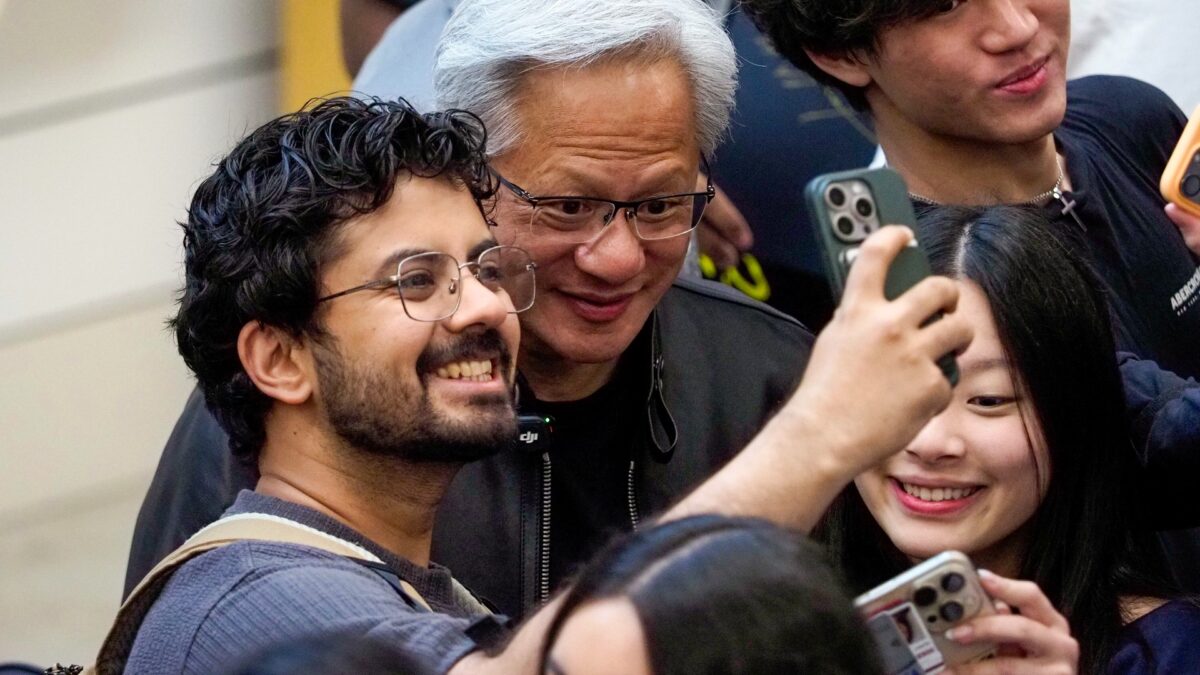
Have you ever watched an empire fall in a single week? Not over decades, not in a slow crumbling of stone, but in days — in the time it takes for a rumour to become a headline, a headline to become a resignation, and a resignation to become a crater in the stock market where five hundred billion dollars used to be? That is what happened this week. And if you think this is a story about a chip company, you have not understood it at all. This is a story about power, about the oldest weakness in the world, and about a king who built the greatest empire of our age and then opened its gates with his own hands.
On Thursday morning, the 12th of November, before the American markets even opened, Nvidia announced that Jensen Huang had resigned. Not stepped aside. Not retired with honours. Resigned — as president, as chief executive, and as a member of the board, effective immediately. The board had accepted his resignation the day before. Thirty-three years after he founded the company, the man who was Nvidia was Nvidia no longer. And by the time the closing bell rang that evening, the shares had fallen by more than fourteen per cent at their lowest, before recovering some ground to close down 4.3 per cent at $166.19. Nearly five hundred billion dollars of value — more than the entire economy of most nations on earth — had been wiped away in less than a week. The most valuable company the world had ever seen, a company worth more than five trillion dollars only last month, slipped below Apple and stood trembling just above Microsoft, its crown gone.
Stop for a moment and take in the scale of what has happened, because the numbers alone refuse to be believed. A month ago, Nvidia’s shares touched a record high of $239.24, and the company was worth more than five trillion dollars — the most valuable public company in the history of the world. Its chips are the engines of the artificial intelligence revolution. Every great AI laboratory on the planet, every chatbot you have ever spoken to, every machine that now writes, draws, diagnoses and dreams, runs on silicon designed by this one company. And at the centre of it all stood one man in a black leather jacket, a rock star in a world of engineers, filling stadiums with developers who chanted his name. The world did not merely admire Jensen Huang. It worshipped him.
And now ask yourself the question that history has asked of every fallen king: how does a man like that fall? Not by the sword of a rival. Not by the invasion of an enemy army. He falls the way kings have always fallen — from within.
The confession that came first
The end did not begin on Thursday. It began on a Sunday evening, the 8th of November, when Huang wrote a letter to his own staff — the people who had followed him for three decades — and confessed. “I was unfaithful to my wife,” he wrote. “My actions hurt her and our children.” Those are his words, and there is something almost unbearable about their plainness. No corporate language, no lawyers’ fog. A man of sixty-three, at the summit of the world, telling fifty thousand employees that he had broken his own family.
But the confession was only the first crack in the wall. Behind it stood a story far larger and far darker than a private failing. The woman at the centre of it is Alice Huang — no relation to Jensen Huang — an executive at Megaspeed, a Singapore-based company that was one of Nvidia’s major customers. United States intelligence officials believe she is working for China’s intelligence services. She is now under federal investigation, and the Justice Department is examining whether she is a spy — though the Attorney General, Todd Blanche, told reporters on Thursday that the department has not yet reached a conclusion, and that the FBI is investigating. Let me be precise here, because precision is a moral duty when a person’s name is in question: no finding has been made. What is established is that the intelligence concern exists, that the investigation is real, and that the most powerful man in the technology world was, by his own admission, intimately involved with the woman at the centre of it.
Then came the second affair, reported by The New York Times and confirmed by The Wall Street Journal — with Kimberly Powell, Nvidia’s own vice-president of healthcare, a senior executive and a direct subordinate. And then, hours after the resignation, reports of a third. The board, which had been preparing to remove him, did not wait. The resignation was announced before the markets opened, and the company’s chief financial officer, Colette Kress — a woman who has been at Nvidia since 2013 and who, by several accounts, was the one executive willing to challenge Huang’s enormous and risky bets — was named interim chief executive. Harvey Jones, a director since 1993, became the company’s first chairman. The king was gone before breakfast.
A company that became an empire
But you must understand what Nvidia had become, or you will not understand what has been lost. This was not a company. This was an empire — and I use the word deliberately, because I have spent my life studying how empires rise and how they fall, and Nvidia followed the old pattern with an exactness that should frighten us.
Consider the East India Company. It began as a trading concern, a group of merchants with a charter and a few ships. Within a century it was not a company at all. It was a state. It had its own armies, its own courts, its own currency. It decided the fate of kings. It ruled a subcontinent. The company had become the empire, and the empire had become the company — and when a private interest holds the powers of a state, the world is at its mercy.
Nvidia did the same thing, in our own century, with a different commodity. It began in 1993, in a booth at a Denny’s restaurant in San Jose, where three young engineers — Jensen Huang, Chris Malachowsky and Curtis Priem — sketched a company that would make graphics chips for video games. Thirty-three years later, the chips it makes are not for games. They are the foundation of artificial intelligence itself. Every government, every corporation, every laboratory that wants to build the future must come, cap in hand, to one company. The world built its entire artificial future on a single throat. One company. One supply chain. One man’s judgement.
And that is the danger history has warned us about a thousand times. When Tipu Sultan’s fortress at Seringapatam fell in 1799, it did not fall because the walls were weak. The walls were the strongest in India. It fell because the gate was opened from inside — because Mir Sadiq, the man trusted with the keys, betrayed the trust placed in him. The fortress was never conquered. It was surrendered. Empires, my friends, are almost never destroyed by their enemies. They are destroyed by the hands that were trusted to guard them.
Look at what the American authorities are now investigating, and tell me this is not the same story in modern dress. Megaspeed, the Singapore company, is reported to have bought more than four billion dollars’ worth of Nvidia chips. The United States authorities are investigating the alleged transfer of at least $7.5 billion worth of restricted Nvidia AI processors to Chinese companies, in breach of American export controls — the very controls designed to keep the most advanced chips out of the hands of a strategic rival. Megaspeed had been under investigation by the Commerce Department since late 2024. The New York Times first reported the business connection between Jensen Huang and Alice Huang in October 2025, and in late October it documented the intelligence concerns about her. And now we learn, from that same newspaper, that President Trump was briefed roughly a year ago on the intelligence about the alleged spying — and did not act. Trump has stood by Huang, calling him an “amazing guy” and an “honourable man”, and saying Huang told him he did not know Alice Huang was a suspected spy. Perhaps. But the questions are now being asked in the one place where they cannot be avoided: the United States Congress.
The questions that will not go away
Congress does not ask questions politely, and it does not forget them. The Senate Democratic leader, Chuck Schumer, stood on the Senate floor this week and demanded a “full accounting” of what the President knew about the alleged spying, and how Huang influenced the administration’s national security decisions — including the decision to allow Nvidia to sell advanced computer chips to China last year for a cut of the profits. The chairman of the Senate Banking Committee, Senator Tim Scott, has requested that Huang and the Commerce Secretary, Howard Lutnick — whose department never placed Megaspeed on its Entity List, the register of companies barred from receiving sensitive American technology without a licence — appear before his committee to testify on the 3rd of December. In the House, the chairmen of the Foreign Affairs Committee, the Select Committee on China, and the Intelligence Committee have requested that Huang appear for a closed-door hearing before Congress breaks for Thanksgiving. Huang has agreed to testify. Senator Elizabeth Warren has said plainly that his resignation “does not absolve him” or the company “for putting our national security at risk or for any potential violations of our law.”
Do you see what has happened? A private failing has become a question of national security. A love affair has become a congressional investigation. A chief executive’s resignation has become a test of whether the most powerful government on earth knew what was happening and chose to look away. This is no longer about one man’s marriage. It is about whether the empire of artificial intelligence — the technology that will decide the next century — was compromised at its very summit.
And inside Nvidia itself, the reckoning is only beginning. Colette Kress, the interim chief executive, is reported to have disagreed with Huang about some of the company’s great bets — including the “circular financing” of the AI boom, in which Nvidia’s money flowed into the very customers buying its chips. A proposed $250 billion plan to support an OpenAI data centre project in Ohio was ultimately pared back to $120 billion. The company has announced its own independent investigation into the potential national security implications. It will report its third-quarter results on the 17th of November, and the whole world will be watching — not merely for the numbers, though the numbers will be enormous, with the company expected to earn more than $200 billion in this calendar year alone — but for the first glimpse of what Nvidia looks like without the man who was its soul.
History does not repeat itself. It rhymes — and it warns.
I have written before that history is a mirror, and I say it again now, because this week has held the mirror up to our faces and we should have the courage to look into it. Every age believes its empires are different. Every age believes its kings are protected by something new — by technology, by money, by genius, by the sheer scale of their achievement. And every age is wrong in exactly the same way.
Rome did not fall when the barbarians arrived at the gates. Rome fell when the emperors began to believe that the empire existed for their appetites rather than their appetites existing for the empire. The Mughal throne did not collapse because its armies were weak. It collapsed because the court consumed itself in intrigue and indulgence while the foundations rotted beneath it. The East India Company did not lose India because its enemies were stronger. It lost its soul long before it lost its charter, in the quiet corruption of men who confused their private interests with the public trust. And Nvidia — the most valuable company in human history, the company that held the keys to the future — was not brought low by a competitor. AMD’s shares rose nearly six per cent on Thursday. Broadcom rose almost as much. The rivals did not defeat Nvidia. Nvidia defeated itself.
There is a lesson here that goes far beyond Silicon Valley, and it is addressed to you, the reader, wherever you are. We live in an age that worships scale. We measure a man by the size of his company, a company by the size of its valuation, a nation by the size of its arsenal. We have built a world in which a single company can hold the future of artificial intelligence in its hands, and a single man can hold that company in his. And we call this progress. But the week that has just passed has shown us the price of that worship. When everything depends on one throat, one man’s weakness becomes the world’s crisis. When the keys to the future are held by a single hand, the trembling of that hand shakes the earth.
Think of it in the simplest terms. The chips that Nvidia makes are not ornaments. They are the infrastructure of the age we are entering — the roads and the railways and the power stations of artificial intelligence. A country that cannot obtain them cannot build AI. A laboratory that cannot buy them cannot compete. And the man who decided who received them, at what price, and under what conditions, was a man whose judgement, by his own admission, had failed him in the most intimate part of his life. I do not say this to condemn a man who has already condemned himself in his own words. I say it because we must ask the question that follows, and we must ask it honestly: if the gatekeeper of the world’s most important technology can be compromised, what else in our new world is held together by a single thread?
The woman who said no
And yet, in the middle of this wreckage, there is one figure who deserves our attention, because she may be the most important person in this story after Huang himself. Colette Kress spent years as the one Nvidia executive willing to check the chief executive’s enormous, often risky ambitions. As he drove the chipmaker deeper into multibillion-dollar AI investments, she pushed back. She disagreed with him about the bets. She questioned the financing. And now, at fifty-nine, the finance chief has been handed the top job — on an interim basis, while the board searches for a permanent successor, considering internal and external candidates.
There is a quiet moral in this. Empires are not saved by the men who build them. They are saved, if they are saved at all, by the people inside them who are willing to say no — the ones who refuse to applaud, who ask the uncomfortable question, who keep the ledger honest while the king is dreaming of glory. Kress may or may not keep the job permanently. That is not the point. The point is that the person now holding the empire together is the person who was willing to disagree with the king. Remember that the next time you are in a room where everyone is nodding, and you are the only one who sees the crack in the wall. Your disagreement may be the only thing standing between the empire and the abyss.
What remains
So what remains, now that the king has fallen? The company remains. The chips remain. The data centres remain. The artificial intelligence that Nvidia’s silicon powers will not stop because its founder has resigned. On Thursday, even as Nvidia’s shares fell, the Nasdaq recovered. The markets, in their cold and brutal way, have already begun to price a world without Jensen Huang. Barron’s, the financial newspaper, argued this week that even in crisis, Nvidia’s stock is still a buy — that the company’s earnings have grown at an average annual rate of more than eighty per cent for five years, and that the business, at less than twelve times estimated earnings, is cheap by its own history. The empire, in other words, may survive its emperor. Empires often do, for a time.
But survival is not the same as innocence, and the questions will not be answered by a share price. Congress will ask what the President knew and when he knew it. The Justice Department will determine whether a spy sat at the table of the world’s most important company. The Commerce Department will answer for the chips that may have crossed the sea in defiance of the law. And Nvidia’s board will answer for how a company worth five trillion dollars allowed itself to become the property of one man’s judgement — and then watched that judgement fail.
I began this column with a question, and I will end with a warning. History does not punish empires for being large. It punishes them for believing that their size makes them safe. No wall is high enough if the gate is opened from inside. No fortune is large enough to buy back a trust that has been broken. No genius is great enough to excuse a character that has failed. The king of chips built the greatest empire of our age, and he lost it in a week — not to an enemy, not to a rival, not to fate, but to himself. Let every man who holds power — in a company, in a government, in a home — hear that sentence and tremble. For the fortress that falls from within is the only fortress that can never be rebuilt.
By Abdul Mannan
Sources & References
The Wall Street Journal — “Jensen Huang Has Been Ousted as Nvidia CEO”
The Times — “Nvidia’s shares rocked by exit of Jensen Huang”
The Times — “Jensen Huang: Nvidia boss accused of third affair”
USA Today — “Congress wants answers after Trump ally Huang caught in alleged spying scandal”
Investopedia — “Nvidia CEO Jensen Huang Resigns — and the Stock Plunges”
Barron’s — “Even in Crisis, Nvidia Stock Is Still a Buy”
Reuters — “Colette Kress, the CFO who challenged Huang’s bets, is Nvidia’s interim CEO”
New York Post — “Ex-Nvidia boss agrees to testify before Congress”
The Hindu BusinessLine — “Top Business & Market Headlines Today, November 13, 2026”

About the Author — Abdul Mannan
Related Articles
The World Was Supposed to End Today: The 1960 Science Paper That Named Friday, 13 November 2026
Sixty-six years ago, three scientists at the University of Illinois calculated that humanity would reach infinity on Friday,…

The Keys in Their Hands: Spain Stopped Work, and a Generation Asked for Its Home Back
On 11 November, four million Spaniards stopped work in the first general strike in 14 years. Their demand…

The War Is ‘Effectively Over’ — But Iran Remains Behind an Iron Gate
The guns have gone quiet over Iran, but the gates have not opened. With Task Force Iron Gate,…