They Caught a Spaceship Out of the Sky — and the World Cannot Decide Whether to Cheer or Weep

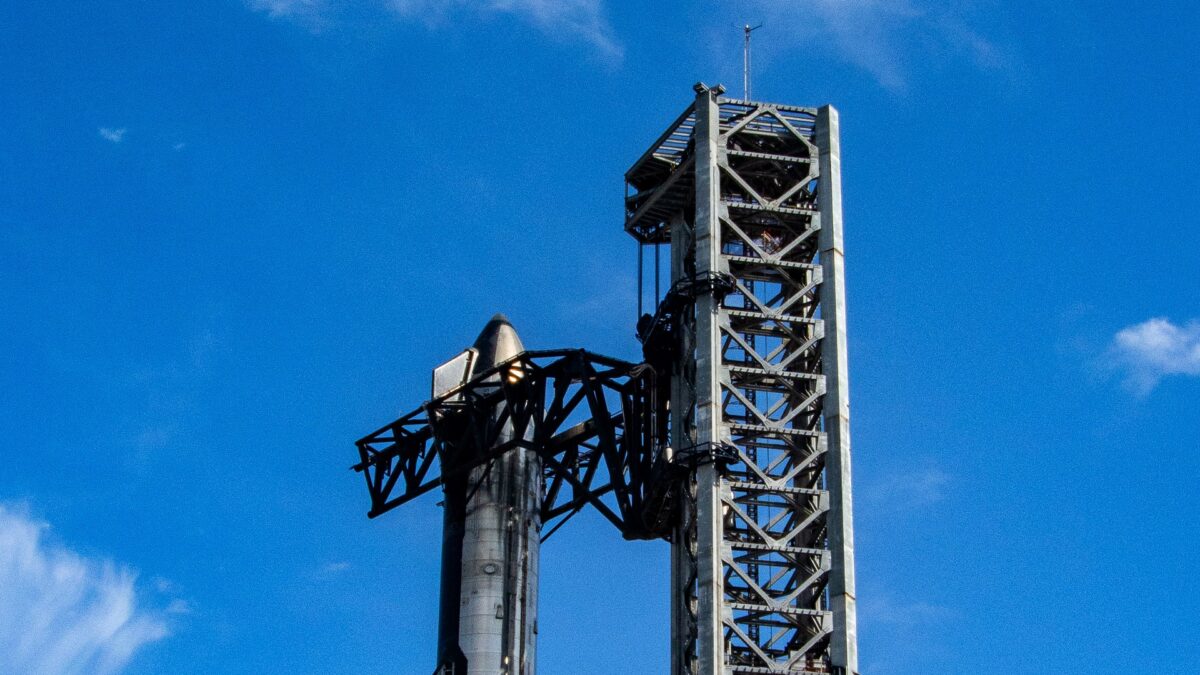
Have you ever watched a building fall out of the sky — and then seen a pair of steel hands reach up and catch it?
That is not a sentence from a science-fiction novel. It happened on Saturday afternoon, over the flat scrubland of South Texas, in front of millions of people watching live on their telephones. A spacecraft the size of a fifteen-storey building, fresh from twenty-two hours in orbit, dropped out of the heavens at many times the speed of sound, fired its engines at the last possible second, swung upright — and was snatched out of the air by two mechanical arms the size of a bridge. Four seconds. That was all it took. Four seconds in which the impossible quietly became the routine.
And yet, reader, I did not sit down to write you a news report. The news you already know. I sat down because something in those four seconds frightened me, thrilled me, and — I confess it plainly — shamed me, all at once. For in those four seconds I saw the whole story of our species compressed into a single gesture: the hand that reaches, the hand that fails, and the hand that refuses to stop reaching.
The Four Seconds That Stopped the World
Let me put the facts before you first, because a column that floats on feeling without fact is only noise. The vehicle was Starship, the largest and most powerful rocket ever built, and the flight was its fifteenth test. It lifted off from SpaceX’s Starbase site in South Texas at 5:47 p.m. Eastern time on Friday, 13 November 2026, riding atop its Super Heavy booster, whose thirty-three Raptor engines lit the evening sky like a second sunset. Within twenty-six minutes the upper stage — officially named Ship 42 — was in orbit. Within the first hour and seventeen minutes it had released all twenty-six of its next-generation Starlink V3 satellites. Then it did something no Starship had ever done before: it stayed. It coasted for roughly twenty-two hours, circling the Earth some fourteen times at an altitude near 275 kilometres, while engineers on the ground studied its telemetry and its heat shield, waiting to see whether the machine they had built could survive a full day in the dark and still come home.
On Saturday afternoon, just after 3:30 p.m. Eastern, Ship 42 fired a single Raptor engine for a deorbit burn of about ten seconds — a small push, precisely aimed, that bent its path back toward the atmosphere. What followed was the violence of re-entry: the ship plunging through the air at orbital speed, its belly of some 18,000 ceramic tiles glowing against the friction of the sky itself. Then, at 4:20 p.m., the final landing burn. Three Raptor engines lit. The great steel cylinder performed its famous “belly flop”, turning end over end, swivelling its fiery plumes downward, slowing, sliding — and then, beside the launch tower, it hovered. The tower’s two mechanical arms, nicknamed “chopsticks”, swung closed around it. “Mechazilla catches Starship!” SpaceX announced, and the webcast erupted. SpaceX commentator Dan Huot could barely contain himself. No one, in the whole history of spaceflight, had ever recovered an orbital-class upper stage at its launch site before. No one had ever caught a spacecraft that had been to orbit and brought it home in one piece.
Understand what that sentence means. For sixty-nine years — since Sputnik first beeped its lonely signal across the night sky in 1957 — every spacecraft that went to orbit either burned up, splashed into an ocean, or landed on legs in a desert, battered and spent. Rockets were ammunition: you fired them once, and they were gone. On Saturday, for the first time, the ammunition came home and landed in the hand that had thrown it.
The Half That Failed — and Why It Matters More
But I would be lying to you — and a columnist who lies to his reader has already lost his soul — if I told you the flight was a perfect triumph. It was not. The mission had been billed as the first attempt at a double catch: both the booster and the ship returning to the same tower on the same day. The booster did not come home.
Super Heavy Booster 22 separated cleanly and began its return about six and a half minutes after liftoff. Then something went wrong. SpaceX said preliminary indications pointed to a low-fuel-mass warning that ended the boostback burn early, leaving the booster wrongly positioned for a tower catch; its guidance system made an automated diversion, and the booster was lost over the Gulf of Mexico, exploding just above the water. Reuters, citing its own reporting, described an onboard navigation issue that triggered the abort. Elon Musk himself, in a post on X on Sunday, blamed slight underperformance of the engines. The precise root cause remains under investigation.
Now, pause here with me, because this is where the story stops being a press release and starts being a parable. The part of the rocket SpaceX had already caught three times — the booster, the familiar half, the proven half — blew up. The part nobody had ever brought home — the ship, the impossible half — landed. Failure and triumph arrived on the same flight, in the same hour, wearing each other’s clothes.
That is how progress actually works, reader. Not as a straight staircase upward, but as a stumble in the dark where one foot finds solid ground precisely while the other slips. Flight 14, only weeks earlier in September, had been the first Starship to reach orbit and deploy operational Starlink satellites — and even that mission ended early, with an engine issue forcing the ship down into the Pacific. The men and women at Starbase did not hold a press conference to explain why the future had been postponed. They built the next rocket and flew it again. And again. Fifteen times. That is the whole secret, and it is not a secret at all: they kept going.
History Is Watching — It Always Is
History, as I have told you before in these columns, is not a museum. It is a mirror, and it is always watching. So hold this Saturday up to the mirror and look.
On 17 December 1903, two bicycle mechanics from Ohio — Wilbur and Orville Wright — flew a machine of wood and cloth for twelve seconds across 120 feet of cold North Carolina sand. The newspapers mostly ignored them. The learned men of the age explained, with great confidence, why heavier-than-air flight was impossible, even as it was happening in front of their eyes. Within sixty-six years of that twelve-second hop, human beings were walking on the Moon. Twelve seconds became a quarter of a million miles. That is what twelve seconds can contain, when the people holding the machine refuse to put it down.
On 20 July 1969, Neil Armstrong stepped onto the lunar dust and spoke a sentence that schoolchildren still memorise. But do you remember what came before that sentence? A decade of explosions. Rockets blowing up on the pad, astronauts dying in a fire on the ground, a nation told by the sceptics that the Moon was a fantasy for dreamers and a waste of money for a country with poor people at home. The Apollo programme was built on wreckage — and on the stubborn refusal to call the wreckage a verdict.
And on 21 December 2015, a Falcon 9 booster — a machine every expert had said could never be landed — came down out of the Florida sky and stood upright on a concrete pad, as calmly as a man stepping off a bus. The crowd that night wept. Nine years later, in October 2024, SpaceX caught a Super Heavy booster out of the air with the same tower arms that caught the ship on Saturday. Each time, the same chorus: it cannot be done. Each time, the same answer: watch.
So when I tell you that Saturday’s catch matters, I do not mean it as a fan of a company or of a man. I mean it as a student of history. Every age has its twelve seconds. Every age has its moment when the impossible is done quietly, in four seconds, in front of cameras, while half the world is looking elsewhere. The tower in Texas is the Kitty Hawk of our century — except this time the machine did not merely fly. It flew to orbit, worked for a day, and came home to the hand that threw it.
Why a Caught Rocket Changes the Price of Everything
You may ask — and it is a fair question, an honest question — what difference does it make to you, sitting in Lahore or London or Lagos, whether a steel tube is caught by a steel arm in Texas? Let me answer it plainly, because the answer is money, and money is the one language every sceptic understands.
A rocket that can only fly once is a cathedral you build and then burn. A rocket that can fly a hundred times is an aeroplane. That is the whole of it. The aeroplane did not change the world because it could fly; it changed the world because it could fly again tomorrow, and the day after, with the same wings. SpaceX’s stated prize is exactly that: rapid reusability — a Starship that lands, is inspected, refuelled, and flies again within days, not months. Musk has spoken of roughly one Starship launch per week in the first half of 2027. Even if that target slips, as such targets always do, the direction of travel is unmistakable.
Consider what rides on that direction. Starship can carry up to sixty Starlink V3 satellites in a single flight — roughly twenty times the capacity of a Falcon 9 load. The constellation those satellites feed is already the largest in history, and the company has spoken openly of packing huge numbers of orbital data centres into the sky for artificial intelligence. The United States Federal Aviation Administration currently permits twenty-five Starship launches a year from Starbase; the queue for more will not be a polite one.
And then there is the Moon. NASA’s Artemis programme, which seeks to return American astronauts to the lunar surface before the end of 2028, depends on a modified Starship as its Human Landing System — the vehicle that will carry crews between lunar orbit and the Moon itself. Artemis III, targeted for next summer, is set to see Starship rendezvous and dock in low-Earth orbit with a NASA Orion spacecraft carrying four astronauts; a test version of Blue Origin’s Blue Moon Mark 2 lander will also link up with Orion. Before any of that can happen, Starship must prove things far harder than a catch — above all, in-space refuelling, because a round trip to the Moon needs more fuel than a single Starship can carry into orbit. Saturday did not solve that problem. But it removed the largest doubt standing in front of it: whether the ship could survive orbit and come home at all.
So yes, reader — it matters to you. It matters because the price of reaching orbit is the price of everything that orbit can give us: internet for villages that have never had it, eyes on storms before they become disasters, science that cannot be done inside the atmosphere. When the cost of going to space falls by ten times, the number of people who can afford to go rises by ten times. And when the number of people who can go rises, the things they do up there stop being the fantasies of billionaires and start being the tools of ordinary nations — including yours.
The Question from the Ground
And yet — and yet. I promised you honesty, and honesty demands that I give the other voice its full hearing, because it rose the moment the catch was announced, and it rose from decent people.
Within hours of the landing, the comment sections under the videos were full of it. “There are hungry people on Earth.” “There are wars, and the dying, and diseases without cures.” “Why are we spending billions to catch a rocket when children have no clean water?” I read those comments. I did not dismiss them. No honest columnist can. The woman who writes that her hospital has no medicine is not the enemy of progress; she is its conscience. The man who asks why the sky gets billions while the street gets nothing is asking the oldest question in the life of nations, and it deserves an answer, not a sneer.
So let me answer it as honestly as I know how. The question assumes that the money is one pile, and that we must choose — the rocket or the bread. But nations are not households, and history does not work that way. The Apollo programme, for all its billions, gave us the microchip, the water filter, the memory foam in your mattress, the satellite that warns your village of a flood. The argument was never “space instead of Earth”. The argument was always whether a civilisation that stops reaching upward can still feed itself downward — and every civilisation that stopped reaching, from the empires of the past to the factories of yesterday, found the same answer. It cannot.
But there is a second half to that answer, and I will not hide it from you: the critics are also right that the triumph belongs to no one unless it is shared. A caught rocket that only makes a few men richer is a circus trick. A caught rocket that brings the cost of space within reach of a hundred nations is a inheritance. The difference between those two futures will not be decided by engineers in Texas. It will be decided by the rest of us — by whether we demand that the door they have opened stays open, that the knowledge is not hoarded, that the sky, like the sea, belongs to no single flag.
History’s mirror shows us both faces. The East India Company also arrived with better ships. Better ships are not a virtue; they are a power. And power, in the hands of the greedy, becomes the very treachery my columns have warned you about a hundred times. The same hands that catch a falling spaceship can catch a falling people — or they can let them fall. The machine does not choose. We do.
What Saturday Asks of Us
So what, finally, do I ask you to take from a Saturday in Texas? Not awe — awe is cheap, and it evaporates by Monday. I ask you to take the discipline inside the awe.
The discipline is this: they failed in public, fifteen times, and flew again. The booster exploded on Friday, and on Saturday they caught the ship anyway — because the ship’s flight had already begun before the booster failed, and the plan did not depend on perfection; it depended on persistence. How many of our own projects — your business, your studies, your country’s plans — died after the first explosion? How many of us declared the verdict after Flight 1, or Flight 5, or Flight 14, and went home? The men of Starbase did not. They examined the wreckage, wrote down what it taught them, and built Flight 15.
That is the moral of the story, and it is not about rockets at all. A people that can bear to fail in public and still return to the pad is a people that cannot be kept down — not by poverty, not by war, not by the sneers of those who have never built anything. And a people that cannot bear failure will never catch anything, because catching requires standing under the falling thing with your arms open, knowing it might crush you.
On Saturday, two steel arms opened over Texas, and a spacecraft the size of a building came home. The sky, for four seconds, looked like it had hands. The question now is not whether we can catch what falls from the heavens. The question is whether we have the courage to stand beneath our own falling dreams — our nations, our children, our futures — and open our arms the same way. The tower has shown us that it can be done. The rest is up to us.
Sources & References
- Scientific American — “Can SpaceX Catch Its Starship?” (updated 14 November 2026)
- Blumefield — “The Starship Catch That Changes Everything” (15 November 2026)
- Digirolla — “SpaceX Catches Starship With the Tower Arms for the First Time After a 22-Hour Orbital Flight” (15 November 2026)
- The Raisina Post — “SpaceX Starship Catch: How Mechazilla Works” (15 November 2026)
- ToTechie — “Starship Flight 15: Ship Caught, Booster Lost. What’s Next?” (15 November 2026)
- AInvest — “The Rocket SpaceX Had Already Landed Blew Up. The One It Never Had Landed.” (14 November 2026)

About the Author — Abdul Mannan
Related Articles

Bahrain at 4 A.M.: The Small Island Caught Between Two Empires — and the Strait the World Cannot Afford to Lose
At 4 a.m. on Sunday, sirens sounded over Manama as Iran claimed a second drone attack on a…

The Car You Buy But Never Own: Tesla’s $29,990 Cybercab and the $299-a-Month Future
Tesla's $29,990 Cybercab has no steering wheel, no pedals — and no motion without a $299-a-month subscription. A…

Three Men, Twelve Thousand Bombs: The Shenzhen Summit and the Fate of the World
On Thursday, the leaders of the three greatest nuclear powers sit down together for the first time in…