Bahrain at 4 A.M.: The Small Island Caught Between Two Empires — and the Strait the World Cannot Afford to Lose

The Sirens at Four in the Morning
Imagine waking at four in the morning to the sound of air-raid sirens over your own roof — not because your country has declared war on anyone, but because two powers far larger than yours have chosen your small island as the place to settle their account. That is what happened in Bahrain on Sunday, 15 November 2026. Explosions rolled across Manama at about 4 a.m. local time, and then again at half past six. The Interior Ministry sent out two public alerts — the first such warnings since September — telling citizens and residents to remain calm and to proceed to the nearest safe location. No one in Bahrain had voted for this war. No one in Bahrain had started it. Yet the sirens sang over Bahrain.
I ask you, the reader, to sit with that image for a moment before the politics begin, because the politics will try to steal your attention from the human fact at the centre of it. A kingdom of some 1.5 million people, an island barely 780 square kilometres in size, woke to blasts it did not cause and could not stop. Iran’s Islamic Revolutionary Guard Corps said it had launched six drones at a United States air-defence radar at the Al-Riffa helicopter base. Bahrain’s Defence Force said its air defences had intercepted and destroyed several Iranian aerial attacks before they could reach their targets. The United States military had not commented on Sunday’s claim by the time the day’s reporting closed. Whether the radar was struck or not, no independent assessment had established it; what was established, beyond dispute, is that the sky over a peaceful Gulf capital filled with explosions before dawn, twice in three days.
Twice in three days. That is the detail that should stop you. On Friday, 13 November, the Guard said it had targeted and destroyed an American early-warning radar in Bahrain, in retaliation for what it described as an American attack on a communications tower at Sirik, on the Iranian coast near the Strait of Hormuz. United States Central Command denied the claim, saying American forces had shot down two Iranian one-way attack drones launched toward Bahrain, with no injuries and no damage. Friday’s claim was the first Iranian attempt to strike a military facility in a Gulf state in more than two months. Sunday’s was the second in seventy-two hours. A pattern, not an accident. A message, not a mistake.
The Narrow Water That Rules the World
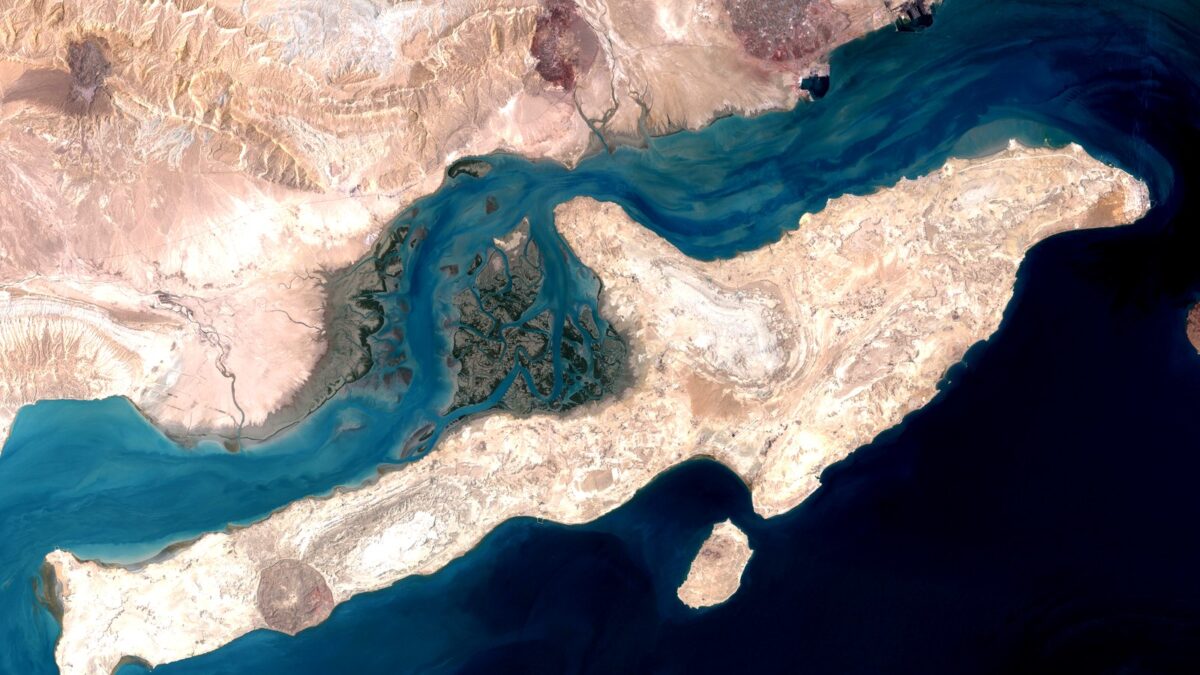
To understand why Bahrain, of all places, has become the anvil on which this war is hammered, you must look at the map — and history, which has never once let this map alone. The Strait of Hormuz is a corridor thirty-nine kilometres wide at its narrowest, its shipping lanes just two miles across, flanked by Iran on one side and Oman on the other. Through it flows roughly twenty million barrels of oil a day — about a fifth of all the petroleum liquids the world consumes, and a similar share of liquefied natural gas. The United States Energy Information Administration put the figure at about twenty million barrels a day in 2024, rising to roughly 20.9 million in the first half of 2025. There is no other route. Every barrel leaving the Persian Gulf must pass through that corridor. Close it, and the world’s economy gasps.
And so the Guard’s words on Sunday carried a weight beyond the drones themselves: “The Strait of Hormuz is closed, and any aggression by the American enemy will be met with an even harsher and more forceful response.” The claim that the strait is closed sits uneasily beside the fact that oil has continued to flow — the International Energy Agency said on Friday that the market was “showing tentative signs of rebalancing”, with global supplies surpassing demand for the first time since the war began. But the threat is not measured in barrels stopped today; it is measured in the fear of barrels stopped tomorrow. In October, attacks on shipping in the strait reached a record high — thirty-seven vessel attacks in a single month, according to Lloyd’s List, the highest monthly total of the conflict, with at least fourteen more confirmed in November. The waterway has become a battlefield in slow motion, and every ship’s captain sailing through it knows the arithmetic of risk.
History Has Sailed This Strait Before
Here is where history holds up its mirror, and I ask you to look into it, because this column has always believed that the present is only the past wearing new clothes. The Strait of Hormuz has been fought over for centuries — by the Portuguese who seized it in the sixteenth century, by the British who policed it as an imperial lake, and by the great powers of the twentieth century who understood that whoever holds the strait holds the tap of the world’s energy. But the closest mirror to our present moment hangs in the 1980s, in the war the world called the Tanker War.
In 1984, four years into the Iran–Iraq War, Iraq began striking Iranian oil tankers at Kharg Island, seeking to strangle Iran’s economy at its single artery. Iran answered by laying naval mines in the Persian Gulf and harassing tankers tied to Iraq, Kuwait and Saudi Arabia. By 1986 the Gulf had become the most dangerous water on Earth. On 17 May 1987, an Iraqi pilot fired two Exocet missiles into the American frigate USS Stark, killing thirty-seven American sailors — and suddenly the Tanker War was no longer someone else’s problem. The United States launched Operation Earnest Will, reflagging Kuwaiti tankers under the American flag and escorting them through the strait with warships. Between 1984 and 1988, more than five hundred commercial ships came under attack; more than four hundred civilian sailors died. The strait was never fully closed. But it was never safe either.
Read that history again and tell me you do not hear our own time in it. The same narrow water. The same tactic — strangle the shipping, and the enemy’s economy, and the world’s nerves, will follow. The same great power stepping in with warships to escort the tankers. The same small Gulf states watching the missiles fly over their heads, praying that the war of others does not become their ruin. The technology has changed — drones now, where once there were mines and Exocets — but the geography has not moved a single mile, and geography, as every sailor knows, is destiny wearing a uniform.
The Island That Hosts Empires
And what of Bahrain itself, the island under the sirens? Bahrain’s tragedy is an old one, and it is the tragedy of small states everywhere: it is too valuable to be left alone, and too small to defend itself. It hosts the headquarters of the United States Navy’s Fifth Fleet at Naval Support Activity Bahrain in Manama — the command that watches over the Gulf, the Red Sea and the Arabian Sea. That base was hit in the opening hours of this war, when the United States and Israel launched surprise attacks on Iran on 28 February 2026. A Pentagon inspector general’s report in September found that Iranian attacks had damaged or destroyed buildings at American installations in eight countries, including Bahrain. The Fifth Fleet’s presence is Bahrain’s shield and Bahrain’s target at once — that is the bargain small nations make when they host great powers, and it is a bargain that is paid in other people’s wars.
Bahrain’s own government said it plainly on Sunday. Its Foreign Ministry called the strikes “a resumption of Iran’s aggression against Bahrain and other countries in the region”, and its military accused Iran of attacking Bahraini territory to settle its score with Washington. That phrase — to settle a score — deserves to be held up to the light. Bahrain is not a party to the quarrel between Tehran and Washington. It is the ground on which the quarrel is being fought. The great powers have always preferred to bleed on someone else’s soil. In the 1980s, the Tanker War was fought in Gulf waters while the capitals that ordered it sat safe at home. In 2026, the drones fly over Manama while the men who command them sit in Tehran and Washington. The island pays; the empires posture. This is the oldest injustice in the book of nations, and it has not changed its chapter in five hundred years.
Neither War Nor Peace
The most chilling words of this whole grim week were not spoken on a battlefield. They were spoken in Tehran, by Iran’s President Masoud Pezeshkian, who said that the Supreme Leader, Mojtaba Khamenei, had instructed his government “to end the state of neither war nor peace”, telling him to “finish” the war with the United States. “We can negotiate with dignity,” Pezeshkian said, “and we can finish it with dignity.” Read that sentence twice. A nation under punishing sanctions and a naval blockade, its shipping lanes choked and its economy squeezed, has been told by its highest authority that the twilight must end — one way or the other. When a leader speaks of finishing a war with dignity, he is telling his people, and his enemies, that he is prepared for either the table or the grave.
And on the other side? A day before Friday’s drones, President Donald Trump declared on Truth Social that the United States no longer needs a deal with Tehran — “We don’t need a deal with Iran. Those days have long since passed! We’ve got their money, Hundreds of Billions of Dollars, and we’ve got their Strait!” — and ordered Vice President JD Vance, who had been leading the negotiations, to turn his full attention to rooting out corruption and crime in Democratic states and cities. The negotiator was dismissed; the negotiation was declared unnecessary. Meanwhile, the director of the Mossad, Roman Gofman, was in Washington on Friday to meet the CIA director, John Ratcliffe, as Prime Minister Benjamin Netanyahu pressed the Trump administration to return to war with Iran — and, according to two Israeli sources cited by CNN, even considered a unilateral Israeli strike, though he would still need the American president’s approval. His main rival, Gadi Eisenkot, demanded and received a security briefing, so alarmed was he at the prospect of Israel acting alone after Netanyahu lost his governing majority.
Put these pieces together and the picture is darker than any single headline. The diplomats are being sent home. The spies are meeting in Washington. The hardliners are pressing for war. And the drones are already flying over Bahrain — twice in three days, after two months of relative restraint. Iran’s correspondent in Tehran told Al Jazeera that Tehran had held back through weeks of intermittent American strikes before firing at Bahrain twice in three days, adding: “It seems this is now the new rule of engagement.” A new rule of engagement. Those are the words nations use when the old rules have died.
What This Means for You
You may be reading this far from Manama — in Lahore or London, in Karachi or California — and wondering what the sirens over Bahrain have to do with your life. Everything, I tell you. Everything. The oil that passes through Hormuz heats your home, fuels your car, and sets the price of the bread on your table; when thirty-seven ships are attacked in a single month in the world’s most important chokepoint, the cost reaches every kitchen on Earth. The war that began on 28 February is now in its ninth month, and wars that enter their ninth month have a habit of finding new ways to surprise us — new targets, new weapons, new victims who never chose the fight.
But there is a deeper lesson here, and it is the one this column exists to speak. Look at Bahrain and see the fate of every small nation caught between empires. Look at the strait and see how a strip of water thirty-nine kilometres wide can hold the whole world hostage. Look at the leaders — one declaring he needs no deal, the other instructed to finish the war — and see how easily the language of pride replaces the language of peace. History has shown us this film before: in 1984, in 1987, in every age when empires decided that the sea belonged to them. Each time, the ending was written in the same ink — in the blood of sailors who were only doing their jobs, and in the fear of islanders who only wanted to sleep through the night.
So I end not with a prediction, because predictions are cheap and this war has already made fools of every predictor. I end with a question, the question Bahrain’s sirens asked at four in the morning: how long will the world watch small nations pay for great powers’ pride? The drones over Manama were intercepted. The radar may or may not have been struck. The strait may or may not be closed. But the warning has been delivered, in the only language the powerful seem to hear — the language of explosions over a sleeping city. If the leaders who command these weapons cannot find the dignity to negotiate, then the rest of us must find the courage to demand it of them. The strait will still be there tomorrow, narrow as ever. The question is whether the men who rule its shores will be wise enough to let the ships pass in peace — or whether history will once again have to teach them, at the price of other people’s lives, what the Tanker War taught their grandfathers: that no empire ever won the Strait of Hormuz, and no nation ever profited from closing it.
Sources & References
- CNN — “Iran targets US military site in Gulf for first time in two months as hopes for a deal fade”, 13 November 2026.
- Al Jazeera — “Iran says it targets US radar in Bahrain. What do we know?”, 15 November 2026.
- Reuters, as cited by Al Jazeera and The Guardian — reporting on the 13 and 15 November Bahrain attacks and the United States Central Command statements.
- France 24 / AFP — “Blasts and sirens in Bahrain as Iran claims drone attack on US radar base”, 15 November 2026.
- U.S. Energy Information Administration, via GulfWar.org — oil flows through the Strait of Hormuz, about 20 million barrels per day in 2024, roughly 20 percent of global petroleum liquids consumption.
- Military.com — “The US Protected Ships from Iran in the Strait of Hormuz in the ’80s. Could It Again?”, 26 April 2026.
- Lloyd’s List, as reported by CNN — 37 vessel attacks in the Strait of Hormuz in October 2026, a record monthly high.
- International Energy Agency, as reported by CNN — oil market “showing tentative signs of rebalancing”, 13 November 2026.

About the Author — Abdul Mannan
Related Articles

The Car You Buy But Never Own: Tesla’s $29,990 Cybercab and the $299-a-Month Future
Tesla's $29,990 Cybercab has no steering wheel, no pedals — and no motion without a $299-a-month subscription. A…

Three Men, Twelve Thousand Bombs: The Shenzhen Summit and the Fate of the World
On Thursday, the leaders of the three greatest nuclear powers sit down together for the first time in…
When America Could Not Fly: The Day the Sky Went Silent
At 3:36 p.m. on Friday, 13 November 2026, the busiest airspace on Earth fell silent. This is the…