Sheikh Hasina Is Coming Home on Victory Day — to Face a Death Sentence

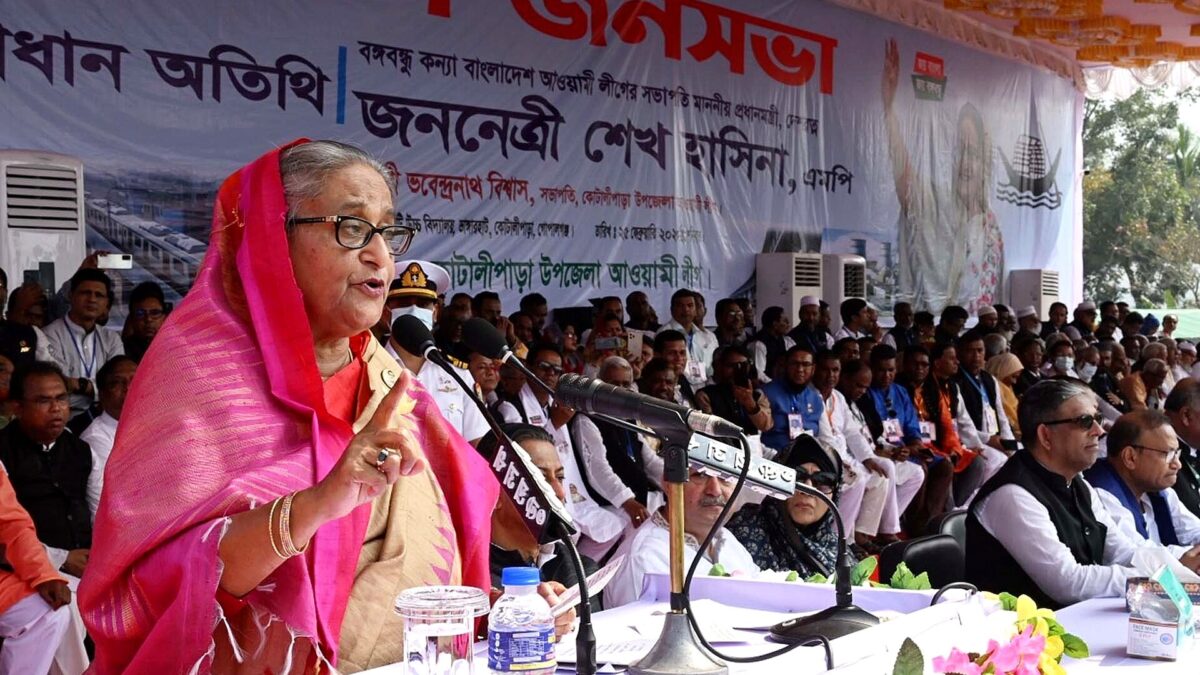
She has named the day. Not in a whisper, not through intermediaries, but in a statement carried to the world by her spokesman on a Tuesday morning in November: Sheikh Hasina will come home on 16 December. She will board a plane of the national airline, Biman Bangladesh, in Delhi, and she will fly to Dhaka. And she knows exactly what is waiting for her on the tarmac. A death sentence, passed in her absence a year ago. A government that has already answered her: you may return, but only in handcuffs.
Stop for a moment and let the weight of that sentence settle. A woman of seventy-nine, the daughter of the man who founded a nation, the longest-serving prime minister in that nation’s history, announces that she will walk back into the country that sentenced her to hang — on the very day that country celebrates its birth. If this were a novel, an editor would call it too neat, too symbolic, too heavy with meaning to be believed. But history, as I have written in these columns before, does not ask our permission to be dramatic. It simply is.
And so the question before us is not only whether a plane will land in Dhaka on 16 December. The question is what Bangladesh has become, what justice means when it is written by the victors, and whether a nation can ever escape the wheel of exile and return that has turned, cruelly and without rest, across South Asia for half a century.
A Date Written in Blood and History
16 December is not an ordinary date in Bangladesh. It is Bijoy Dibos, Victory Day. On that day in 1971, after nine months of war, Pakistani forces surrendered in Dhaka, and Bangladesh was born. It is the most sacred date on the Bangladeshi calendar, the day schoolchildren sing about and old soldiers weep over. Sheikh Hasina chose it deliberately. Her spokesman, Syed Mozammel Ali, said it plainly: “It is deeply symbolic that she has chosen 16 December, our Victory Day, for her planned return to Bangladesh.”
Symbolic, yes. But symbolic of what? To her supporters, the choice says: I am not a fugitive sneaking home in the dark. I am the daughter of the founder, returning on the day my father’s dream was fulfilled. To her enemies, the choice says something else entirely: a condemned woman trying to wrap herself in the flag on the nation’s holiest day, daring the state to arrest her in front of the cameras.
Both readings are true. That is the tragedy of Bangladesh. Every symbol in that country now belongs to two warring histories, and neither side will surrender it.
Hasina’s demand is precise, and it is worth quoting in full, because it tells you everything about how she sees herself. “Since Sheikh Hasina was flown to India on a Bangladesh aircraft on August 5th, 2024, she now calls upon the government to arrange for her air transport from Delhi back to Dhaka,” her spokesman said. The logic is that of a woman who still believes she is the lawful prime minister, removed by force rather than by law: the state flew her out, so the state must fly her back. She is not asking for mercy. She is demanding what she regards as her right.
The government of Prime Minister Tarique Rahman has answered with equal precision. Its press secretary, Abu Abdullah M Saleh, told the Associated Press that the government would stick to its position: she can return only through extradition. And Humaiun Kobir, the minister of state for foreign affairs, put it in words no one can misunderstand. “Hasina is a convicted criminal; a fugitive terrorist,” he told Reuters. “She can only return home by extradition treaty; in handcuffs, and under strict surveillance.” On the request for a Biman flight, he was blunter still: “Bangladesh will not entertain any such delusional request.” An adviser to the prime minister went further, telling reporters that the government plans to carry out the death sentence if she returns.
So there it stands. One woman, one date, one plane that does not exist yet — and a state that promises handcuffs and a gallows. What happens between now and 16 December will be watched by 170 million Bangladeshis, by Delhi, by Islamabad, and by every capital that has ever wondered how a nation buries its past without burying itself.
The Daughter of the Founder
To understand why this moment matters, you must go back — as I always insist we must — to the beginning. Sheikh Hasina was born on 28 September 1947, a few weeks after the partition of India, into a house that was already history. Her father, Sheikh Mujibur Rahman, would become Bangabandhu, the Friend of Bengal, the man who led a people out of subjugation and into nationhood. She grew up in the shadow of a giant, and giants cast long shadows.
In 1971, when the Pakistani army launched its crackdown and the war of liberation began, the Mujib family was at the centre of the storm. Mujib was arrested and taken to a prison in West Pakistan. His family remained in Dhaka through the war. And when victory came on 16 December 1971, it was Mujib who returned — released from prison, flown to London, then to Delhi, and finally home to Dhaka on 10 January 1972, to a crowd of hundreds of thousands who had waited for him as one waits for a prophet.
Hasina was twenty-four years old then. She had seen her father become the father of a nation. What she could not have known was the price that family would pay. On 15 August 1975, a group of army officers stormed the family home in Dhaka and murdered Mujibur Rahman, his wife, and almost his entire family. Hasina survived only because she was abroad with her younger sister, Rehana. She was twenty-seven years old, and in a single night she became an orphan of history — the daughter of a murdered founder, carrying a name that was both a blessing and a curse.
I ask you, reader, to sit with that fact for a moment, because everything that follows in her life flows from it. She returned to Bangladesh in 1981 to lead the Awami League, her father’s party. She spent years in opposition, years under military rulers, years in prison and under house arrest. She became prime minister in 1996, lost power, and returned in 2009 — and then she did not leave. For fifteen years, from 2009 to 2024, she ruled Bangladesh, winning elections her opponents called rigged, building roads and bridges and a growing economy, and, her critics say, strangling dissent, jailing opponents, and hollowing out the institutions that might have checked her.
History will argue for a hundred years about which of those two Hasinas was the real one: the builder or the autocrat. But history has already rendered one verdict, and it was written in the streets of Dhaka in the summer of 2024.
The Summer That Ended Fifteen Years
It began, as these things so often do, with students. In July 2024, students protesting against a quota system for government jobs took to the streets. The protests spread. The government’s response was force — live fire, helicopters, drones, in the words of the tribunal that would later judge her. The United Nations says up to 1,400 people were killed. Young men and women, many of them barely out of their teens, died in the streets of a country their grandparents had liberated at the cost of their own blood.
On 5 August 2024, the army told Hasina it could no longer protect her. She boarded a military helicopter, then a plane, and fled to India. Within hours, crowds stormed her official residence, Ganabhaban. Her father’s statues were toppled. His house, the Bangabandhu Memorial Museum, was set on fire. The images travelled the world in minutes: a nation tearing down its own founding myth, live on television.
I have seen this scene before, in other countries, in other decades. The palace stormed, the statues pulled down, the leader fleeing by helicopter. It is the oldest scene in the politics of South Asia, and it never ends the way the crowd imagines it will. The crowd believes it has finished the story. In truth, it has only turned the page.
An interim government under the Nobel laureate Muhammad Yunus took charge. It promised reform, justice, and elections. In February 2026, elections were finally held, and the Bangladesh Nationalist Party, the BNP, won a landslide — 209 of the 297 seats declared — and its leader, Tarique Rahman, was sworn in as prime minister on 17 February 2026. The wheel had turned again: Tarique Rahman is the son of President Ziaur Rahman and the former prime minister Khaleda Zia, Hasina’s great rival. He had himself returned from seventeen years of exile in London only two months before the election. In Bangladesh, it seems, every leader is either in exile, in prison, or on the way to one of the two.
The Tribunal She Built
And now we come to the bitterest irony of this story, the one that would make a Greek tragedian nod in recognition. The court that sentenced Sheikh Hasina to death was created by Sheikh Hasina herself.
The International Crimes Tribunal was established to try those who had collaborated with the Pakistani army during the 1971 war. It was Hasina’s instrument, built to settle the accounts of 1971, and it hanged several of her political opponents. Her critics called it victor’s justice. Her supporters called it long-delayed justice. Both, in their way, were right — and both, in their way, missed the point. For a tribunal built to punish the crimes of one generation can always be turned upon the next, and the sword you forge for your enemies has a habit of finding your own neck.
On 17 November 2025, a three-member bench of that tribunal, headed by Justice Golam Mortuza Mozumder, delivered its verdict in a hearing broadcast live for hours. Hasina was convicted on five charges of crimes against humanity for her role in the crackdown on the 2024 uprising, and sentenced to death. She was also sentenced to imprisonment until natural death on a separate charge. Her former home minister, Asaduzzaman Khan Kamal, was sentenced to death alongside her. The former police chief, Chowdhury Abdullah Al-Mamun, became a state witness and received five years. The verdict ran to 453 pages. The tribunal said she could appeal only if she surrendered or was arrested within thirty days — a window that closed long ago.
Hasina, from Delhi, called the tribunal rigged, established by an unelected government with no democratic mandate. Her supporters point out, with some justice, that the tribunal that once served her now serves her enemies, and that the Awami League was barred from contesting the February election altogether. Her opponents answer that the dead of July and August 2024 deserve justice, and that no one — not even the daughter of the founder — stands above the law.
Both arguments contain a truth. Neither contains the whole truth. And that is precisely why this case will haunt Bangladesh for a generation. A death sentence passed in absentia, by a court the condemned woman herself created, against a leader who denies its legitimacy, enforced by a government that won an election she was forbidden to contest — tell me, honestly, does that sound like justice to you? Or does it sound like revenge wearing the robes of justice?
I do not ask that question to absolve Hasina. Up to 1,400 people died, and the dead deserve an accounting that no rhetoric can replace. I ask it because a nation that confuses justice with revenge will find, sooner or later, that it has built a machine that grinds everyone — today’s rulers included. The tribunal has already changed hands once. Who is to say it will not change hands again?
The New Bangladesh She Would Land In
Consider, for a moment, the country Hasina would return to. It is not the country she left. The Awami League, the party of her father and her life, is banned from politics and was barred from the February election. Her father’s house is a ruin. His statues are gone from the squares. The interim government of Muhammad Yunus has handed power to Tarique Rahman, a man whose family has been the Awami League’s rival for fifty years, and whose mother, Khaleda Zia, Hasina once kept under house arrest and in prison.
And yet — and yet — the BNP’s victory was not the clean new dawn its supporters promised. Turnout was around sixty per cent. The country remains deeply polarised, its economy strained, its young people impatient. The July Charter, the package of constitutional reforms born from the uprising, was approved in a referendum held alongside the election, but its implementation has run into deadlock. Tarique Rahman, for all his landslide, governs a nation that is still arguing with itself about what happened in 2024 and what it meant.
This is the Bangladesh Hasina would land in: a country that has changed its government but not yet settled its history. And into that unsettled history she proposes to walk, on its most sacred day, demanding the state’s own aeroplane to bring her.
There is courage in that, whether you admire her or despise her. There is also calculation. Hasina knows that a return by extradition — in handcuffs, under surveillance, as her enemies demand — would be a humiliation. A return by her own demand, on Victory Day, on a Biman flight, would be a political act: a claim that she is not a fugitive but a former prime minister coming home. She is forcing the government to choose: arrest her as a criminal in front of the world, or let her turn her homecoming into a spectacle. Either way, she wins the argument that she is still the centre of Bangladeshi politics. And that, perhaps, is the point. Exile had made her irrelevant. This announcement has made her unavoidable again.
Delhi Holds the Key
But the decision is not Dhaka’s alone. It is not even Hasina’s alone. The key is held in Delhi.
Hasina has lived in India since 5 August 2024, under the protection of the Indian government. India has an extradition treaty with Bangladesh, and Dhaka has formally sought her return. Delhi has declined, saying it noted the tribunal’s verdict and would engage constructively — the language of a government that has not yet decided what it wants, or that has decided and does not wish to say so.
Put yourself in Delhi’s position. Handing Hasina over means handing a former prime minister, a long-standing ally, to a government that has promised to carry out her death sentence. Keeping her means sheltering a convicted leader, straining relations with a neighbour of 170 million people with whom India shares its longest land border, and handing Dhaka a permanent grievance. There is no clean choice. There is only the choice of which price to pay.
And there is the calendar. 16 December is not only Bangladesh’s Victory Day. It is also, in the memory of Delhi, the day of India’s greatest military victory, the day its army accepted the surrender in Dhaka. The symbolism cuts in every direction. If Hasina boards a plane that day, the world will watch Delhi as closely as it watches Dhaka.
I have written before that India and Bangladesh are condemned by geography to live together, like two families sharing one house. They can quarrel, they can sulk, they can even stop speaking — but they cannot move out. The Hasina question will test that proposition as nothing has since 1971. A wrong step by either side could poison the relationship for a decade. A wise step could begin to heal it. Wisdom, however, has been in short supply in South Asia of late.
What Happens on 16 December?
Let us be honest about what is likely. The government has said plainly that it will not send a plane. It has said she will be arrested and jailed on return. An adviser has said the death sentence will be carried out. If Hasina charters her own flight and lands in Dhaka, she will be taken into custody at the airport. The cameras will be there. The world will see the daughter of Bangabandhu led away in handcuffs on Victory Day. That image, whatever your politics, will burn itself into the memory of a generation.
Or she may not come at all. She may announce, she may threaten, she may negotiate — and the date may pass with nothing but statements. She has set a date before, in the loose language of exile politics, and dates have a way of slipping. The announcement itself may be the act: a reminder that she exists, that she has not surrendered, that the story is not finished. Exiled leaders have always understood that the threat of return can be as powerful as return itself. Tarique Rahman knew it during his seventeen years in London. Hasina knows it now.
But suppose she does come. Suppose the plane lands, the doors open, and she walks down the steps. What then? A trial cannot be re-run — the verdict is already passed. An execution would make her a martyr to millions and a warning to every future ruler that in Bangladesh, defeat means death. Imprisonment would make her a living symbol, a Mandela in reverse, a prisoner whose very existence accuses her jailers. And a pardon, or a commutation, would enrage those who lost children in the summer of 2024 and who believe, with every right, that justice must be done.
There is no outcome that heals everyone. There is only the choice of which wound the nation is willing to live with. That is the terrible arithmetic of revolutions: they promise justice, and they deliver a bill that no one can pay in full.
The Question History Will Ask
South Asia knows this story by heart. It has watched it play out, again and again, with different names and the same ending. Benazir Bhutto returned to Pakistan in October 2007 after eight years in exile, to crowds of hundreds of thousands — and was assassinated ten weeks later. Nawaz Sharif returned from London in 2023 to reclaim his party and his country. Mujib himself returned in 1972 from a Pakistani prison to a nation that worshipped him — and was murdered by his own army three and a half years later. The wheel turns. The exiles return. The crowds cheer. And then, too often, the guns speak.
I write this not as a partisan of any party in Bangladesh. I write it as a man who has watched his own region repeat its tragedies with the faithfulness of a ritual, and who believes that nations, like people, must one day choose to break the pattern or be broken by it.
So I ask you, the reader, the question I have asked in every column I have written about power and its price: what is justice, if it is only the revenge of the winners? Hasina ordered, or permitted, a crackdown in which up to 1,400 people died. That is a crime, and crimes must be answered for — I have never said otherwise, and I never will. But a death sentence passed in absentia, by a tribunal she herself built, against a woman barred from contesting the election that chose her judges’ masters — is that justice? Or is it the old story, the one South Asia knows too well: today’s rulers hanging yesterday’s rulers, and tomorrow’s rulers sharpening the rope for them?
The daughter of 1971 says she is coming home on the day her father’s nation was born. She may come to face a gallows. She may come to face a prison cell. She may not come at all. But she has already done the one thing that matters most: she has forced Bangladesh to look at itself in the mirror, on the eve of its Victory Day, and ask what victory means when the victors cannot agree on what they won.
History is watching. It always is. And history, unlike tribunals, does not accept appeals. It simply waits — and it remembers everything.
Sources & References
- Reuters — Sheikh Hasina seeks to return to Bangladesh on December 16 on state carrier
- Associated Press — Ousted leader Hasina plans to return to Bangladesh from exile on Dec. 16, spokesperson says
- The Business Standard — Hasina calls on govt to bring her back on 16 December
- International Institute for Strategic Studies — Bangladesh: Rahman wins but faces challenges
- Oxford Death Penalty Research Unit — The ultimate penalty? How a death sentence might help Sheikh Hasina
- Associated Press — Former Bangladesh leader Hasina sentenced to death for crackdown on uprising that ousted her

About the Author — Abdul Mannan
Related Articles

Putin Declares Moscow the Third Rome — But History Has Heard This Sermon Before
"Moscow is the Third Rome, a fourth there shall not be." In a 20 November interview, Vladimir Putin…

The King Returns: Jensen Huang’s Eleven-Day Exile and the Trillion-Dollar Verdict of the Market
Eleven days after resigning in scandal, Jensen Huang is back as Nvidia's chief executive — restored by a…

Twelve Thousand Souls Walked Into the Manchester Night — and the City Remembered 2017
On Sunday night, 12,000 people fled Manchester's Co-op Live arena as an unknown substance filled the air. No…