Twelve Thousand Souls Walked Into the Manchester Night — and the City Remembered 2017

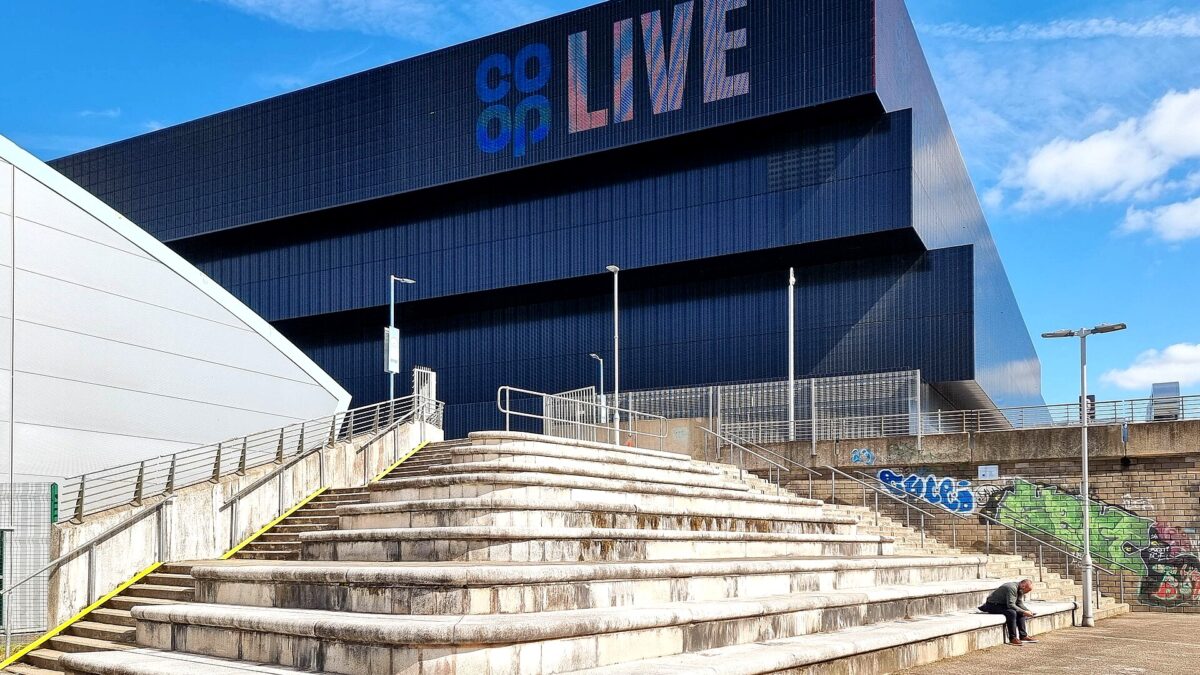
What do you do when the air itself turns against you in a room full of twelve thousand people?
That is the question Manchester is asking this morning, and it is not a theoretical one. On Sunday night, in the middle of a song, in the middle of a crowd, in the middle of Britain’s largest indoor arena, something invisible was released into the air. Eyes began to sting. Throats began to burn. People began to cough, to cover their mouths, to look at one another with the dawning horror that every person in a crowded place carries somewhere deep inside them: we have to get out of here.
By the time the night was over, more than twelve thousand people had been evacuated from the Co-op Live arena. More than fifty had been assessed by paramedics. One person had been taken to hospital. And a city that buried twenty-two of its children less than a decade ago had lived through its worst nightmare all over again — this time, thank God, without a funeral to follow.
I have been thinking about that night since the first reports came in, and I cannot shake one image from my mind: the lights coming on in the middle of a concert. The music stopping. A voice telling twelve thousand young people that the show was finished, that they must leave, that something was wrong with the very air they were breathing. There is a particular kind of fear that belongs only to crowds — not the fear of one person, but the fear of thousands discovering the same danger at the same instant. Manchester felt it on Sunday night. Manchester has felt it before.
The night the music stopped
It was shortly after ten o’clock on Sunday, 22 November 2026. The American rapper Don Toliver — Caleb Zackery Toliver, thirty-two years old, on his Nitrous tour — was on stage at Co-op Live, the vast black arena on the Etihad Campus in east Manchester. The show was nearing its end. According to fans who were there, the rapper had reached the song “K9” when the trouble began. Plumes of smoke drifted through the crowd. People began coughing. Some covered their faces with their hands, with their shirts, with anything they could find.
Greater Manchester Police were alerted shortly after 10 p.m. The North West Ambulance Service said the substance was initially believed to be tear gas, understood to have been released towards the end of the show. Attendees told the Manchester Evening News that it appeared a smoke canister had been thrown into the crowd. The police, careful with their words as they should be, later spoke only of an “unknown substance”. The substance has still not been identified. That single fact — that on Monday morning, hours after the event, nobody could say with certainty what twelve thousand people had breathed — is itself the most unsettling detail of the whole night.
Toliver left the stage and did not return. The lights came up. A representative of the venue told the crowd, in the flat language of officialdom that always sounds stranger than any poetry in such moments, that “due to unforeseen circumstances, the show is now finished”. Then the evacuation began.
Consider what that means, in practical terms. Twelve thousand people, in the dark, in a building they do not know, many of them young, many of them frightened, many of them coughing, being moved towards the exits in an orderly fashion. The police declared a major incident — a formal step that allows the emergency services and partner agencies to coordinate their response quickly and effectively. The ambulance service deployed several emergency crews, including its Hazardous Area Response Team. Decontamination was carried out as a precaution. More than fifty people were assessed by clinicians on site, some with eye and respiratory symptoms. One patient was taken to Manchester Royal Infirmary for further assessment.
And then, shortly after two o’clock on Monday morning, the police issued the statement that everyone had been waiting for: the attendees had been safely evacuated. Assistant Chief Constable Steph Parker, the Gold Commander for the incident, said the force’s priority had been “to ensure the safety of every person that was attending the concert”. She thanked the public for their patience. She asked anyone who had left the event and since become unwell to attend their local hospital. And she said, in the sentence that now hangs over the whole affair: “We will now begin to fully understand what this substance was and how this incident came about.”
No serious injuries have been reported. No arrests had been announced by Monday morning. The investigation is under way. The venue has said it is working closely with the police “to identify the cause and action appropriately”, and that its priority “remains the safety and security of all visitors to Co-op Live”. The American singer Phoebe Bridgers is scheduled to perform at the arena on Thursday. Life, in other words, is supposed to go on.
But the question will not go away, and it should not. How does a substance — tear gas, a smoke canister, something still unnamed — find its way into a crowd of twelve thousand people, in the most modern arena in Britain, in a city that knows better than any other in this country what a crowd in danger looks like?
A city that has seen this film before
Here is where I must ask you, the reader, to pause with me. Because Manchester is not any city. And a concert crowd in Manchester is not any crowd. The history of this city is braided into Sunday night’s events whether we wish it or not, and to write about Co-op Live without writing about the Manchester Arena would be an act of cowardice — the kind of polite forgetting that lets the same wounds reopen.
On 22 May 2017, at 10:31 in the evening — almost the same hour, almost the same minute — a suicide bomber named Salman Abedi detonated a homemade bomb packed with nuts and bolts in the foyer of the Manchester Arena, as people were leaving a concert by the American singer Ariana Grande. Twenty-two people were killed. More than a thousand were injured. The youngest of the dead was Saffie Rose Roussos, who was eight years old. Ten of the dead were under twenty. The bomber’s brother, Hashem Abedi, was later convicted of murder and sentenced to life imprisonment with a minimum term of fifty-five years, the longest ever imposed by a British court. Ariana Grande returned within a fortnight to host the One Love Manchester benefit concert, which raised seventeen million pounds for the victims.
I remember that night, as millions do, because it was the night the world learned something about Manchester that Manchester had always known about itself: that this is a city which grieves in public and refuses, stubbornly and beautifully, to be broken. The bees appeared on walls and on arms. The vigils filled the squares. The city sang. And then the city did something rarer than singing: it demanded that the law change.
The mother of one of the victims, Martyn Hett — a twenty-nine-year-old who had gone to the concert and never came home — campaigned for years until Parliament listened. The result is Martyn’s Law, formally the Terrorism (Protection of Premises) Act 2025, which received Royal Assent on 3 April 2025. It requires the people responsible for publicly accessible venues to plan for attacks — to have procedures for evacuation, lockdown and communication — with the largest venues, those holding eight hundred people or more, facing the strictest duties, overseen by the Security Industry Authority. The duties are expected to come into force in the spring of 2027, after an implementation period to give venues time to prepare.
Now, hold that thought beside Sunday night. The law born from Manchester’s grief is not yet in force. The arena where the substance was released is the largest indoor arena in the United Kingdom, holding twenty-three thousand five hundred people, opened only in 2024. Twelve thousand people were inside it on Sunday — a crowd larger than the entire population of many English towns. The evacuation, by every account, was orderly and swift. That is to the enormous credit of the venue staff, the police, the ambulance crews, and the crowd itself. But the questions that Martyn’s Law was written to force venues to answer in advance — how do you search a crowd of twelve thousand? How do you stop a canister from reaching the floor? How do you protect the air itself? — those questions are now being asked in retrospect, in the cold light of a Monday morning, rather than in the safety of a planning meeting.
That is not an accusation. It is a warning. Laws are written in the blood of the past; they are tested in the smoke of the present. Sunday night was a test, and while the human cost was mercifully small, the test exposed a gap that no one should pretend away: a person, or persons, unknown, carried something dangerous into a crowd of thousands and released it — and as of this writing, the police still cannot tell the public what it was.
Who does this — and why?
I do not know who released that substance. Neither, at the time of writing, do the police. So I will not pretend to know. But I will ask the questions that any honest observer must ask, because the answer will decide whether Sunday night is remembered as a frightening prank or as something far darker.
Was it a thoughtless stunt — a young person with a canister bought online, showing off to friends, with no understanding that tear gas in a crowd is not a joke but a weapon? Was it malice — someone who wanted to hurt, to frighten, to ruin a night for twelve thousand strangers? Or was it something colder still — a deliberate probe, a test of how a modern arena responds, a rehearsal dressed as a prank?
Each possibility demands a different response, and that is precisely why the police’s careful language matters. The substance is “unknown”. The cause is under investigation. No arrests yet. In an age when every incident is instantly interpreted, spun and weaponised on social media, there is something almost old-fashioned — and admirable — about the refusal to guess. But the public deserves answers, and quickly. Twelve thousand people went home on Sunday night not knowing what they had breathed. Some of them will be watching their own health in the coming days. Their parents will be watching too. “Unknown” is not a resting place. It is a starting point.
There is also the question of the door. Every arena in Britain now searches its visitors. Bags are checked, coats are patted, wands are waved. Yet something got through — or was thrown, or was smuggled, or was already inside. Which is it? The venue has promised more information “once we have an update from GMP”. The police have promised to “fully understand what this substance was and how this incident came about”. These are the right promises. But promises are not procedures, and the public will judge both institutions by what changes before the next concert, not by what is said after this one.
And here I want to say something plainly, in my own voice, without hiding behind the hedges of commentary. If what happened on Sunday was a prank, then let the person who did it be found, and let them stand in front of a court and look at the faces of the fifty people who were treated for burning eyes and struggling breath, and let them explain what was funny. If it was malice, let the law fall on them with its full weight. And if it was something else — something organised, something testing the defences of a British arena — then let us be honest with ourselves that the age of the lone bomber has given way to something more diffuse, and that our vigilance must grow to match it.
The truth is that crowds are the soft underbelly of modern life. We gather in our thousands to sing, to worship, to watch, to celebrate — and every gathering is a trust. A trust that the doors will hold, that the exits will be clear, that the air will be safe to breathe. When that trust is broken, even without bloodshed, something precious is damaged. Fear is a tax on joy, and Sunday night’s crowd has paid it.
The crowd that saved itself
But let me also say what is too rarely said after such nights: the crowd behaved magnificently. Twelve thousand people, many of them young, many of them frightened, coughing in the dark — and there was no stampede. No crush. No one trampled in a panic for the doors. The footage shared on social media shows people covering their mouths, helping one another, moving steadily towards the exits as they were directed. The police spoke of an audience “safely escorted from the arena”. The ambulance service spoke of people “assessed” and “supported”. The language is bureaucratic, but the reality it describes is human and heroic: ordinary people, in an extraordinary moment, choosing order over panic.
That is Manchester, too. The same city that queued for hours to give blood in 2017. The same city that opened its homes to strangers that night. The same city that turned grief into a law. On Sunday night, the city did not panic — and in a crowd, the absence of panic is itself a kind of victory.
I think also of the emergency services, who deserve more than the passing mention they usually receive. The Hazardous Area Response Team — men and women trained to walk towards the thing everyone else is walking away from — were at the scene within the hour. The paramedics who assessed more than fifty people, one by one, in the chaos of an evacuation, did work that will never make a headline. The police officers who declared a major incident within minutes, and who kept twelve thousand people moving safely into the Manchester night, did work that matters more than any speech. A society is judged by what its institutions do at ten o’clock on a Sunday night, when no one is watching and everyone is frightened. On this occasion, they did their jobs.
What happens now
The immediate future is clear enough. The investigation continues. The substance will be identified — the police have the samples, the laboratories, the time. The question of how it entered the arena will be answered, and with it the question of whether the venue’s security needs to change. Phoebe Bridgers is due to perform at Co-op Live on Thursday, and the venue will have to show, not merely say, that it is safe. Every ticket holder for that show, and every parent of a ticket holder, will be watching.
The longer future is less certain, and more important. Martyn’s Law comes into force in the spring of 2027. Between now and then, every large venue in Britain is in a period of preparation — writing procedures, training staff, thinking about the unthinkable. Sunday night should be treated as a free lesson, paid for in fright rather than in lives. The venues that learn from it will be safer. The ones that file it away as an unlucky night will not.
There is a wider lesson, too, and it concerns all of us who live in crowded, open societies. We cannot make every concert hall a fortress. We cannot search every pocket, scan every body, seal every door — and we should not want to, because a society that does that has already surrendered something essential about itself. The freedom to gather is the freedom that makes all the other freedoms visible. What we can do is insist on three things: that venues plan as if the worst will happen; that the police tell the public the truth quickly, even when the truth is incomplete; and that those who attack a crowd, whether with a bomb or with a canister of gas, are found and punished — not as pranksters, but as people who struck at the heart of public life.
I keep returning to a simple fact: the concert ended at 10 p.m. on a Sunday. The fans went home. One went to hospital. Fifty were treated. And the rest — twelve thousand of them — walked out into the Manchester night, coughing, shaken, alive. In 2017, twenty-two people did not walk out of a Manchester arena. The difference between those two nights is the difference between a tragedy and a warning. Warnings are gifts, but only if we heed them. History does not repeat itself politely; it repeats itself with escalating force until the lesson is learned.
Manchester has learned its lessons in blood. It should not have to learn another. The smoke has cleared from the Co-op Live arena, but the question hangs in the air where the gas once hung: who will make sure it never happens again? The police will investigate. The venue will review. The law will arrive in the spring. But the real answer belongs to all of us — to the crowds who refuse to panic, to the staff who hold the doors open, to the paramedics who walk towards the danger, and to a city that has decided, twice now, that it will not stop singing.
Twelve thousand people went to hear music on Sunday night. They came home with a story they will tell for the rest of their lives. Let us make sure that the story ends here — with a fright, an evacuation, and a lesson learned — and not with a third chapter that this city has already paid too dearly to read.
Sources & References
- Reuters — Don Toliver concert in Manchester evacuated after unknown substance released, police say (23 November 2026)
- CNN — Thousands evacuated as “unknown substance” fills UK arena during US rapper’s show (23 November 2026)
- The Times — Manchester Co-op Live evacuated after “unknown substance” released into crowd (23 November 2026)
- Wikipedia — 2026 Co-op Live incident (accessed 23 November 2026)
- Wikipedia — Manchester Arena bombing, 22 May 2017 (accessed 23 November 2026)
- Legal 500 — UK Venues Face New Security Requirements Under “Martyn’s Law” (Terrorism (Protection of Premises) Act 2025)

About the Author — Abdul Mannan
Related Articles
Antalya’s Silence: When the World Could Not Even Name the Fire Burning It
In Antalya, nearly 200 nations spent two weeks trying to save the planet — and walked out unable…
Miley Cyrus Marries Maxx Morando: The Girl Who Grew Up in Front of the World Finally Chooses Herself
Miley Cyrus married Maxx Morando in Palm Springs on 21 November 2026. This is not a celebrity story…
The Week the World’s Money Panicked: Nine Trillion Dollars Gone and the AI Dream on Trial
Nine trillion dollars vanished in a week. The Nasdaq suffered its worst week since 2020, Nvidia lost $2.2…